

The voyage that failed
at everything except
coming home
In August 1914, twenty‑eight men sailed from Plymouth to make the first overland crossing of Antarctica. They never set foot on the continent. They lost their ship, drifted on pack ice for nearly six months, sailed eight hundred miles in an open boat, and crossed an unmapped island on foot. Every one of them came back alive.
The story of the Endurance is usually told as a triumph. It is more interesting as a failure. Ernest Shackleton's third Antarctic expedition set out to do something that had never been done — cross the continent on foot, from the Weddell Sea to the Ross Sea, via the Pole — and abandoned that goal before its ship had even reached its intended landfall. What followed is one of the most documented survival sequences in the history of exploration, and it happened because every part of the original plan had already collapsed.
By the summer of 1914, Shackleton was forty years old and had already turned back from the South Pole once. Roald Amundsen had reached it in 1911. Robert Falcon Scott had died on the return from his own attempt the following year. What remained, in Shackleton's reading, was the continent itself. He named the project the Imperial Trans‑Antarctic Expedition and assembled two ships, two crews, and a route that would have stretched roughly 1,800 miles across territory no person had ever seen.
The ship he chose for the Weddell Sea party had been laid down in Norway as a luxury Arctic tourist vessel. Built at the Framnæs shipyard in Sandefjord under the master shipwright Christian Jacobsen, designed by Ole Aanderud Larsen, she had been launched in December 1912 as Polaris — three masts, barquentine rig, a 350‑horsepower coal‑fired steam engine, and a hull of oak, Norwegian fir and greenheart engineered for ice. Her commissioners went bankrupt before she earned her keep. Shackleton bought her in January 1914 for £14,000 and renamed her after his family motto, Fortitudine vincimus — by endurance we conquer. The motto was about to be tested with a literalness no one in Plymouth could have anticipated.
Endurance sailed from Plymouth on 8 August 1914, four days after Britain entered the First World War. Shackleton offered the ship and crew to the Admiralty before departure. The reply came in a single‑word telegram from Winston Churchill: Proceed. She did. Twenty‑eight men, sixty‑nine sledging dogs and one cat called Mrs. Chippy left for Buenos Aires, where Shackleton himself would join, and from there for the last station of the known world — the Norwegian whaling outpost at Grytviken, on South Georgia.
South Georgia, and the last warning
Endurance arrived at Grytviken on 5 November 1914 and stayed a month. The whaling captains there had spent a season watching the ice. They told Shackleton that the Weddell Sea was unusually bad — that the pack had pushed further north than was customary, that the leads were closing as soon as they opened. They advised waiting. Shackleton thanked them and continued.
She left South Georgia on 5 December 1914. From that morning, the crew would not touch land again for four hundred and ninety‑seven days. The first pack ice was sighted two days later, far further north than expected. By 30 December the ship had crossed the Antarctic Circle. On 10 January 1915 the men sighted Coats Land — the white front of the continent, exactly where the charts said it would be — and for a few hours, the expedition seemed to be working.
It was the last few hours during which that would be true. The ice tightened around the hull. Endurance worked her way through narrowing leads, sometimes ramming, sometimes waiting, sometimes drifting backward in the gyre. On 18 January 1915, at 76°34′ South — roughly sixty nautical miles from the bay where the crossing party was to disembark — the ship stopped moving entirely. The ice had closed around her in every direction. There would be no landing. There would not, for some time, be any decision left to make.
Thirteen months inside a moving floe
For the first weeks of the besetment, the men kept working. They ran the engines, raised sails, dynamited ice, sawed channels by hand. None of it released the ship. The pack moved instead of yielding. By 22 February 1915, Endurance had drifted to 77° South — her furthest‑south position — and the men began to understand that the ship was no longer something they were sailing. It was something they were inside.
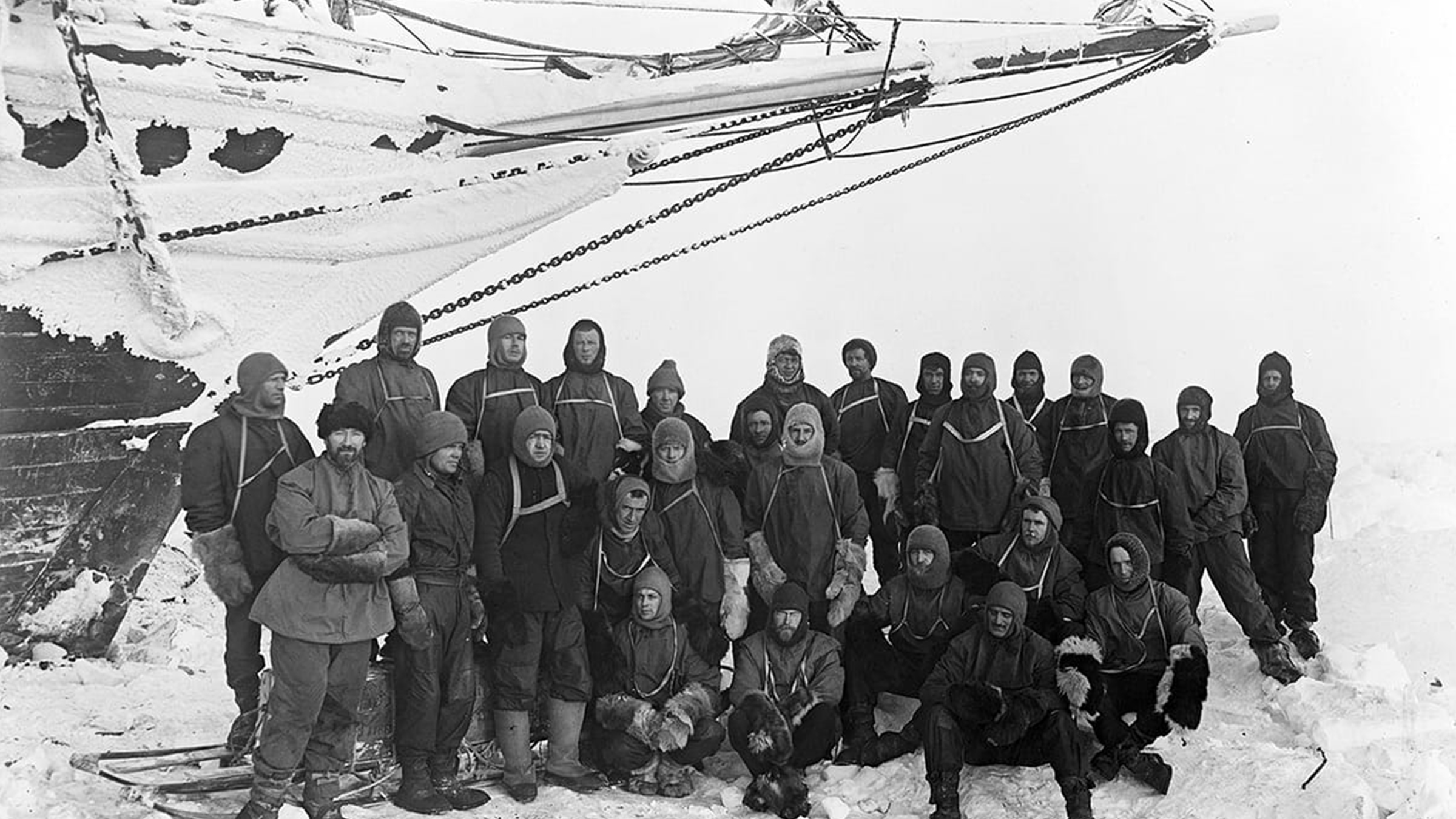
A different routine took over. Officers and crew built kennels for the dogs on the surrounding ice. The scientists — Reginald James the physicist, James Wordie the geologist, Robert Clark the biologist, Leonard Hussey the meteorologist — continued their measurements. The surgeons, Macklin and McIlroy, kept records. The cook, Charles Green, kept feeding twenty‑eight men out of a galley designed for a tenth of that on a wooden ship that was no longer travelling anywhere. Football matches were organised on the floe. Theatrical sketches were performed. Hussey's banjo was played most evenings. None of this was the failure. The failure was a thousand miles away.
The ship's official photographer was Frank Hurley, an Australian who had already worked on Douglas Mawson's Antarctic expedition. Hurley shot in a darkroom set up below decks, using large‑format glass plates and a cinematographic camera. He photographed the ship from the ice, the ice from the rigging, and the men from every angle he could think of. He climbed the mast to make panoramas. He spent hours on the floe waiting for light. When the polar night arrived in May 1915, he experimented with flash powder and magnesium flares. The result is the visual record by which the whole expedition would later be known.
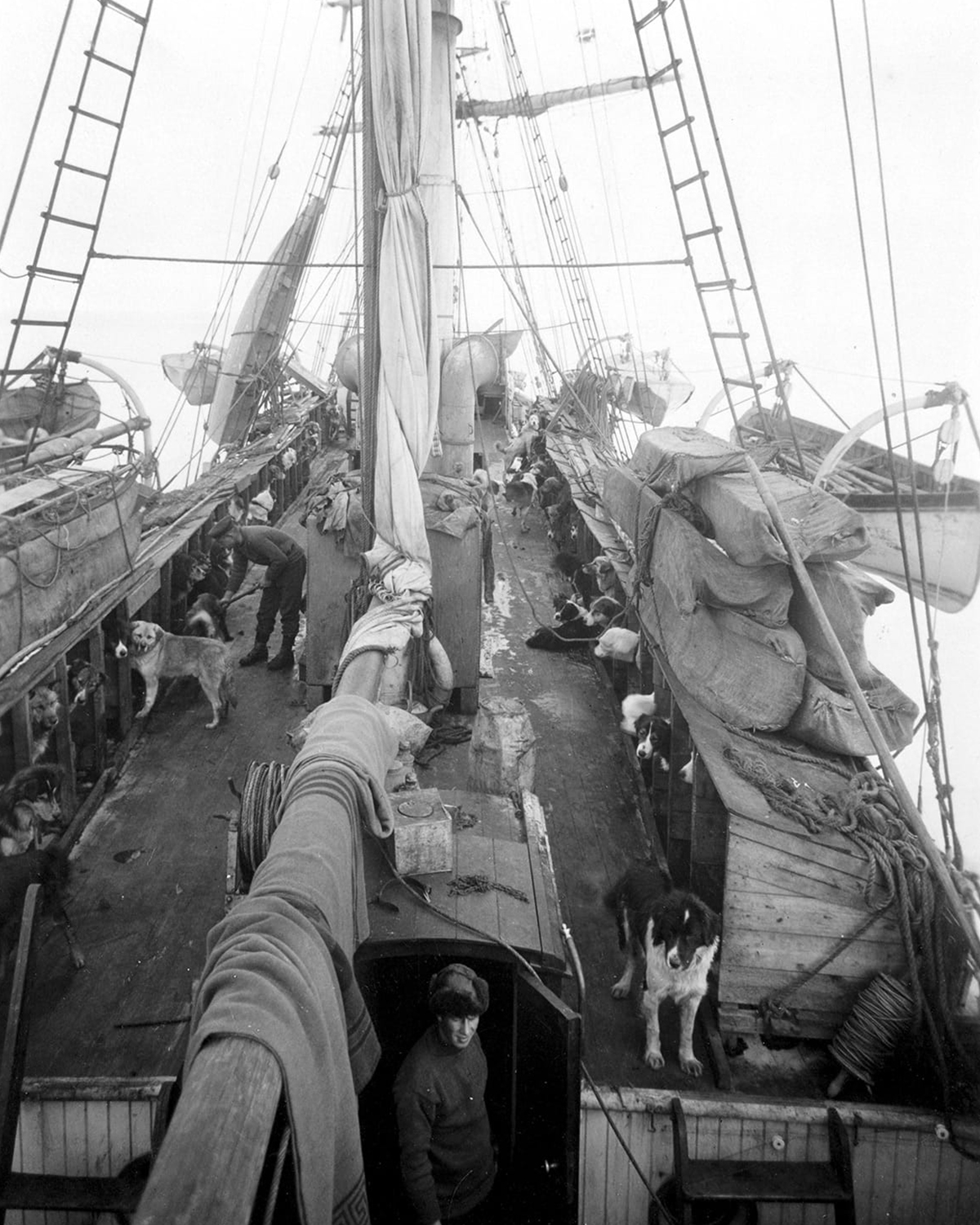
Through the winter the pressure built. The pack ice did not simply hold the ship; it began to rotate it. Floes lifted and tilted against the hull. By August 1915 the men could hear the timbers groaning at night. In September the ice began to act on the ship in earnest — squeezing the hull lengthwise, then crosswise, then both at once. Endurance had been built to resist ice. She was not built to be slowly destroyed by it.
On 24 October 1915, with the ship leaking badly along the starboard side, Shackleton ordered preparations for abandonment. Three days later, on 27 October at five in the afternoon, the crew stepped onto the ice with what they could carry. Each man was allowed two pounds of personal possessions. Two exceptions were made: Hussey's banjo, which Shackleton called vital mental medicine; and Hurley's photographic plates, the case Shackleton himself ordered preserved.
Even with the order given, the plates were not yet safe. They were inside a sinking ship. On 8 November, Hurley dove into the flooded darkroom and pulled them out one by one. With Shackleton he sorted the four hundred or so glass negatives down to one hundred and twenty. The rest he smashed on the ice so he would not be tempted to risk his life retrieving them later. The archive that survives today — held by the Royal Geographical Society in London — is exactly what Hurley salvaged and what Shackleton allowed him to keep.
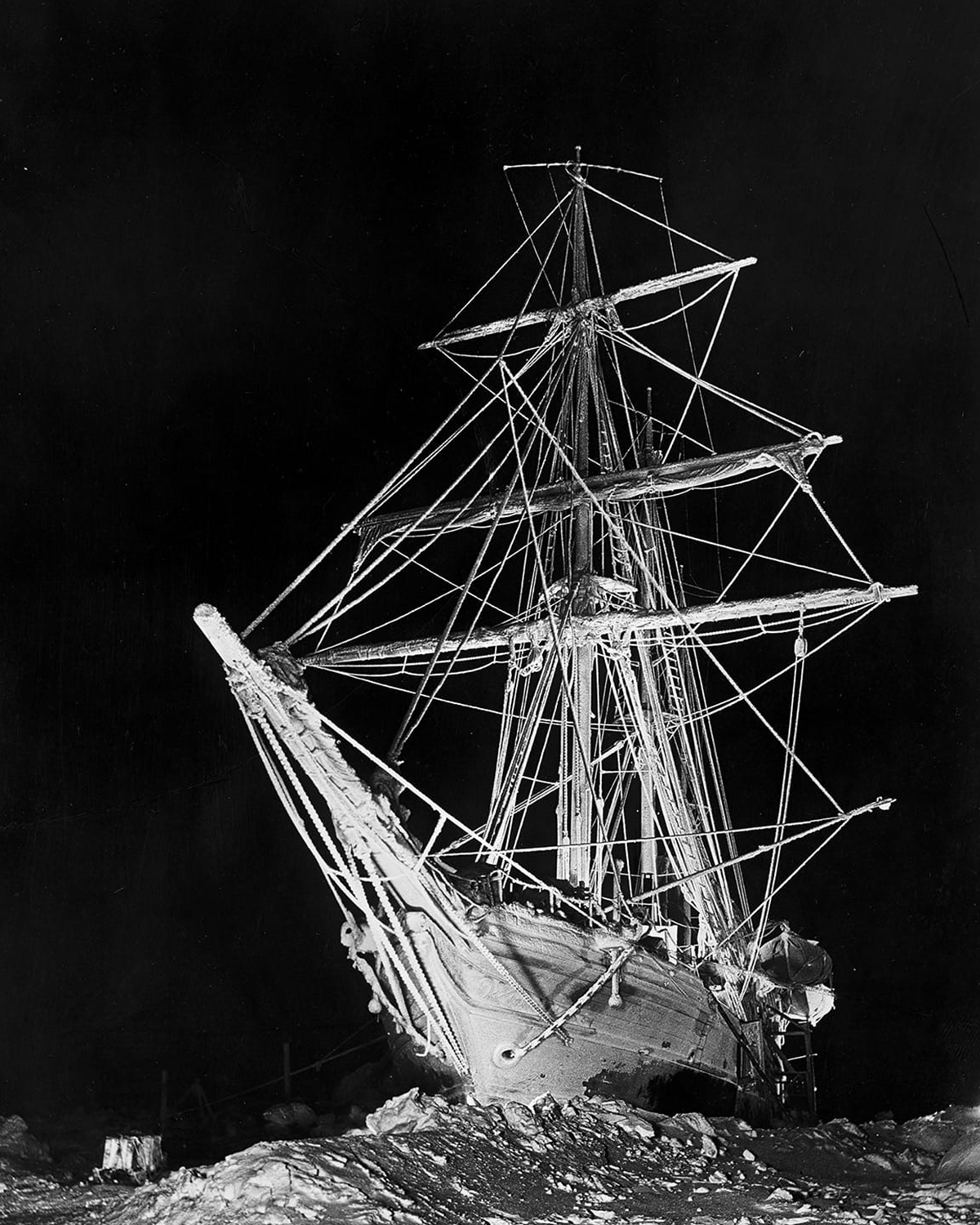
The sinking itself was almost silent. On 21 November 1915, with the men camped a mile and a half away at a site they had named Ocean Camp, the stern of the wreck lifted briefly above the surrounding floes. The ice opened just long enough for the hull to slide through. It closed again immediately. There was no visible trace of where the ship had been. Captain Frank Worsley took a position the following day from Ocean Camp and recorded it in the log: 68°39′30″ South, 52°26′30″ West. The figure would not be tested for one hundred and seven years.
What remained for Shackleton, by his own later account in South, was a problem of arithmetic. He had twenty‑eight men, three open wooden lifeboats from the ship, supplies for several months on diminishing rations, a slow seaward drift on a current he could not steer, and a chain of islands he could not reach. The expedition was no longer about crossing Antarctica. It was about not adding to the list of men who had died trying.
The objective was now the ordinary one. Get the men home. Every man.
Five months on a moving piece of ice
Ocean Camp lasted seven weeks. The floe carried the men northwest on the Weddell Gyre at an average of about four miles a day, sometimes more, sometimes nothing. Shackleton's instinct was movement. On 23 December 1915 he ordered the camp struck and the lifeboats hauled across the ice by hand, in the direction of Paulet Island and a known food depot. The crew managed two miles in three days, dragging the heavy boats over broken pressure ridges. On the third evening Shackleton called it off. They built a new camp, named it Patience Camp, and stayed there.
They lived on the ice for the next three months. Stores ran down. The dogs were eaten — first the weaker ones, then the rest. The cat, Mrs. Chippy, had already been put down before the abandonment. The men subsisted on seal, penguin, and seaweed cooked over a stove fuelled by seal blubber. Through April the floe began to break beneath them. Cracks opened in the centre of camp. Tents were moved at night. On more than one occasion men woke to find the ice splitting under their bodies and had to be hauled out of the water before they froze.
On 9 April 1916, the floe finally fractured to the point that the men could no longer stay on it. Shackleton ordered the three lifeboats — the James Caird, the Dudley Docker and the Stancomb Wills — launched into the broken pack. They spent seven days in open boats among shifting ice, sleeping in turn on whatever floe held them, drinking glacial meltwater when they could find it. The boats took on water in heavy seas. Several men developed severe frostbite. Percy Blackborow, the young Welsh stowaway turned steward, would later have toes amputated by the surgeons. On 15 April they reached Elephant Island. It was the first solid ground any of them had stood on in four hundred and ninety‑seven days.
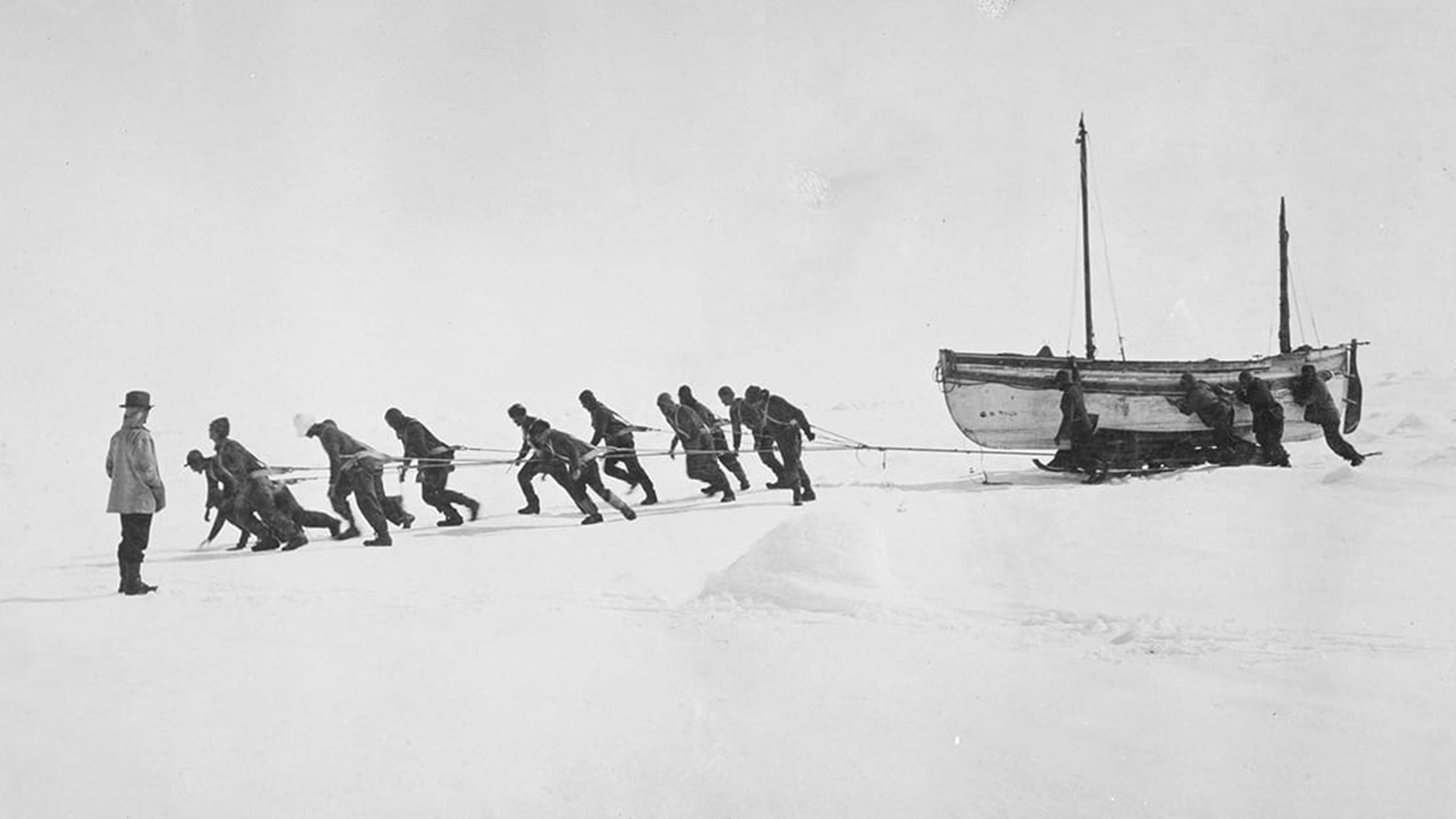
Elephant Island was uninhabited and uninhabitable. A narrow gravel beach below sheer cliffs, no shelter, no food other than penguins and seals that came ashore by chance, no possibility of being found by a passing ship — because no ship would pass. The island lay outside every shipping lane in the southern hemisphere. The men were saved, technically, but no one knew where they were, and the calendar was working against them. The Antarctic winter was approaching. Twenty‑eight men could not feed themselves through it on what the beach offered.
Shackleton calculated the alternatives and there was only one. The whaling stations on the north coast of South Georgia lay roughly eight hundred nautical miles northeast across the Drake Passage — among the most violent stretches of ocean in the world, particularly in autumn. He would take the largest of the three lifeboats, the twenty‑two‑and‑a‑half‑foot James Caird, modify her for open ocean, and sail for help.
The risk was justified solely by the alternative. Staying on Elephant Island meant dying on Elephant Island.
Eight hundred miles in an open boat
The carpenter, Henry McNish, raised the gunwales of the Caird with wood from the other two lifeboats and sealed her decking with seal blood, oil paint and the canvas of the men's tents. She had a small cabin built forward, ballast of stones and bagged ice, and rigging stitched from the heavier sailcloth the expedition had retained. Six men sailed her: Shackleton, Captain Frank Worsley as navigator, Second Officer Tom Crean, the carpenter McNish, and able seamen Timothy McCarthy and John Vincent. The twenty‑two who stayed behind on Elephant Island — under the command of Frank Wild, Shackleton's second‑in‑command — built an upturned‑boat shelter known as Cape Wild and waited.
The James Caird launched on 24 April 1916. The crossing took seventeen days. Worsley navigated with a sextant he could rarely use — the sun appeared four times in two and a half weeks — and otherwise by dead reckoning, in conditions where the boat heeled too sharply to take an accurate sight even when there was a horizon to take one against. They sailed through gale, blizzard, a hurricane that lasted most of a day, and one wave Worsley would later describe in his own published account as larger than any he had seen in twenty‑six years at sea. They reached the uninhabited southwest coast of South Georgia at King Haakon Bay on 10 May 1916.
The whaling stations were on the opposite side of the island. The Caird was no longer seaworthy. Shackleton, Worsley and Crean left McNish, McCarthy and Vincent at a camp under the upturned boat and set out across South Georgia on foot. The interior of the island — a chain of glaciated peaks rising to nearly three thousand metres — had never been crossed. They had a sledge, no map, fifty feet of rope, three days of cooked rations, and screws from the boat driven through the soles of their boots in place of crampons.
Thirty‑six hours, on foot, across an unmapped island
03:00
Daybreak
Late afternoon
Through the night
06:30
15:00
Four attempts, one Chilean tug
Shackleton's first attempt to reach Elephant Island, in late May 1916, was made with a borrowed British whaler called the Southern Sky. She was turned back within sight of the island by pack ice. He tried again with the Uruguayan trawler Instituto de Pesca No. 1, lent by Montevideo. Same result. A third attempt, in the schooner Emma out of Punta Arenas, ended a hundred miles short. Each time Shackleton returned south, knowing the men on the island had less food and less time.
On the fourth attempt the Chilean navy lent him a small steam tug, the Yelcho, under the command of Luis Pardo. The ice was unusually open that week. Yelcho reached the beach on 30 August 1916. Frank Wild, who had kept the twenty‑two men alive for four and a half months in an upturned‑boat shelter on a stone beach, later said that when he sighted Shackleton coming ashore, he could not speak for several minutes. All twenty‑two were alive. They came aboard. The tug reached Punta Arenas on 3 September. The Weddell Sea party returned to civilisation with the same headcount it had carried out of Plymouth two years earlier.
There were costs. Several men had lost toes to frostbite. McNish, the carpenter who had built the James Caird seaworthy enough to survive eight hundred miles of open ocean, never fully recovered. Several of the expedition's veterans — Cheetham, McCarthy and others — would die within months of returning, killed in the war that had begun the day before Endurance sailed and was still being fought. But the headline number held. Zero men were lost on the ice.
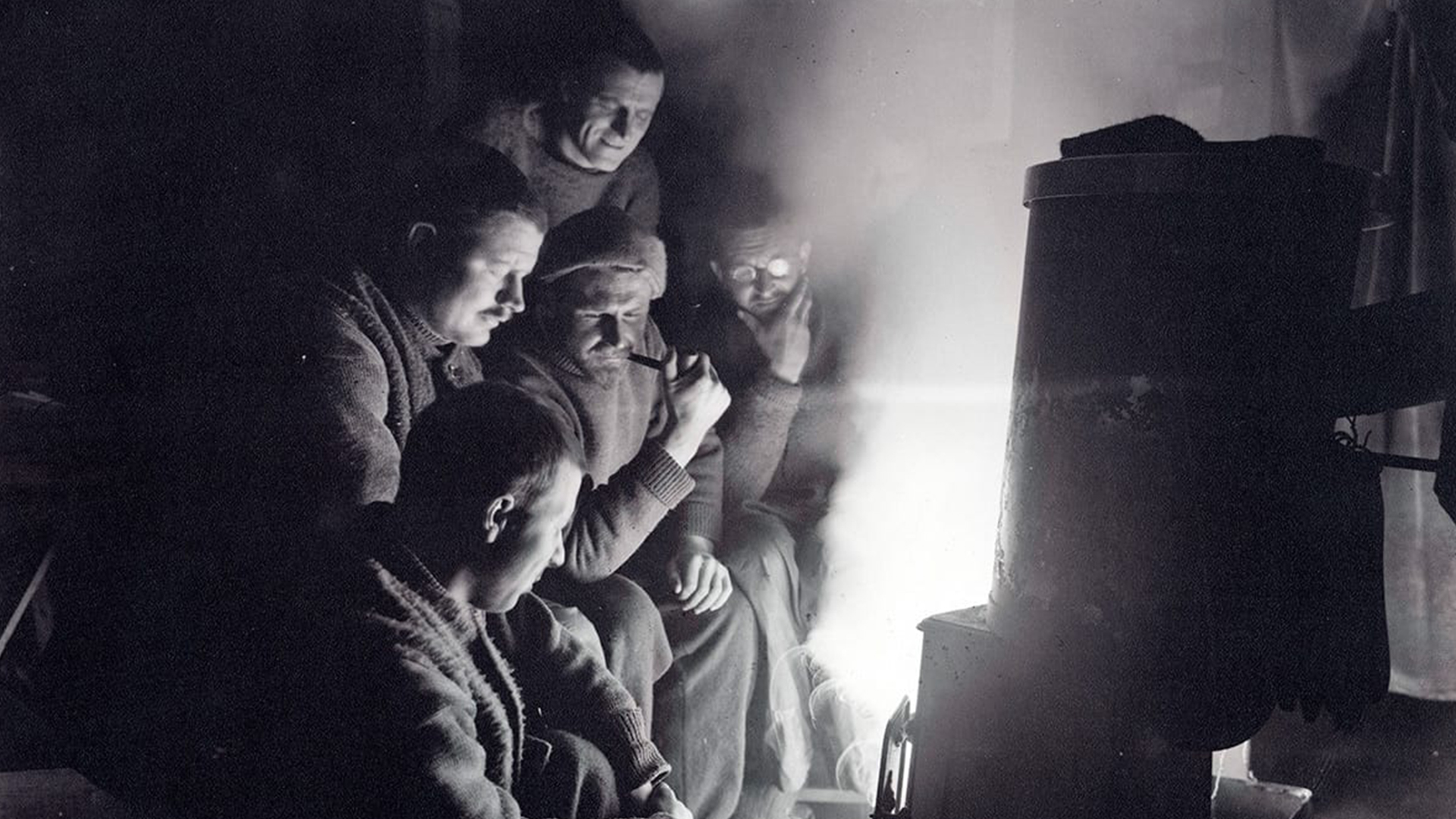
The twenty‑eight who came back
Selected by Shackleton from over five thousand applicants, recruited for skill, temperament and the capacity to work in close quarters for indefinite periods.
- Sir Ernest ShackletonExpedition Leader
- Frank WildSecond‑in‑Command
- Frank WorsleyCaptain
- Lionel GreenstreetFirst Officer
- Tom CreanSecond Officer
- Alfred CheethamThird Officer
- Hubert HudsonNavigator
- Lewis RickinsonFirst Engineer
- A. J. KerrSecond Engineer
- Reginald W. JamesPhysicist
- Leonard D. A. HusseyMeteorologist
- James M. WordieGeologist
- Robert S. ClarkBiologist
- Dr. Alexander H. MacklinSurgeon
- Dr. James A. McIlroySurgeon
- Frank HurleyOfficial Photographer
- George E. MarstonOfficial Artist
- Thomas Orde‑LeesMotor Expert & Storekeeper
- Henry McNishCarpenter
- Charles J. GreenCook
- William BakewellAble Seaman
- Walter E. HowAble Seaman
- Timothy McCarthyAble Seaman
- Thomas McLeodAble Seaman
- John VincentAble Seaman
- Ernest HolnessFireman / Stoker
- William StephensonFireman / Stoker
- Percy BlackborowStowaway, later Steward
Endurance returns
For more than a century the wreck remained where she had sunk. Worsley's coordinates — written into the log the day after the ship went down, from a camp on the moving ice — were the only reference point. They were also a guess. He had been unable to take a proper sextant reading at the moment of sinking, and the chronometers were no longer fully reliable. Several expeditions over the decades considered searching for her. The pack ice of the Weddell Sea, present year‑round and impassable in most seasons, kept making the project impossible.
In early 2022, the Falklands Maritime Heritage Trust mounted the Endurance22 expedition aboard the South African polar research vessel S.A. Agulhas II, under expedition leader John Shears and director of exploration Mensun Bound. The ship sailed from Cape Town with autonomous underwater vehicles designed to operate under ice, in waters that had defeated every previous attempt to image the seabed of the Weddell. Conditions that year were unusually mild. Antarctic sea ice was at the lowest level recorded since satellite monitoring began in the 1970s.
The wreck was located at 16:05 GMT on 5 March 2022 — by coincidence, exactly one hundred years to the day after Shackleton was buried on South Georgia, where he had died in 1922 at the start of a final, unrelated expedition. She lay at 3,008 metres, upright on the seabed, her name still legible across the stern and the polar star emblem clear beneath it. The wood had been preserved by the absence in those deep cold waters of the marine organisms that consume wooden hulls elsewhere. According to Endurance22, she is in brilliant condition. The site is now designated a protected monument under the Antarctic Treaty.
Five miles from where Worsley said she was.
Three kilometres down.
The wreck was found within the search area defined before departure from Cape Town, approximately five and a half nautical miles from the position recorded in the expedition log on the morning after the sinking. Given that Captain Worsley fixed that position from a moving floe, without a clear horizon, using chronometers that had drifted across eighteen months at sea, the accuracy is remarkable.
The site is protected under the Antarctic Treaty System. Nothing may be recovered. The Endurance will remain where she fell.
The Imperial Trans‑Antarctic Expedition failed in its single stated objective. None of its twenty‑eight men ever set foot on the Antarctic continent. They are remembered because all of them came home.