




Buying a Used Boat
A used boat can be a smart entry to the water or a slow, expensive lesson. The difference lives in what you inspect, what you verify, and what you walk away from.
Every used boat tells two stories. One is the one the seller tells, polished by photography and a fresh coat of wax on the topsides. The other is written in the bilge, in the engine hours, in the title chain, and in the small repairs no one bothered to document. The first story is free. The second is what you are actually buying, and reading it well is the entire job.
Before contacting any seller, do the homework that protects the rest of the process. Research the categories of boats that match your intended use, the brands and model years that hold their reputation in that segment, and the realistic market range for the configuration you want. Local rules around ownership, registration, and use vary by state and by waterway; knowing them in advance prevents the kind of surprise that surfaces only after the bill of sale is signed. The research phase costs nothing and recovers itself many times over once the listings start arriving.
If this is your first boat, the question that determines everything else is what you will actually do with it. Fishing rewards a fast hull, an open deck, and storage for rods and tackle. Watersports want a clean wake, strong torque off the line, and a layout the family can move around. Long trips and weekends aboard call for accommodations, fresh water capacity, and a galley that works. Living aboard, even part of the year, raises the bar again. The boat that is brilliant at one of these missions tends to be mediocre at the others. Choosing without that clarity is how owners end up replacing the boat within two seasons.
Size is the other variable that punishes guesswork. A boat too small for the use case becomes frustrating before the first summer is over. A boat too large for the use case becomes a different kind of problem: heavier to handle, slower to maneuver at the dock, more expensive at every fuel pump and every haul-out, and harder to crew shorthanded. If children are part of the picture, the calculation tightens further around freeboard, deck layout, shaded seating, and the small amenities that make hours on the water bearable for everyone.

Why used, why now
The case for a used boat is straightforward. Depreciation has already happened, the inventory is broader than anything a single dealer can carry, and the previous owner has usually paid for the first wave of upgrades that a new boat will demand within its first year. A well-kept ten-year-old hull in a popular size often delivers more boat for the money than anything comparable on a showroom floor. The case against a used boat is equally straightforward. Whatever has been neglected, hidden, or ignored is now part of the deal, and the cost of discovering it after the sale falls entirely on the buyer.
The market itself comes in three flavors, and each one carries a different risk profile. A private sale, owner to owner, tends to be the cheapest entry point and the one with the least protection. A brokerage transaction adds a professional in the middle who has paperwork experience and a reputation to preserve. A certified dealer sale, common with late-model boats, offers the strongest documentation trail and sometimes a limited warranty, at the highest price. None of the three substitutes for an independent survey, but each one changes how much of the diligence has been done before the listing was published.
A private seller may know the boat intimately and price it sharply, but you inherit every undisclosed problem. A broker filters the obvious lemons and handles the paperwork, but their commission is built into the price. Neither model replaces an independent surveyor; both are improved by one.
A final element belongs in this opening conversation: age, but not the kind printed on the hull identification plate. The year a boat was built is one number. The hours on its engines, the water it ran in, whether it slept in the slip or rested on a lift between weekends, the cycles its electrical system has seen, the quality of the previous owner's record-keeping. These are the numbers that tell you what the boat has actually lived through. Two boats from the same model year can be a decade apart in real condition, and the price tag rarely reflects which one is which. The next four sections are how you find out.
The sea trial tells the truth
No used boat is bought from a dock. Every serious buyer takes the boat out, runs it the way they intend to run it, and watches what happens. The sea trial is not a formality; it is the only chance to test the seller's narrative against the behavior of the hull. A boat that looks immaculate at the slip can reveal itself within ten minutes of leaving it, and the cost of that disclosure is a tank of fuel and an hour of attention.
Bring a notebook or a phone, and start the clock at idle. Listen to the engines warming up; watch the gauges climb into their normal range and stay there. Take the boat out of the slip under the seller's hand if needed, then take the wheel. Run the boat at displacement speed, work it onto plane, hold cruise for ten or fifteen minutes, push it to wide-open throttle in a safe stretch, and bring it back down. At each stage, the questions are the same. Does the boat track straight, or does it pull to one side. Does the steering feel even, or notchy. Does the temperature stay where the engine wants it. Are the exhausts running clean, or showing white smoke that suggests water in the cylinders, blue smoke that suggests burning oil, or black smoke that suggests an over-fueled or laboring engine.

The instruments deserve the same scrutiny as the engines. Every screen, gauge, switch, and breaker is part of the package, and a sea trial is the time to verify each one under load. The chartplotter and depth sounder should read steady; the VHF should transmit and receive clearly; the bilge pumps should cycle on demand; the trim tabs should respond at both extremes. Lights, horn, blower, refrigerator, head, freshwater pump, shore-power transfer: each item that fails to operate is either a negotiating point or a reason to walk. Sellers vary in their willingness to make small repairs before closing; what matters is that the list of issues is complete before any number changes hands.
Hull, engine, and systems
A sea trial reveals behavior. A marine surveyor reveals condition. The two are not interchangeable, and skipping the second to save a few hundred dollars is how buyers end up with a five-figure regret. A qualified surveyor brings instruments, training, and the discipline to look at parts of the boat the owner has not seen in years: the bilge under the engines, the laminate behind the head, the wiring runs above the headliner, the stringers under the deck. The written report that follows the survey becomes the document the entire negotiation runs on.
The hull is the first concern, because a hull failure is the one that ends a boat. The surveyor looks for damage, repairs, patches, and the telltale signs of water that has worked its way into the fiberglass laminate. The most visible alarm is a pattern of blisters on the underside of the hull, small raised bubbles that signal moisture trapped in the layers beneath the gelcoat. A moisture meter confirms what the eye suspects. Water inside the laminate is not cosmetic. Severe cases can add as much as half again to the weight of the hull, which loads the engines, kills the boat's ability to climb onto plane, and drives fuel consumption past anything reasonable. The repair is expensive when it is possible and definitive when it is not.
The engine is the second concern, and the most expensive correction if it goes wrong. The surveyor, or a separate marine engine technician, runs through the diagnostics that the sea trial alone cannot perform. Compression in each cylinder, traces of water in the oil, the condition of the heat exchangers, the color of the coolant, the rate of corrosion in the exhaust manifolds and risers: each datum is a window into how the engine has been used, serviced, and stored. On older gasoline engines, exhaust riser corrosion is so consistent a failure mode that a refusal to inspect them is itself a finding. On diesel engines, hours alone are not the answer; the maintenance record is.
Four systems.
Each one written into the report.
I
Hull
Laminate and structure
Moisture readings across the bottom, blister survey, evidence of past repairs, stringer condition, transom integrity, keel attachment where applicable.
II
Engine
Mechanical condition
Compression by cylinder, oil and coolant analysis, exhaust riser corrosion, heat exchanger condition, hour meter against documented service history.
III
Electrical
AC, DC, and grounding
Panel condition, breaker function, battery age and capacity, charging system output, shore-power galvanic protection, bonding circuit continuity.
IV
Systems
Plumbing, fuel, safety
Fuel tank and lines, fresh and waste water, through-hulls and seacocks, bilge pumps, fire suppression in the engine compartment, life jackets and signaling gear.
“
A survey is the only document in the transaction that works for the buyer alone. Every other paper has the seller's interest somewhere in it.
Field Note · USA Onboard Editorial
The systems beyond engine and hull tend to be where small failures hide. The electrical system is the most common offender on a ten-year-old boat: corroded terminals, undersized wiring added by a previous owner, a shore-power inlet that no longer isolates galvanic current properly. The plumbing system, freshwater and waste, accumulates its own list of leaks and worn components. Through-hulls and seacocks need to be tested for free movement and for evidence of corrosion. Fuel tanks, especially aluminum tanks in older powerboats, can develop pinhole leaks that the surveyor will catch and the owner will not have noticed.
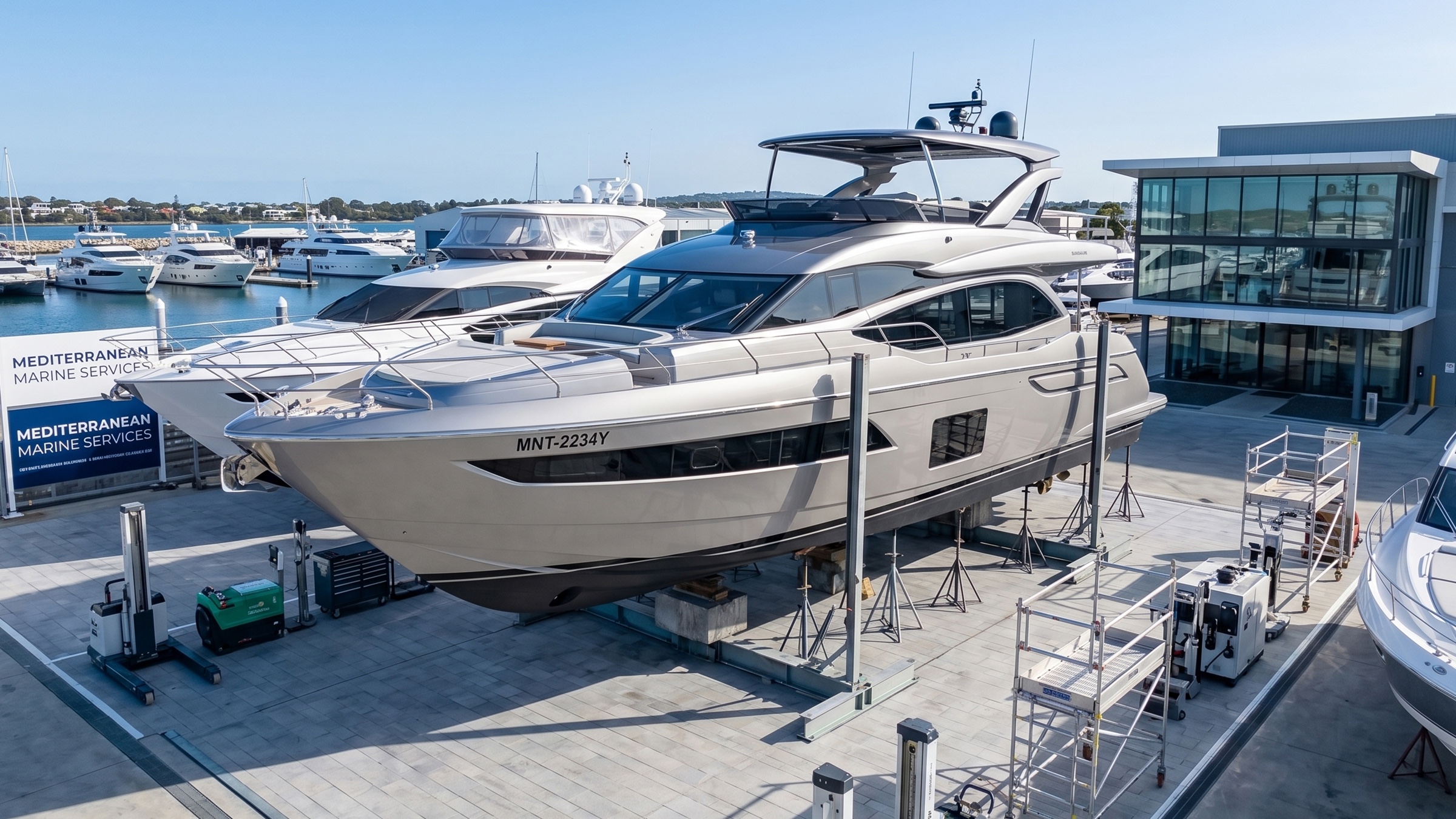
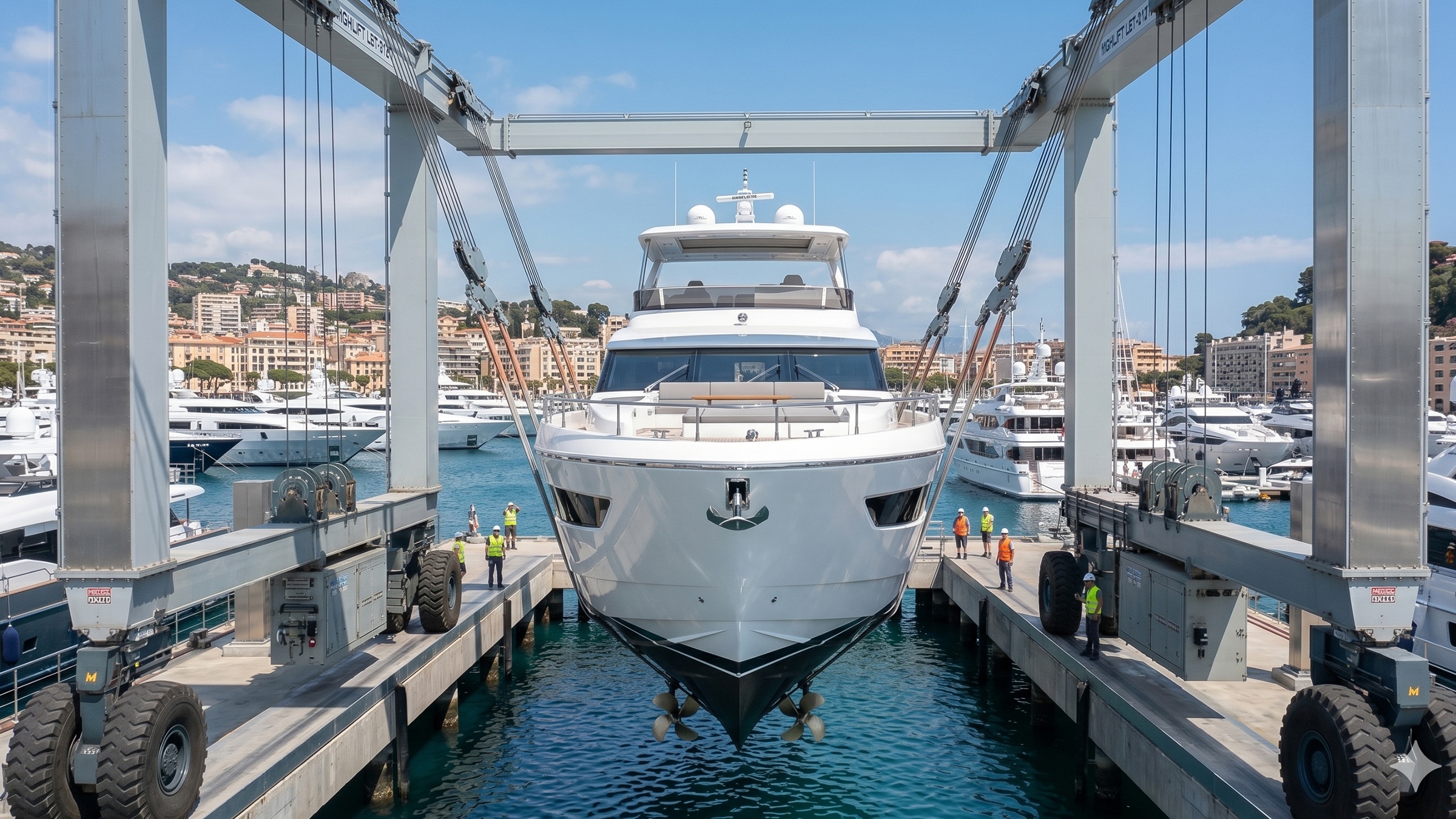
A proper survey ends, ideally, with the boat out of the water for a few hours. The yard pulls the hull with a travelift, and the surveyor walks underneath with a moisture meter, a flashlight, and a notebook. Bottom paint condition, propeller and shaft alignment, rudder bearings, transducer mounts, sacrificial anodes: each of these is impossible to read with the boat in the slip. The cost of the haul-out is one of the most defensible line items in the entire purchase.

Title, lien, and the paperwork that protects you
A boat without clean paperwork is a boat the buyer cannot legally own, insure, or sell. The mechanical survey answers the question of condition; the documentation review answers the question of whether the seller has the right to transfer the vessel at all. The two reviews run in parallel, and skipping the second is how buyers discover, weeks after closing, that the boat carries a lien they did not know about or a title that does not match the hull identification number on the transom.
Recreational vessels in the United States travel under one of two registration regimes, and the distinction matters. Boats under five net tons, and most under sixty-five feet, are titled and registered by the state in which the owner keeps them, on the same model as an automobile title. Boats above the threshold, plus any vessel the owner elects to document for financing or operational reasons, can be federally documented through the U.S. Coast Guard's National Vessel Documentation Center, which issues a Certificate of Documentation in place of a state title. A documented vessel still carries state registration in many jurisdictions, but the controlling document is the federal certificate. Verifying which regime applies, and verifying that the current paperwork is in order under that regime, is the first step of the documentation review.
The lien search is the second step, and the one most often skipped by buyers in a hurry. A boat purchased from a private seller can carry an outstanding loan, a mechanic's lien from a yard, or a claim from an unpaid broker, none of which appear on the certificate of title and all of which transfer with the hull. For federally documented vessels, the National Vessel Documentation Center publishes an abstract of title that lists every recorded encumbrance against the boat. For state-titled vessels, the lien check runs through the state's department of motor vehicles or department of natural resources, depending on the jurisdiction. The cost of the search is trivial. The cost of inheriting an undisclosed lien is not.
Four documents.
Each one verifiable, each one in the buyer's name at the end.
I
Title or Documentation
State title or USCG certificate
The controlling ownership document. State-titled boats follow state DMV procedure; federally documented vessels carry a USCG Certificate of Documentation. HIN on the document must match the hull.
II
Bill of Sale
Signed, dated, with HIN
The transfer instrument. Includes price, full names of seller and buyer, vessel description, hull identification number, and engine serial numbers. Notarization is required in some states; advisable in all.
III
Lien Release
From every recorded lender
Confirms that any prior loan or claim has been satisfied. Required before clean transfer. For documented vessels, recorded with the National Vessel Documentation Center; for state-titled, with the state agency.
IV
Maintenance Records
Service history and warranties
Not a transfer document, but part of any complete sale. Engine service records, haul-out reports, prior surveys, transferable warranties on electronics or major equipment, and the owner's manual binder.
A marine documentation specialist is the most useful professional the average buyer has never heard of. Working alongside the surveyor and ahead of the closing, this specialist verifies the title chain, files the lien searches, prepares the bill of sale to the requirements of the relevant state or federal agency, and submits the transfer paperwork that puts the boat in the buyer's name. The fee, typically modest against the price of the vessel, buys speed and certainty in a process that punishes amateurs. Buyers financing the purchase through a marine lender will often find the lender requires a documentation agent as a condition of closing, which is itself an indicator of how much the professionals trust the process to amateurs.
The seller's records are the other half of the paperwork conversation. Engine service logs, oil analysis history, prior survey reports, haul-out invoices, electronics receipts, warranty paperwork on aftermarket equipment: a well-kept boat travels with a binder. The presence of that binder is itself a finding. A seller who can answer specific questions about when the impellers were last replaced, when the exhaust risers were inspected, and when the fuel polishing was last performed has almost certainly maintained the boat with the same discipline they apply to the paperwork. The buyer who receives that binder at closing inherits a maintenance schedule already running.
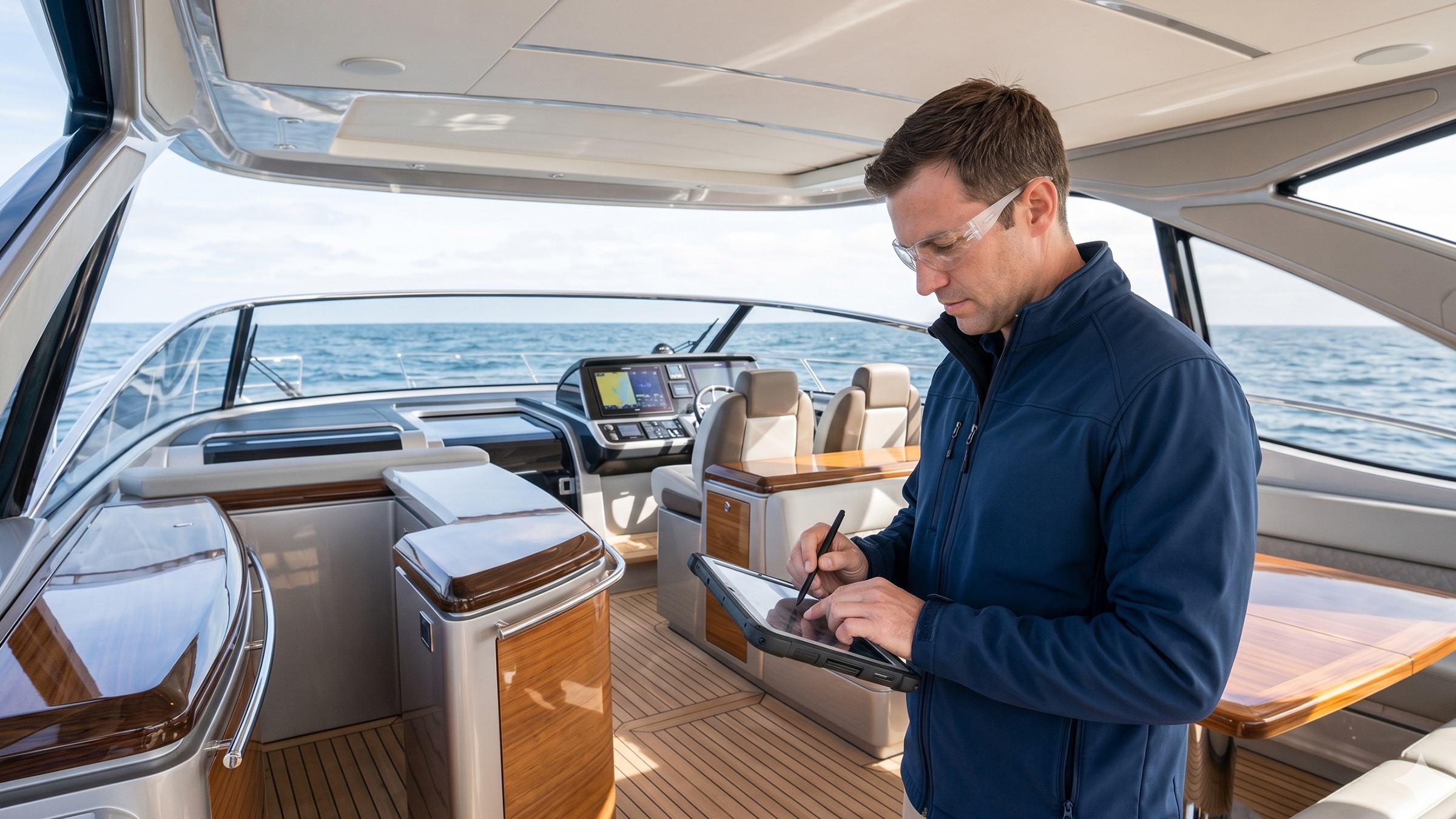
The surveyor at work Notes taken in the cockpit become the report that prices the next conversation.
“
A clean title, a recorded lien release, and a notarized bill of sale are the three pieces of paper that turn a boat into an asset. Anything less is a story.
Field Note · USA Onboard Editorial
Closing, and the first ninety days
The negotiation begins, in practice, the moment the survey report lands in the buyer's hands. A clean report often holds the price. A report with a list of findings, even modest ones, opens the conversation. The most useful approach is not adversarial; it is specific. Each finding is a number, each number is a quote from a yard or technician, and the resulting list becomes the basis of either a price adjustment, a credit at closing, or a set of repairs the seller agrees to complete before the boat changes hands. Sellers who refuse to engage with a survey report at all are usually sellers worth walking away from.
Closing itself, when the parties have done the work, is undramatic. Funds move through escrow or a marine lender, the bill of sale is signed and notarized, the lien releases are recorded, and the title or documentation paperwork is filed with the relevant agency. A documentation agent handles the filing and tracks the timeline; the buyer receives a temporary registration in many states while the permanent paperwork is processed. Insurance binds the day funds are released, not the day the registration arrives. A boat without insurance, even for a week of paperwork lag, is exposure no rational buyer accepts.
The first ninety days of ownership are the period when the boat reveals itself, and when the small omissions of any survey, however careful, tend to surface. A reasonable plan budgets for this. Set aside an amount equal to roughly five percent of the purchase price for first-quarter discoveries: a hose that fails on the third weekend, an alternator that needs replacement, a chartplotter that drops its sounder feed. These are not failures of due diligence. They are the cost of the gap between what any inspection can catch in two days at the dock and what three months of regular use will surface. Buyers who expect this and budget for it tend to enjoy the boat. Buyers who do not tend to resent it.
The equipment review is the other piece of the first ninety days. A used boat arrives with whatever its previous owner thought sufficient, which may or may not match the buyer's standard. The fire suppression system in the engine compartment should be inspected and, if older than its certification date, replaced; expired flares should be retired and current ones bought; life jackets in the right sizes for everyone who will routinely be aboard, plus extras, should be confirmed against the count and weights of the passengers the boat will carry. Safety equipment is the budget line that no thoughtful owner economizes. The Coast Guard's minimum carriage requirements are exactly that: a minimum, not a standard.
A new owner inheriting a used boat also inherits a maintenance schedule, whether they read it or not. Oil change intervals, impeller replacements, anode rotations, bottom paint life, zinc condition, electronics firmware updates, dock line and fender wear: each item runs on its own calendar, and the well-kept binder from the previous owner is the starting point for the new owner's version. A spring commissioning at the local yard, even on a boat the buyer believes to be in good condition, sets a baseline the next year's maintenance will measure against. The boat that arrives well-maintained and stays well-maintained is the boat that holds value when the next owner asks the same questions the current one just finished asking.
Two short lists worth keeping at hand.
Before You Sign · Do
- Commission an independent survey and a sea trial, with the boat hauled at the yard for bottom inspection.
- Run a lien search through the National Vessel Documentation Center for documented vessels, or the state agency for titled vessels.
- Verify the hull identification number on the document against the HIN on the transom and engine serial numbers.
- Bind insurance for the moment funds are released, not the moment paperwork arrives.
- Budget roughly five percent of the purchase price for first-quarter discoveries beyond the survey.
Before You Sign · Don't
- Skip the survey to save a few hundred dollars. The math never works out in your favor.
- Accept verbal assurances about loan payoff, prior repairs, or engine hours. Ask for paper.
- Close on a private sale without a notarized bill of sale and the seller's identification on file.
- Assume the previous owner's safety equipment meets your standard. Verify, replace, and document.
- Take delivery of a boat with a list of unresolved survey findings and a promise to fix them later.

A used boat bought well is one of the better deals available on the water: the depreciation is someone else's expense, the upgrades have been paid for, and the boat arrives with a working history that, read carefully, tells the new owner what the next decade will require. A used boat bought poorly is the opposite. The difference is rarely talent, and never luck. It is method, paperwork, and the willingness to walk away from any boat that resists either one.
USA Onboard Editorial