

Wallywind 110 — A High‑Performance Cruiser That Defies Its Own Nature
Wally's first semi‑custom sailing yacht under Ferretti Group is a study in resolved contradiction — a 33.42‑metre flush‑deck cruiser engineered with the temperament of a racer, and the discipline to behave as both.
There is a quiet question that runs under every conversation about large sailing yachts above the hundred‑foot line. Can a boat of this scale still feel like sailing — sharp, responsive, alive in the helm — without dissolving into the soft furniture of cruising comfort? Most yards of the last two decades have answered by choosing a side. Wally's first model under Ferretti Group has chosen, instead, to argue.
The Wallywind 110 is the first vessel in a new semi‑custom range conceived in 2022 to span 110 to 150 feet. Hull number one, named Galma, touched water in Marina di Ravenna on 1 June 2024 and made her world debut at the Monaco Yacht Show that September — the largest sailing yacht delivered by Wally since the brand became part of Ferretti Group in 2019. A second hull, finished in sand‑grey, followed in July 2025 with private previews in Sardinia and Monaco before her official debut at the Cannes Yachting Festival.
What unites the two hulls — and what the entire Wallywind argument turns on — is a refusal to treat performance and habitability as opposites. The platform is carbon end to end: hull, superstructure, mast, boom, bowsprit, rigging. The naval architecture is by Germany's judel/vrolijk & co, a studio whose portfolio reads like a roll call of recent fast cruiser‑racers. The deck and interior were developed in‑house with Studio Santa Maria Magnolfi. Light displacement, deep cockpit, raised saloon, twin rudders, twin helms aft. None of these decisions is decorative. Each one is in service of the same idea.
Overall
Cockpit
Downwind
Ratio
Carbon, all of it
Wally's relationship with carbon fibre is not recent. The yard introduced the material to large‑yacht sailing in 1994 with Nariida, the industry's first all‑carbon ketch, and has continued to refine its use across three decades. On the Wallywind 110, the commitment is total. The hull is laminated in pre‑preg carbon foam sandwich on a female mould, post‑cured at high temperature; the superstructure, bulkheads, mast, boom and bowsprit are all carbon; the standing rigging is high‑modulus ECsix, the spar is by Hall Spars. The light‑ship displacement comes in under seventy tonnes — a number the design team has called the founding constraint of the entire project.
That weight discipline is what makes the rest of the brief possible. The hull form, drawn by judel/vrolijk, is a development of the Wallycento geometry stretched marginally wider at 7.60 metres of beam to absorb the weight of a richer interior and a more complex deck. Some three metres of overhang aft allow the waterline to extend in cruising trim without becoming draggy. Twin rudders provide the steering authority a hull of this length and stiffness needs. The result is a boat that, on her first proper Mediterranean season, logged more than three thousand five hundred miles — much of it under sail — and saw twenty‑three knots of boat speed in twenty‑eight knots of true wind, under main and jib alone.
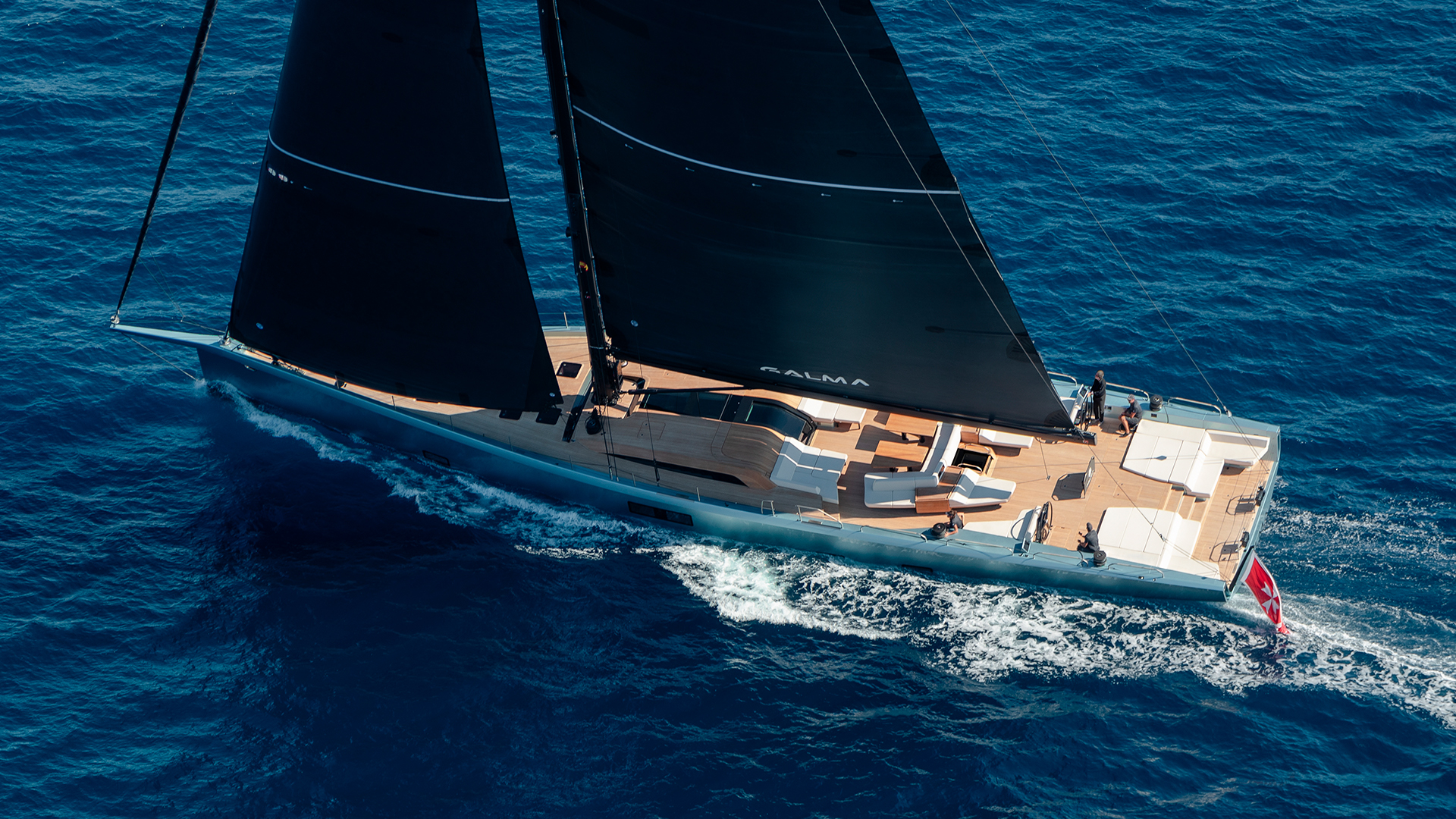
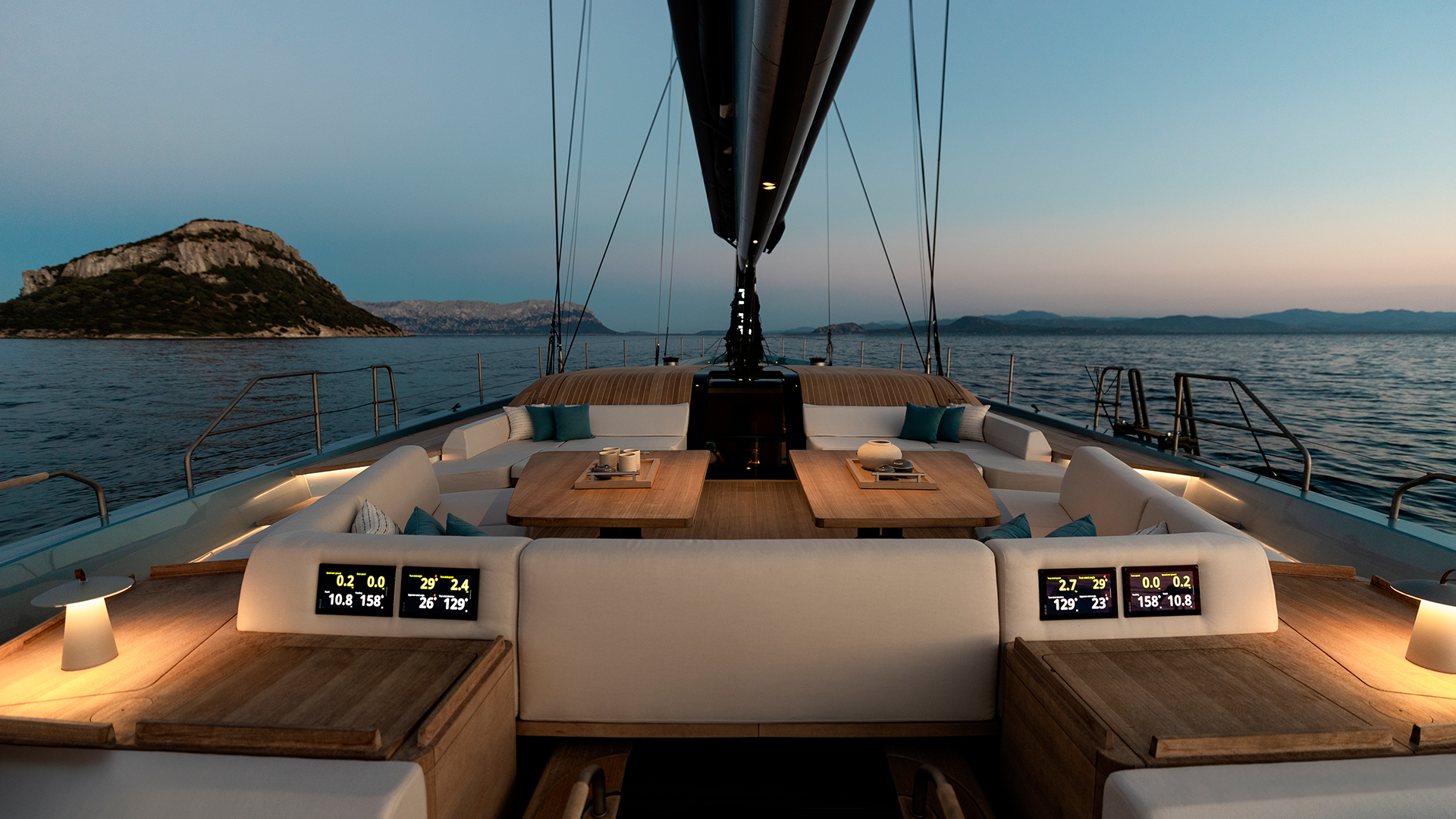
If the carbon decision shapes the platform, it is the cockpit that shapes the experience of being on board. At more than eighty square metres on a single level, the guest cockpit of the Wallywind 110 is comparable in scale to those found on sailing superyachts in the fifty‑metre class. Every sailing control — winches, sheets, helms — has been pushed aft into a dedicated working zone, leaving the entire forward cockpit clear of the choreography of sailing. Sofas, sunpads, an informal dining table; nothing fixed, everything reconfigurable. The deck itself is step‑free fore to aft, an unusual gesture at this length.
The architecture of that division is what the rest of the yacht hangs from. With the operational stations isolated, guests can experience the thrill of sailing without having to navigate around the people doing the work. With the deck flush, the silhouette is clean from any angle. And with the saloon raised — though carefully concealed beneath high bulwarks and continuous teak — the lower deck is freed for accommodation that, in a different layout, would never have fitted in this volume.
It offers the volumes of a deckhouse yacht with the spirit and performance of a racing boat.
Three ideas that define her
A raised saloon is concealed beneath continuous teak and tall bulwarks, producing the silhouette of a fully flush deck while preserving the volumetric advantages of a deckhouse below — Wally's quiet sleight of hand on a yacht of this length.
Twin helms, winches, sheets and operational stations are all concentrated at the stern, separated from the guest cockpit by both space and intent. The choreography of sailing and the experience of being aboard are no longer the same room.
A signature Wally gesture: the aft platform steps down toward the water, opening a stepped social terrace at the waterline. It is the closing note of the deck — a place to descend into the sea rather than look at it from a height.
Light from above, volume below
The raised saloon is the architectural pivot of the entire layout. By lifting the floor of the main living space, the design team frees the volume directly underneath for the engine room and the technical plant — and recovers the rest of the lower deck for accommodation that would otherwise be impossible at this length.
Hull glazing, framed windows and overhead skylights pull daylight into the saloon along three axes. The atmosphere is contemporary rather than nautical — pale woods, soft upholstery, visible carbon accents holding the line between cruiser warmth and racer discipline. A formal dining table to starboard seats up to eight; a lounge to port handles the softer hours.
The interior development was led by Wally founder Luca Bassani in collaboration with Studio Santa Maria Magnolfi. The brief, by the team's own description, was a hybrid: a yacht with the volumes and habitability of a deckhouse boat, finished with the lightness and modernity of a racer.
Eighty square metres, no obstructions
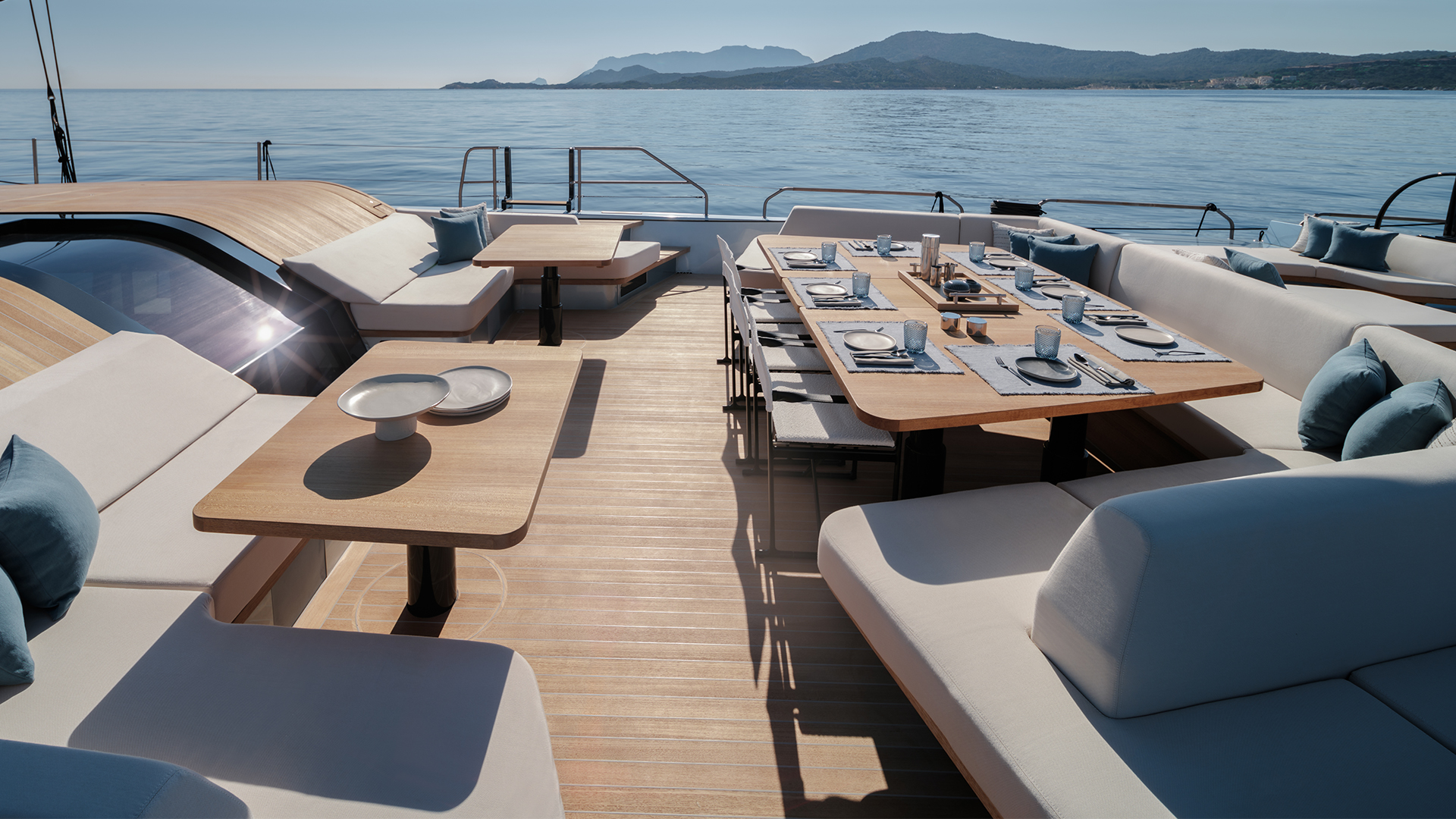
The cockpit is the social heart of the boat, and its scale is the headline. Eighty square metres of single‑level guest space — comparable, in raw area, to the cockpits found on sailing superyachts in the fifty‑metre class — is reserved entirely for living. There are no winches in the way, no sheet leads underfoot, no operational equipment to navigate around.
Sofas, sunpads, an informal lunch table, concealed refrigeration along the bulwark coamings: the brief is a step‑free deck that behaves as a true outdoor living platform. The absence of steps fore to aft is itself an editorial decision — comfort, safety and the visual cleanliness of a continuous teak surface, all at once. Outboard‑facing seating reorients every meal toward the water rather than the table.
Surfaces, stations, light
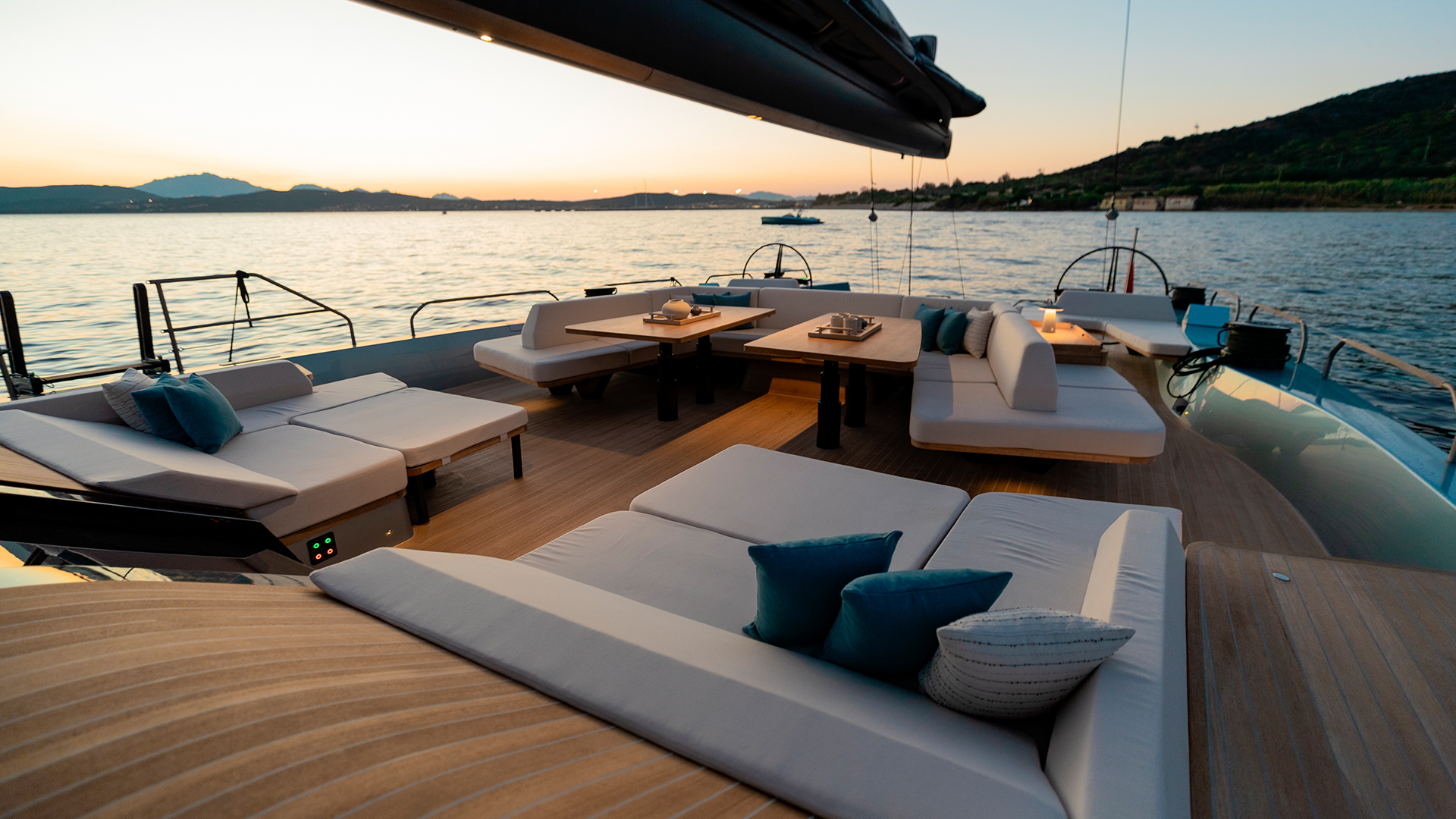
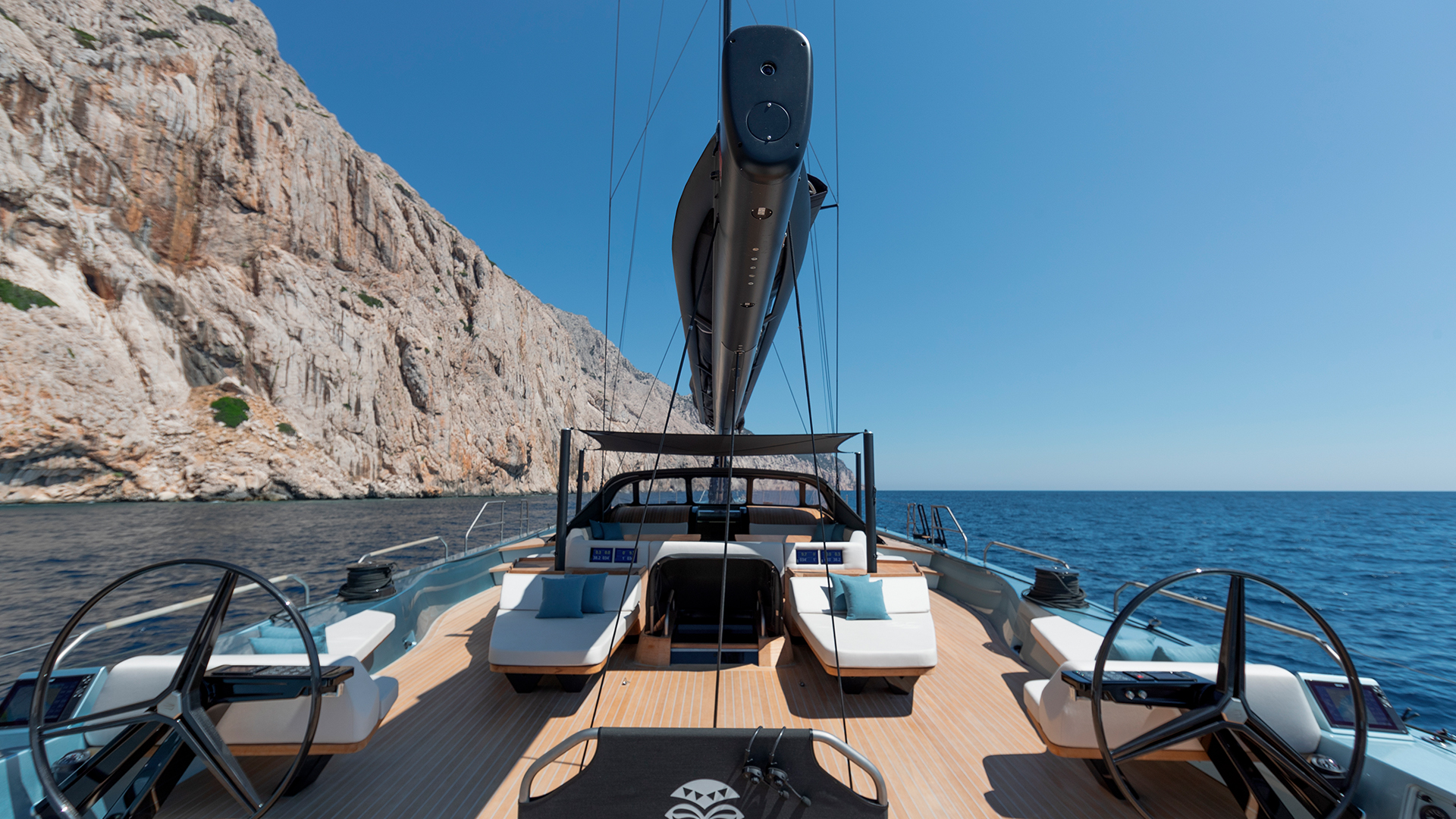
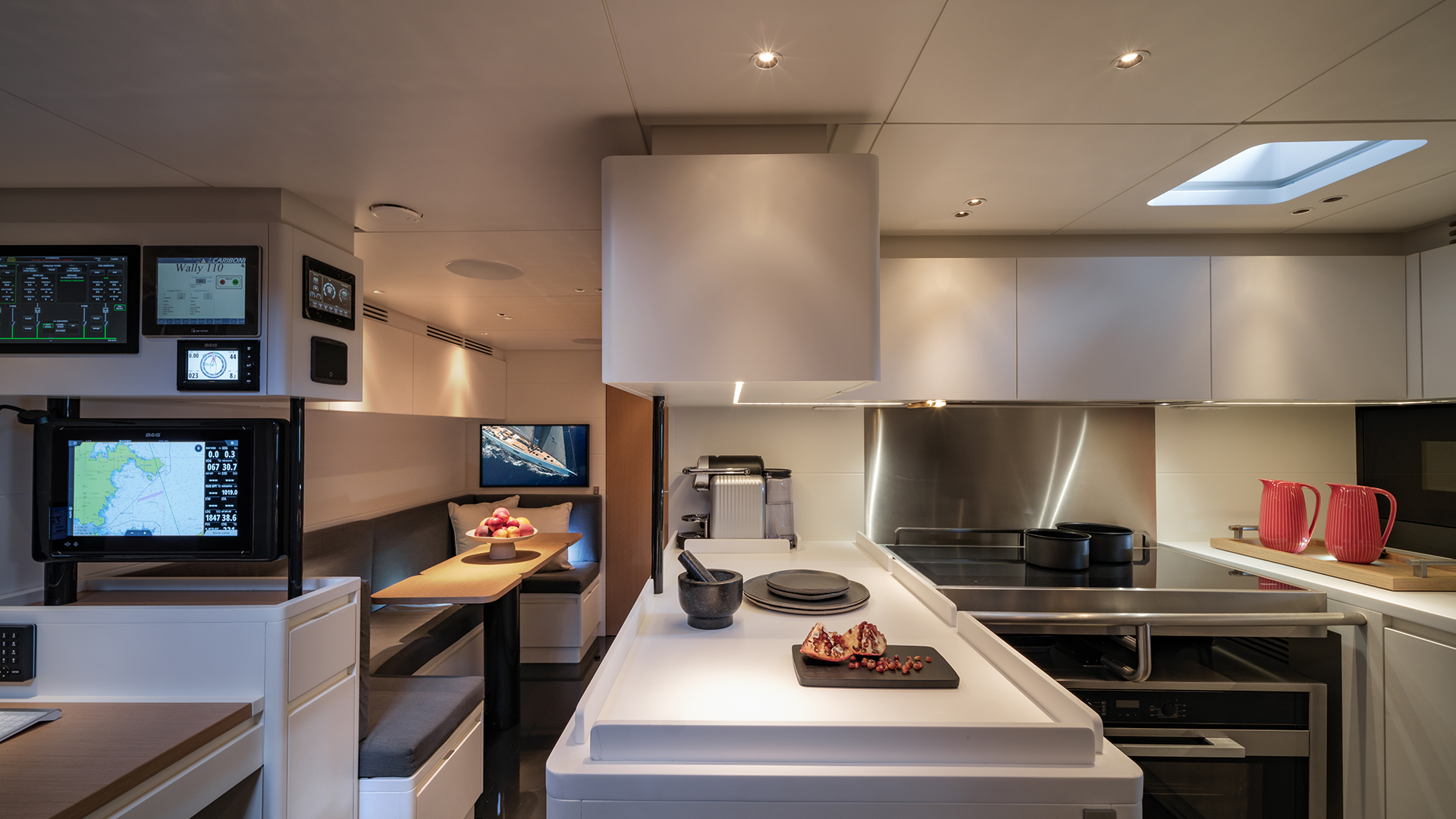
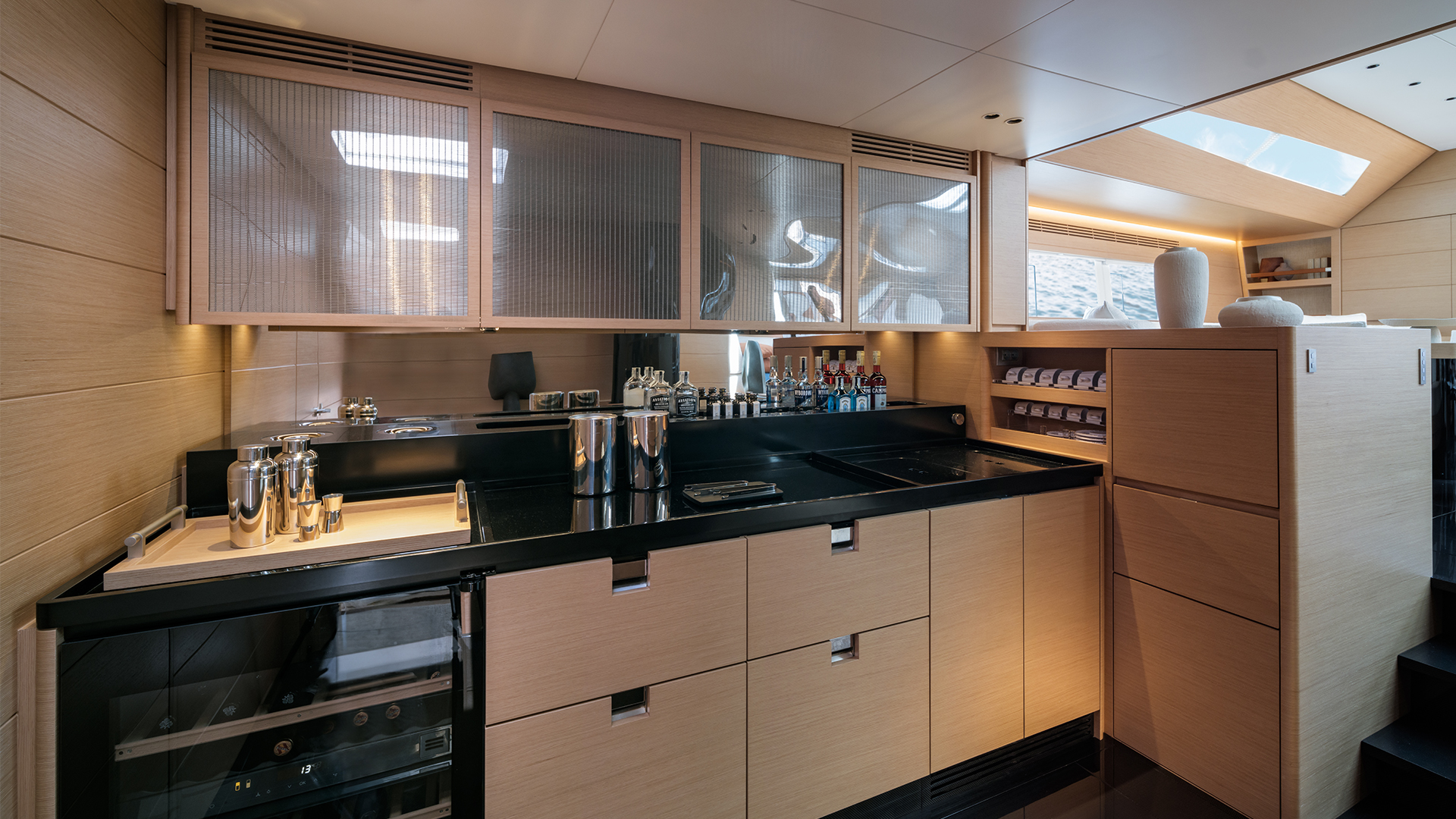
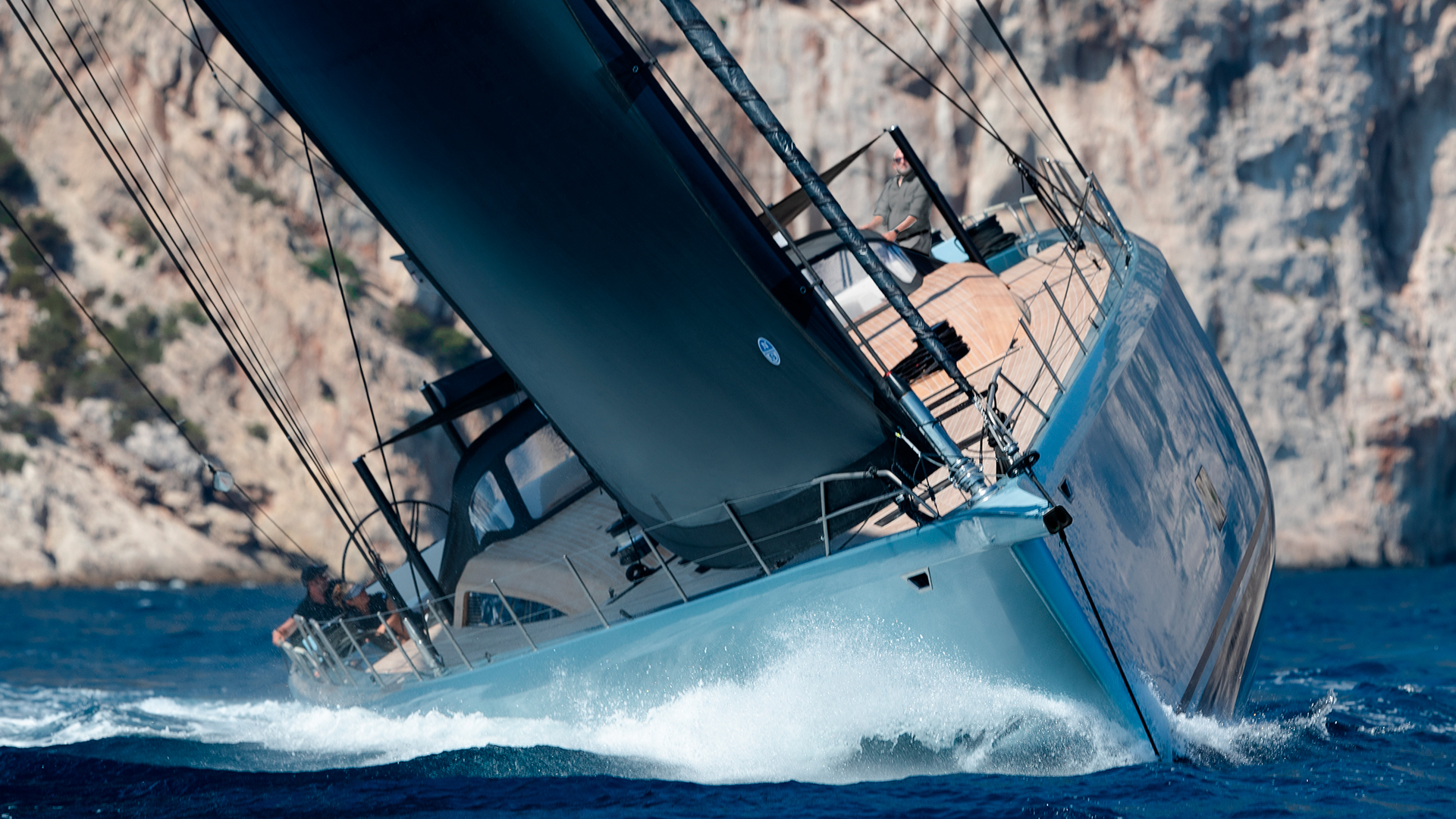
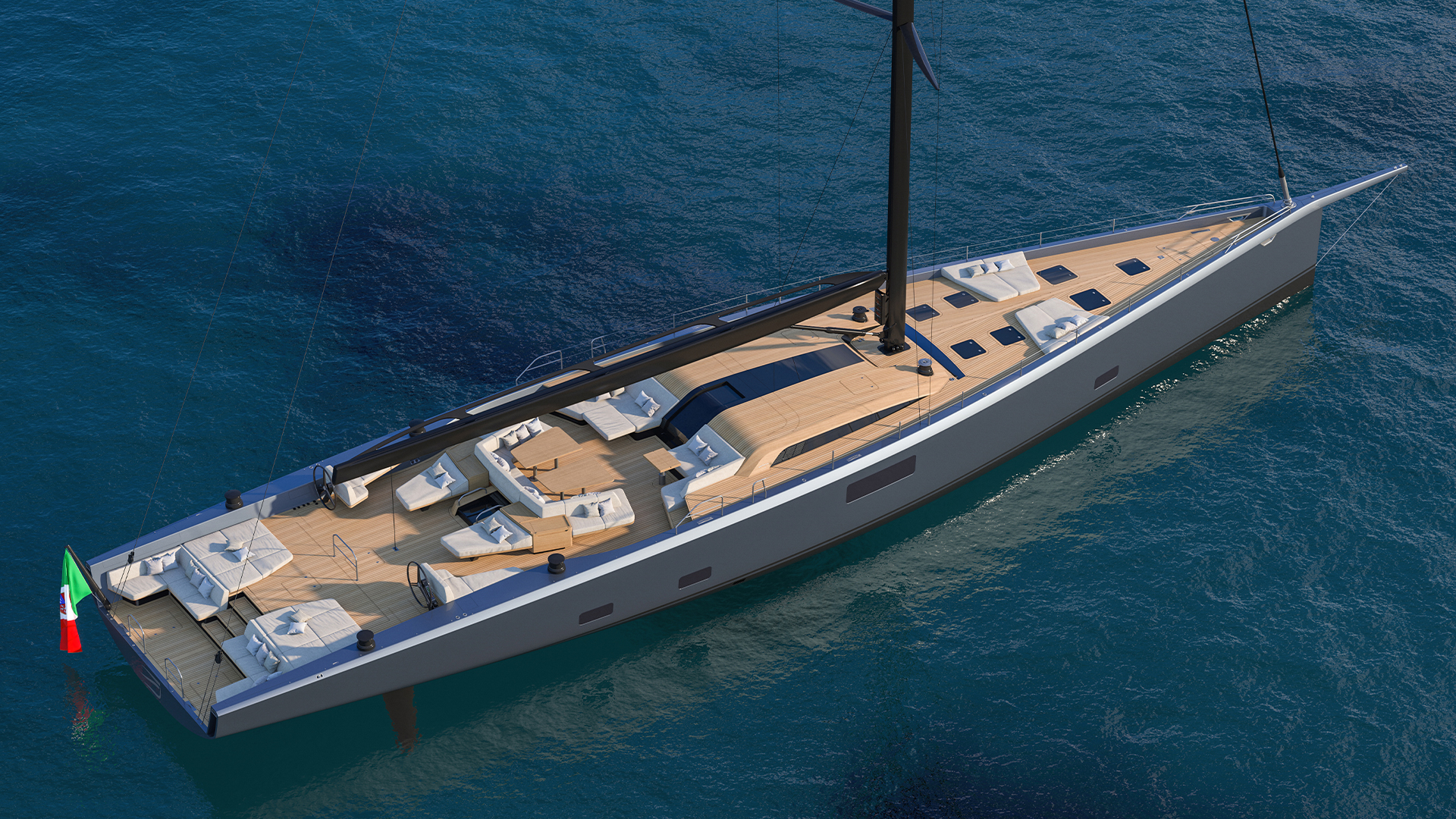
Wherever you turn the dial between cruising and racing, a Wally yacht will always be fast and innovative.
Below deck, the architecture of the raised saloon translates into accommodation flexibility that defines the semi‑custom proposition. Owners can specify up to four guest cabins plus three crew cabins, with optional bar, office or media zones depending on the layout chosen. On the second hull delivered in 2025, the owner replaced the bar in the lower saloon with a multi‑purpose workspace, and chose a sliding bed for the VIP cabin that converts between double and twin — the kind of personalisation the platform was designed to absorb without losing coherence.
The systems serving all of this are equally deliberate. A 425‑hp Cummins diesel sits flanked by twin generators with power take‑offs, feeding hydraulics through a dedicated oil tank. Magic Trim, Wally's signature one‑touch hydraulic system for mainsheet and jib sheet, allows short‑handed sail trim from either helm. Pop‑up cleats, a submarine anchor system that disappears entirely below the waterline, ECsix carbon standing rigging — the boat's deck is uncluttered because every system that could distract from it has been engineered out of view.
At a glance
A visual tour through the vessel
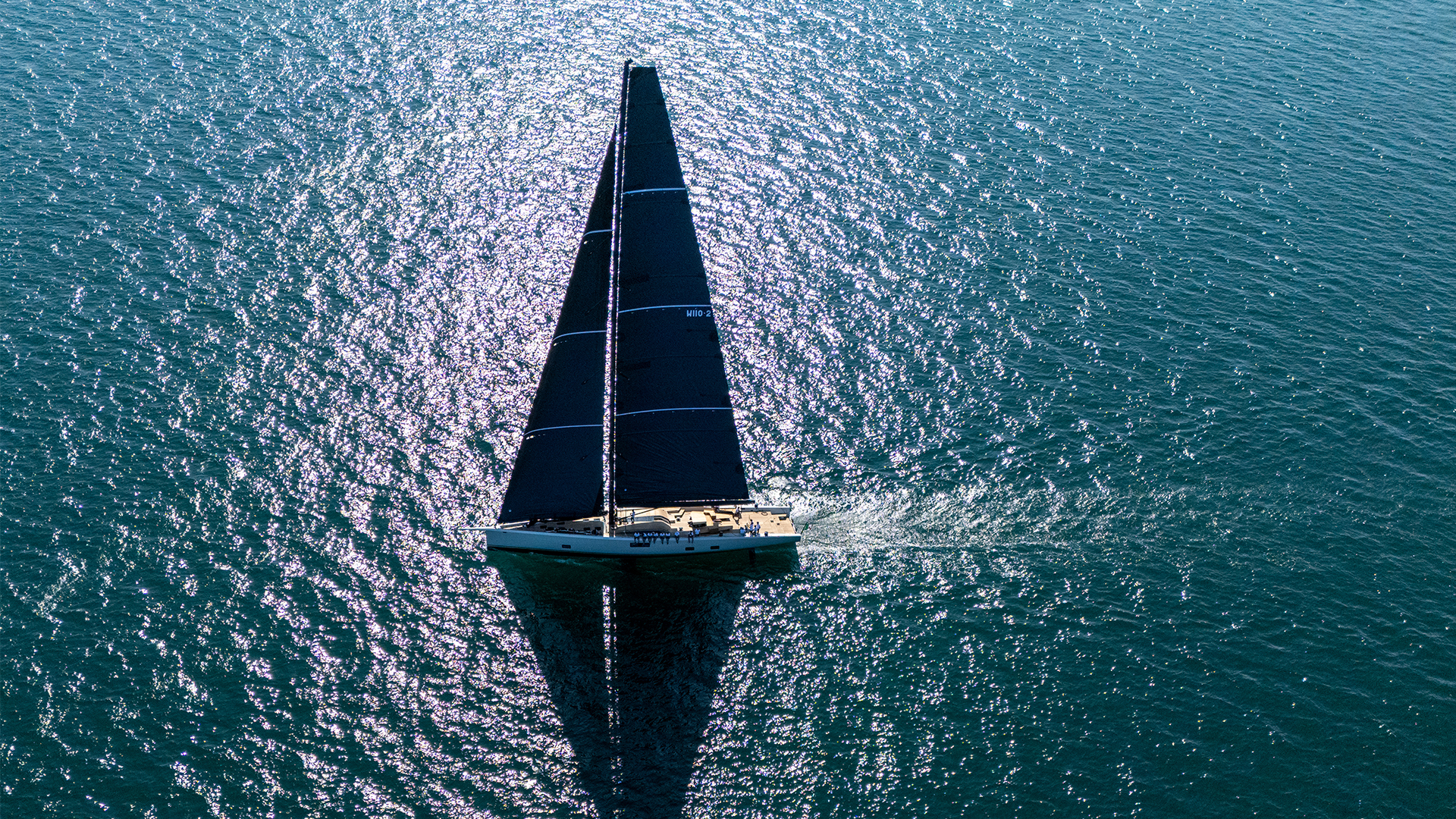
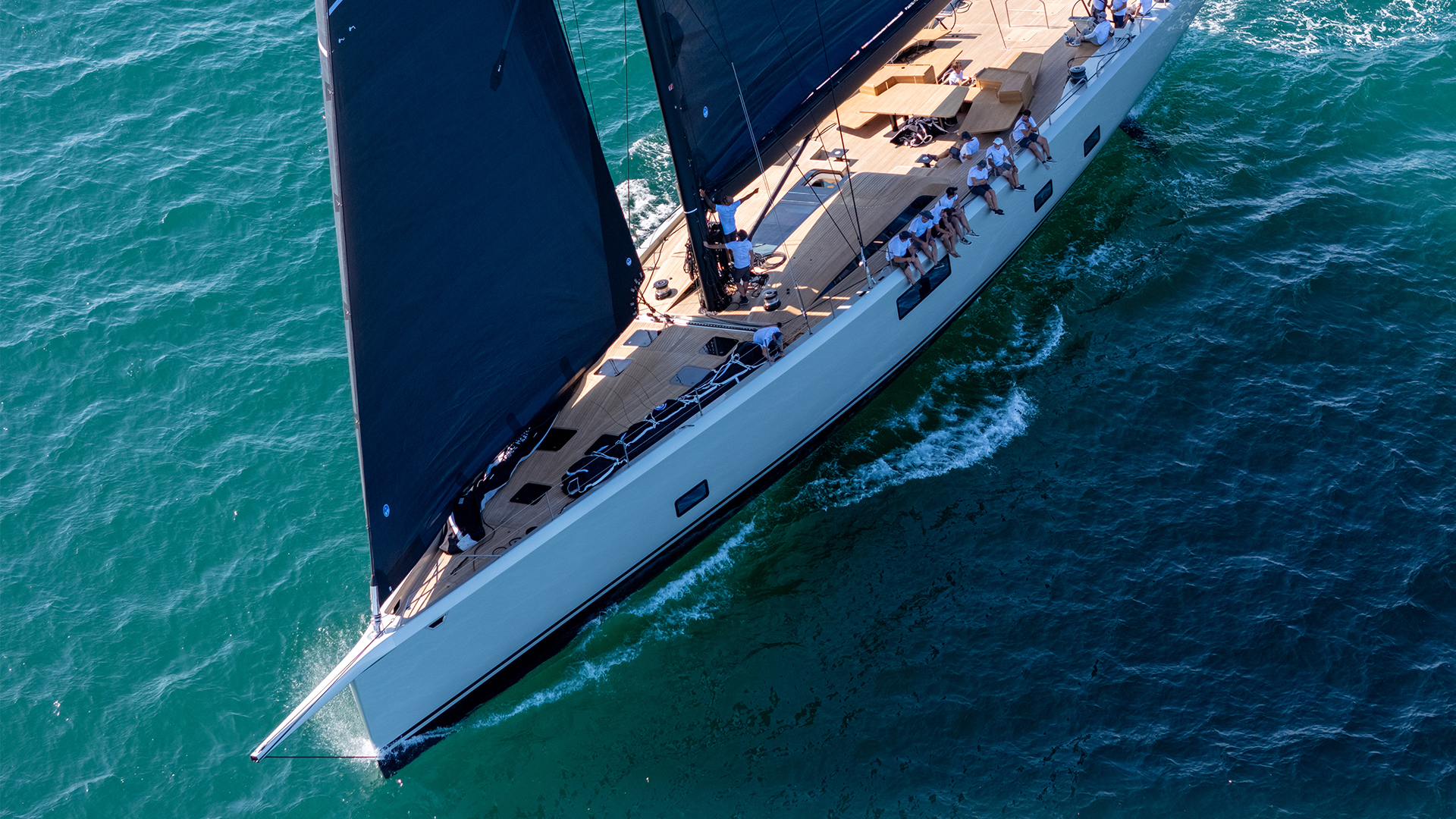
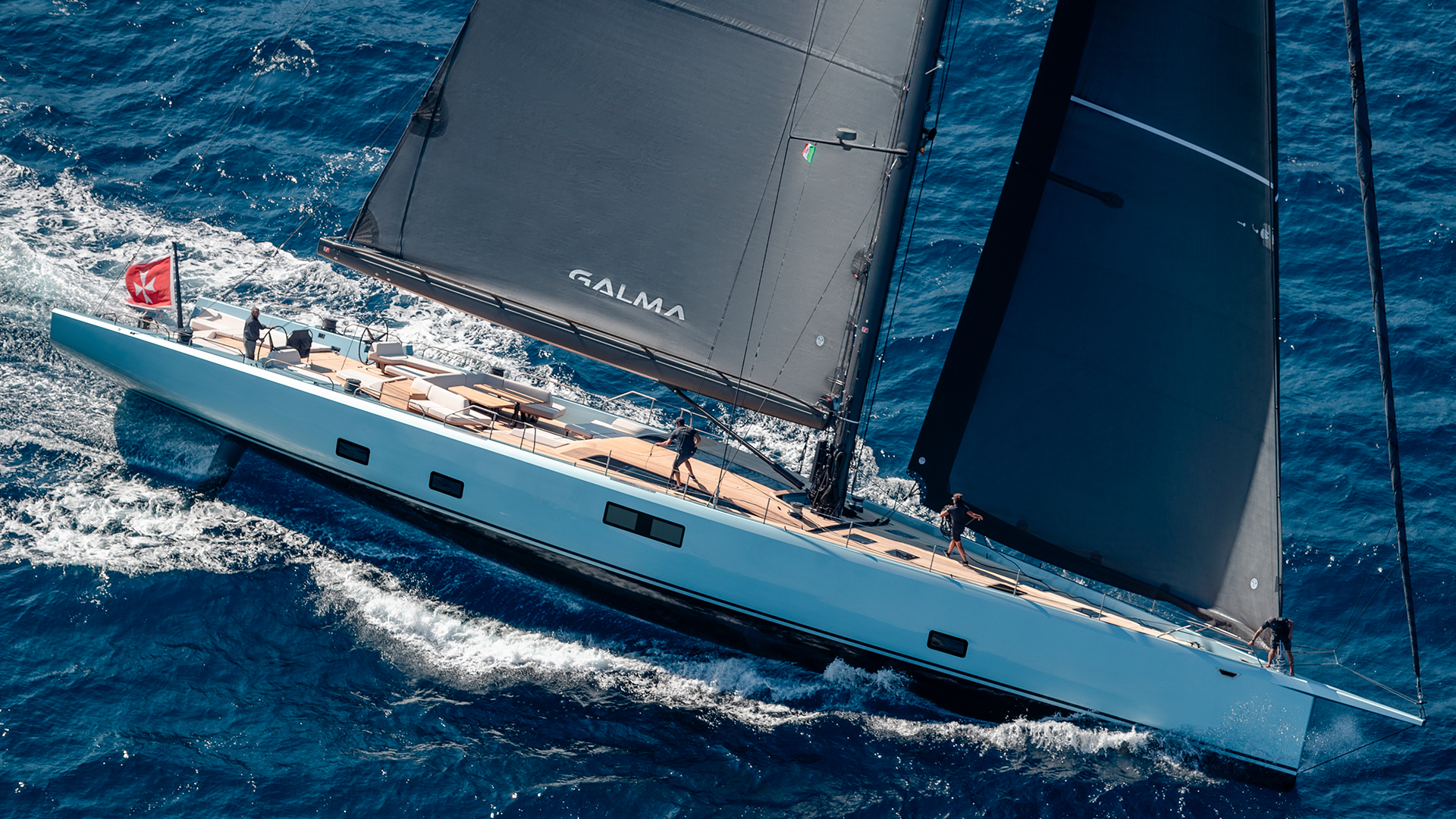
Galma's first proper editorial validation arrived in early 2026, when the BOAT International Design & Innovation Awards named her Outstanding Exterior Sailing Yachts for the year. The recognition placed the Wallywind 110 inside a roster of yachts that included Royal Huisman's Aquarius for naval architecture and Perini Navi's Katana for interior design — quiet company for a first‑in‑series semi‑custom delivery.
The second Wallywind 110, finished in sand‑grey and laminated in the same moulds as Galma, was completed ahead of schedule and made her global debut at the 2025 Cannes Yachting Festival after private previews at Phi Beach in Sardinia and at the Yacht Club de Monaco. Her interior is a paler counterpoint to the first hull, the bar replaced by a workspace, the VIP cabin reconfigurable. Wally has confirmed that the Wallywind range will continue with 130‑ and 150‑foot models — an extension of the same argument across larger platforms.
What the Wallywind 110 demonstrates, in the end, is that the cruiser‑racer category is less a fixed point than a sliding scale. The yacht is built to the limit on both sides: enough sail area, stiffness and weight discipline to make a regatta worth taking seriously; enough cockpit, accommodation and finish to make a Mediterranean season feel like a way of life. The flush deck, the aft helm zone, the carbon throughout — these are not features. They are the means by which the contradiction at the centre of the brief is held open without resolving in either direction.
A yacht that refuses the choice between racer and cruiser, and is engineered through every square metre of carbon to keep refusing it.