

The Story of
Black Pearl
At 106.7 meters, the largest DynaRig sailing yacht ever built rewrites what a wind-powered vessel can be — a 2,864-ton platform capable of crossing the Atlantic on the strength of breeze and a single idea.
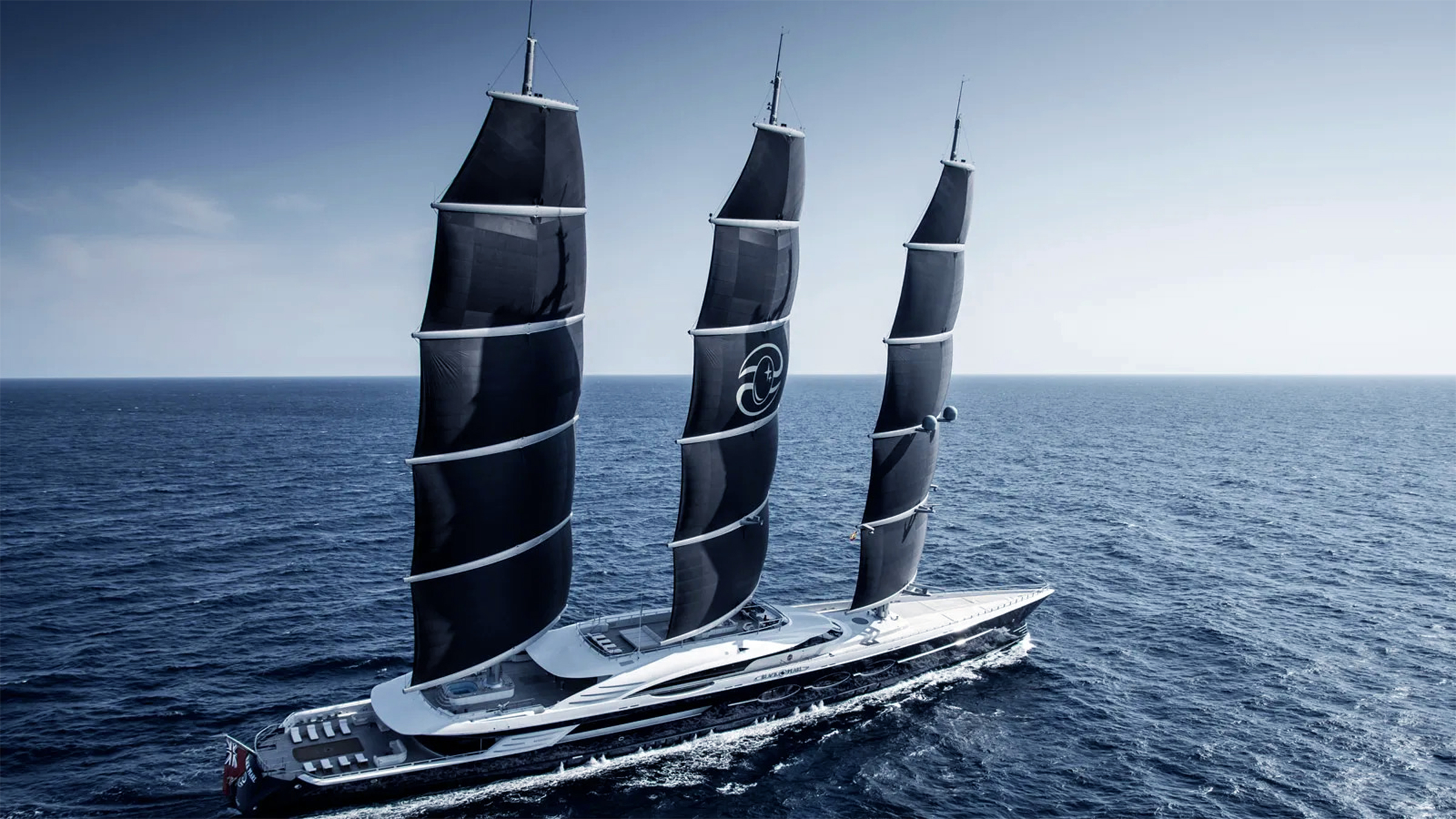
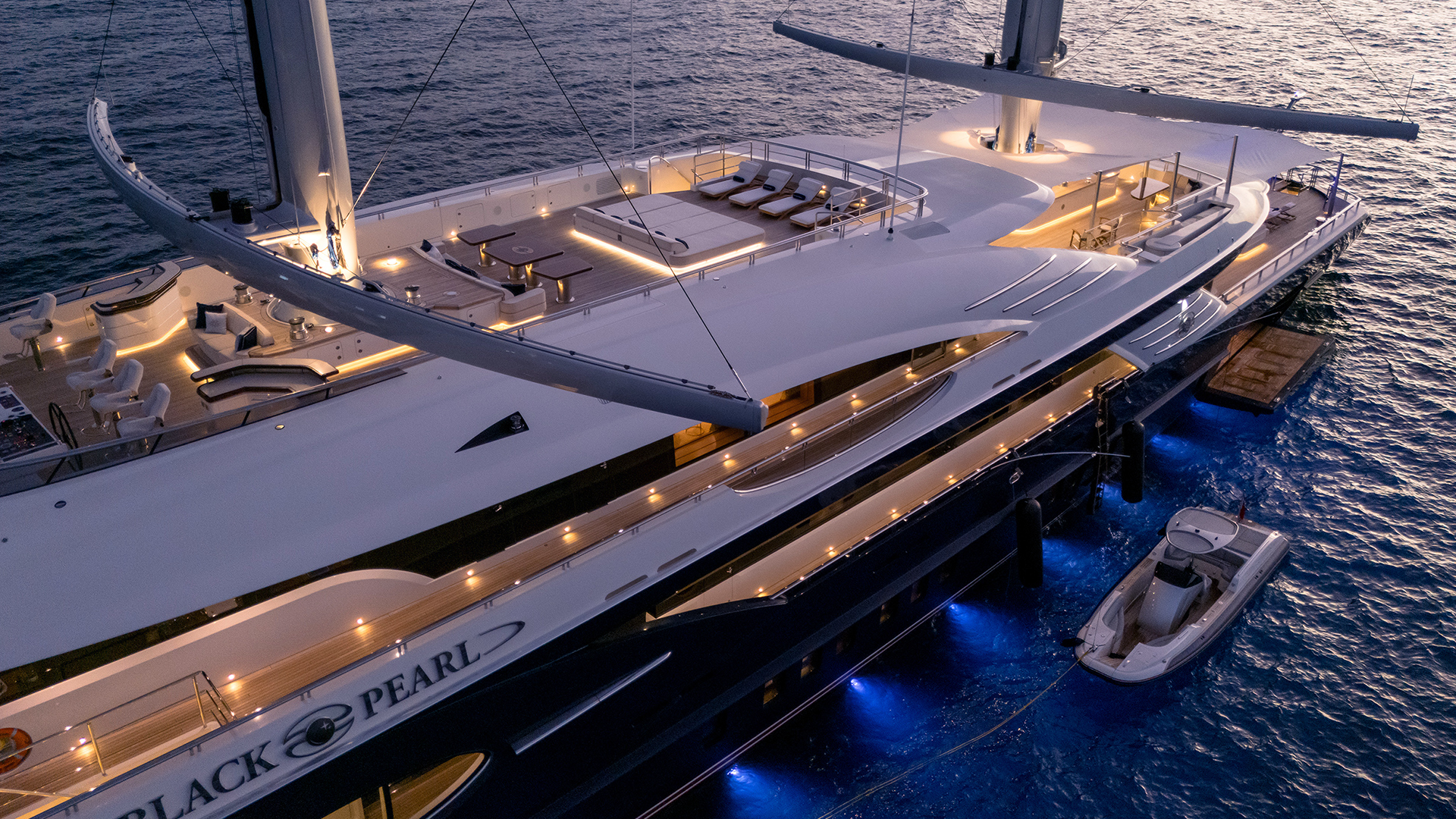
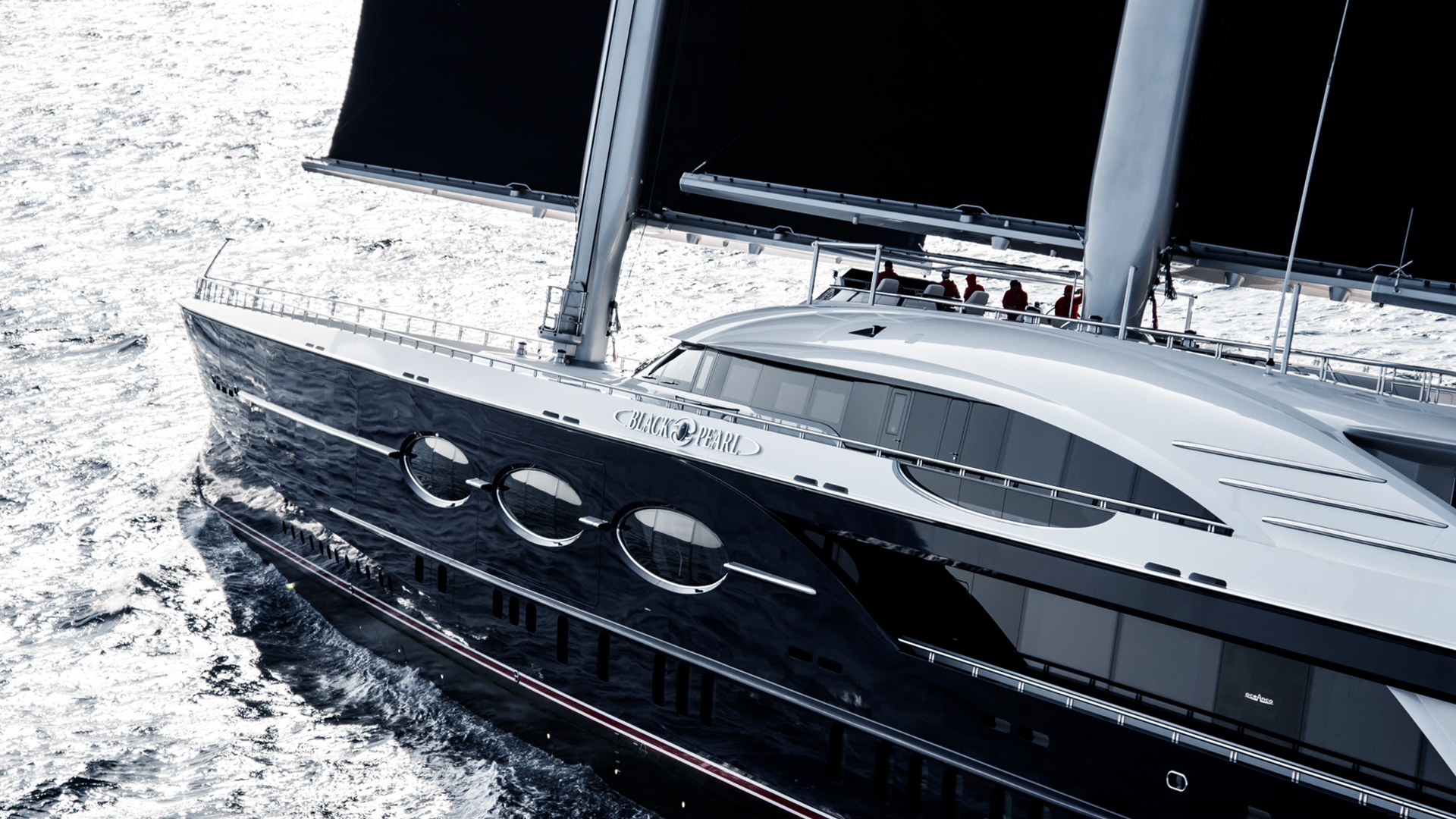
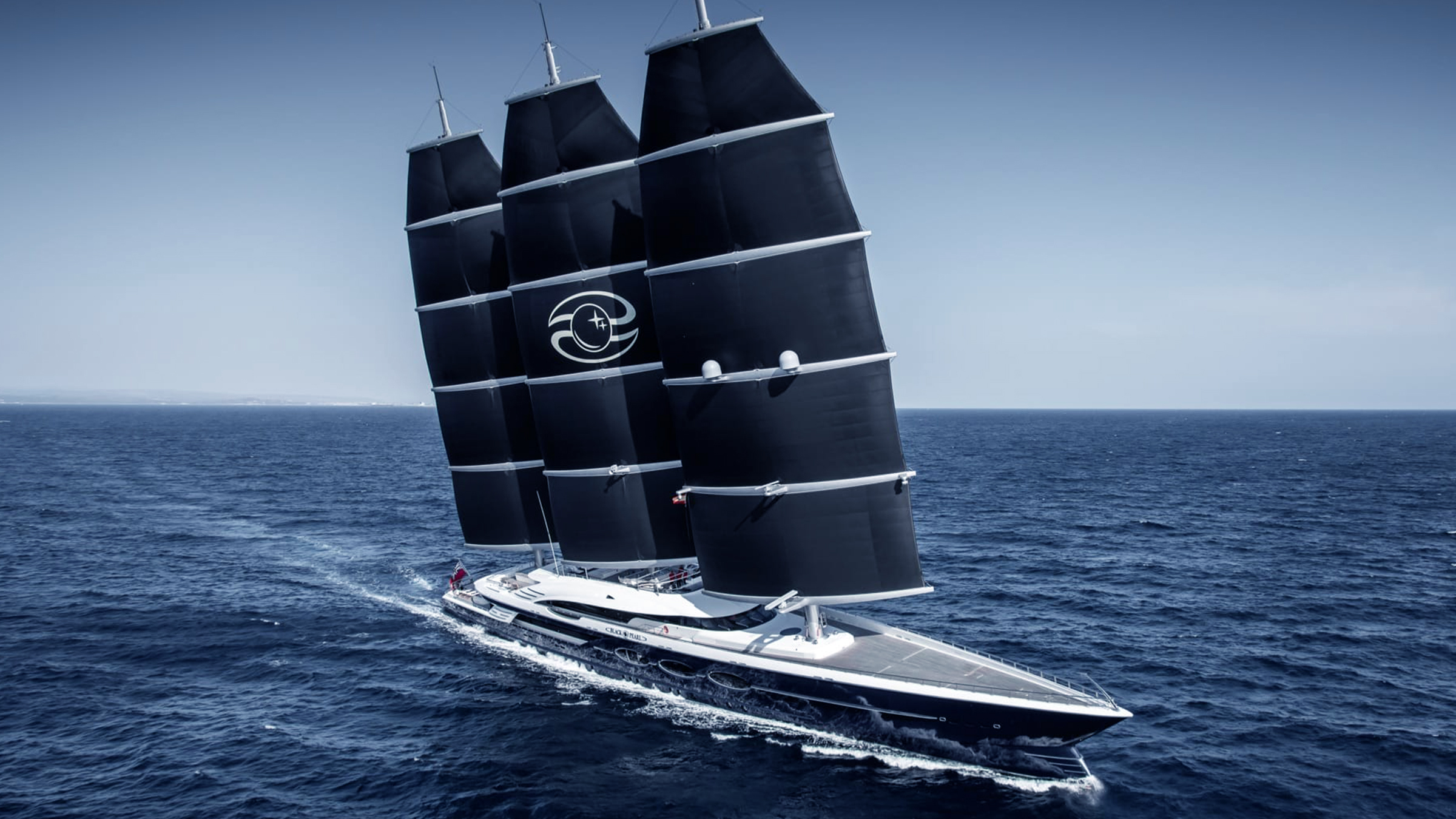
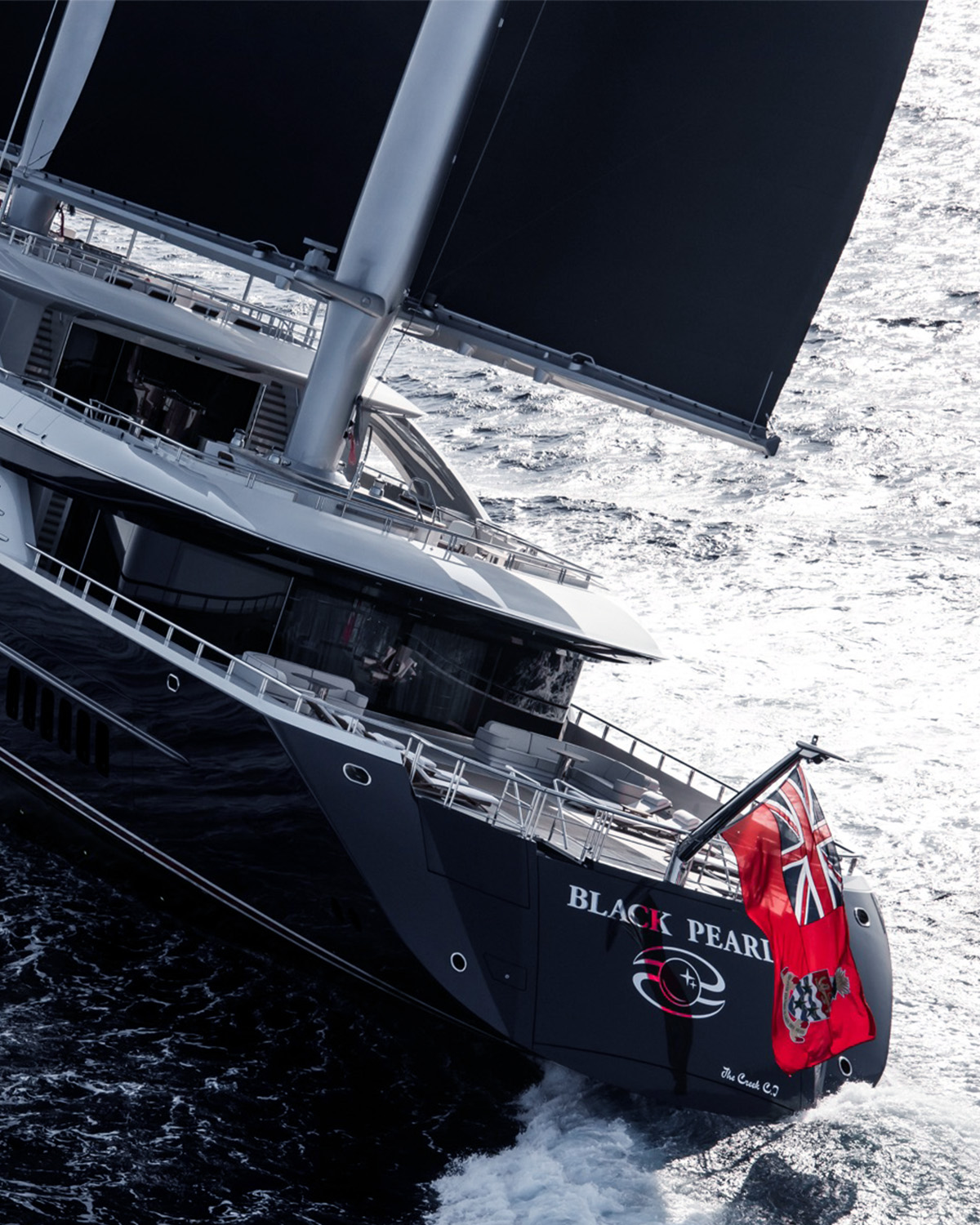
She arrives at every anchorage with a silhouette that the eye has nowhere to file. Three black carbon masts rising seventy meters into the wind, a wave-piercing reverse bow, a hull the color of deep water — and the steady, almost unsettling absence of engine noise.
The Black Pearl is the largest DynaRig sailing yacht ever built, the second-largest sailing yacht in the world, and — by every measure the industry currently uses — the most consequential single argument made in modern sailing yacht design. Delivered in 2018 by Dutch shipyard Oceanco at its Alblasserdam yard, she is the realization of a brief written by Russian businessman Oleg Burlakov, who treated the project less as a pleasure craft than as an applied research vessel: a moving laboratory for the proposition that scale and sustainability are not opposing values.
The numbers explain part of the case. One hundred and six point seven meters on deck, a 15-meter beam, 2,864 gross tons of interior volume, accommodation for twelve guests across seven cabins, a crew complement of twenty-seven. But the numbers are the easy part. What makes the Black Pearl genuinely new is what those numbers do — and what they refuse to do — with the wind, with the ocean, and with the energy they leave behind them.
She is, in the precise sense the industry rarely allows itself, a proper sailing yacht: one capable of leaving her mooring under canvas alone and crossing the Atlantic without burning a drop of fossil fuel. The largest yachts of comparable size that carry sails treat them as a supplement. On Black Pearl, the masts are the premise; the diesels are the reserve.
A rig commanded by a single button
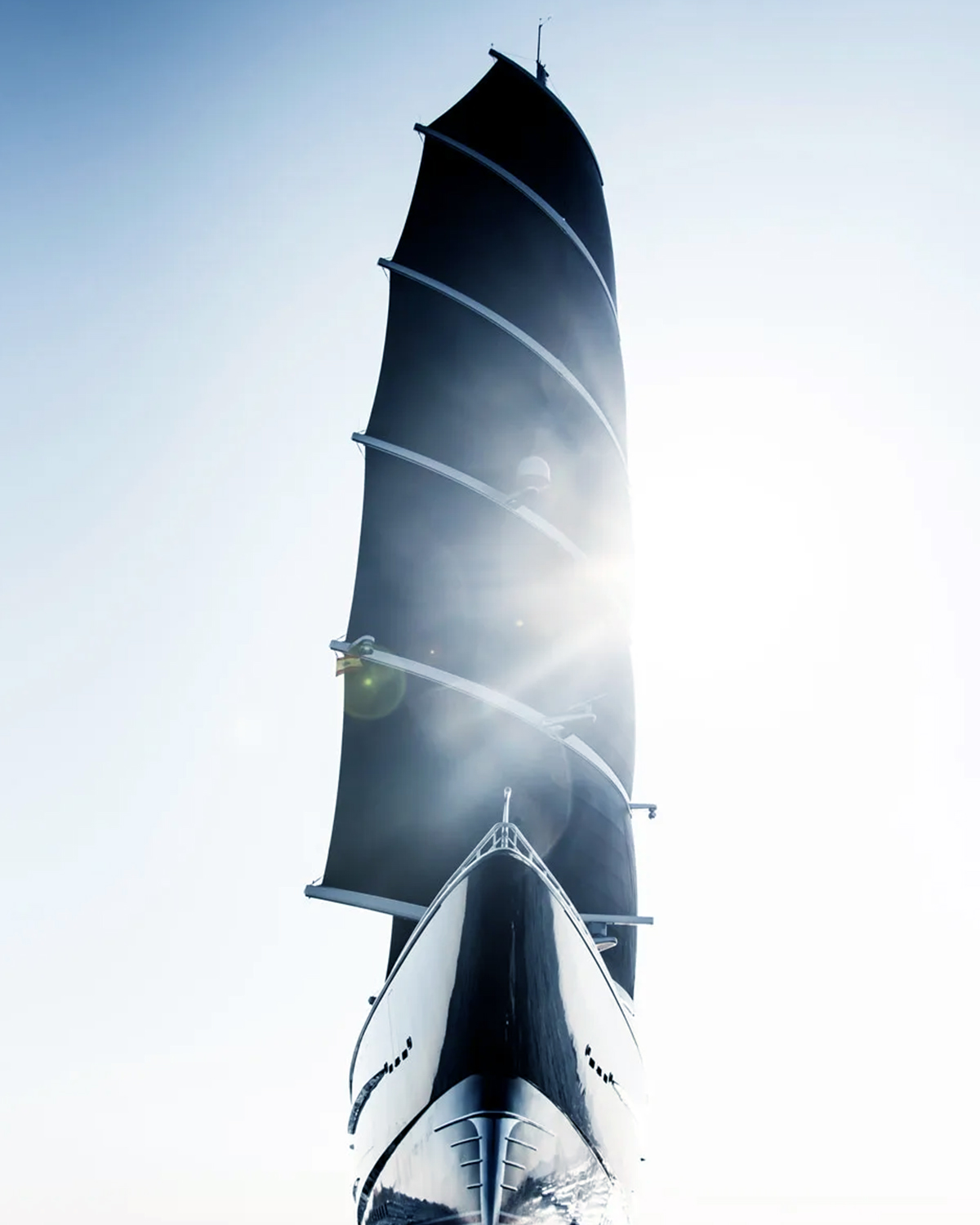
The DynaRig system is not a Black Pearl invention — it owes its existence to research carried out by German engineer Wilhelm Prölss in the 1960s and to its first full-scale application on Tom Perkins's 88-meter Maltese Falcon in 2006. What Black Pearl does is take the concept and stretch it to a scale almost no one in the industry was certain it could survive. Three freestanding, rotating carbon-fiber masts. Six rigid yards per mast. Fifteen square sails per mast set between the yards with no gaps, behaving as a single curved airfoil. 2,934 square meters of total sail area — a surface roughly the size of half a football field — fully deployed in under seven minutes by one crew member at the helm console.
The masts themselves are 70.6 meters tall and built from carbon laid by Dykstra Naval Architects, the firm that engineered the Falcon's rig and used the Black Pearl program to refine almost every detail of the original concept. The masts fold to clear the Panama Canal. The sails furl into the masts and slide out along tracks on the yards. There is no climbing required. There is no traditional rigging to coil, no crew on the foredeck wrestling canvas in a squall. The yacht is trimmed by rotating the masts themselves.
A massive step forward in sailing technology, and a particularly beautiful, handsome yacht.
Ken Freivokh · Exterior & Concept Designer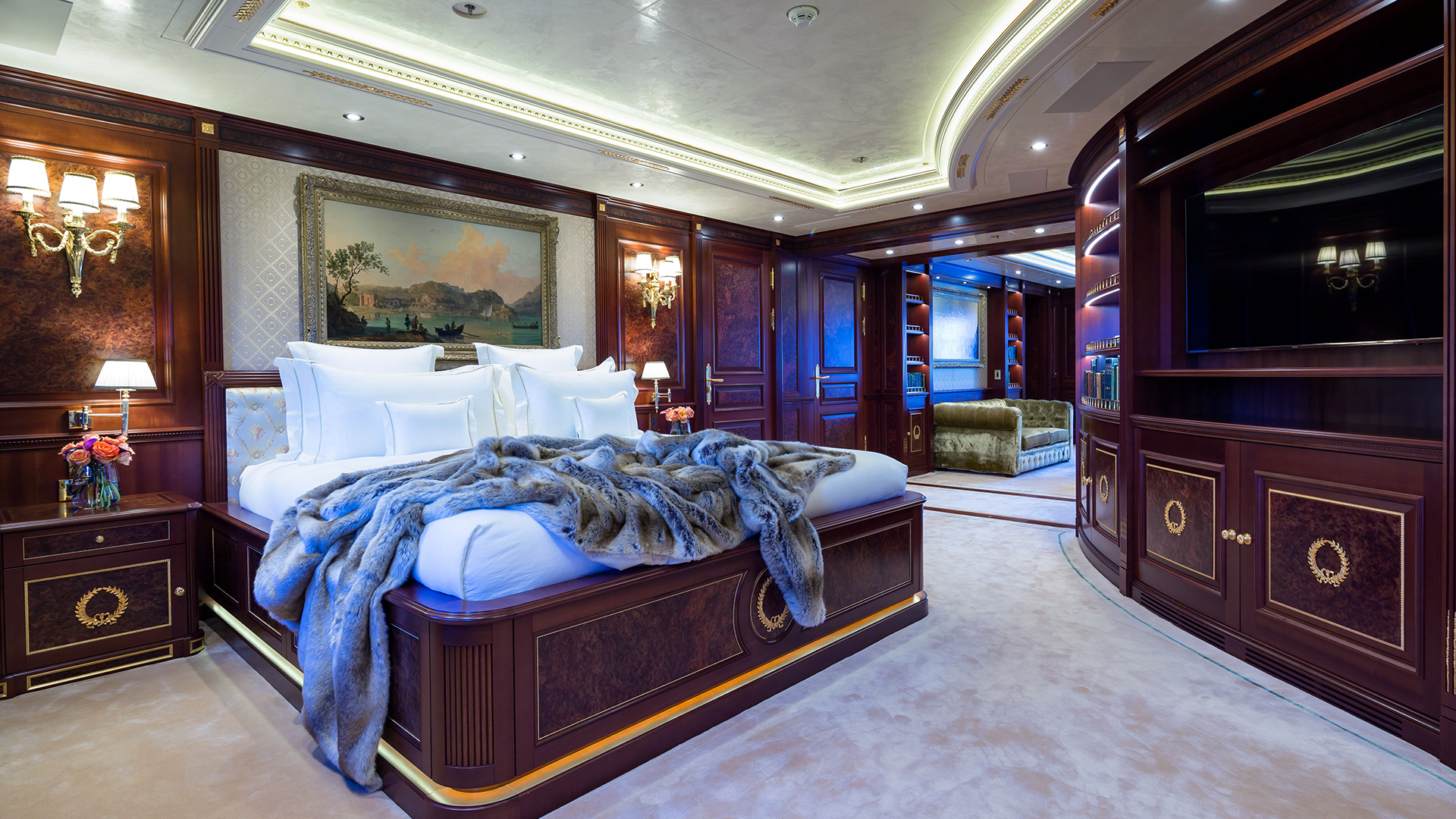
The owner's quietest decision
The layout reads, at first, as a misprint. On most yachts of this scale the master stateroom claims the bow of the main deck — the prestige slot, the panoramic windows, the prow of the vessel. On Black Pearl, the master sits on the lower deck. Modest in position, generous in proportion, conceived as a private retreat rather than a stage.
What the bow gives up, the main saloon and the private study take in. The owner asked for room to entertain, to read, to work — and gave the bow over to those rooms instead. It is a brief that quietly inverts a century of yacht convention, and it is the clearest signature of an owner who treated this vessel as a project rather than a possession.
The diesels are the reserve, not the answer
The hybrid system on board was developed by Oceanco in collaboration with Lateral Naval Architects (the marine-systems practice that grew out of BMT Nigel Gee). Twin MTU 12V 2000 M72 diesels handle propulsion under engine power and push the yacht to 17.5 knots. Three Scania generators supply hotel load when the yacht is at anchor or running auxiliaries. Under sail, the boat clears 20 knots routinely and has been recorded above that figure in suitable winds; the builder cites a maximum of 30 knots under canvas in optimum conditions.
The clever part sits between the two systems. When the yacht is sailing, her variable-pitch propellers can be reversed and used as turbines, harvesting kinetic energy from the water flowing past the hull. At an average sailing speed of 14 knots, the system harvests roughly 138 kilowatts — enough to run the entire hotel load and charge the battery banks without firing a single generator. The yacht enters what the crew call silent ship: hours of cruising with the diesels and gensets entirely off, on nothing but wind and stored kinetic energy.
A waste-heat recovery system handles the rest. The combination is what enables the yacht's most quoted claim — the transatlantic capability without burning fossil fuel. The figure isn't theoretical. On her first Atlantic crossing in late 2023, Black Pearl sailed from Montenegro to St Barths: 5,600 nautical miles, 20.5 days, around 32,000 liters of diesel consumed. A 100-meter motor yacht of comparable volume would have burned an order of magnitude more on the same route.
A Louis XVI brief, kept behind closed doors
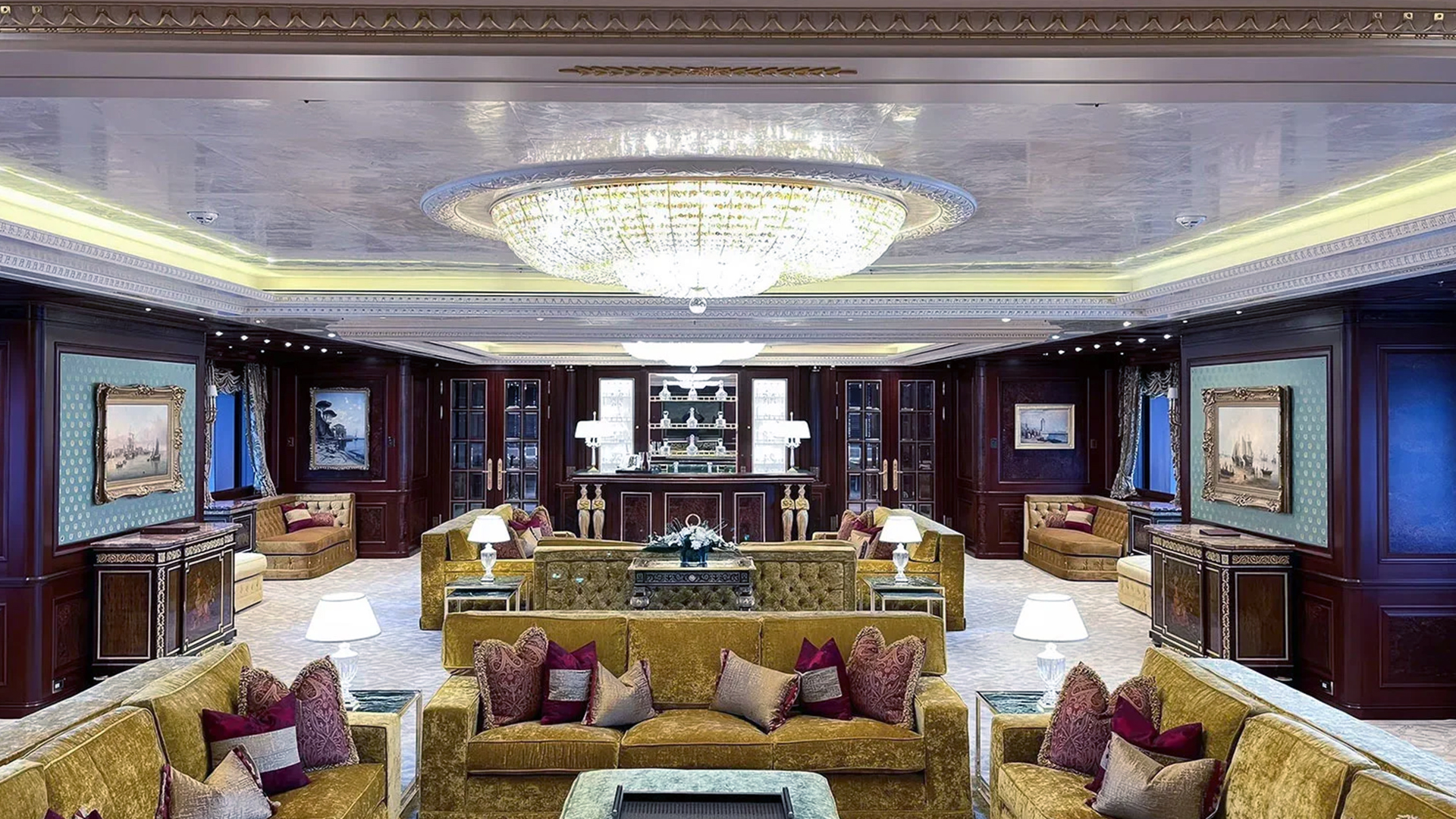
For years, the inside of Black Pearl was the best-kept secret on the water. Owner Oleg Burlakov banned interior photography during his lifetime, and the rumors that filled the vacuum tended toward the operatic. Charter access has since changed that, and the interiors — designed by Nuvolari Lenard in collaboration with Villate Design, with input from Ken Freivokh — have been described by the team as a tribute to the neoclassical idiom of Louis XVI.
The vocabulary is precise rather than ostentatious: ornate woodwork in rich mahogany, hand-laid silk carpets, restrained gold accents, marble flooring kept warm by underfloor heating throughout most of the public spaces. A nineteenth-century French piano, an extensive curated art collection, shell doors that open from the formal dining room onto private balconies. It is, in design terms, a deliberate counter-program to the brutal modernism of the exterior — an interior tuned for evenings in a vessel built around days at sea.
A yacht born out of technological research.
Ken Freivokh · On the Black Pearl briefA vessel kept in the eye
A beach club under a sky of stars
The full-beam beach club on the lower deck is the most theatrical room on board, and the most specific. Its ceiling is finished in fiber-optic LEDs arranged to replicate the constellations as they appeared above Rotterdam on the night Black Pearl was launched — a private piece of celestial cartography that reads as wallpaper until you actually look at it. The space transforms across the day: a wellness suite with sauna, hammam, massage room and gym; an evening lounge; and, with terrace doors that drop open onto the sea, an entirely separate room when the yacht is at anchor.
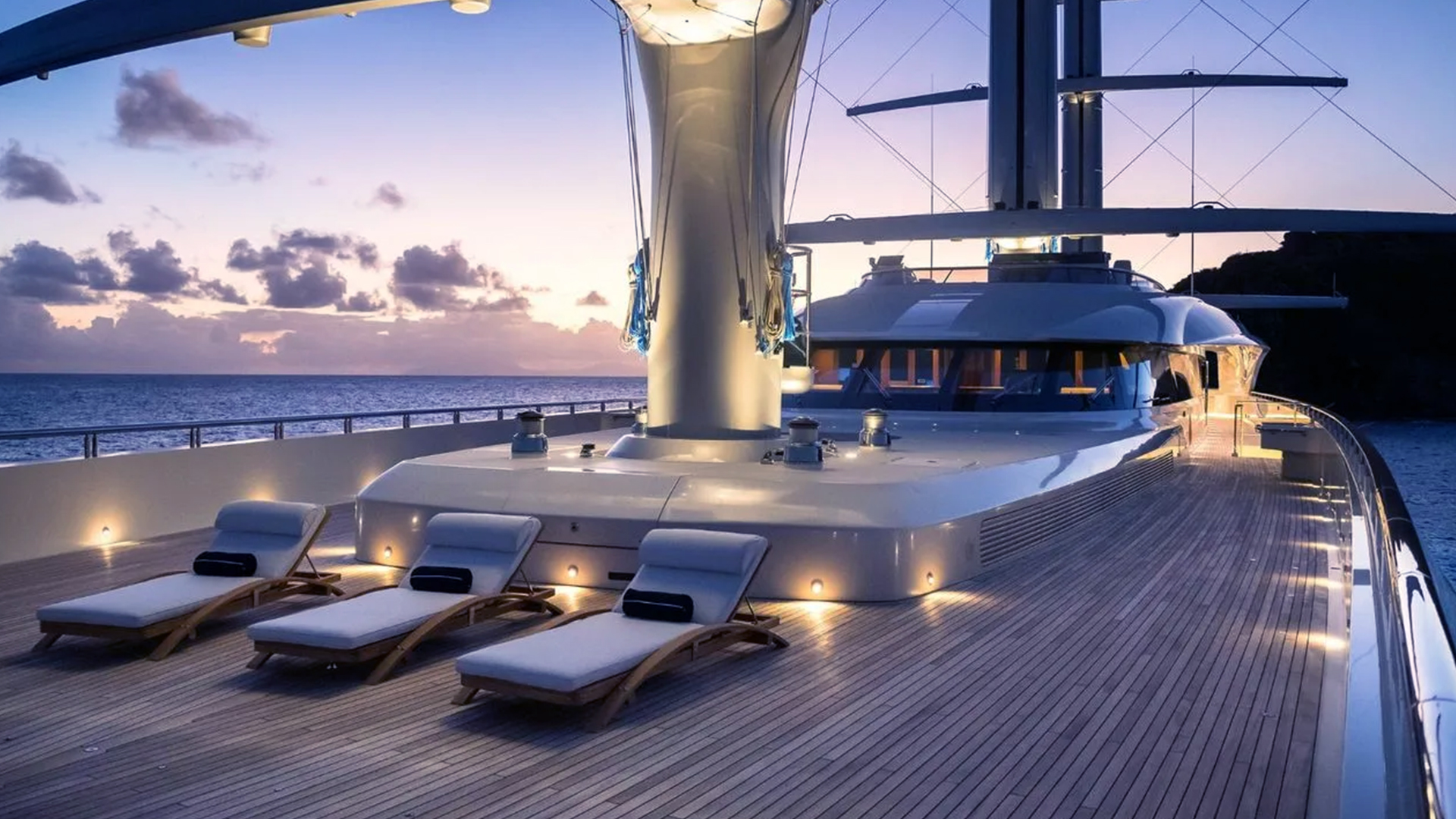
On the upper deck, the mizzen mast carries the largest exterior cinema screen ever fitted to a yacht — a 14-by-9-meter installation that turns the flybridge into an open-air theater after sundown. Forward, an on-deck jacuzzi looks over the bow. Below, a temperature-controlled wine cellar holds a curated collection alongside a tasting room; figures cited in various accounts range from 400 to 4,000 bottles, depending on whether the count includes spirits and the dedicated reserve. Either way, it is a room drawn for evenings ashore that the yacht is no longer planning to take.
Beyond the principal master, the lower deck carries four further guest cabins — two VIP, one double, one twin, with two convertible configurations — for a total of twelve guests across seven sleeping spaces. The crew complement of twenty-seven runs the vessel and the program. A motorized crow's nest, a jet-stream pool whose floor lifts to convert into a dance floor, a tender garage on the foredeck for a custom 10-meter Pascoe limousine tender, and bulwarks that fold down to form a touch-and-go helipad complete the program.
At a glance
Black Pearl, in context
She won the World Superyacht Awards' top sailing trophy in 2019 — Sailing Yacht of the Year — along with Best Naval Architecture for sailing yachts at the Boat International Design & Innovation Awards. The accolades are useful shorthand, but they undersell what the vessel actually represents. The yacht's owner died in 2021 without seeing her enter the charter market; that happened in late 2024, the moment at which the interiors finally became visible to the public for the first time.
In the years since her delivery, Black Pearl has done what genuinely consequential vessels tend to do: she has produced descendants. Jeff Bezos's 127-meter Koru — launched by Oceanco in 2023 — is in significant part the next step in the conversation Black Pearl started, drawing on the same shipyard and aspects of the same engineering grammar. The DynaRig system itself, once a curiosity, is now the reference platform for any serious large sailing yacht project.
What sets her apart, still, is the discipline of the original brief. Black Pearl was not built to be the biggest or the most ornamented; she was built to prove that scale, silence and sustainability could be drawn into the same hull. The fact that she is also one of the most arresting silhouettes on the water — three black masts on a black hull, slicing through the chop with no audible engine — is, in a sense, a consequence of that brief rather than its goal. The Black Pearl, to use a phrase her own designers permit themselves, is unlike any yacht the world has ever seen.
A 106.7-meter sailing yacht drawn around the wind, drawn against the diesel, and drawn from a brief that read more like a research grant than a yacht commission — the second-largest sailing vessel afloat, and the largest argument the industry has yet made for what one ought to be.