




The Sea,
Brought Aboard
Benetti's Oasis 34M is the calibrated translation of a larger concept into a 34.36-metre hull — a tri-deck displacement yacht in which the architecture of the aft deck quietly rewrites the relationship between salon and sea.
Most yachts of this size offer a beach club. The Oasis 34M, in a quietly radical move, refuses the noun. What it offers instead is a piece of architecture — an aft deck that opens, drops to the waterline and dissolves the wall between interior and ocean — which the shipyard insists on calling a deck, because that is what it is.
Benetti has been building displacement yachts in Viareggio since the nineteenth century, and over the last decade the Italian yard has used the Oasis name to articulate something specific: a way of organising the stern of a yacht so that the boat's social centre of gravity sits at the water rather than above it. The original Oasis 40M proved the thesis. The Oasis 34M, designed by RWD with interiors by the New York studio Bonetti / Kozerski Architecture, is the more demanding exercise — the same idea condensed into a 34.36-metre hull without losing its proportions or its conviction.
The result was recognised quickly. In February 2023, the model took Best New Series at the Boat International Design & Innovation Awards. Three months later, the lead hull Unknown won her category at the World Superyacht Awards in Istanbul. Two awards from the same editorial body, in the same year, for the same naval object — the kind of double endorsement that rarely happens by accident, and which positioned the Oasis 34M as the displacement tri-deck of its generation.
What follows is not a survey of features. The 34M has plenty — five suites, an owner's stateroom on the main deck with full-height glazing, a fly bridge with hardtop dining and an upper-deck salon. But the yacht's interest lies elsewhere, in a single design decision held with unusual discipline across three decks. The shipyard built a 112-foot motor yacht around the conviction that the most valuable square metres on a tri-deck are the ones closest to the sea.
A Boat International jury described the model as a ground-breaking yacht that fits extraordinary features into its compact size — a verdict echoed three months later when the first hull also won at the World Superyacht Awards.Boat International · World Superyacht Awards 2023
A 112-foot hull built around one idea
The conventional displacement tri-deck stacks its volumes vertically: engine spaces below, guest accommodation in the middle, social areas above. Movement on board is upward — through the salon, up to the flybridge, down to the beach club only at anchor and only briefly. The Oasis line inverts the gravity. Its proposition is that the lowest deck — the one closest to the water — should be the most generous, the most social, and the most consequential.
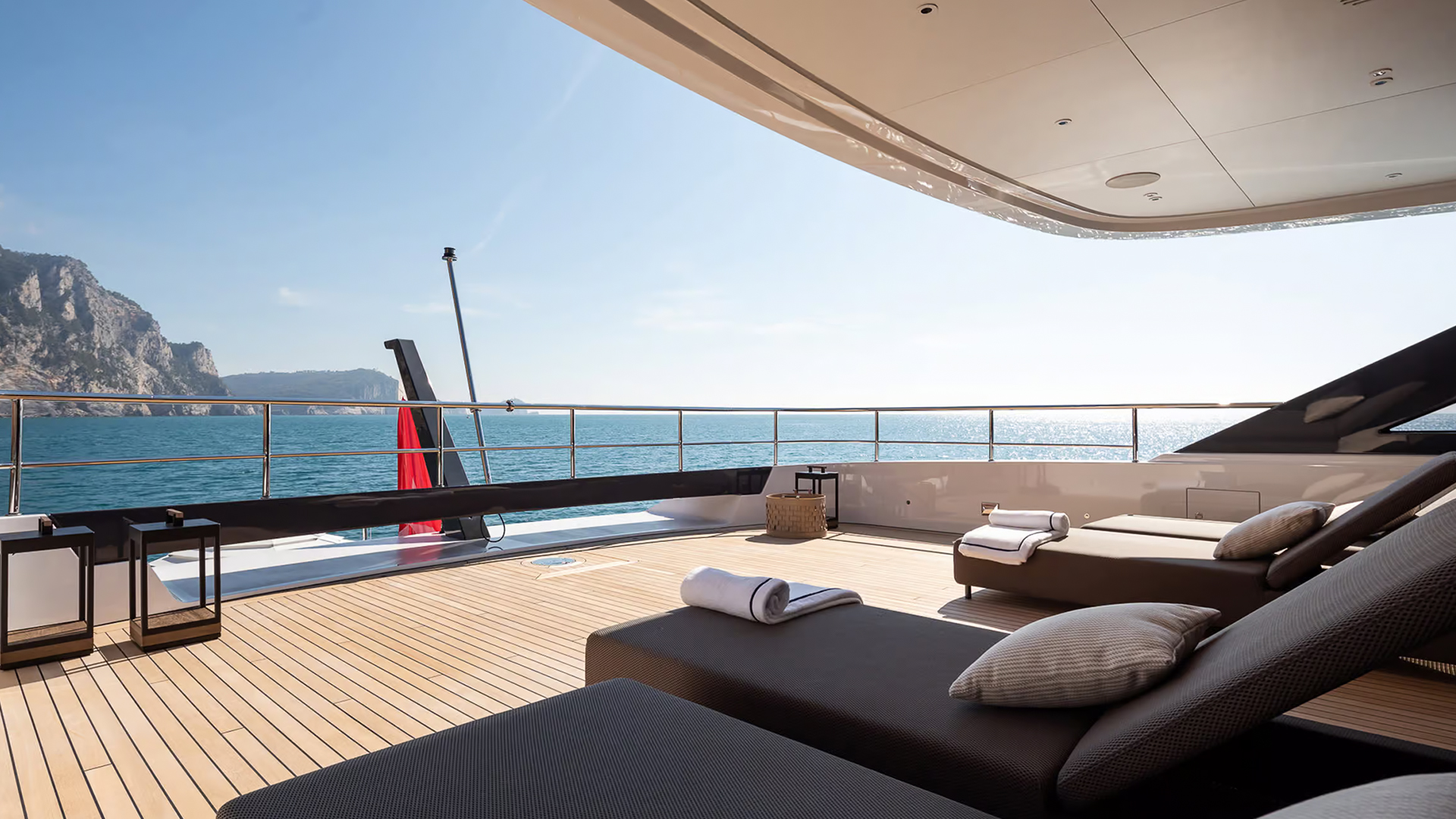
On the 34M, this argument is made by three architectural moves operating in concert. The first is the Oasis Deck itself: a low aft platform whose port and starboard bulwarks are not bulwarks at all, but folding wings hinged outward. With them open, the deck spreads to roughly seventy-six square metres of usable surface, edged on three sides by water. With them closed, the same surface contracts back into a conventional aft deck capable of being driven into a confused sea without complaint.
The second move is the integrated infinity pool, sunk into the centre of that deck rather than perched on a sundeck above. The decision is editorial as much as technical: it places the water — the actual swimmable water — where the social life of the boat already lives, eliminating the migration between "lounge area" and "swimming area" that organises most yachts in this segment.
The third is the retractable glass separating the main salon from the cockpit. Curved sliding doors fold open along the entire stern beam, dissolving the threshold. From a sofa inside the salon, the view runs uninterrupted across the dining area, across the cockpit, across the Oasis Deck, to the wake. Benetti reports the resulting visual sweep at roughly 270 degrees — a number that sounds promotional until one stands inside the salon and counts the angles.
How the Oasis Deck reorganises the stern
A simplified flow of the architectural decisions that turn a conventional aft platform into a continuum with the sea.
The aft deck, conceived as a stage.
Not the residual space behind the salon, but the architectural protagonist of the yacht. Every other decision on board accommodates this premise.
Underway · sea-keeping mode.
The boat is at speed. The deck's social ambitions yield to its naval ones. The wings are folded into bulwarks; the pool sits flush; the geometry is conventional.
At anchor · transformation mode.
The yacht is stationary. The deck is free to become what it was designed to be — a piece of architecture rather than a piece of seamanship.
Wings closed.
The conservative configuration. Useful in a confused sea or when leaving port: the deck contracts to its travelling footprint, ready for the next passage.
Wings open.
The signature configuration. The deck spreads to roughly seventy-six square metres, the infinity pool sits at its centre, the sea is one step away on three sides.
Salon doors retracted.
The most radical configuration. Curved sliding glass disappears along the stern beam; the dining table, the lounge, the deck and the wake become one continuous room.
From foredeck dawn to dinner aft
The boat is designed to be moved through. A representative twenty-four hours, traced across the three decks.
The Oasis 34M, in four registers
Four scenes, one yacht. Each deck argues for the same idea in a different vocabulary — water, table, sky, suite.
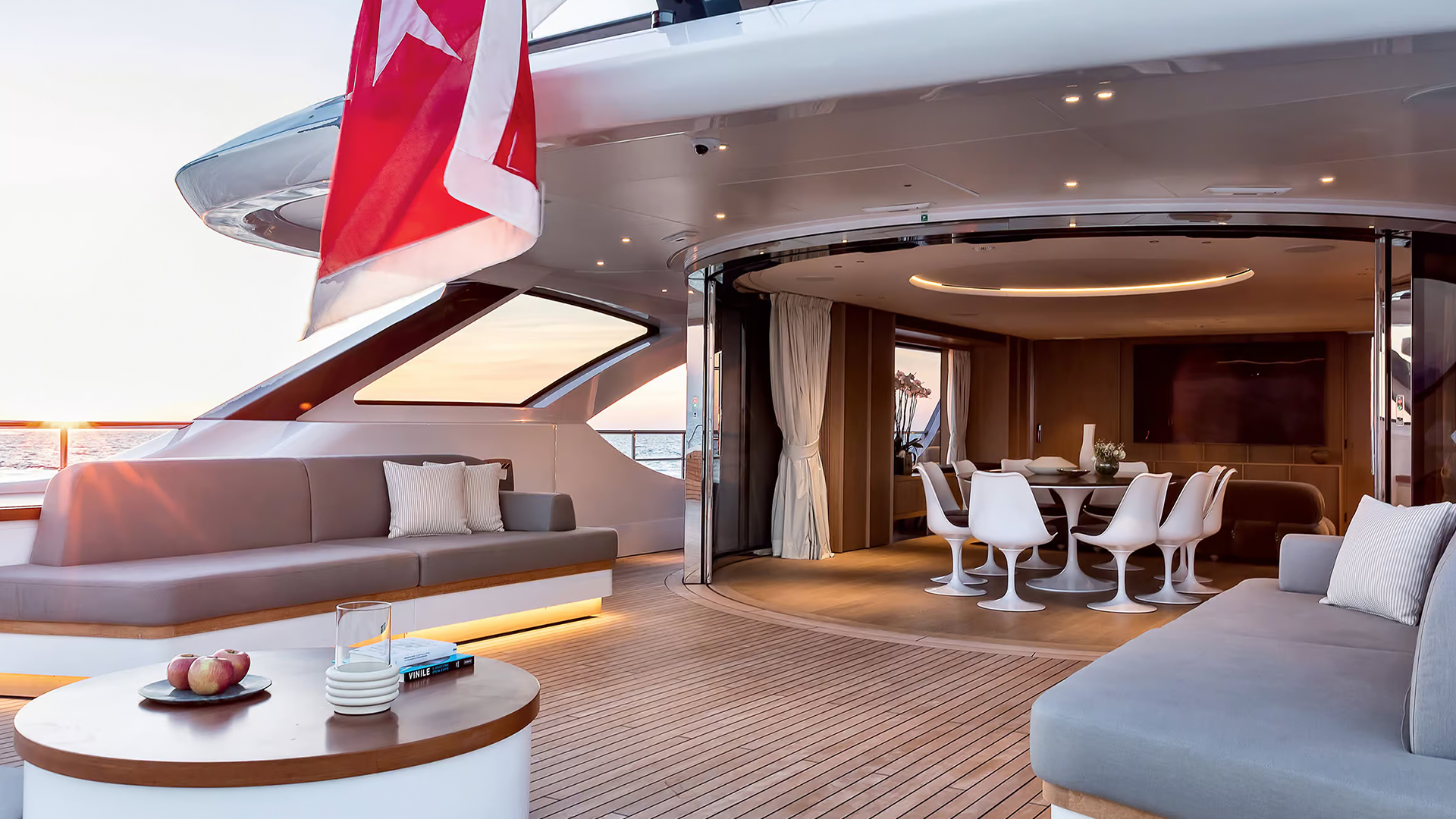
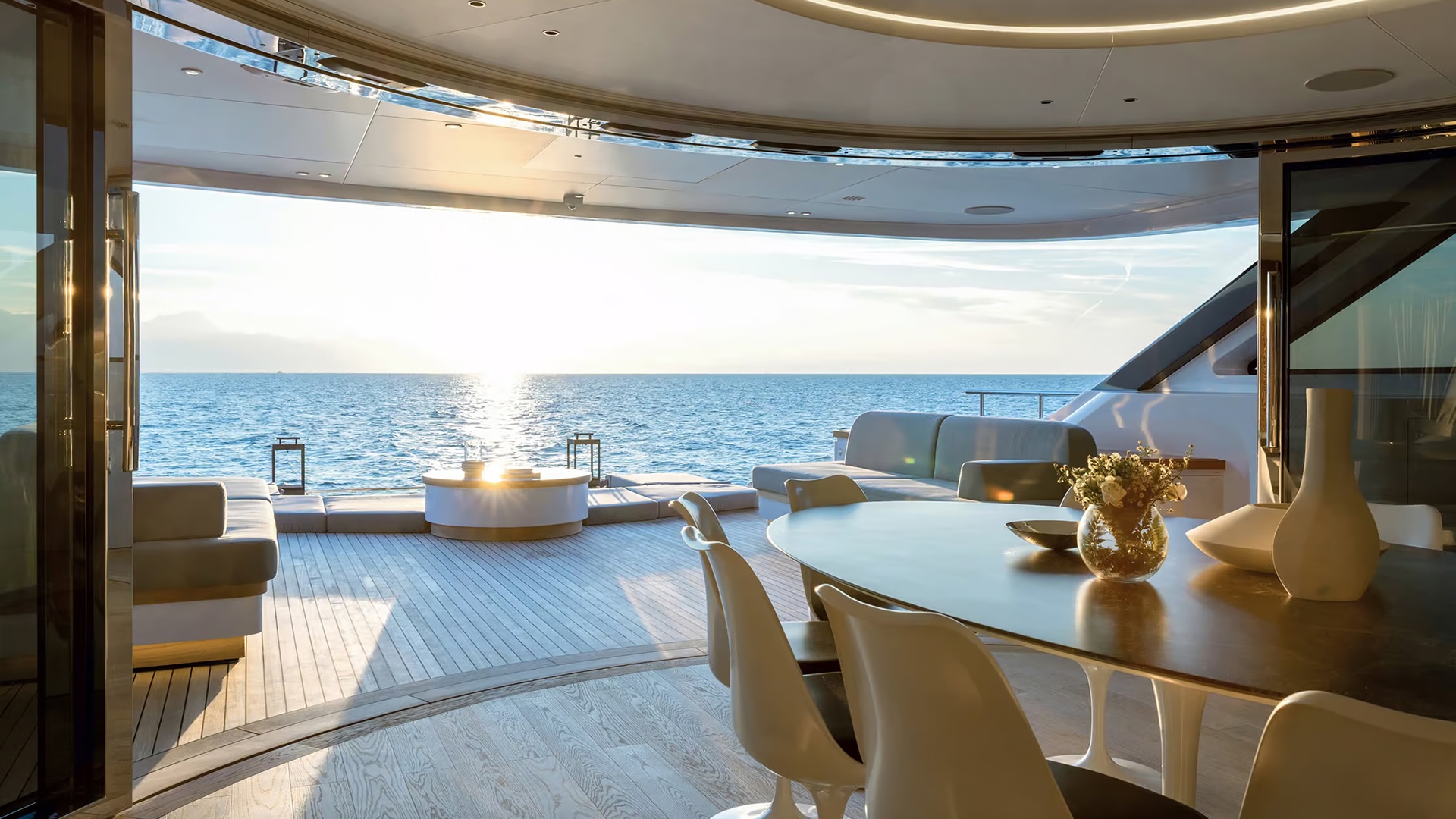
The aft deck, at the water
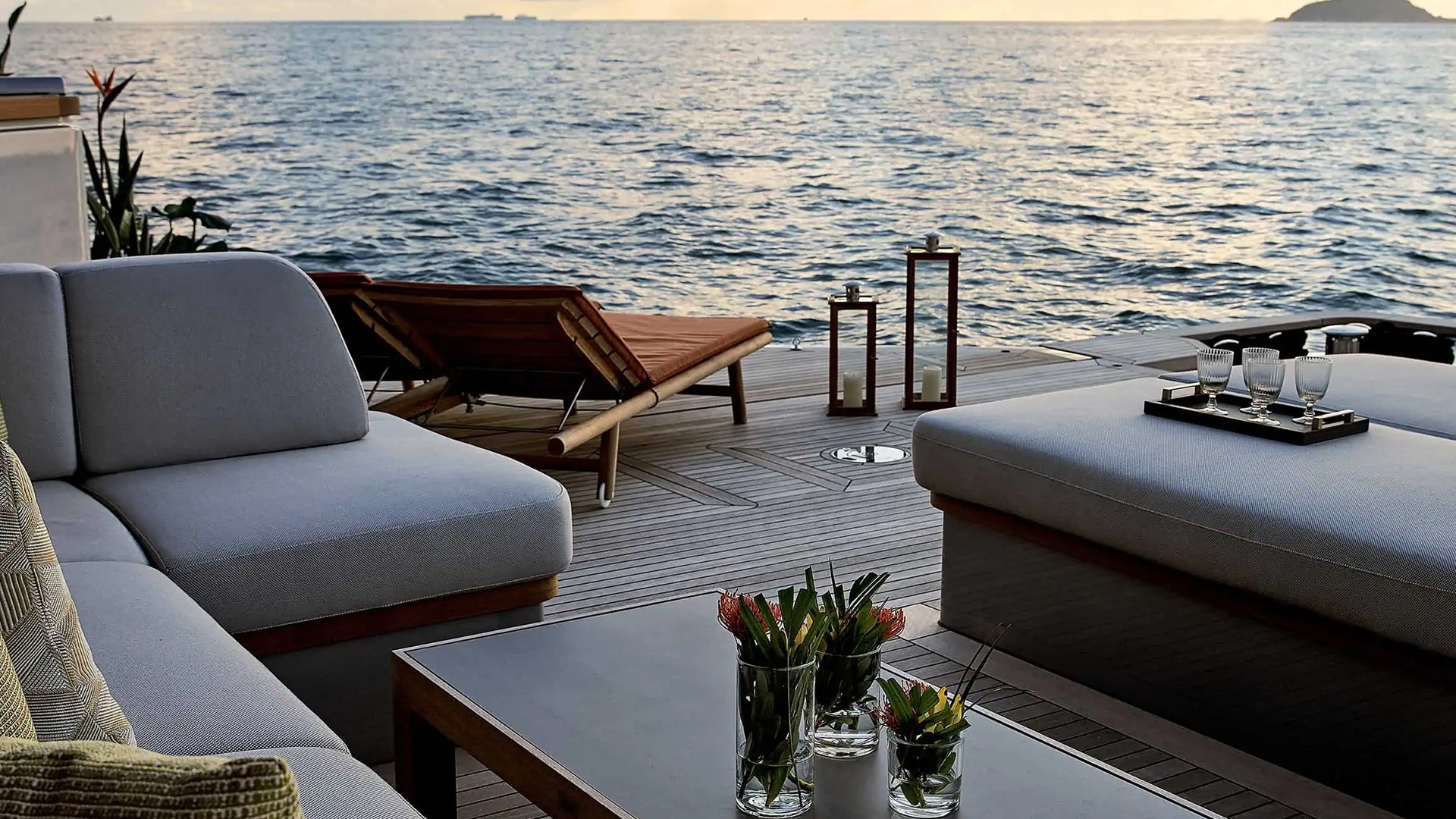
The Oasis Deck in social configuration: lounge seating set within the deck's open footprint, the sea visible at the same level as the cushions. The line between hull and ocean is, deliberately, the lowest point on the yacht.
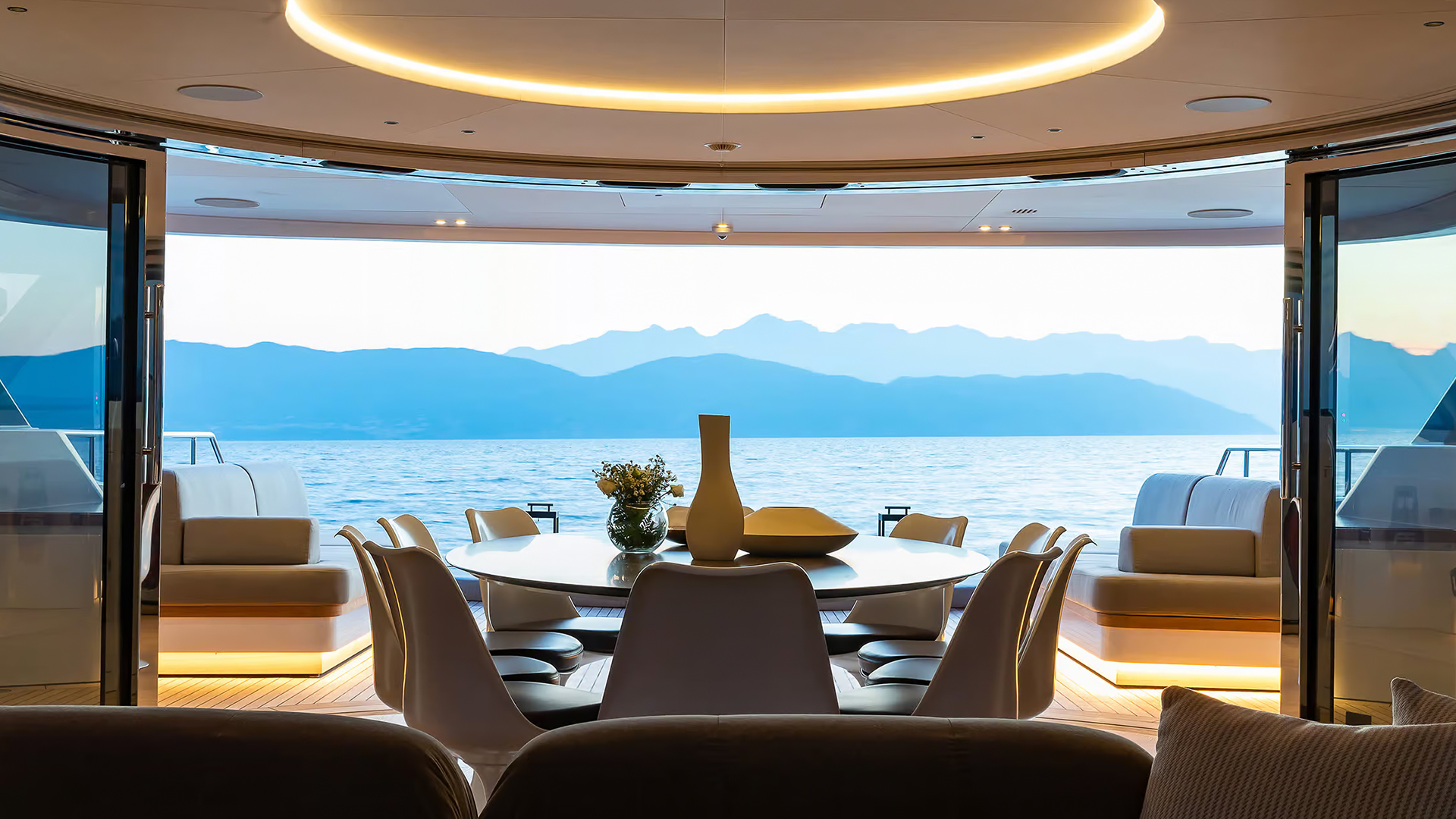
The dining room, without walls
The main salon's dining area, with the curved doors fully drawn back. The threshold is a strip of teak. Bonetti / Kozerski's restraint — pale woods, a pastel palette, almost no decorative weight — keeps the eye on the landscape beyond.
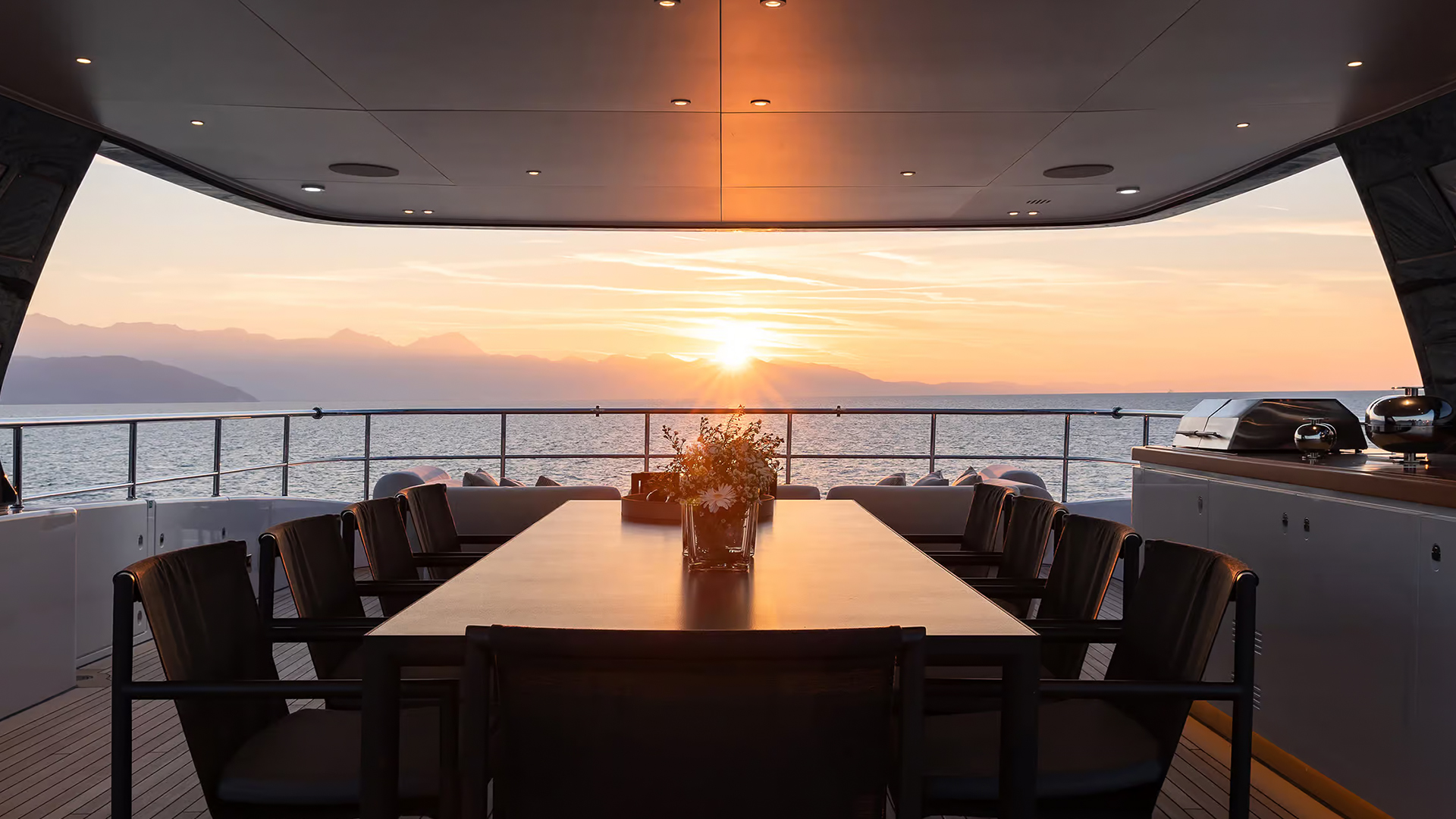
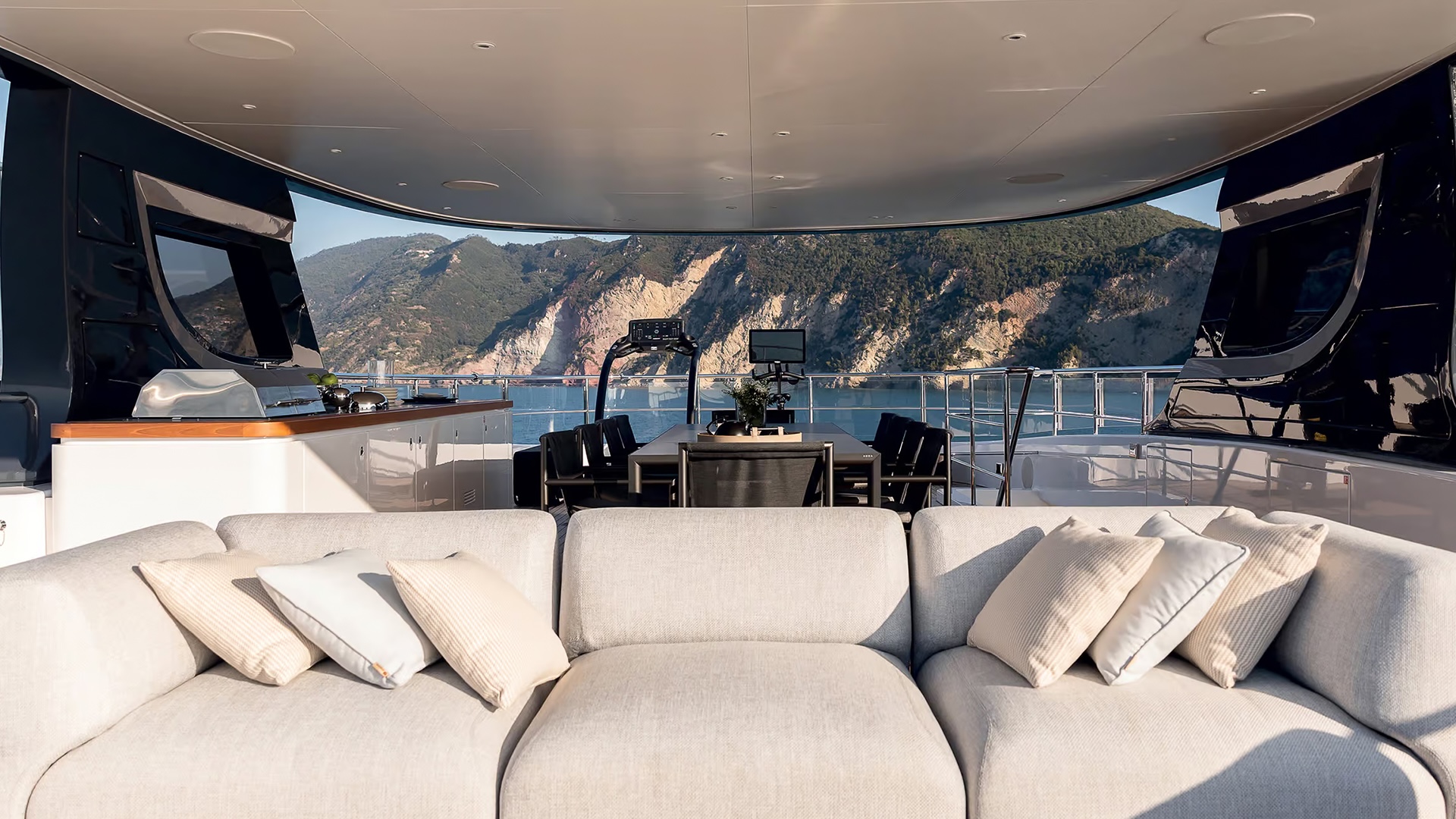
The flybridge, under hardtop
The upper deck offers the yacht's second social centre: dining under a fixed hardtop, the bar within reach, the lounge sliding into shade. With the wheelhouse placed forward, the central flybridge is wholly given over to guests.
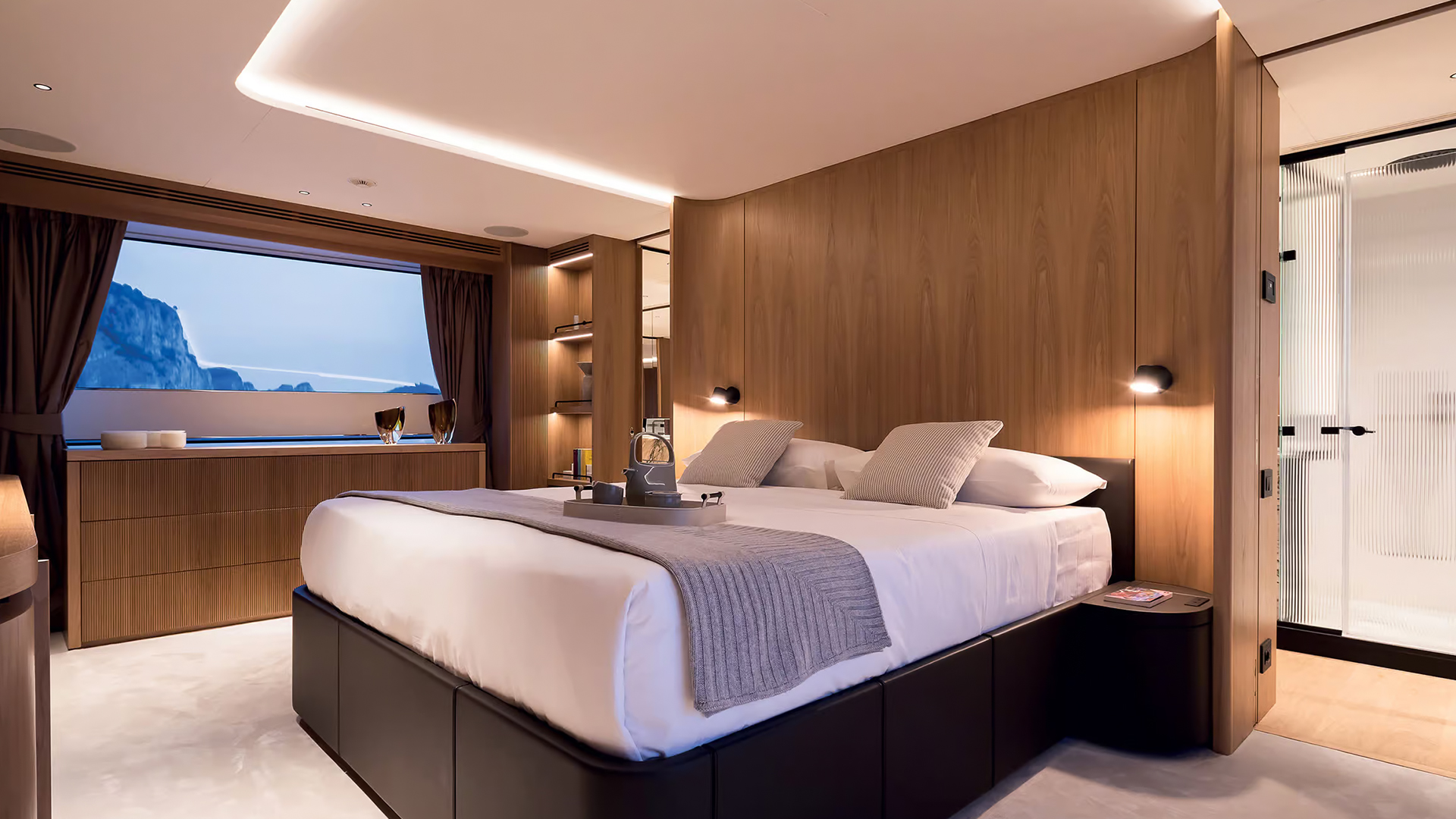
The owner's suite, full beam
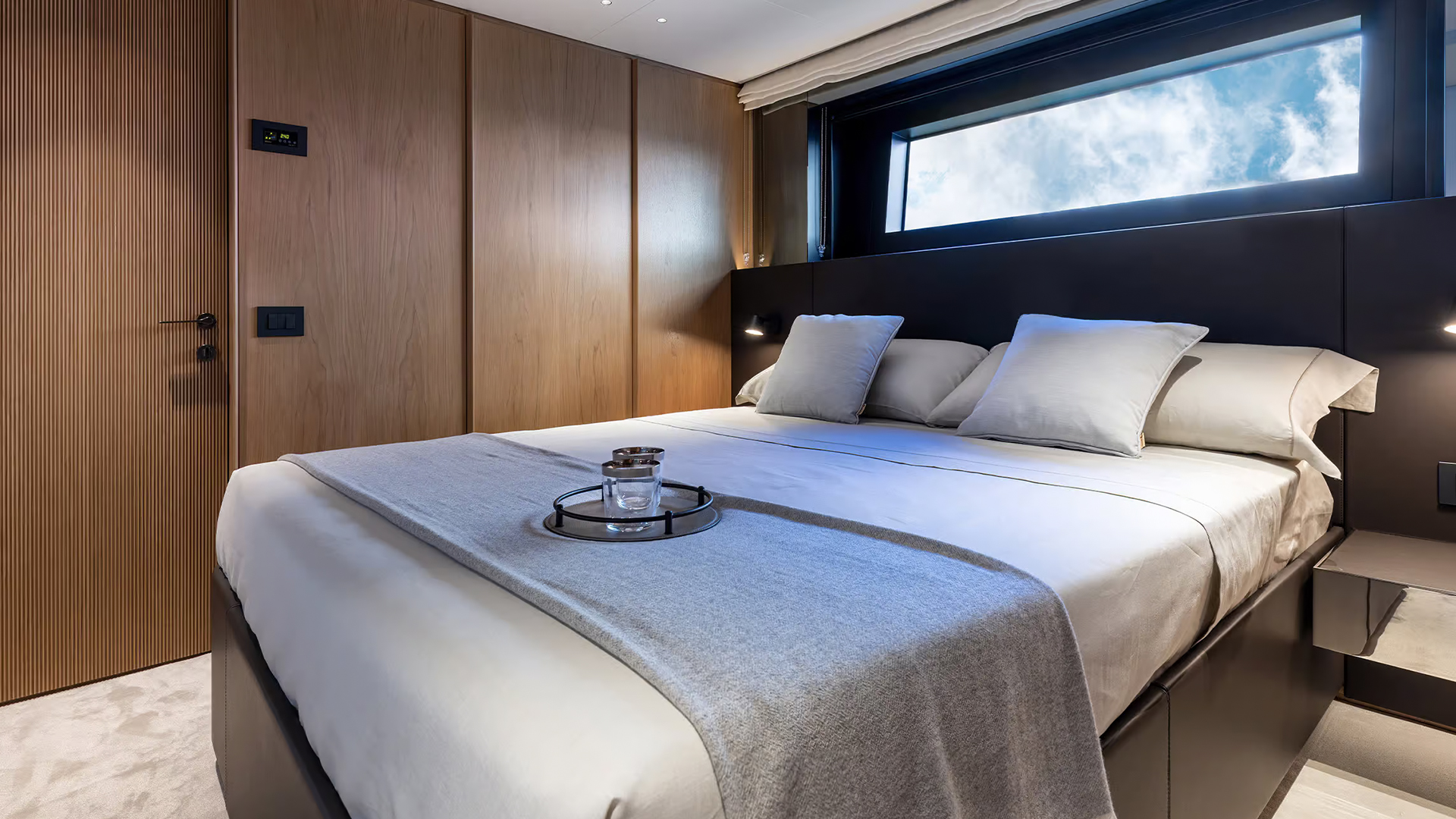
Forward on the main deck, with floor-to-ceiling glazing on both sides and a bath spanning the entire seven-and-a-half-metre beam. Materials and fittings track those used elsewhere on board — a coherent vocabulary, not a hierarchy of finishes.
A ground-breaking yacht that fits extraordinary features into its compact size.
Boat International Jury · World Superyacht Awards 2023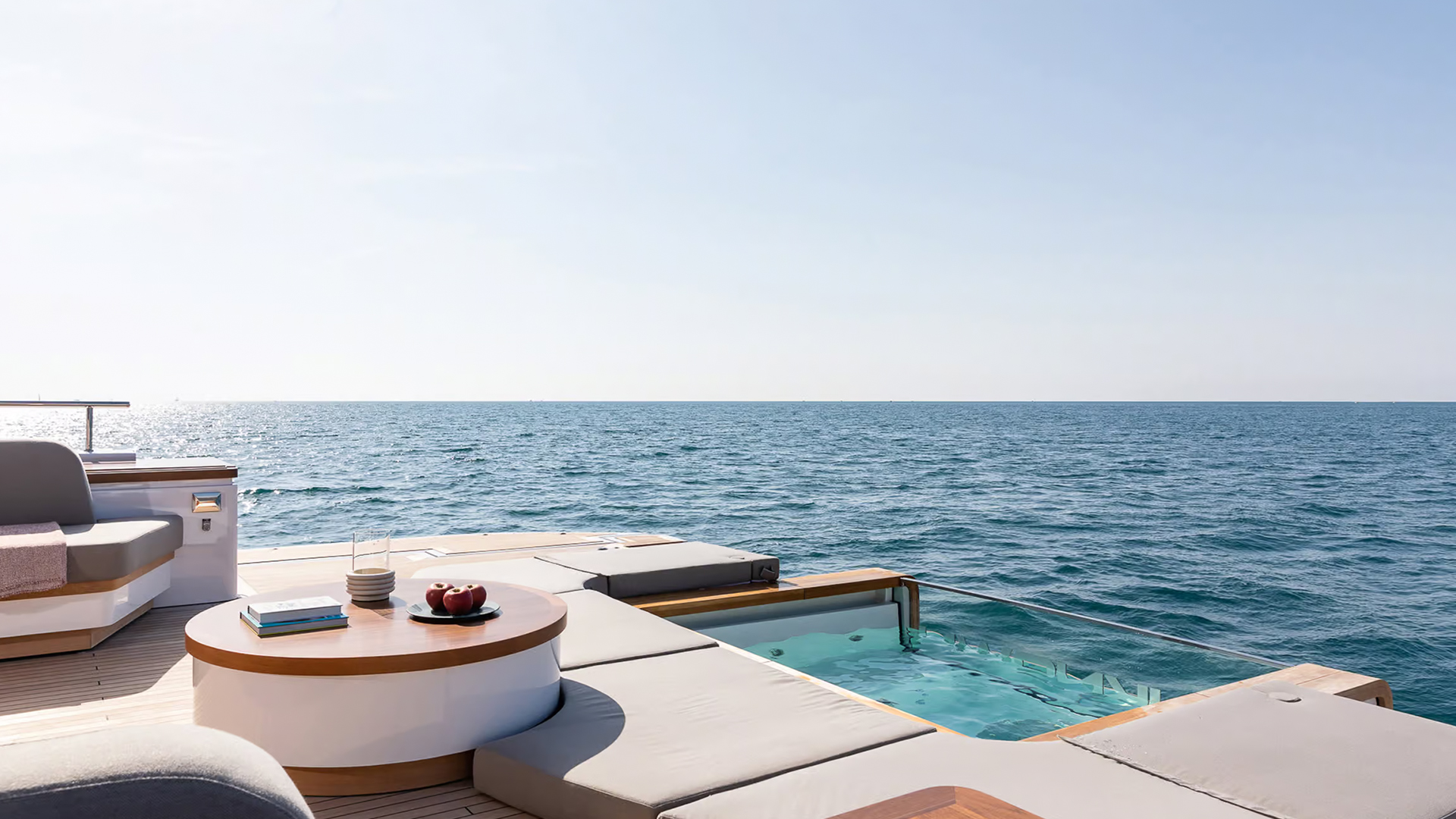
A yacht measured in two
different vocabularies
A boat in this segment is described, almost by reflex, in the language of metrics: length overall, beam, gross tonnage, fuel capacity, cruising speed, range. The Oasis 34M absorbs that vocabulary cleanly. She is 34.36 metres long, 7.7 wide, draws roughly 2 metres at full load, and carries a gross tonnage in the high two hundreds. Her two MTU engines deliver 1,380 horsepower each; she cruises at fourteen-and-a-half knots and reaches sixteen at her ceiling. Her 25,000-litre fuel tanks support a 2,700-nautical-mile range at the displacement speed Benetti recommends.
All of which is verifiable, useful, and ultimately insufficient. The numbers describe a hull. They describe the carbon-fibre superstructure resting on a GRP displacement form, the RINA classification, the seven crew quarters, the five guest staterooms. What they do not describe is the editorial decision the yacht is built around — the one the Boat International jury was paying for when they handed the model two awards in the same year.
That decision is legible only when the yacht stops moving. It surfaces the moment the wings open, the pool flushes into the deck, the salon doors retract along the stern beam, and what was a tri-deck motor yacht becomes a piece of waterside architecture. The 34M's significance, in other words, is not what the spec sheet records but what the spec sheet cannot.
Two ways of measuring the same yacht
A comparative ledger. The numbers on one side, the architectural decisions on the other. Both are honest; only one tells you what owning the boat is like.
The Oasis 34M, in three registers
Performance, accommodation, critical reception. The verifiable record, organised by domain.
The smaller sister of a successful series is, almost always, a compromise. The 34M, on the evidence of the past three years, is the rarer thing — an exercise in condensation that retains the original idea without diluting it. What it offers in 34 metres is what the Oasis line has always offered: the sea, brought aboard.
USA Onboard · Yacht ProfileFeature Desk
Benetti · P.L.A.N.A.
Image Library