



Nighttime Navigation
An ocean that fades into a single tone, lights that mean things, distances that no longer behave. A working guide to the hours when the water teaches everyone to look twice.
A boat at night becomes a different boat. Distances stretch and contract, color disappears from the water, and the world is reduced to a small constellation of lights whose meanings are not optional. Boating after sunset rewards the prepared and humbles everyone else. The discipline is not difficult, but it is unforgiving of improvisation.
Open water at night is, paradoxically, the easier piece. With calm weather and sea room, there is little to see beyond the lights of distant vessels and the periodic flash of a buoy or tower; the eye learns to track sparse, identifiable targets and the mind has time to interpret them. Coastal water is the difficult piece. Bays, channels, and approaches concentrate traffic, hide depth changes, and crowd the field of view with shore lights that compete with every navigation aid. The closer to land, the more cognitive load the night demands.
Whatever the setting, preparation does most of the work before the engine starts. A clear distribution of duties on board, agreed in daylight, becomes useful within the first hour after sunset. Routes verified against the chart and not improvised, weather windows confirmed against the latest forecast, and contingencies discussed openly with the crew: these are not formalities. They are how a night passage stays uneventful. If the destination is unfamiliar, the prudent plan calculates departure so that the difficult sections, the entrance to a harbor or a narrow channel, are reached in daylight at one end of the trip.
What the dark actually changes
The eye works differently at night. Rod cells take over from cone cells, color vision collapses, and the area of sharp focus at the center of the retina becomes nearly useless. Peripheral vision becomes the better tool, which is why an experienced lookout scans by sweeping the eyes across a sector rather than fixing them on a single point. Full dark adaptation takes about twenty to thirty minutes. A glance at a bright white light resets the clock to zero. The cabin red-light convention that older cruisers still favor is not nostalgia; it is the only artificial light that preserves the adaptation already built.
Distances become unreliable. A flashing buoy a mile away and the headlights of a car three miles inland can look comparable in apparent brightness, and the eye that has not been trained to read the differences will tend to overestimate the closeness of strong lights and underestimate the closeness of weak ones. The corrective is not intuition. It is the radar, the chartplotter, and the persistent habit of confirming what the eye thinks it sees against what the instruments can measure.
Full night vision takes twenty to thirty minutes to develop. A single flash of a bright white light, on a phone screen, a deck light, or a passing flashlight, resets it almost completely. Red light preserves it; dimmed instrument displays preserve it; everything else costs you the night.
Sound, on the other hand, gains. Without the daytime traffic of voices and engines from shore, a boat under power at night can be heard from much farther away, and the noise of the boat itself can mask the audible signals of approaching vessels. Mariners who run at night learn to throttle back occasionally and listen, especially in restricted visibility. A bell at anchor, a horn from a fog signal, the low grumble of a distant displacement engine: each is information the night gives back if the engine room is briefly quieted.
Reading lights, not landscapes
After dark, navigation collapses into the language of lights. Channel buoys, lighthouses, range markers, anchored vessels, vessels underway: each one carries an identifier built into its color and the cadence of its flash. The chart calls them out by abbreviation. Fl R 4s means flashes red every four seconds. Q G means quick-flashing green. Mo (A) W means a white light cycling the Morse letter A. None of these are decorative. Each is the same buoy described twice, once on the page and once on the water, with the cadence as the password.
The first job of the lookout is to match the two. A flashing light to starboard becomes useful only when it is identified on the chart, located in the expected position, and confirmed by a few full flash cycles. Approaching a strange harbor by night, the experienced approach is patient: ease off the throttle, count seconds with a watch, and verify before committing the boat to a turn. Misidentifying a buoy at speed is one of the most common ways a competent boater ends a passage on a rock.
Other vessels are read the same way, and the language is codified. The international rules of the road, COLREGS, prescribe the configuration of navigation lights for every category of vessel underway: a powerboat shows a forward white masthead light, red and green sidelights at port and starboard, and a white sternlight. A sailboat under sail shows the sidelights and sternlight without the masthead, and may also use a single tricolor at the masthead in lieu of separates if under twenty meters. A vessel at anchor shows a single all-round white light. The geometry of those lights, seen from across a mile of dark water, tells a boater the type, size, and direction of the other vessel before the eye can resolve a hull.
Four common cadences.
Match each one to the chart.
I
Fl
Flashing
A single flash per cycle, period stated in seconds. Fl R 4s is a red flash every four seconds. The most common cadence on U.S. buoys.
II
Q
Quick-flashing
Sixty flashes per minute, no break. Q G typically marks channel edges where attention is critical. Often used on preferred-channel or tight-bend buoys.
III
Iso
Isophase
Equal periods of light and dark. Often used on safe-water marks and fairway entrances. The light is on as long as it is off.
IV
Mo (A)
Morse A · short-long
A Morse-letter cadence, typically white, signaling a safe-water mark or an offshore landfall. Reads as a dot followed by a dash, repeating.
“
A light without a cadence is just a light. The pattern, not the color, is what tells you which buoy is in front of you.
Field Note · USA Onboard Editorial
The case for instruments
Night is when the instrument panel earns its keep. A GPS coupled with a chartplotter shows position, course over ground, and speed; the same plotter overlays the route, every charted hazard, and the buoys whose flashes the lookout is trying to identify. A modern unit also accepts AIS targets, the digital broadcast that commercial traffic and many recreational vessels use to announce their identity, position, course, and speed to anyone listening. AIS does not replace eyes on the water, but at night it converts the dim white lights of distant shipping into named, tracked targets with closing-point projections.
Radar is the instrument that most rewards night use. Where the eye sees only a flash and an indistinct shape, radar shows a return, a bearing, a range, and a track. The screen separates landmasses from vessels, identifies the rain band that the eye cannot see, and resolves a small boat against the clutter of a busy anchorage. Reading a radar takes practice. The screen needs to be tuned for gain and clutter; targets need to be acquired and watched for change; the difference between a stationary echo and a moving boat needs to be learned by use, not from a manual. A radar set powered up for the first time at midnight, twelve miles offshore, is too late.
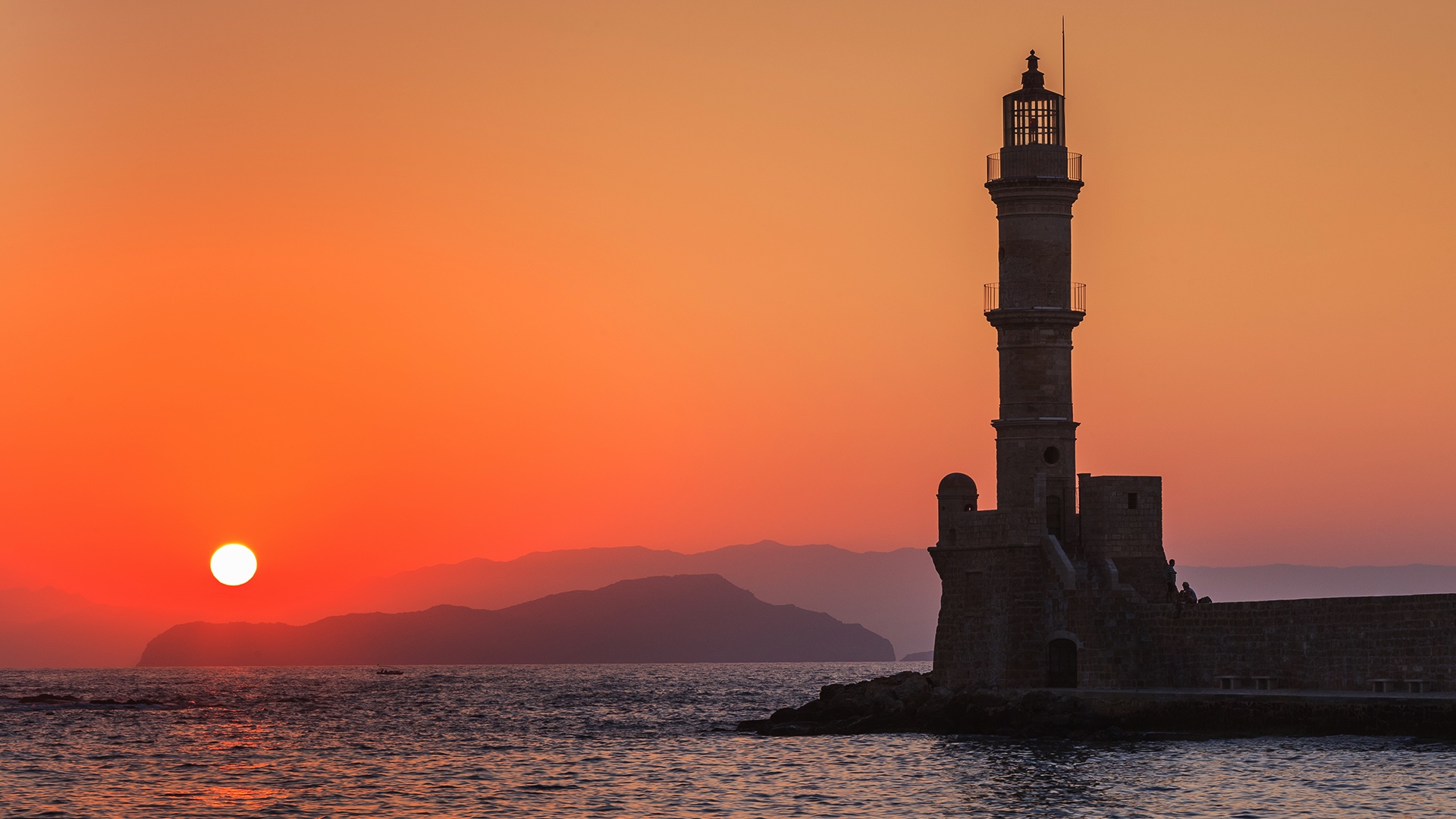
Two more instruments deserve a mention. A reliable magnetic compass remains the backup for everything that can fail, and the only reference that works without power. A depth sounder, ignored on most clear daylight passages, becomes essential after dark: a sudden shoaling on the display is often the first warning of an unmapped sandbar or an error in position fix. The instruments together replace the eye that the night has taken away. None of them lead. All of them confirm.
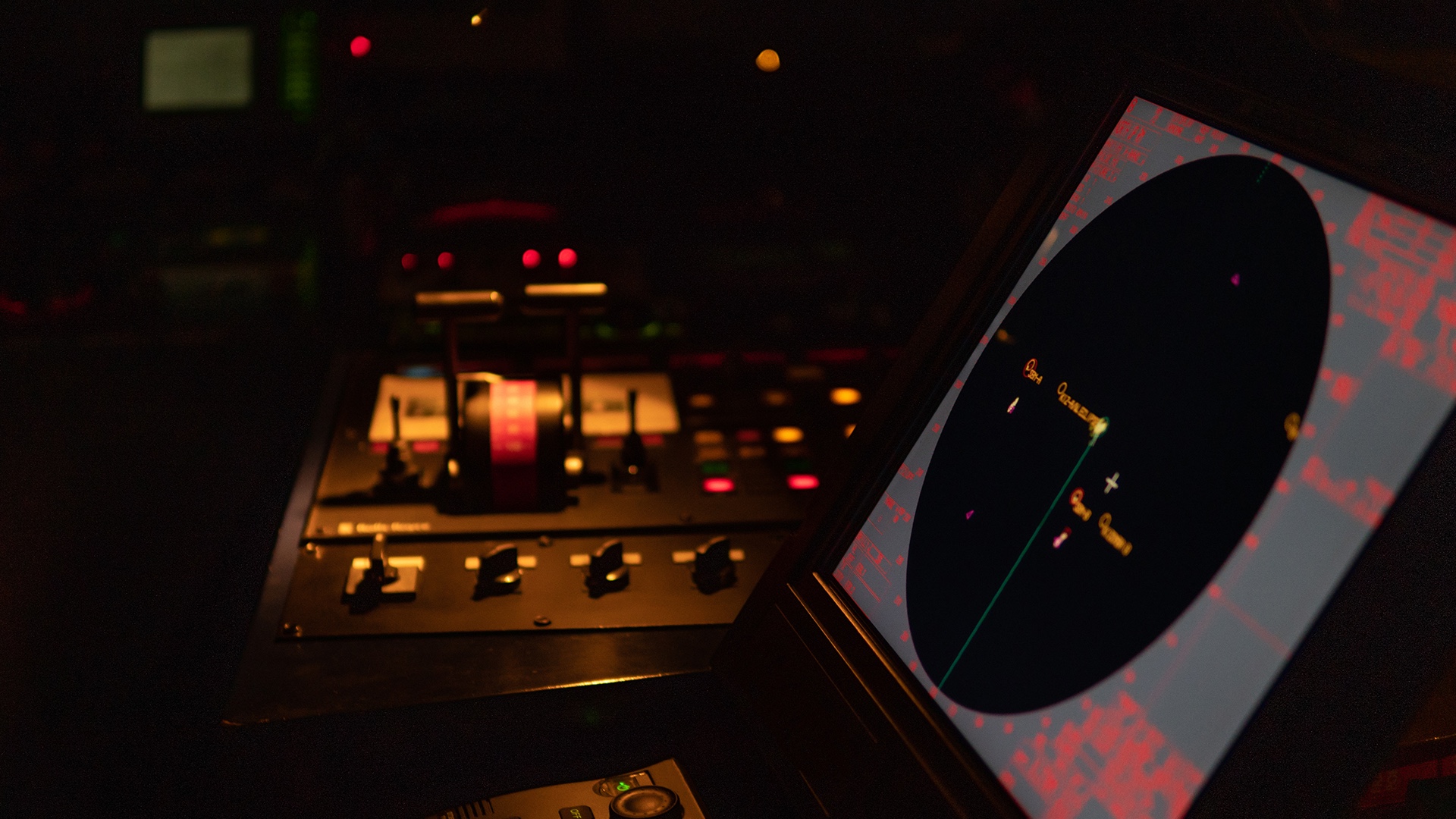
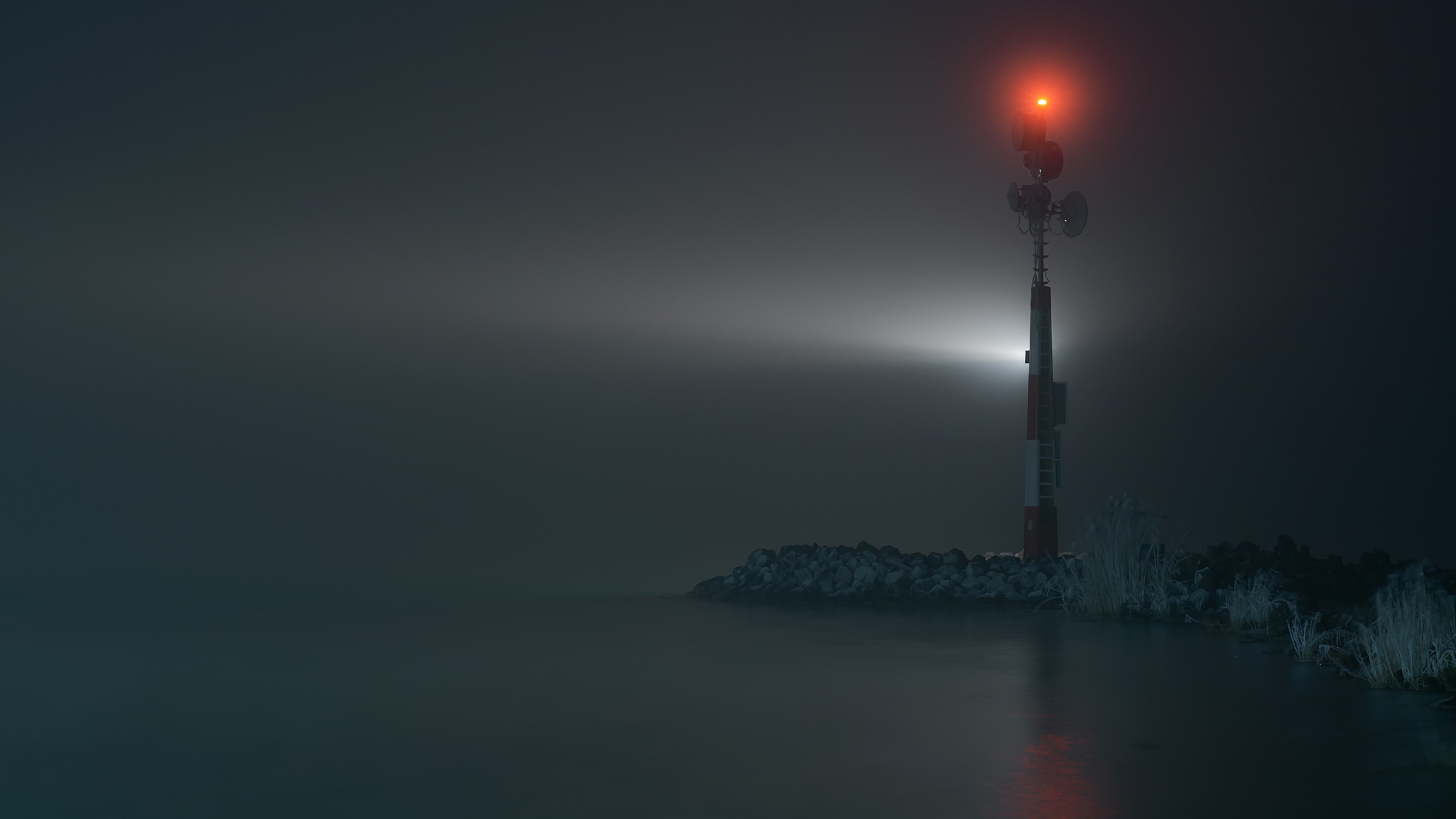
Radar at the interior helm At night, the screen sees what the eye cannot, and earns the seat at the wheel.
Visibility, both ways
A boat at night has two visibility problems, and they are different. Outbound visibility, the lookout's ability to see the water, depends on dark adaptation and on the discipline of keeping unnecessary white light off the boat. Inbound visibility, the ability of other vessels to see you, depends entirely on the navigation lights working as the rules of the road require. Both are fragile. Both fail quietly.
Before sunset, the navigation lights deserve a full check on the dock. Each bulb on, each fuse intact, each lens clean and properly oriented. A masthead light that points slightly off centerline reduces the arc that other vessels can see, and a sidelight obscured by a cockpit fender or a stacked headsail vanishes from the angle it is supposed to mark. Once underway, a single passing vessel asking where is your starboard light? over the radio is a small humiliation easily avoided.
Interior lighting is the second part of the same problem. Bright cabin lights spilling through windows or hatches destroy the helm's night vision and announce the boat as a smear of glow rather than a set of discrete navigation lights. The solution is to dim everything not essential, switch instrument displays to night mode, and reserve the red cabin lights for chart consultation. A handheld spotlight kept at the helm is the right tool for the moments when full white light is genuinely needed: identifying a marker at close range, picking out a mooring ball, or warning a small unlit craft. Used briefly and pointed away from the helm, it does not cost the night.
Four configurations.
The lights tell you the type, the size, the direction.
Rule 23
Power-driven underway
Masthead · Sidelights · Sternlight
A forward white masthead light visible from ahead and through 112.5 degrees each side; red port and green starboard sidelights; white sternlight covering the rear 135 degrees. The classic powerboat signature.
Rule 25
Sailing vessel under sail
Sidelights · Sternlight · No masthead
Sidelights and sternlight as for a powerboat, but the white masthead light is omitted. Under twenty meters, a single tricolor at the masthead is permitted in lieu of separates. Engine running converts the vessel to Rule 23.
Rule 30
At anchor
All-round white · One light
A single white light visible from all directions, mounted where it can best be seen. Under fifty meters, no additional anchor light is required; over fifty meters, a second one is added near the stern.
Rule 27
Restricted maneuverability
Red · White · Red · Vertical
Three all-round lights in a vertical line, red over white over red, identify a vessel constrained in her ability to maneuver. Common on tugs working, dredges, and survey vessels. Give them wide berth.
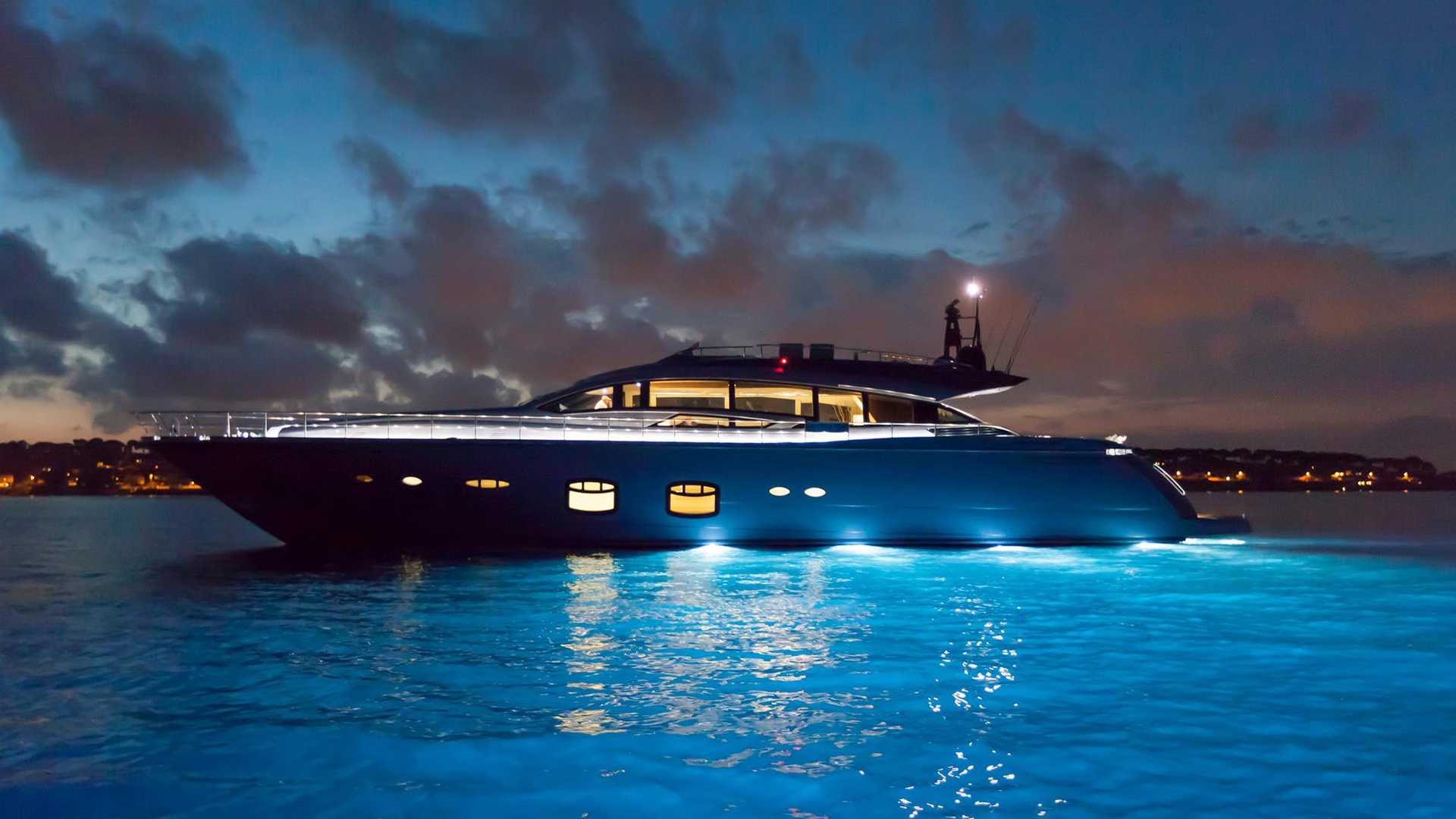
Underwater lighting at anchor Decorative for the boat, useful for the cockpit, never a substitute for navigation lights underway.
Planning, and the crew
A night passage begins long before the engine turns over. Someone on shore should know the planned route, the expected arrival window, and a description of the boat and crew. The float plan is not paperwork; it is the single piece of information that allows the Coast Guard to find a vessel that does not arrive. The same plan should include weather windows confirmed against the most recent forecast, not against yesterday's, and a stated contingency in case the wind builds or visibility drops. Mariners who have run night passages for years tend to start them well-rested and end them in daylight at one end. The middle is the part the dark hour earns.
A clear distribution of duties on board is the single most useful piece of preparation, especially when the crew's experience is uneven. Someone is captain at any given moment, with the helm and the radio. Someone is lookout, watching the water and the lights ahead and reporting plainly. Someone, eventually, will need to be relieved. Four eyes see more than two; six eyes see more than four. Rotations every two to three hours keep attention from collapsing, and any crew member who feels drowsy hands the helm to another without negotiation. Fatigue at the wheel ends in a grounding more reliably than weather does.
Conditions of fitness matter more than usual. A heavy meal, a drink with dinner, a routine sedative or pain medication: any one of them shifts judgment and reaction time enough to matter on a night passage. Speed should be moderated to the visibility on hand, leaving time and water to maneuver around a buoy seen late or a small unlit craft. Communications gear should be on and monitored, and the safety inventory, life jackets worn or within arm's reach, flares accessible, fire extinguishers checked, should be reviewed in daylight rather than discovered missing at midnight.
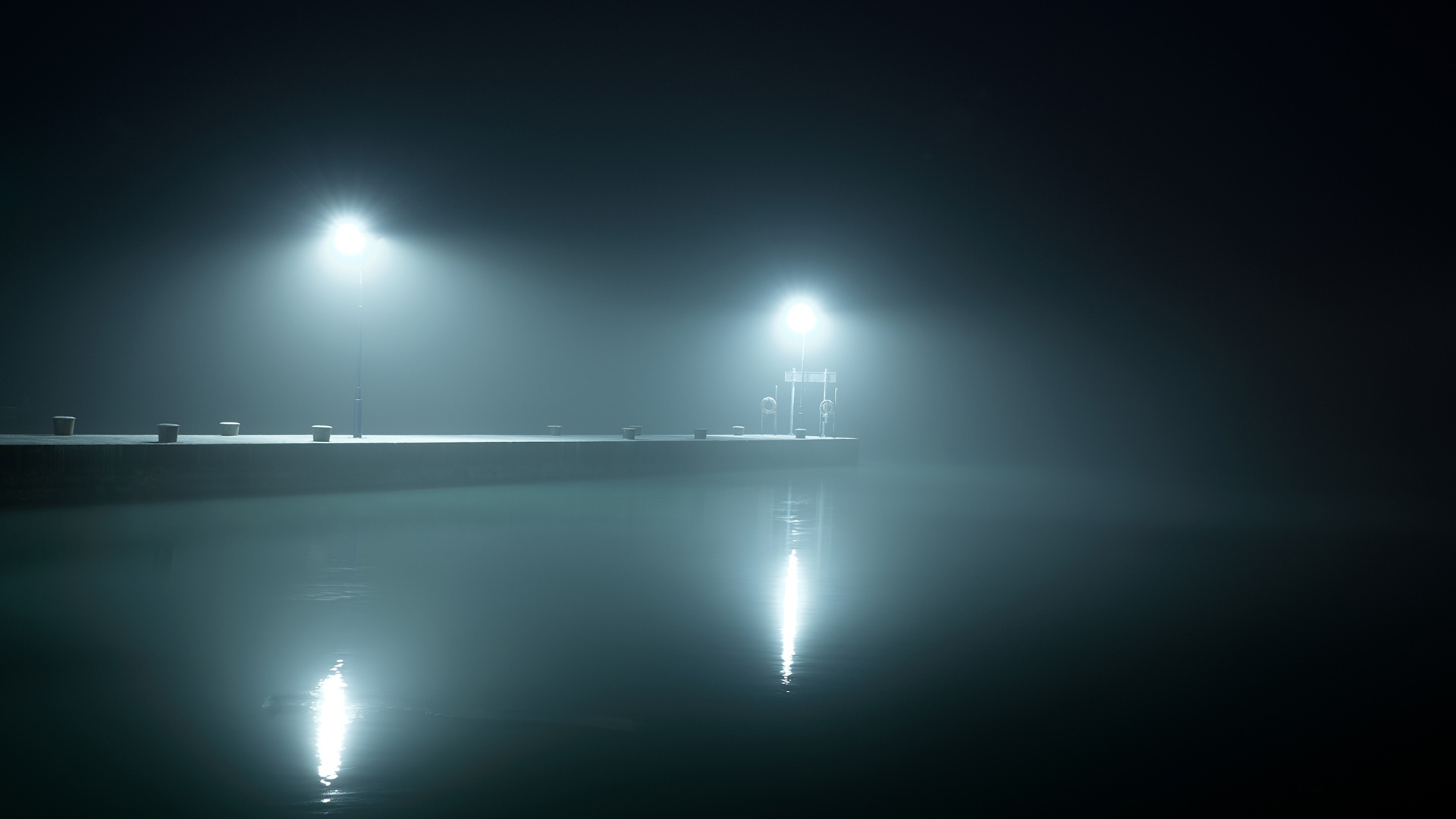
Pier lights in fog The destination, finally visible, after the work of the night.
Two short lists worth keeping.
At Night · Do
- Check every navigation light on the dock before sunset. Bulb, fuse, arc, lens.
- Leave a float plan on shore: route, ETA, boat and crew description.
- Match every flashing light to its chart symbol before committing to a turn.
- Run radar and chartplotter the way they are meant to be run: tuned, watched, trusted but verified.
- Rotate watch and lookout duties every two to three hours.
At Night · Don't
- Flood the cockpit with white light to read a chart. Use red, or use the dimmed plotter.
- Trust shore lights for position. Distance and depth are not in their language.
- Run at cruising speed when visibility is reduced by fog, rain, or moonless dark.
- Pair night passages with alcohol, heavy meals, or sedative medication.
- Power up an instrument for the first time underway. Train on it before you need it.
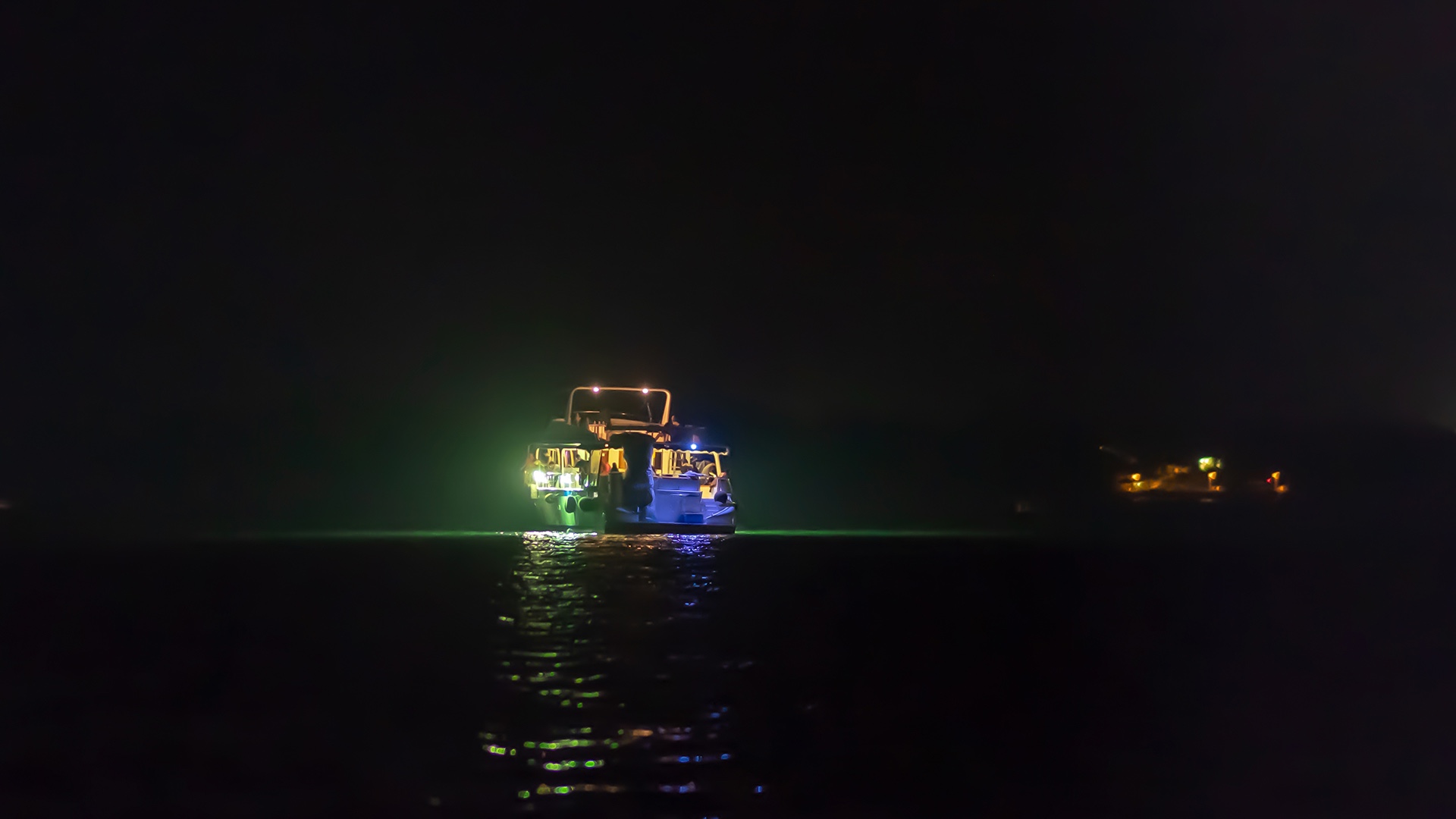
Done well, a night passage is the quieter, more rewarding cousin of every day on the water. Done casually, it is the moment a competent boater discovers what was missing from the preparation. The difference between the two is rarely luck. It is the small habits, agreed beforehand, that keep the dark uneventful.
USA Onboard Editorial