




Navigating Connectivity
The boat has become an office, a living room, and a navigation desk all at once. Staying connected offshore is no longer a luxury; it is the layer the entire vessel runs on. A field guide to how the signal actually arrives.
A modern cruiser leaves the dock with the same expectation a modern household carries to the kitchen: that the signal will be there when needed. Email moves, weather routing updates, the family video-calls from the cockpit, a remote workday continues from a quiet anchorage. None of that exists without a deliberately built connectivity stack on board. The signal that feels invisible on land becomes an engineered layer of the boat, and reading that layer well is one of the new skills of ownership.
A decade ago, going boating meant going offline. Phones searched for a tower that wasn't there, emails queued, weather depended on the VHF, and the boat existed in a kind of temporal pocket separated from the shore. That world is gone. The boat is now expected to behave like an extension of the home network, with bandwidth, latency, and reliability all measurable against terrestrial benchmarks. The technology that made the shift possible arrived in two waves: cellular networks dense enough to reach miles offshore in U.S. coastal waters, and a generation of low-earth-orbit satellite constellations that pushed real broadband into the open ocean for the first time.
The consequences are not only convenience. Connectivity has become the operational backbone of safety, navigation, charter logistics, and remote work afloat. Weather services arrive as data, not a forecast read aloud. Plotters synchronize routes across devices in real time. Engine telemetry, when the boat is so equipped, reports to the owner's phone from a thousand miles away. The single VHF radio that used to define communication at sea is now one channel among many, valued for what it does that nothing else does, rather than for what it covers on its own.
Two contexts shape every connectivity decision a boater makes, and confusing them is the most common mistake on the water. Coastal navigation, within roughly twenty to thirty nautical miles of a populated shoreline, is solvable with cellular technology equipped correctly. Offshore navigation, beyond cellular range, has historically been the domain of expensive geostationary satellite services and remains so for legacy installations, but has been transformed in the last three years by Starlink's low-earth-orbit constellation. The two zones demand different hardware, different budgets, and different mental models. A connectivity plan built for one will fail in the other.

Connectivity as infrastructure
The first useful reframing is that connectivity on a boat is no longer an accessory. It belongs in the same conceptual category as electrical power, fresh water, and navigation electronics: a system that needs sizing, redundancy, monitoring, and a maintenance schedule. Treating it as a single subscription, paid monthly and forgotten about, is the path to discovering at the wrong moment that the antenna is misaligned, the SIM is suspended in the country you just sailed into, or the dish that worked in port cannot lock satellites at speed. The connectivity stack rewards the same discipline as any other system on board.
Who uses it determines how it gets built. A weekend boater who runs within sight of land on Saturday mornings needs a different stack than a charter operator handling guest expectations of streaming and video calls, who in turn needs something different from a long-distance cruiser making ocean passages, who needs something different again from an owner running a remote workplace from the cockpit. The mistake of buying for the wrong profile shows up either as overspending on capability that never gets used, or, more painfully, as underprovision exposed at the precise moment the boat is too far from shore to fix it.
Coastal: cellular technology, augmented by a marine antenna and amplifier, will carry the boat reliably out to twenty or thirty nautical miles of a populated shoreline. Offshore: cellular drops to zero, and the conversation shifts to low-earth-orbit satellite or legacy geostationary service. The boundary between the two is the most important line in any connectivity plan.
The third reframing is the most important: no single technology covers every scenario at an acceptable cost. The cruiser who runs Starlink alone discovers the power draw and the moments of cloud-induced dropout. The boater who relies on the cellular plan alone watches it die offshore. The owner with only an emergency communicator can text for help but cannot stream a weather forecast. A working connectivity strategy is a deliberate combination of layers, each carrying part of the load, and each chosen to compensate for the limits of the others. The next four sections are how those layers are read, priced, and built.
The four layers of marine connectivity
Every working connectivity plan on a recreational vessel can be reduced to four technologies. Each one solves a different problem. None solves all of them. Reading the four correctly, and understanding what each was designed to do, is how an owner spends money where it matters and stops paying for capability that the boat will never use. The order below is the order in which most owners encounter the layers as the boat moves from the slip to the open ocean.
The first layer is cellular, the most under-appreciated technology on the water. A modern smartphone, used as-is on a coastal boat, is already a connectivity device; the limit is the antenna, not the network. Equipped with a marine cellular amplifier and an external high-gain antenna mounted as high as the boat allows, the same phone or a dedicated marine router can reach reliable LTE and 5G service well past the point most owners assume coverage ends. In U.S. coastal waters, twenty to thirty nautical miles of usable signal is the working baseline; line-of-sight propagation over water consistently outperforms the equivalent distance over land. The hardware cost ranges from a few hundred dollars for a Shakespeare-style cellular booster to roughly one thousand for a multi-SIM marine router such as the Peplink BR1 Pro, plus a high-gain marine antenna mounted at the mast or hardtop.
The second layer is marina WiFi, the most often dismissed and the most quietly improved. A decade ago, marina WiFi was a euphemism for unusable. The current generation of marina installations, particularly in Florida and the Caribbean, runs on enterprise access points with directed antennas, and pairs with a marine WiFi extender on the boat side to deliver respectable bandwidth when berthed. A boat-side extender is a small router that captures the marina's signal through its own external antenna and rebroadcasts it as a private network inside the vessel. It works only in port, but in port it does the job at no incremental data cost, and conserves the satellite quota for offshore use.
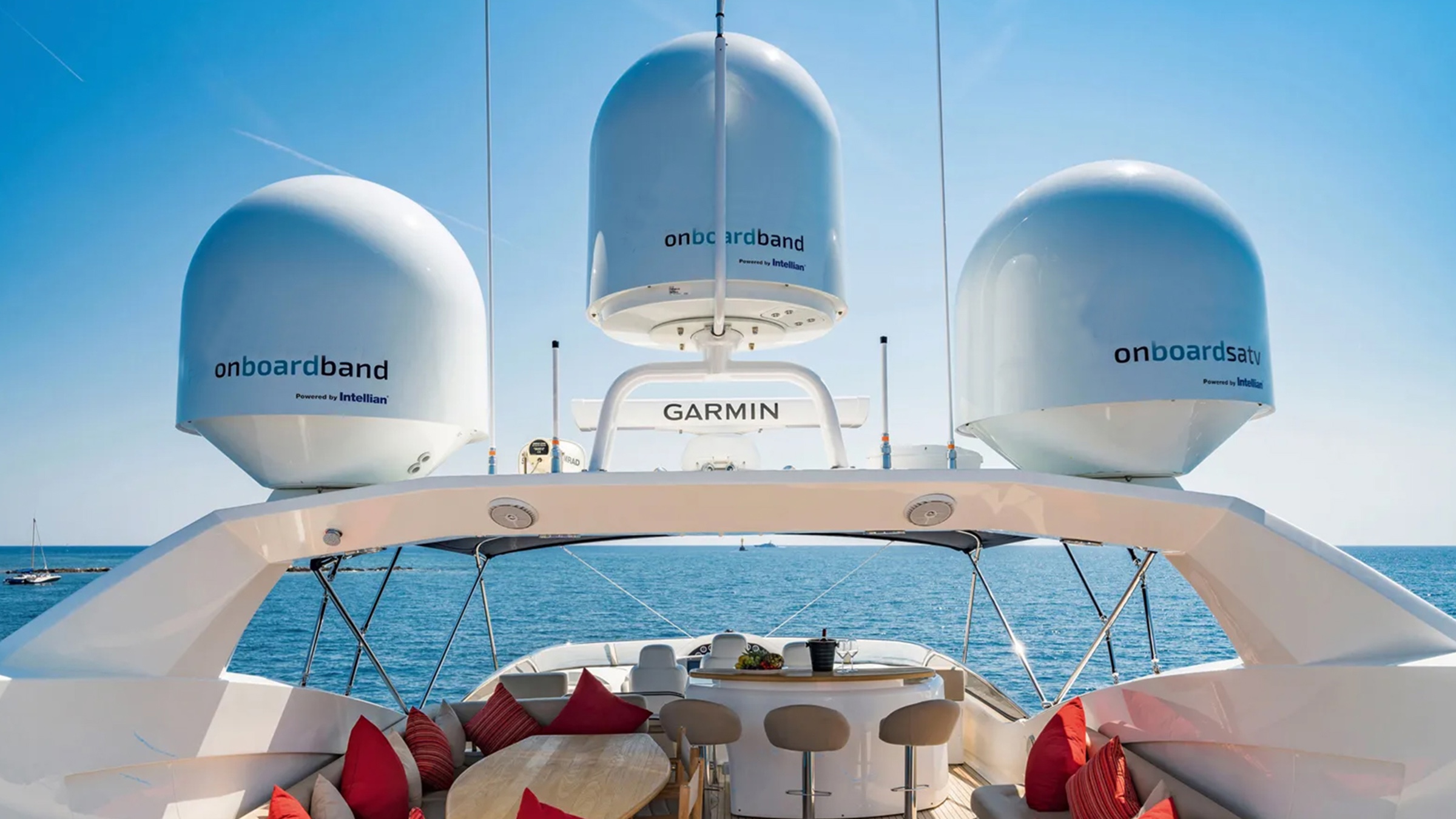
The third layer is low-earth-orbit satellite, the technology that rewrote the offshore conversation between 2022 and 2025. Starlink, operated by SpaceX, runs a constellation of satellites in orbit at roughly 550 kilometers of altitude, an order of magnitude closer to the boat than the geostationary fleet that previous generations of marine satellite service relied on. The proximity collapses latency from the 600 to 800 milliseconds typical of legacy VSAT systems to 20 to 60 milliseconds, comparable to a residential cable connection. The effect on the user is the difference between a usable video call from mid-ocean and one that never connects. The hardware is a self-aiming dish that locks onto satellites overhead and hands off between them as they pass; the marine-grade Flat High Performance unit is built for in-motion use and the harsher RF environment of a moving vessel. We return to Starlink in detail in the next section.
The fourth layer is legacy and emergency satellite, the one most likely to save a life and the one most easily overlooked. Iridium, the global satellite voice and data service operating on a 66-satellite constellation, predates Starlink by more than two decades and still provides what no other system can: pole-to-pole coverage with a device that fits in a hand and runs on a small battery. The current generation of Iridium-based personal communicators, including the Garmin inReach line, deliver two-way text messaging, location sharing, and an interactive SOS signal that triggers the Garmin International Emergency Response Coordination Center. They are not internet devices and were never designed to be. They are the device that works when nothing else does.
Four technologies.
Each one designed for a different distance from shore.
I
Cellular
Coastal broadband
LTE and 5G reach to roughly 20 to 30 nautical miles offshore with a marine antenna and amplifier. The cheapest layer to operate. Useful in 80 to 90 percent of recreational coastal use.
II
Marina WiFi
Berthed connectivity
A boat-side WiFi extender captures the marina's network. Works only in port, at no data cost. Preserves satellite quota for offshore segments of the trip.
III
LEO Satellite
Offshore broadband
Starlink delivers real broadband beyond cellular range with 20 to 60 ms latency. The first system that makes video calls and remote work practical from mid-ocean.
IV
Emergency Satellite
Global coverage, text and SOS
Iridium-based devices like the Garmin inReach line deliver two-way text, location sharing, and SOS to a 24/7 coordination center. Pole-to-pole coverage with no broadband expectation.
“
No single technology covers every scenario at an acceptable cost. The working strategy is a layered one, and each layer is chosen to compensate for the limits of the others.
Field Note · USA Onboard Editorial
Reading the technologies
The four layers differ in three measurable dimensions: bandwidth, latency, and power. A working owner reads each technology against those three before reading the price. Bandwidth determines what the connection can do at a given moment, whether that is loading a weather page or carrying a four-person video call. Latency determines how the connection feels: a high-bandwidth, high-latency link, the classic VSAT failure mode, looks impressive on a speed test and stutters in conversation. Power determines what the boat can sustain at anchor, where the battery bank, the solar array, and the genset schedule become the real constraint.
Cellular wins on power. A modern marine router and a passive amplifier draw a handful of watts continuously and far less than that in idle. Marina WiFi inherits the cellular numbers, since the extender is essentially a small router. Starlink consumes meaningfully more: the standard dish draws around 50 to 75 watts under load, the Flat High Performance maritime unit closer to 100 watts in motion, and the figure rises in cold weather as the dish heats its panels to clear ice or condensation. Over twenty-four hours of continuous operation, that translates to between one and two-and-a-half kilowatt-hours, the kind of number that reshapes battery and solar planning on smaller boats. Iridium-based devices draw a fraction of a watt and run on internal batteries for days at a time, which is precisely why they remain the canonical emergency layer.
Hardware placement does most of the work once the technology is chosen. Cellular antennas reward height; the radio horizon for a five-foot waterline rises to roughly twenty nautical miles when the antenna sits twenty feet above water, and to thirty miles at thirty feet. Marine cellular antennas are typically mounted at the top of the mast or on a dedicated communications pole because every foot of elevation buys nautical miles of range. Starlink, by contrast, needs an unobstructed view of a wide arc of sky rather than height per se; a flat, level surface clear of standing rigging and biminis is the priority. Crowding the dish under a hardtop or behind a mast is one of the most consistent installation mistakes on the water.
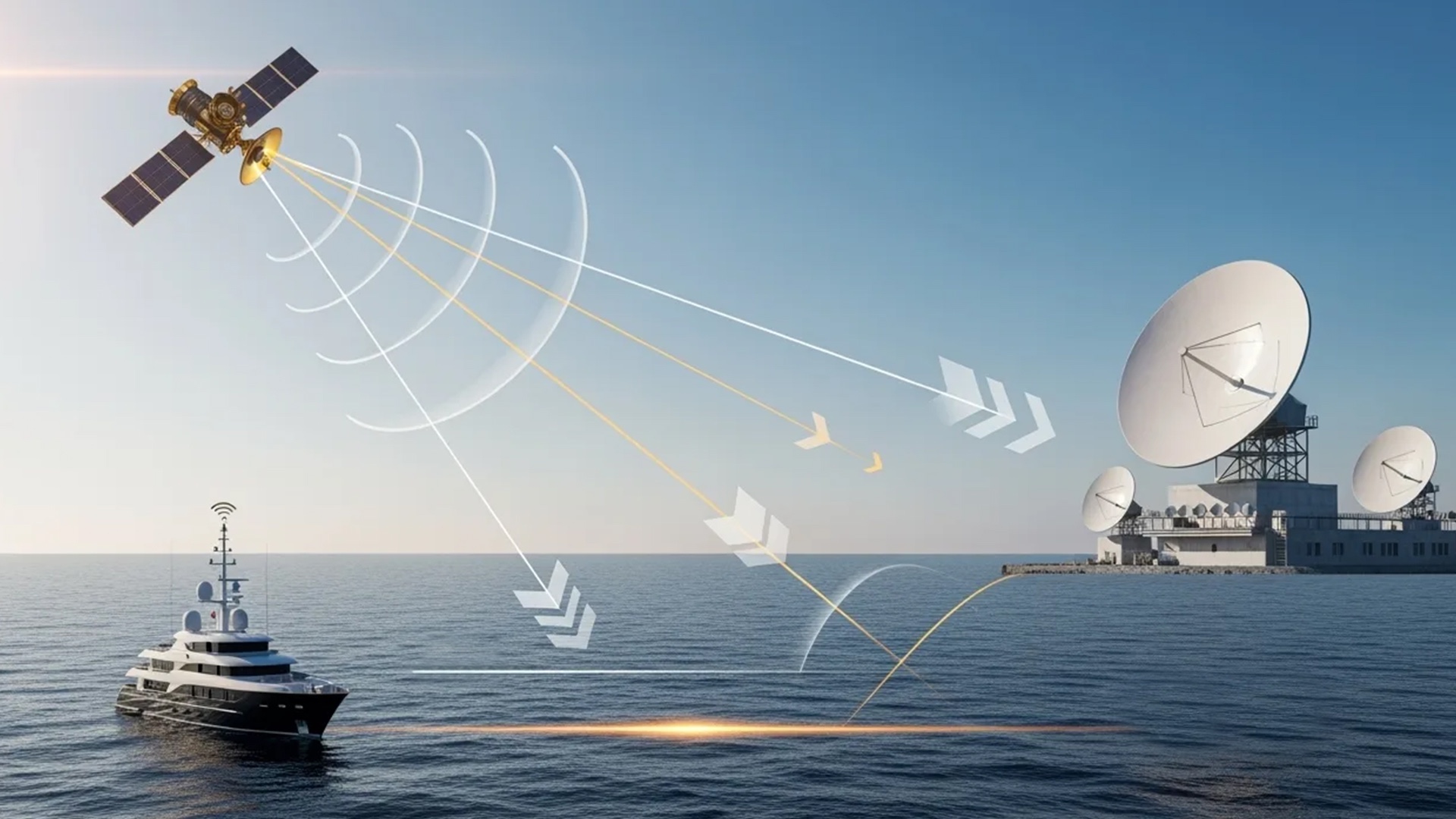
Anatomy of the system The router is the center of the network on board. Every layer above feeds into it, and every device aboard receives signal from it.
The router deserves its own paragraph because it is the piece most owners forget to budget for. A marine-grade router with multiple WAN inputs, the ability to accept two or three SIM cards, and intelligent failover between connections is what turns four separate technologies into one connectivity stack. Without it, the cellular plan, the marina WiFi extender, and the Starlink terminal each operate as isolated islands; the owner switches between them manually and rarely happily. With it, the boat carries one network identifier that every device aboard connects to, and the underlying transport, cellular, WiFi, or satellite, becomes a software choice the router resolves automatically. The Peplink marine line, paired with comparable units from Cradlepoint or Teltonika, is the segment of the market most navigators reach for. The unit is not a connectivity layer in itself; it is the spine that makes the layers behave as one.
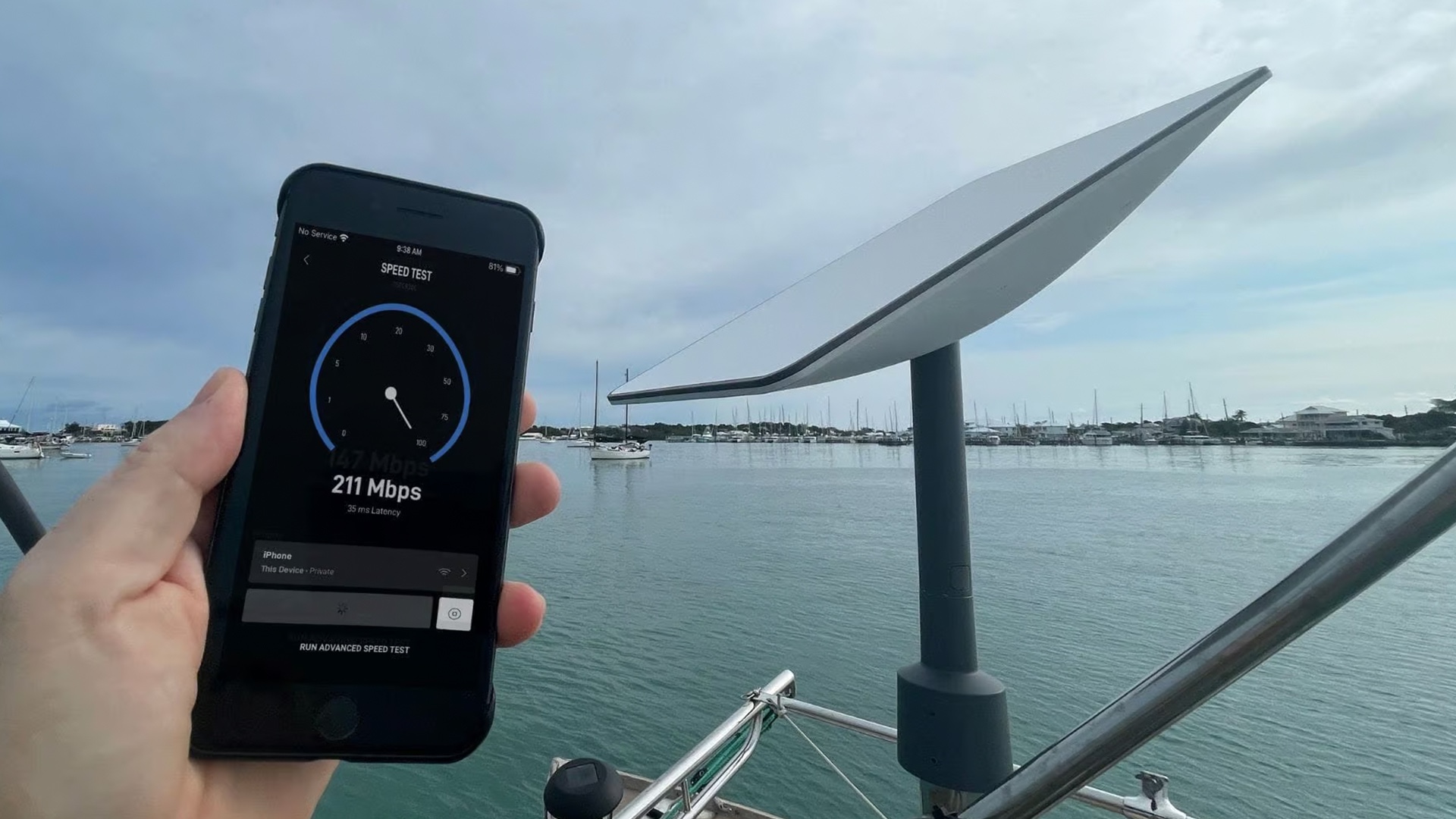
Starlink and what it actually changed
Starlink belongs in its own section because the technology rewrote the offshore conversation in a way no system has since the introduction of GPS for civilian use. Before 2022, real broadband at sea was a six-figure installation problem reserved for commercial vessels and the high end of the megayacht segment. The geostationary providers that dominated marine satellite, primarily KVH and Inmarsat, delivered service that worked but worked slowly, expensively, and with latency that defeated most consumer applications. The recreational boater who wanted email and basic weather at sea paid hundreds of dollars per month for a connection that an urban office would have rejected outright.
The technical change is at altitude. A geostationary satellite sits at roughly 36,000 kilometers above the equator, the orbital distance required to match Earth's rotation and appear stationary from the ground. A signal that travels from a boat to that satellite and back covers more than 70,000 kilometers of round trip, which alone introduces about half a second of unavoidable latency before any processing happens. Starlink's constellation operates at approximately 550 kilometers of altitude, an order of magnitude closer, and the round-trip latency drops to 20 to 60 milliseconds. The number sounds small until placed next to its consequence: video calls work, remote work works, cloud-based applications respond as they do on a residential cable connection. The threshold separating "satellite internet" from "internet that happens to come from satellites" was crossed.
The cost of access fell in parallel. A Starlink terminal for recreational use, the standard self-orienting dish, retails at $349 in the United States as of early 2026; the compact Mini, sized roughly like a laptop and weighing under three pounds, sells for $249 and serves a meaningful subset of small-boat use cases. The marine-grade Flat High Performance unit, designed for in-motion operation and harsher RF environments, sits at $2,500. The price gap between the consumer and maritime hardware is significant, but for the first time in the history of marine satellite service, the entry point to broadband at sea is accessible to an individual owner rather than to a vessel operator.
The plans themselves have evolved continuously since launch, and 2026 settled into a recognizable four-tier structure for the marine user. The Roam plans, designed originally for land travel but widely adopted by coastal boaters, deliver standard data with priority data caps that vary by tier. The Mobile Priority plans, branded as Maritime in earlier marketing, allocate higher-priority data buckets and are the tier most relevant to offshore use, where in-motion performance and tracking handoff between satellites become consequential. The structure rewards owners who match the plan to the actual use rather than overprovisioning out of caution.
Four tiers.
The use case picks the plan, not the other way around.
I
Roam 50GB
From $55 per month
Entry tier for coastal use within Starlink's terrestrial coverage. Standard-grade data with a monthly cap. Works at the dock, at anchor, and in coastal waters where service is licensed. Hardware: Standard dish or Mini.
II
Roam Unlimited
From $175 per month
The most popular plan among cruisers in 2026. Unlimited data within the country of registration, with international roaming under documented constraints. Designed for stationary or slow in-motion use up to roughly 100 mph.
III
Mobile Priority Local
From $250 per month
Priority data buckets for in-motion use within the country of registration. The tier most charter operators settle on. Bucket sizes from 50 GB upward; additional data billed per GB. Compatible with Flat High Performance hardware.
IV
Mobile Priority Global
$150 access plus data
Global priority data, including ocean coverage. Terminal access fee plus priority data buckets billed separately. The tier built for ocean passages and international cruising. Flat High Performance hardware effectively required.
The hardware decision tends to drive the plan decision, and it should. A boat that never leaves coastal waters and stays in a single country is over-served by Flat High Performance and well-served by a Mini or a Standard dish on a Roam tier. A boat making ocean passages benefits unambiguously from the Flat High Performance unit and a Mobile Priority Global plan; the cheaper hardware loses its lock during sustained motion in heavier sea states, and the consumer plans do not deliver priority data over open ocean. Between those two ends, a Standard dish paired with Roam Unlimited covers the majority of recreational use convincingly, and is the configuration most owners arrive at after a season of trial and error.
The limits of Starlink deserve as much attention as the capabilities. Power draw, as covered earlier, is meaningfully higher than every other layer in the stack and reshapes battery planning on smaller boats. Coverage gaps exist over portions of the open ocean far from terrestrial service licensing, and the user needs to verify against the current Starlink maritime coverage map before committing to a passage. Service can degrade in dense rain or heavy convective cells, both because the signal is attenuated and because the dish prioritizes self-protection over throughput. And the geopolitical layer remains real: Starlink's licensing varies country by country, and a boater crossing into a jurisdiction where service is not authorized may lose the connection without warning. None of these limits are reasons to avoid the system. They are reasons to keep the other three layers of the stack alive.
“
Starlink did not replace the marine connectivity stack. It replaced the assumption that one layer of the stack would never be affordable.
Field Note · USA Onboard Editorial
Building the layered system
A connectivity plan is not a purchase; it is a configuration. The right combination depends on three variables an owner has to answer honestly before spending money: how far the boat actually goes from shore in a typical month, how many people aboard rely on the connection for non-recreational purposes, and how much electrical budget the boat can sustain at anchor. Most owners overestimate the first, underestimate the second, and discover the third the hard way. A clean answer to all three turns the four-layer stack from an abstraction into a hardware list.
A reasonable starting configuration for a coastal cruiser who occasionally crosses to a barrier island or a near-shore anchorage looks like a marine cellular amplifier feeding a multi-WAN router, a small WiFi extender for marina use, and a Garmin inReach kept in the ditch bag. The cellular layer carries the day-to-day, the marina WiFi conserves data when berthed, and the inReach exists for the moment when something goes wrong and no other layer can help. The total hardware investment lands in the low four figures, the monthly recurring cost is modest, and the boat behaves as if connected without any single point of failure.
A long-range cruiser making passages adds Starlink to that base. The configuration becomes cellular for in-shore movement, marina WiFi at the dock, Starlink as soon as the boat is past meaningful cellular range, and the inReach as the redundant emergency layer that runs on its own battery and works when everything electrical on the boat does not. The cost jumps meaningfully on the recurring side: a Starlink Mobile Priority plan plus the inReach subscription puts the monthly bill in the high three figures, and the hardware budget adds the Flat High Performance dish to the existing stack. The expense is real and the payoff is real: a remote workday from a Bahamas anchorage, weather routing in the Atlantic Ocean, and a video call to family from a passage at sea become routine rather than aspirational.


Installation is where most owners discover what theory left out. The dish needs a clear sky view; the cellular antenna needs height; the WiFi extender needs proximity to the marina access point; the router needs a dry, accessible location with the airflow to dissipate heat and the cabling discipline to keep the run from each antenna short enough to preserve signal. The wiring closet of the modern connected boat looks closer to a small office data rack than to the marine electrical panels of a decade ago, and the boats that age well are the ones built or refit with this in mind from the start. Retrofitting a four-layer stack onto a hull that was never planned for it is possible, but expensive, and the cost of doing it twice, the second time correctly, is one of the more avoidable lessons of the segment.
Integration with the vessel's existing electronics is the second layer of the installation conversation. Modern marine routers expose their connection to NMEA 2000 networks, the standard data bus that links chartplotters, autopilots, and engine monitors on most contemporary boats. A connected router can carry telemetry off the boat to the owner's phone in real time, can feed weather forecasts back into the chartplotter, and can update navigation software without the owner manually moving files. The integration is not optional for charter operations and is increasingly the expectation for owner-operated boats over forty feet. The vessel becomes a node on the owner's own network rather than an island that happens to also have internet.
Operational discipline is the part the hardware never solves. A connectivity stack at sea behaves differently than a home network in three ways: bandwidth is finite and metered, signal is conditional on geometry and weather, and power is always a budget rather than a given. The owner who runs the boat with those three constraints in mind, who treats data the way an offshore sailor treats fresh water, who switches between layers deliberately and turns the high-draw equipment off when it is not in use, gets the connectivity they paid for. The owner who treats the boat as an extension of the home WiFi runs out of data, drains batteries, and discovers in the wrong moment that the redundancy they thought they had does not exist.
Two short lists worth keeping at hand.
Building the stack · Do
- Map the boat's real use first: coastal mileage, monthly hours, number of users, electrical budget. The configuration follows from the answer.
- Build redundancy into the stack: a primary layer for daily use, a secondary for fallback, and an emergency device that runs on its own battery.
- Mount cellular antennas as high as the vessel allows and Starlink with a clear sky view, away from masts, biminis, and standing rigging.
- Use a multi-WAN marine router as the spine. One network identifier aboard, automatic failover between transports.
- Verify Starlink licensing for every jurisdiction the boat will enter before relying on the service for that leg.
Building the stack · Don't
- Rely on a single layer. Every technology in the stack has a documented failure mode, and the failure modes do not overlap.
- Skip the emergency layer because Starlink "works everywhere now." It does not, and the device that works when nothing else does is the one that runs on its own battery.
- Install the Starlink dish under a hardtop, behind a mast, or anywhere the sky view is obstructed. Reception will be intermittent at best.
- Treat data caps as theoretical. Streaming, automatic backups, and operating system updates exhaust priority data faster than most owners expect.
- Forget the power budget. A continuous Starlink load reshapes anchor and solar planning on any boat under fifty feet.

A connected boat is not a luxury. It is the modern definition of what the boat is, and the layer the rest of the experience now runs on. Built well, the stack disappears: weather routing updates without being asked, the family video-calls from a quiet anchorage, the workday continues from the bow, and the boat does what every boat has always done, which is take its owner somewhere worth being. Built poorly, the same stack interrupts the experience it was meant to enable. The difference, as with every other system on board, is method.
USA Onboard Editorial