

A Bigger
Dolcevita
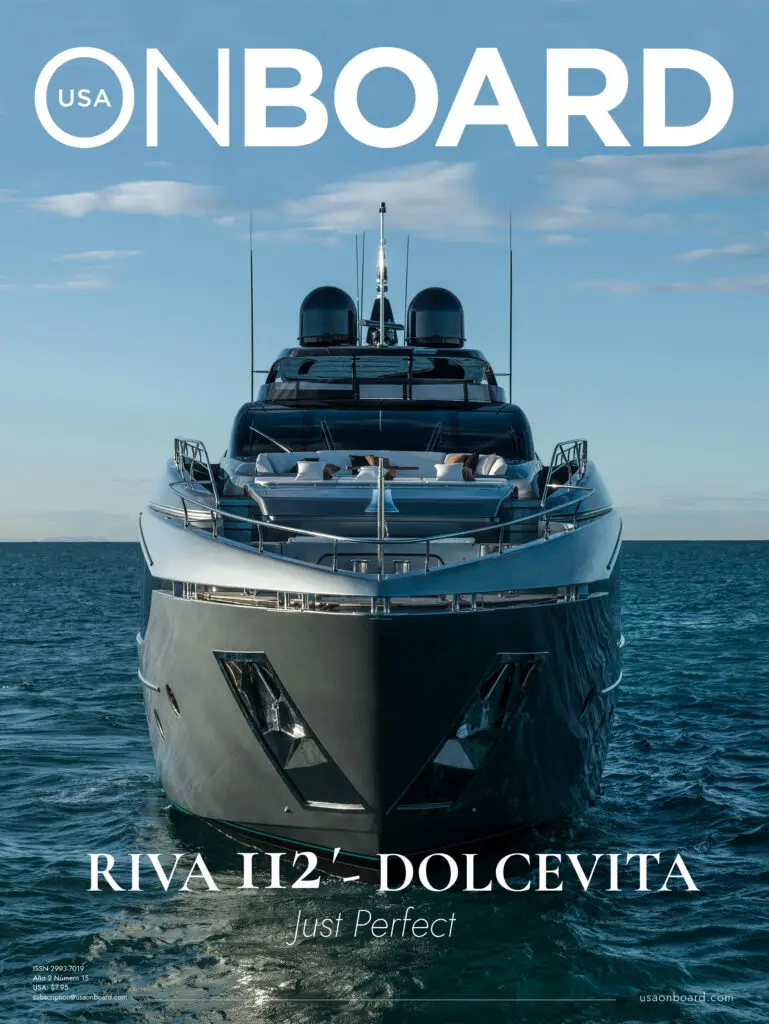
A 34-meter flybridge that stretches the most admired profile in the Riva catalog and rewrites the aft deck around the waterline — the most consequential refinement the Dolcevita line has produced since its 2018 debut.
Some yachts arrive with a thesis. The first Riva 112' Dolcevita Super, launched in La Spezia in July and unveiled at the 2025 Cannes Yachting Festival, arrives with a refinement — the kind a shipyard only attempts once it knows precisely what its audience came for.
The 112' is the successor to the Riva 110' Dolcevita, a 34-meter flybridge that, since 2018, has quietly become one of the most quoted shapes on the Mediterranean. The new model keeps the silhouette and pushes against everything else. Length grows to 34.37 meters, beam holds at 7.27 meters, and the aft deck is reorganized around a 35-square-meter beach club that sits a few inches above the surface of the water. Riva calls the exercise a radical restyling. The phrase reads stronger in marketing than it does on board: what has actually changed is the geometry of how the yacht meets the sea.
Officina Italiana Design — the studio that has drawn every Riva since 1994, founded by Mauro Micheli and Sergio Beretta — worked the project with the Ferretti Group Engineering Department and the Strategic Product Committee chaired by Piero Ferrari. The collaboration was renewed earlier this year and now runs through 2030. That continuity matters here. The 112' is not a reinvention. It is the most disciplined application of a vocabulary the studio has spent three decades sharpening.
It also enters the world with a confidence built into the spec sheet. The first hull was awarded Best Exterior Design (30–50m) at the 2025 World Yachts Trophies before most owners had seen it in person. The award is less interesting than the consensus behind it: that in a segment crowded with novelty, Riva has produced a refinement worth pausing over.
The 112', read across every deck
The stern, rewritten at the waterline
If there is a single argument this yacht is built to make, it is the one written into the back of the hull. The beach club spans thirty-five square meters of platform that sits dramatically close to the surface — almost flush — and opens further with two large bulwarks that swing outward on hinges to form side terraces. The result is a sea-level living room with the geometry of a small private dock and the proportions of a Mediterranean villa terrace.
Behind the platform's central sunpad, a ventilated locker holds two SeaBobs, ready to slide out without disturbing anyone resting on the cushions above. Beneath the sunpad, a full garage accommodates a tender and a jet ski. None of this is theatrical engineering for its own sake; it is the kind of choreography that distinguishes a yacht built around an aft deck from one that merely has one. The 110' Dolcevita carried a single fold-down platform. The 112' adds the two side balconies and lowers the floor by a meaningful margin. The water is no longer somewhere you go to. It is where the day already lives.
A third living room, redrawn from scratch
The flybridge is the gesture where Officina Italiana Design has been most explicit about replacing built-in cabinetry with freestanding furniture. At sixty square meters, the upper deck reads less as a helm-station-with-bench-seating and more as an open-air apartment. A cocktail bar runs through the middle of the layout, with stools facing a hi-lo television that rises and disappears on demand. Opposite, a deep sofa lounge anchors what is, in practice, the social heart of the yacht at anchor.
The cockpit below adopts the same instinct. Twenty-four square meters of aft terrace, two large sofas, freestanding pieces rather than fixed banquettes, and a built-in unit configured to the owner's preferences. Forward, an enlarged sunpad and seating area can be specified with a foredeck jacuzzi — the configuration chosen on hull number one. Read together, the three exterior decks operate as a vertical sequence of social spaces, each with a distinct light, a distinct breeze, and a distinct relationship to the horizon.
The same yacht, observed from three different decks
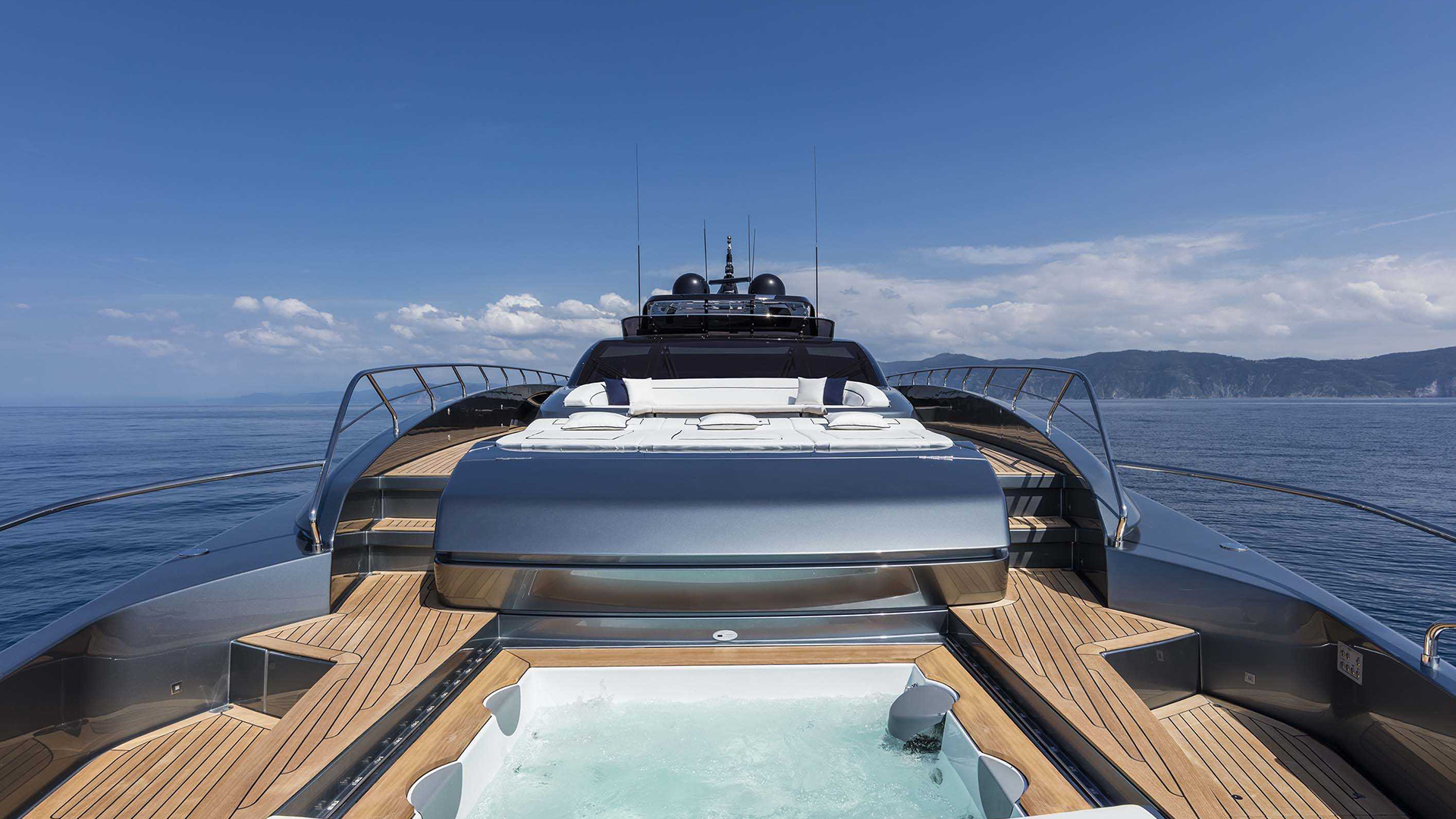 Foredeck · Jacuzzi
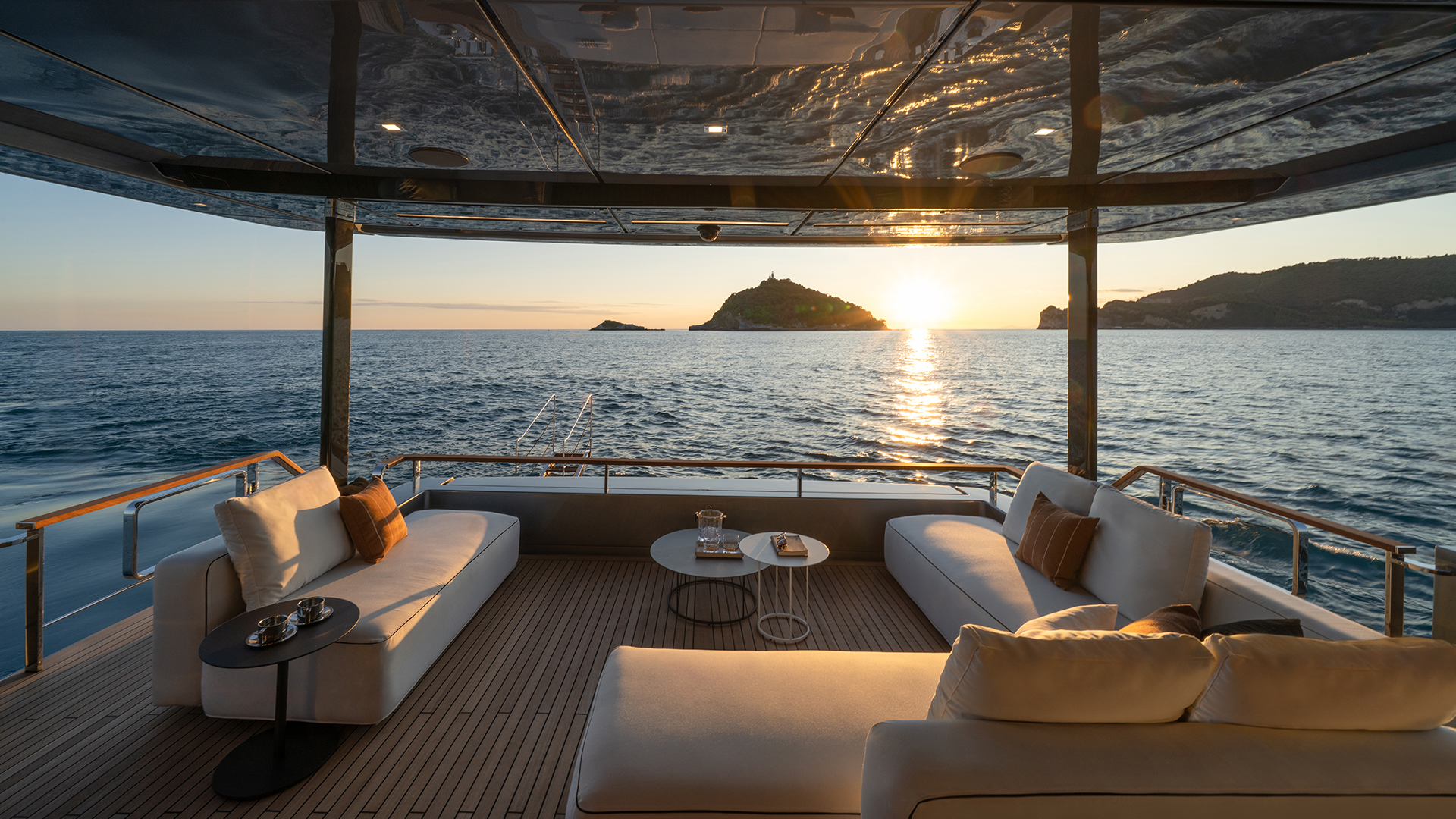 Flybridge · Aft lounge
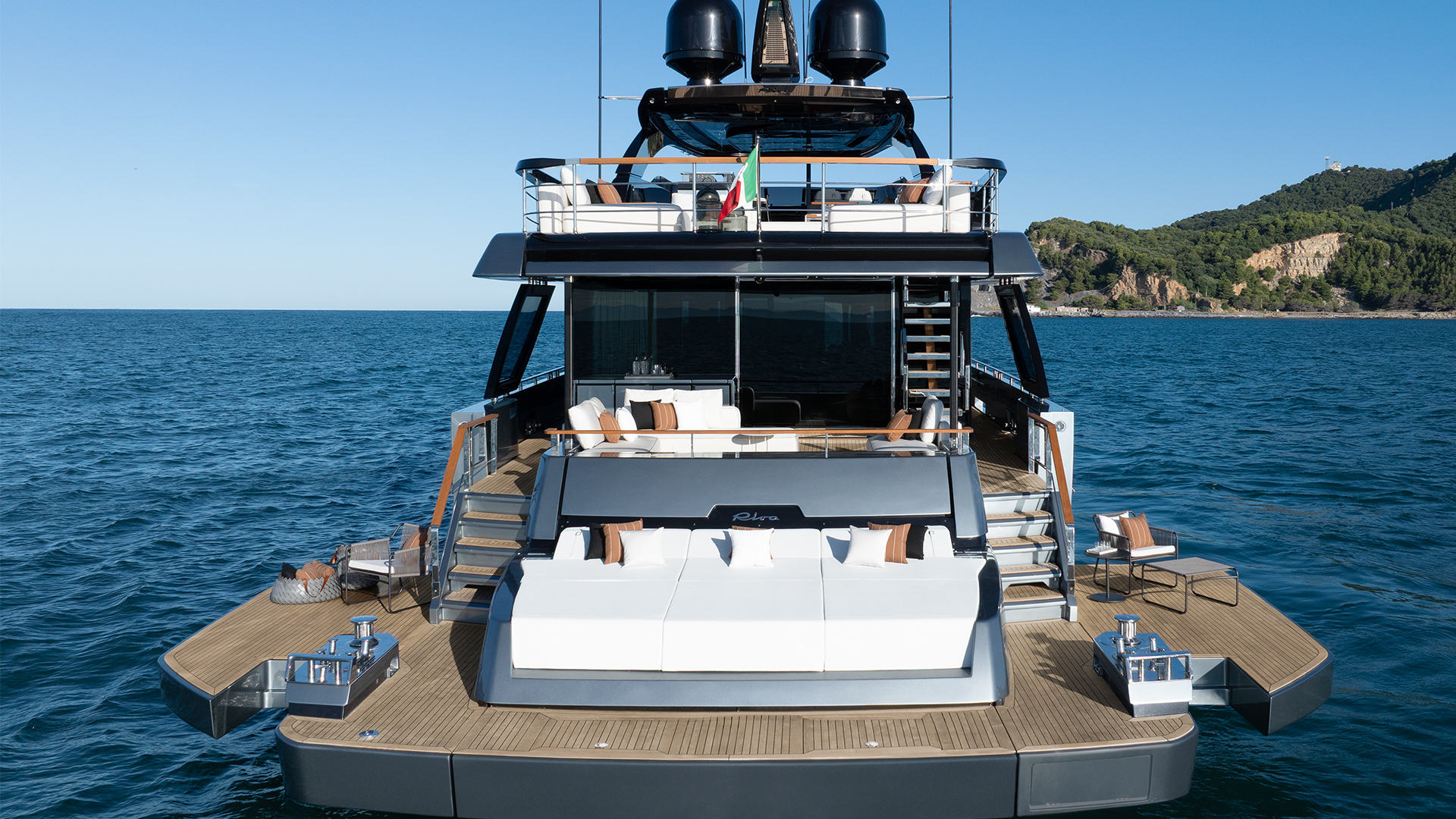 Aft solarium · Sea-level
A Dolcevita design expresses a deep rapport with the sea. On the 112', that connection becomes its argument.
USA Onboard · After Mauro Micheli & Sergio Beretta, Officina Italiana Design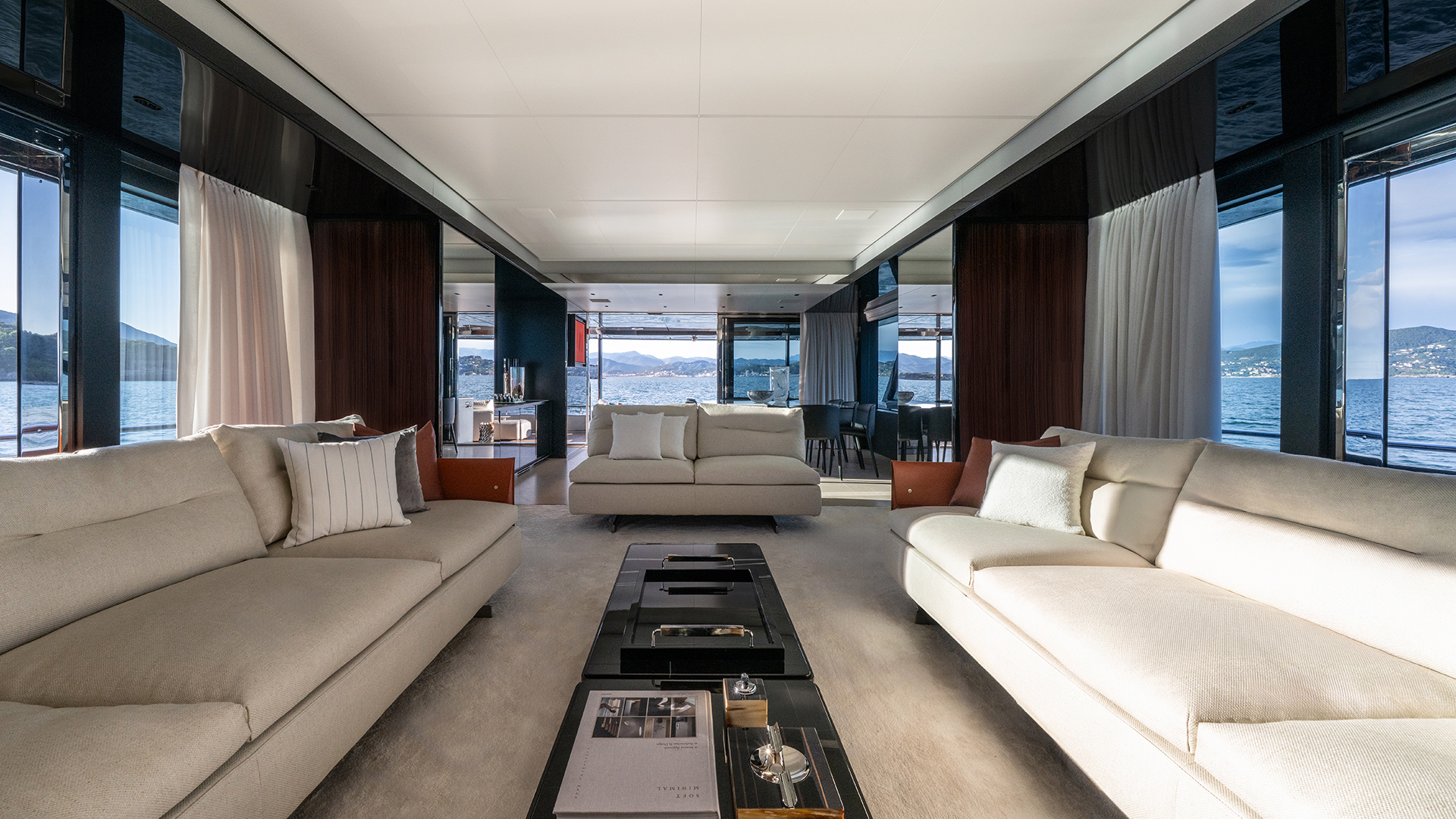 Main saloon · Hull #1 layout
Fifty square meters, two different rooms
Riva offers the 112's main saloon in two layouts, and the choice is consequential. The conventional configuration places the lounge area aft, on entry, with the dining table in the center — the formula familiar from the smaller 102' Corsaro Super. Hull number one inverts the order: dining aft, lounge midships. The owner's instinct here is worth noting. Placing dinner on the threshold of the cockpit, with the saloon's sliding port doors open, turns the meal into a partly outdoor event. Placing the lounge amidships, anchored by three Poltrona Frau sofas around a Poliform low table, gives the social heart of the boat a place to breathe.
The dining setup on hull one centers on an Acerbis Int table with a stainless-steel base and a glass top, surrounded by ten leather-upholstered MDF Italia chairs. The galley sits, in another quiet break with convention, on the starboard side. Throughout, the dominant timber is high-gloss rosewood, set against decorative inserts of black hammered leather in the saloon and in the master cabin detailing. Light carpets and pale ceilings keep the wood from closing in. The room reads at over fifty square meters, with a ceiling height above two meters everywhere — and reaching 2.25 meters at the highest point — proportions more typical of yachts a full size class larger.
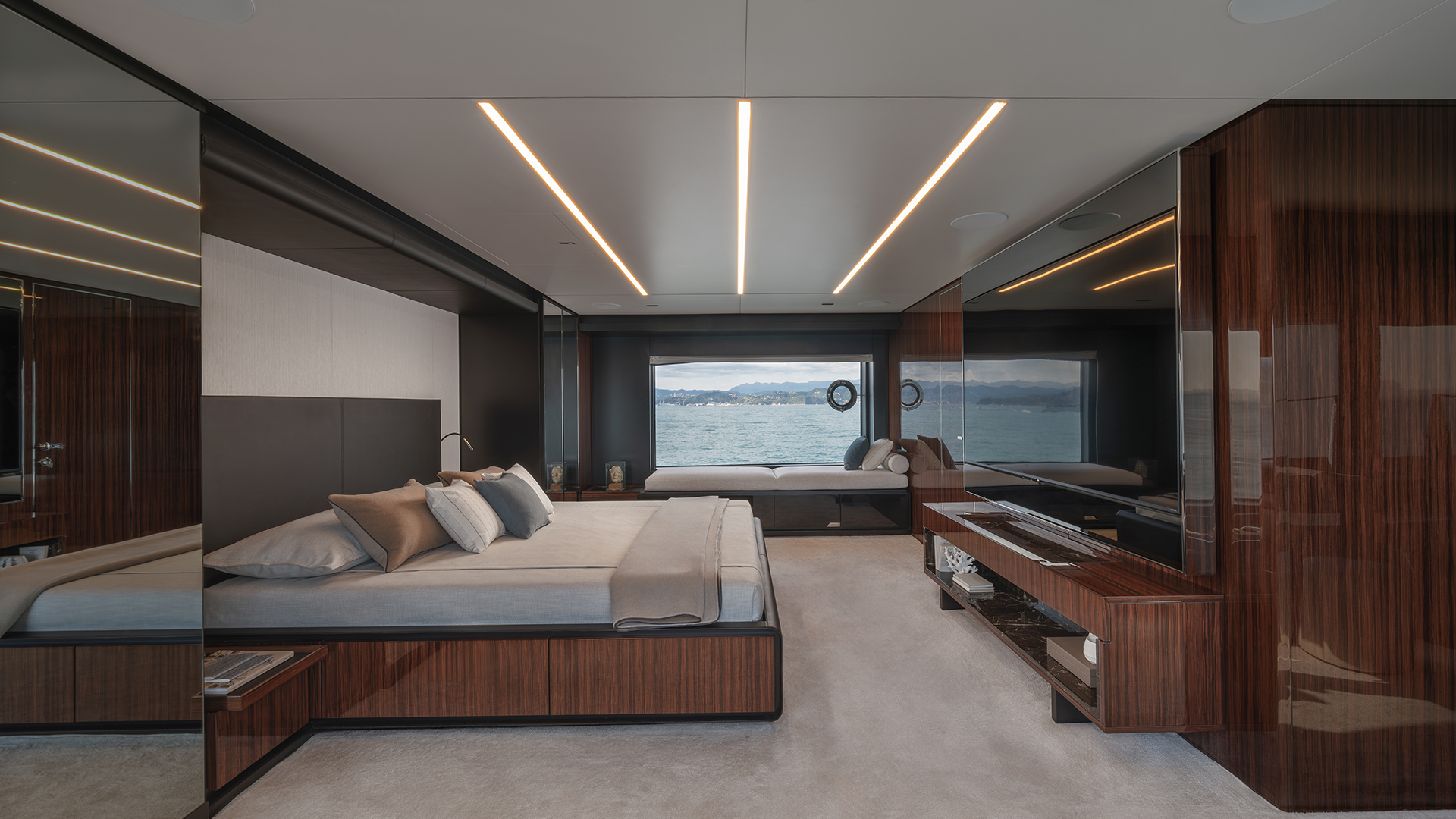 Master suite
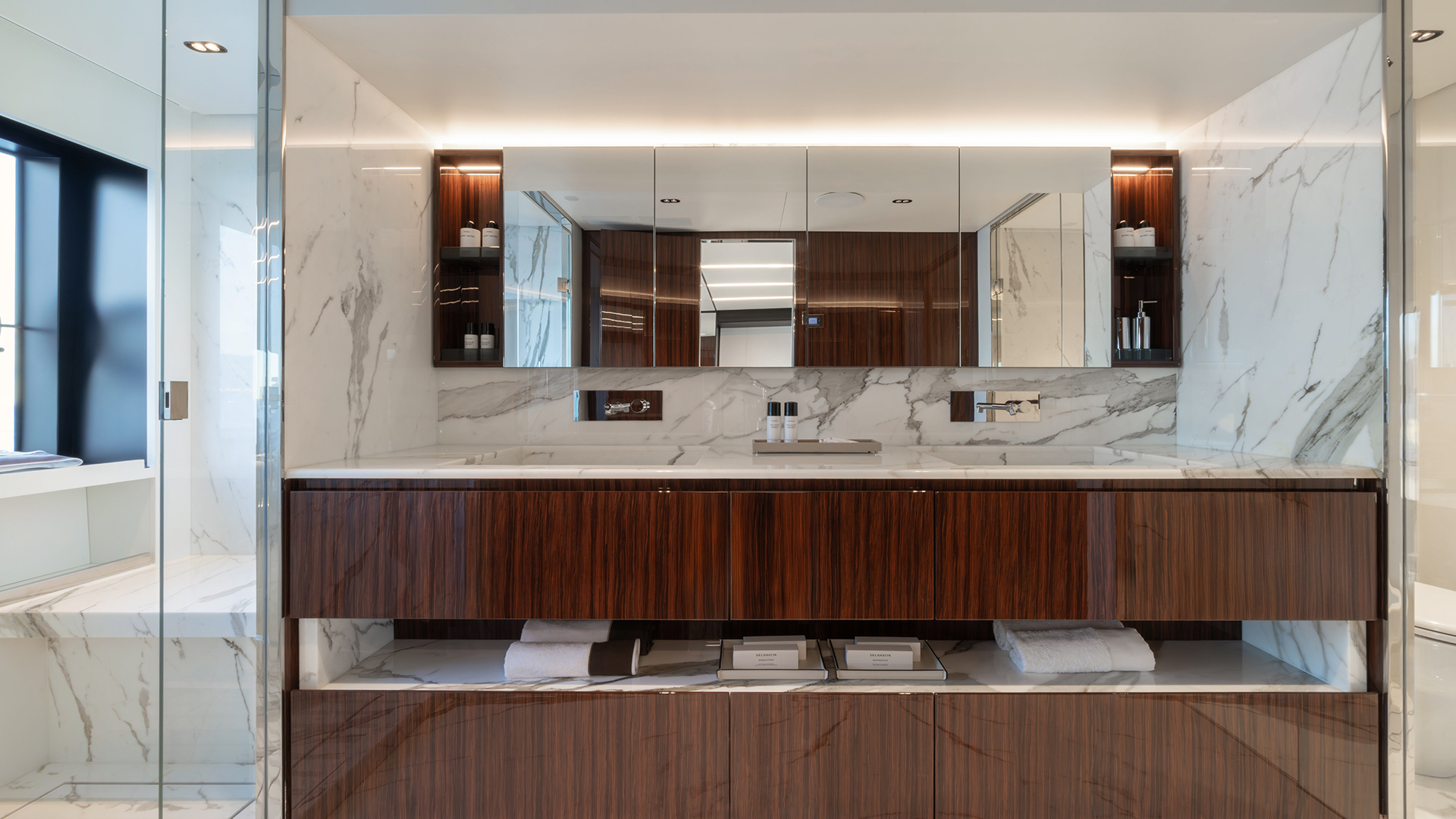 Master bath
The bow as the owner's terrace
The master suite occupies thirty-four square meters at the forward end of the main deck — a layout that places the owner at the front of the yacht and at the level of the helm, rather than below it. A new walk-in wardrobe articulates the entry, two large closets line the cabin, and a vanity desk faces hull-side glazing significantly larger than on the 110'. The bathroom carries twin basins and the same rosewood-and-leather discipline as the rest of the interior.
Below, the lower deck is structured entirely around guests and crew. Four cabins handle accommodation — two full VIPs and two doubles, each with an en-suite — and acoustic comfort has been engineered into the bulkhead rather than added on later. A reinforced partition separates the crew quarters from the guest cabins, and the flooring has been redesigned to attenuate slamming and vibration at sea. None of this shows in photographs. All of it shows in how the yacht feels under way.
A planing hull that earns its twenty-five knots
The standard package pairs two MTU 16V 2000 M96L engines, each rated 2,638 horsepower, for a top speed of 25.5 knots and a cruising speed near 23. An optional spec swaps in the M97L variants with SCR aftertreatment for nitrogen-oxide reduction — the same outputs, configured for owners cruising under tighter emission requirements. The hull is GRP with carbon reinforcement, with a planing geometry tuned for a shallow draft of less than seven feet. The performance numbers matter less than what the engineering enables: stability sufficient to make the beach club genuinely usable at anchor.
That stability comes from a layered package. Two stabilizer fins handle zero-speed and underway work. Humphree interceptors keep trim disciplined at the higher end of the speed envelope. Two optional Seakeeper NG18 gyros can be specified for owners who want to remove residual roll entirely at rest. The bridge offers three dashboard tiers — the first hull was configured with the super-premium spec, anchored by two Boening 49-inch displays. None of it is decorative. All of it is the apparatus the Dolcevita's social ambitions require to function in real conditions.
- Length overall
- 34.37 m · 112 ft 9 in
- Maximum beam
- 7.27 m · 23 ft 10 in
- Construction
- GRP hull and superstructure with carbon reinforcement
- Propulsion · Standard
- 2 × MTU 16V 2000 M96L · 2,638 hp each
- Propulsion · Optional
- 2 × MTU 16V 2000 M97L with SCR system
- Top speed
- 25.5 knots · Cruising 23 kn
- Stabilization
- Twin fins · Humphree interceptors · Optional 2 × Seakeeper NG18
- Beach club
- ~35 m² · Folding side terraces
- Accommodation
- Owner's suite plus four guest cabins · Crew quarters separated by reinforced bulkhead
- Exterior design
- Officina Italiana Design · Mauro Micheli, Sergio Beretta
- Naval architecture
- Ferretti Group Engineering Department
- Strategic direction
- Strategic Product Committee · Chaired by Piero Ferrari
- Shipyard
- Riva · La Spezia, Italy
- World debut
- 2025 Cannes Yachting Festival
Riva did not need to rebuild the Dolcevita. It needed to find what the line had never quite delivered — a stern that behaves like a beach, an interior that holds two equally serious layouts, an upper deck that earns the word residential. The 112' Super is the answer to a series of small questions the 110' had quietly been asking for seven years.
USA Onboard Editorial