

A Statement in Considered
Speed
Alia Yachts presented its latest fully custom raised pilothouse along Flagler Drive in late March. The model's intent is plain in the lines — and clearer still once one steps aboard the first hull built to it.
There is a particular silence around a yacht that has been built without compromise. It does not announce itself. It simply sits in the water, lower and longer than expected, with the unhurried confidence of an object whose decisions were made one at a time, slowly, by people who agreed about what mattered.
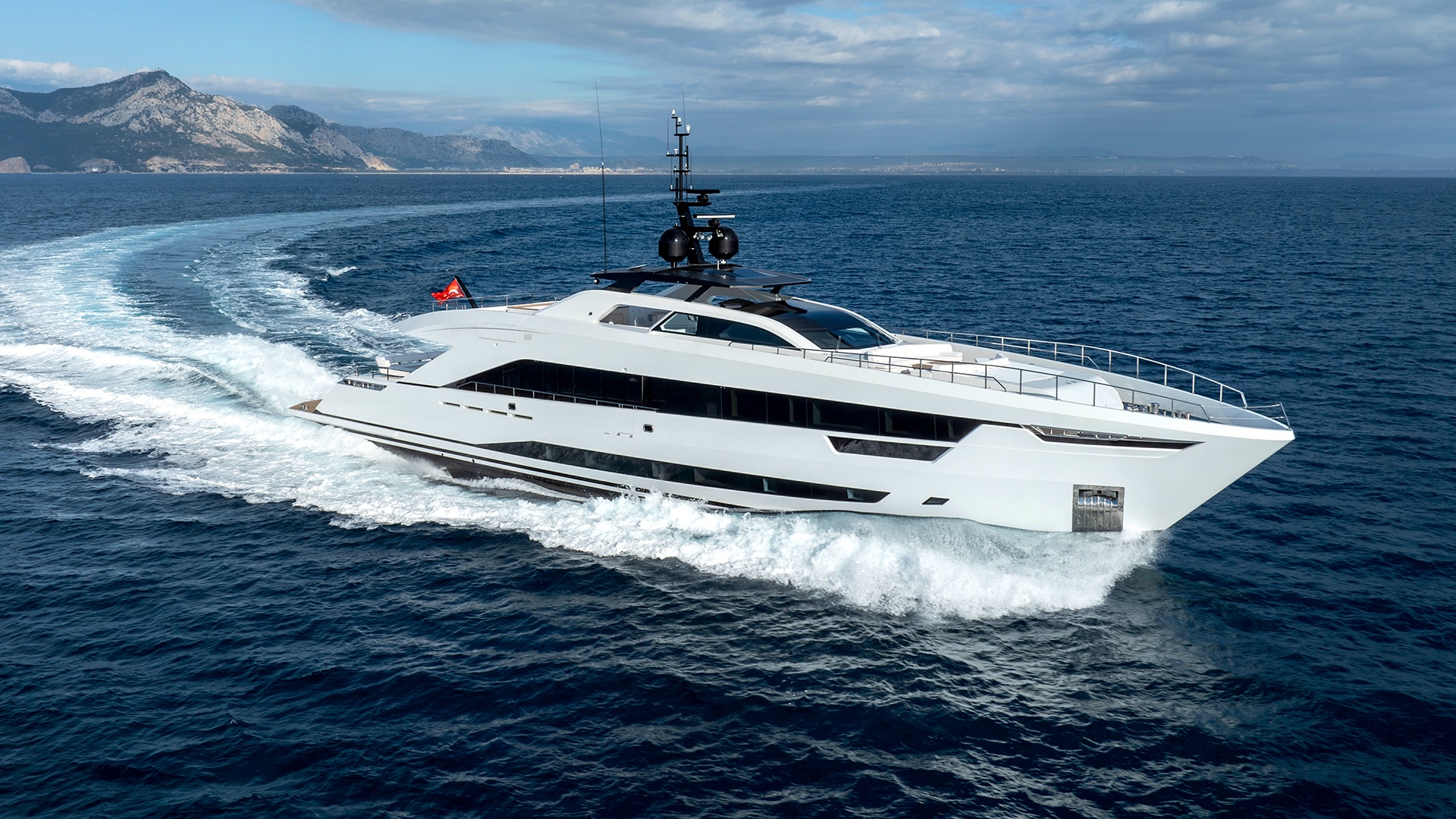
The Alia 43M arrived at Palm Beach in late March in the form of its first hull, moored along Flagler Drive for the city's annual five-day showcase, and quickly drew the kind of attention that does not depend on size. At 43 meters the platform is not the largest at the show, nor the loudest. It is, however, the one most owners walked back to a second time. The reason is not immediately visible from the dock, and that, in a way, is the point.
It is the latest fully custom build from Alia Yachts, the Antalya-based yard that has spent the last decade refining a quiet specialty: yachts in which the program is dictated by the owner rather than by the production line. The 43M is the most articulate expression of that approach to date — a raised pilothouse motor yacht designed by Omega Architects, engineered by Van Oossanen, and finished inside, on this first hull, by the Miami-based studio Yodezeen.
It is also, for what the segment has become, an unusual proposition. A 43-meter platform built around speed with intent: 22.6 knots flat out, 20 at cruising, and 3,200 nautical miles of range when settled at twelve. A 2.10-meter draft that opens the Bahamas to a yacht that could comfortably cross the Gulf Stream that morning. An aluminum hull and superstructure throughout. The performance figures matter not because the model is a performance yacht in the racing sense, but because they describe a builder that refused to choose between the things most yards present as a binary.
A figure rare among raised pilothouse yachts of this size, and rarer still among those that also report a 3,200-nautical-mile range at a twelve-knot cruise.Alia Yachts · Performance Brief
Speed without the usual concessions
The hull form is the conversation that defines the rest of the yacht. Alia returned to a long-standing partner, Van Oossanen Naval Architects, and specified their Fast Displacement Hull Form — a platform now well-tested across yards and sizes, prized for the way it behaves between hull-speed and planing speed without the usual penalty in either direction.
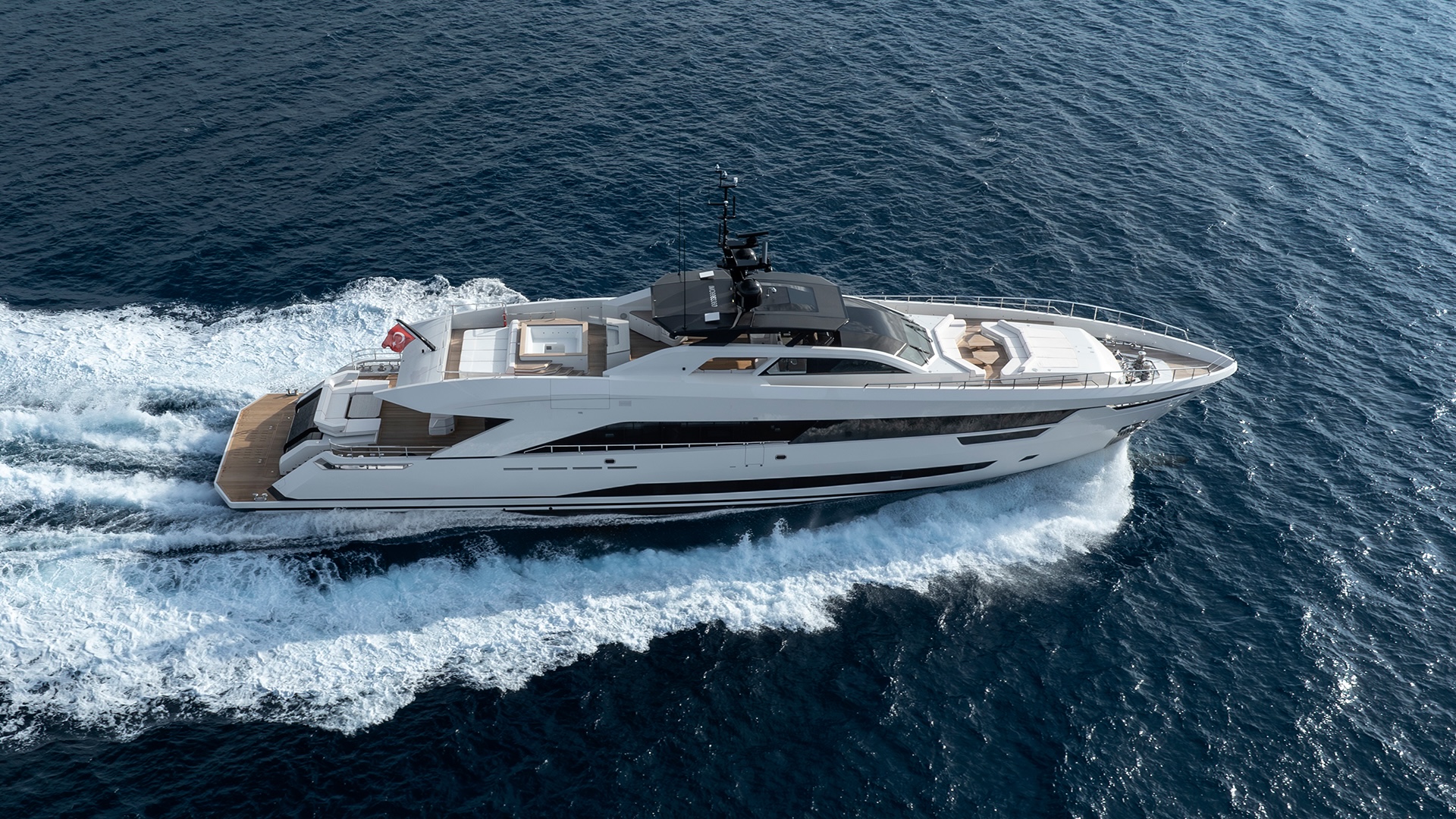
The visible signature of the choice is the bow. Sharp, forward-leaning, with the pronounced overhang the studio calls a pelican's bill, it gives the 43M its characteristic forward stance even at rest. It is not a stylistic flourish. The fine entry, shallow transom and bow spray rail are the quiet engineering decisions behind a top speed of 22.6 knots and a comfortable cruising regime at 20.
The other half of the calculation is range. At a twelve-knot cruise the same hull stretches to roughly 3,200 nautical miles — enough for transatlantic passages, enough for the long Caribbean season, enough that the question of where to take her does not begin with the question of where she can go. The yacht is powered by twin MTU 16V 2000 M96L engines, each rated at 2,000 horsepower, certified to TIER III emissions standards. The engineering is unembellished and properly conservative: serious power, contained appetite, deliberate margins.
Beneath these figures sits the third decision, less photogenic but more consequential than either. A 2.10-meter draft. On a 43-meter yacht that draft is the difference between the harbors a captain can consider and the harbors that get crossed off the list before the season begins. It is what makes the 43M a serious proposition for the Bahamas, the Florida Keys, the shallower anchorages of the Caribbean — cruising grounds normally surrendered to smaller boats. The yacht is built throughout in aluminum, hull and superstructure, classed by Lloyd's Register and compliant with the MCA Cayman Islands commercial code.
A yacht read vertically
Five horizons of life on board, from the beach club at the waterline to the sundeck two-and-a-half decks above.
Sundeck — over fifty square meters of social geography
Sheltered comfort under a black hardtop, open lounging around the jacuzzi, a fully equipped bar, and a pop-up screen that turns the deck into an evening venue. Twin pilot seats forward give guests a front-row view when the yacht is underway.
Main Deck Forward — the owner's reach
The owner's suite, set forward on the main deck and exceeding fifty square meters, is built around clean sightlines, generous glazing and a near full-beam dressing area. His-and-hers bathrooms in fantastic grey marble connect through a shared shower.
Main Deck Aft — the social spine
Saloon, dining and aft cockpit form a single continuous space, with concealed audio, integrated lighting and a drop-down cinema screen. The covered cockpit reads as outdoor lounge by day and full dining venue by night.
Lower Deck — four guest cabins, two registers
Two VIP cabins aft, two further cabins forward, each given a slightly different material vocabulary — travertine with ridged detailing, Invisible Grey marble — to register identity without breaking the yacht's overall coherence. The midships garage holds a 6.5-meter tender.
Beach Club — the waterline reclaimed
A wide teak platform with a centrally positioned hydraulic lift, and behind the glass transom, a fully fitted gym that opens directly onto the sea. The space connects wellness and leisure without surrendering one to the other.
The vertical reading
The yacht's two-and-a-half-deck arrangement keeps the profile low and drawn out, while the raised pilothouse holds the working brain of the boat above the noise of guest life. Each level was designed to be reached without crossing another.
From Antalya to Flagler Drive
A three-and-a-half-year project, traced through the milestones that mattered most to the yard and to the team that built her.
The yacht outside, in four readings
Four exterior spaces, each conceived for a different hour of the day and a different use of the boat. The connections between them are the design.
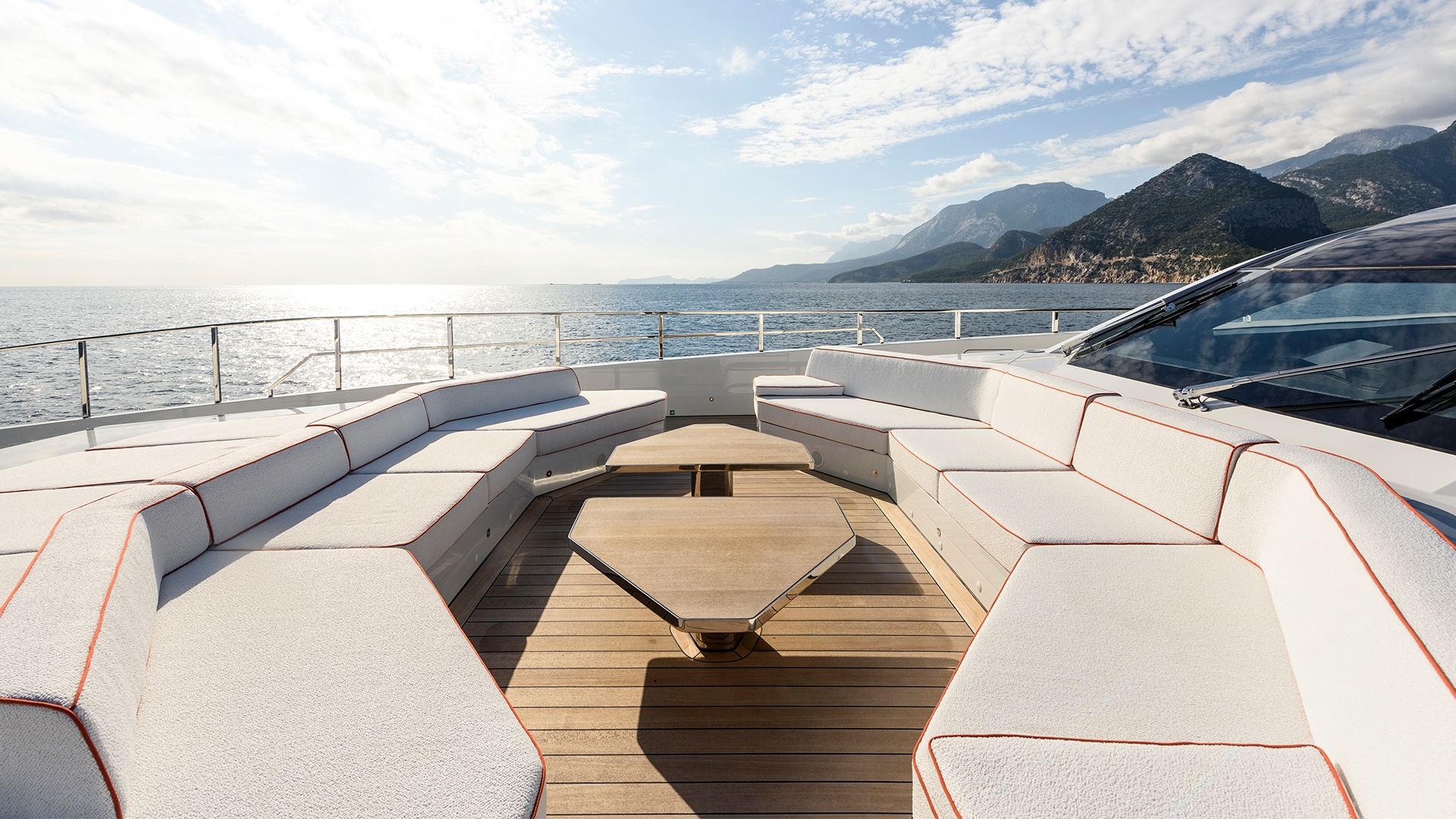
Foredeck — the quieter room
Forward of the wheelhouse, a lozenge arrangement of low seating around two tables — more intimate than the sundeck, more sociable than the saloon. The space holds a larger group comfortably and reads as the natural evening venue once the wind drops.
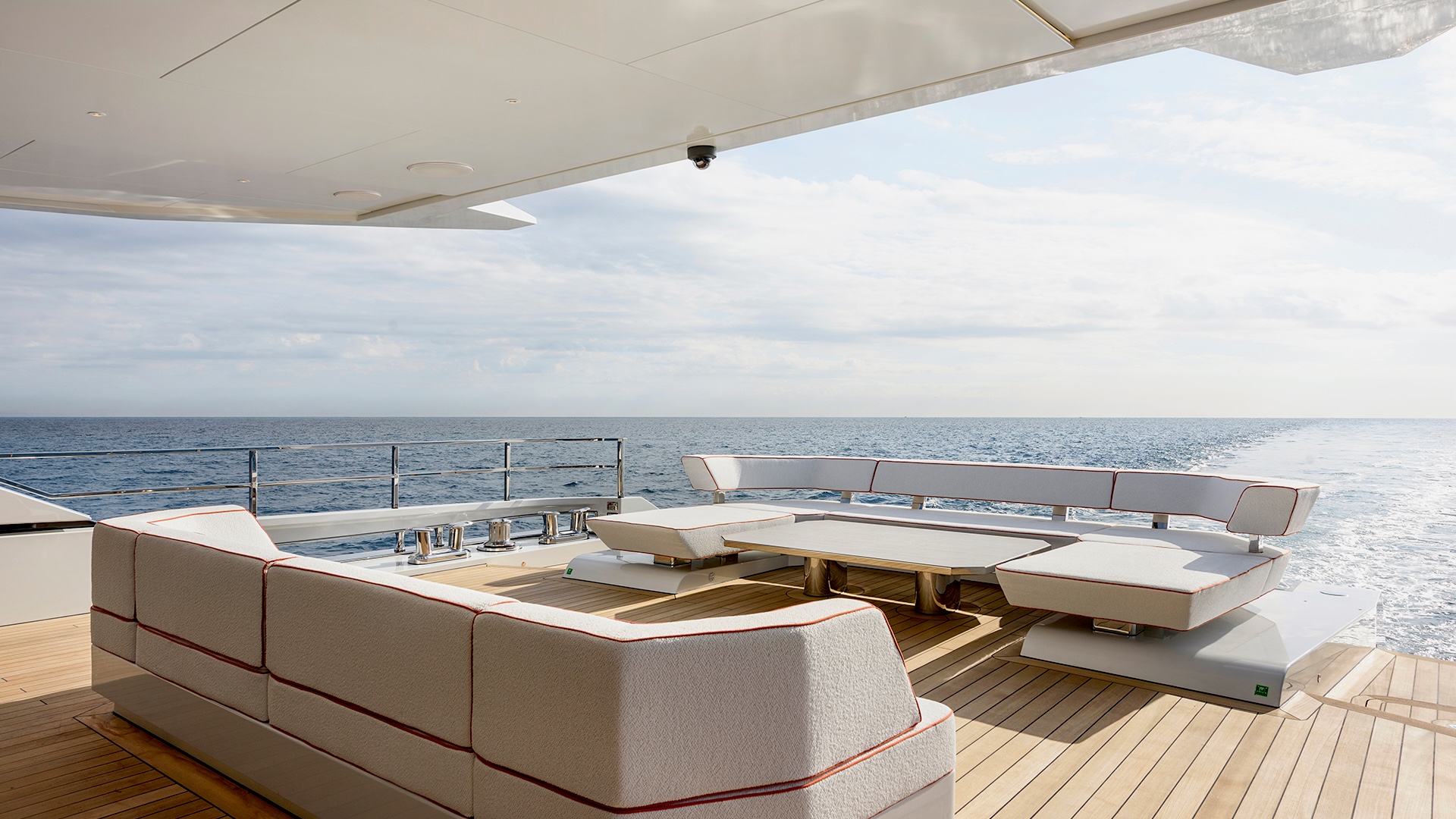
Aft Main — the flexible spine
The main deck cockpit reads in two registers: covered for shade and for after-dinner cinema, open for the long lunch that runs into the afternoon. Concealed audio, integrated lighting and a drop-down screen turn the same square footage into something different by 9 p.m.
Sundeck — over fifty square meters
Sheltered comfort under a black hardtop, open sunbathing around the jacuzzi, a full bar, generous seating and a pop-up screen. Twin pilot seats forward make the sundeck a vantage point in motion as well as at rest — the day's most flexible deck on the yacht.
Beach Club — the water-level argument
A wide teak platform meets the sea directly, with a centrally positioned hydraulic lift for swimmers and water toys. Behind the glass transom, the gym opens onto the same horizon — a single architectural gesture that lets wellness and the waterline share a room.
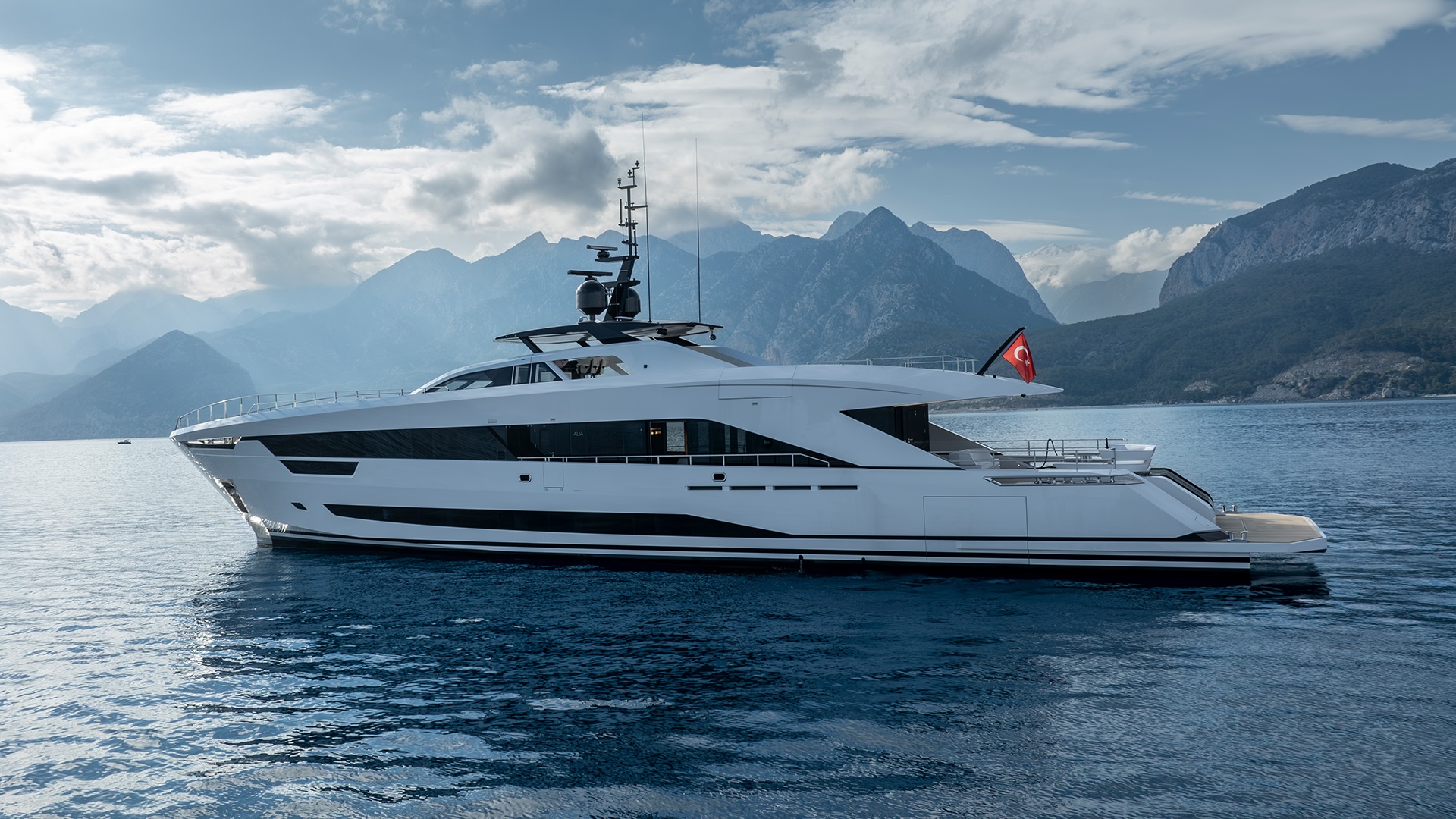
A truly custom yacht, built without compromise — fast, distinctive, and deeply personal.
Gökhan Çelik · President, Alia YachtsA loft at sea
Step inside, and the yacht's register changes. The exterior was built around motion; the interior is built around stillness — the kind that comes from rooms whose materials have been chosen by people who know the difference between expensive and considered.
Yodezeen, working in close dialogue with Alia's in-house team, set the brief in plain terms: a contemporary loft at sea, warm rather than cold, layered rather than flat, with soft curves replacing the hard geometry that has dominated yacht interiors for the last decade. The result is an interior that does not look like every other 43-meter saloon, and does not announce itself trying.
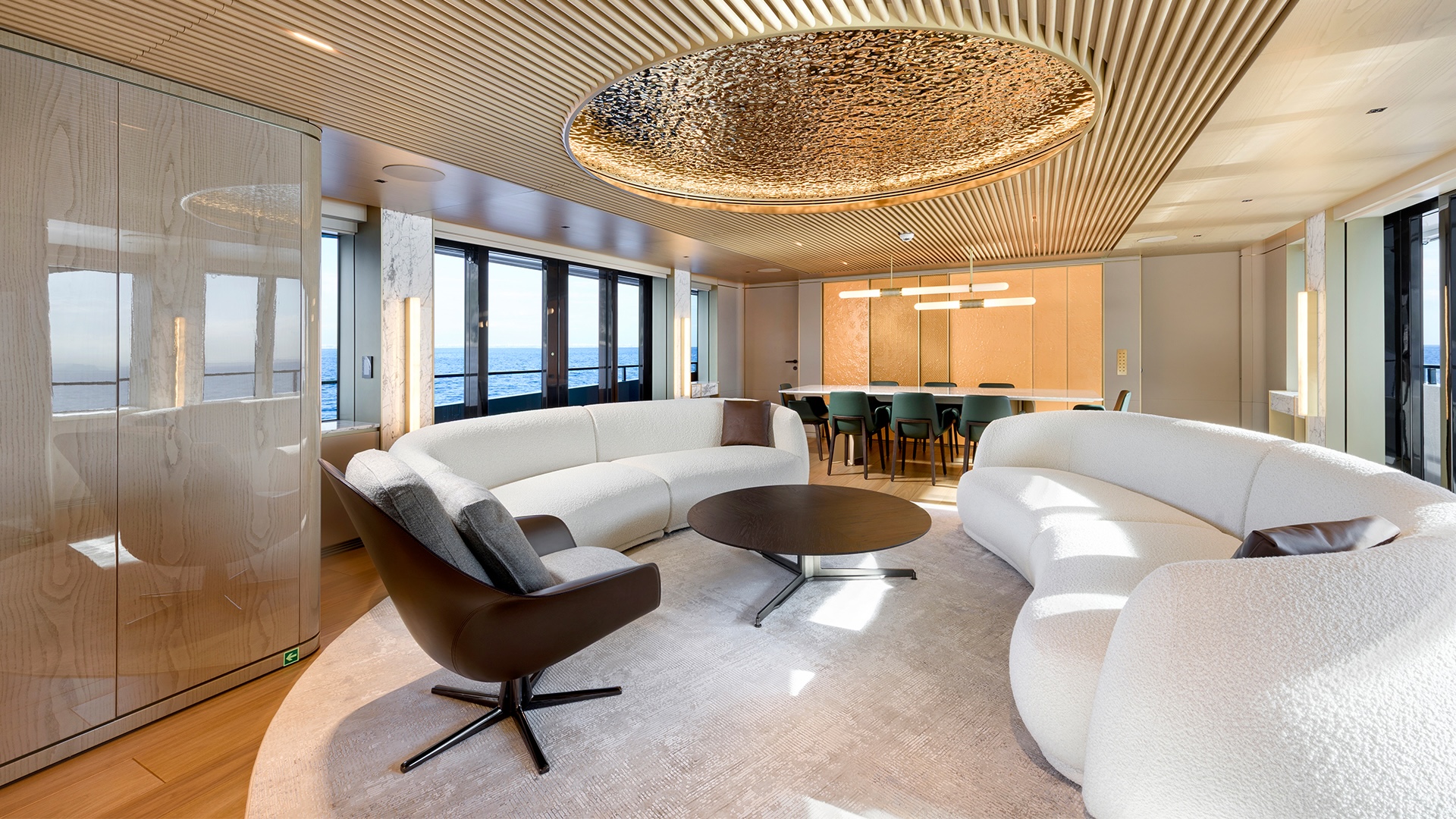
A continuity of materials runs through the yacht. Pale ivory onyx from Antolini appears twice — as a sculptural bar element and as the centerpiece of the dining table — and the eye learns the surface before naming it. Oak parquet on the cabin floors echoes the scale of the exterior teak decking, which is the kind of dialogue between inside and outside that is easy to write into a brief and difficult to actually deliver.
Wavy smoked glass, brass accents, royal gloss lacquer and natural leather complete the palette. In the main saloon, light interacts constantly with the textured surfaces — a circular ceiling feature in wavy glass behaves almost like a slow chandelier, throwing different patterns into the room as the sun moves. The curved seating and the onyx bar make the geometry of the room obvious without making it loud.
Forward on the main deck, the owner's suite occupies more than fifty square meters and is conceived, in Yodezeen's phrase, as a private retreat. Clean sightlines, generous glazing and balanced materials give the room a calm, almost residential register. His-and-hers bathrooms in fantastic grey marble — copper and brass veining running through the stone — connect through a shared shower, and a near full-beam dressing area provides the kind of storage rarely seen on a yacht of this size.
The four guest cabins on the lower deck speak the same design language with subtle variations. Two VIP cabins aft, two further cabins forward; travertine with ridged detailing in some rooms, Invisible Grey marble in others. Each space registers its own identity without breaking the yacht's overall coherence — the principle of variation within a single language is what keeps a 43-meter interior from feeling repetitive.
The interior, read by room
Five spaces that carry the weight of the design intent, each photographed in the daylight that defines them.
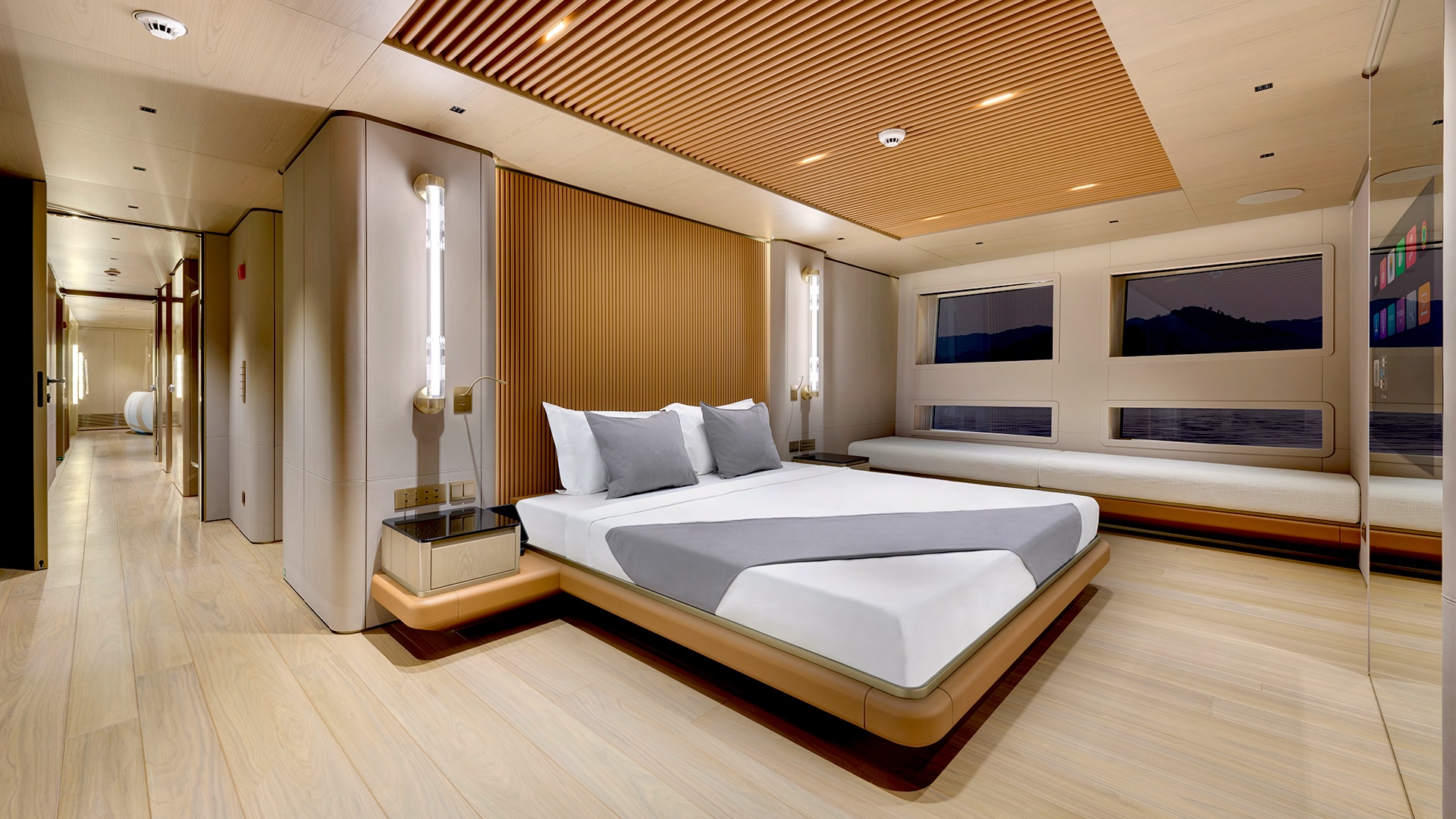
Owner's Suite
Over fifty square meters set forward on the main deck, with full-beam proportions, generous glazing and a dressing area that runs almost the width of the yacht. The room is conceived as the calm anchor of the boat.
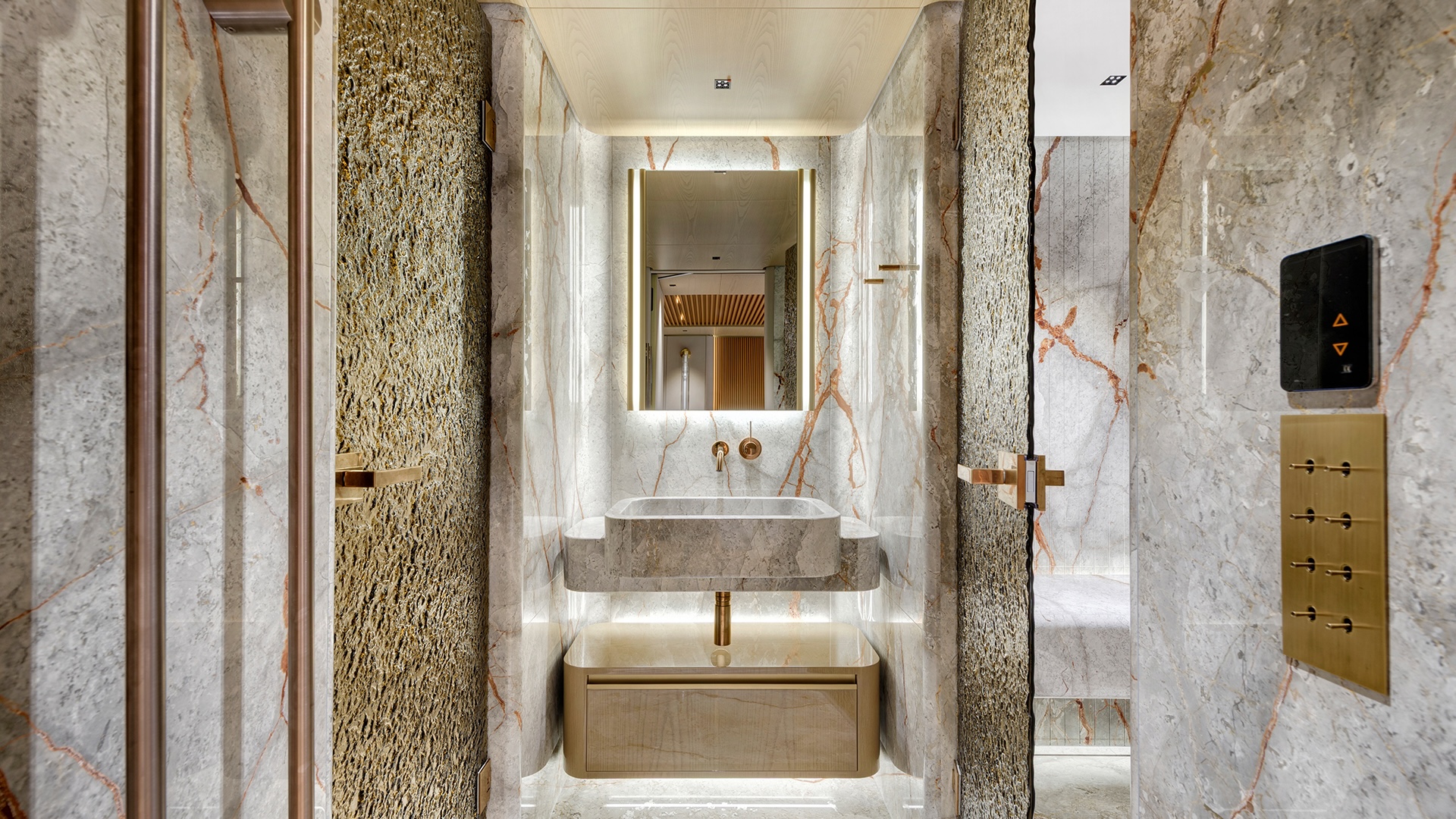
Fantastic Grey
His-and-hers bathrooms in fantastic grey marble, the stone's copper and brass veining used as the principal ornament. A shared shower connects the two rooms and resolves what is usually a compromise.
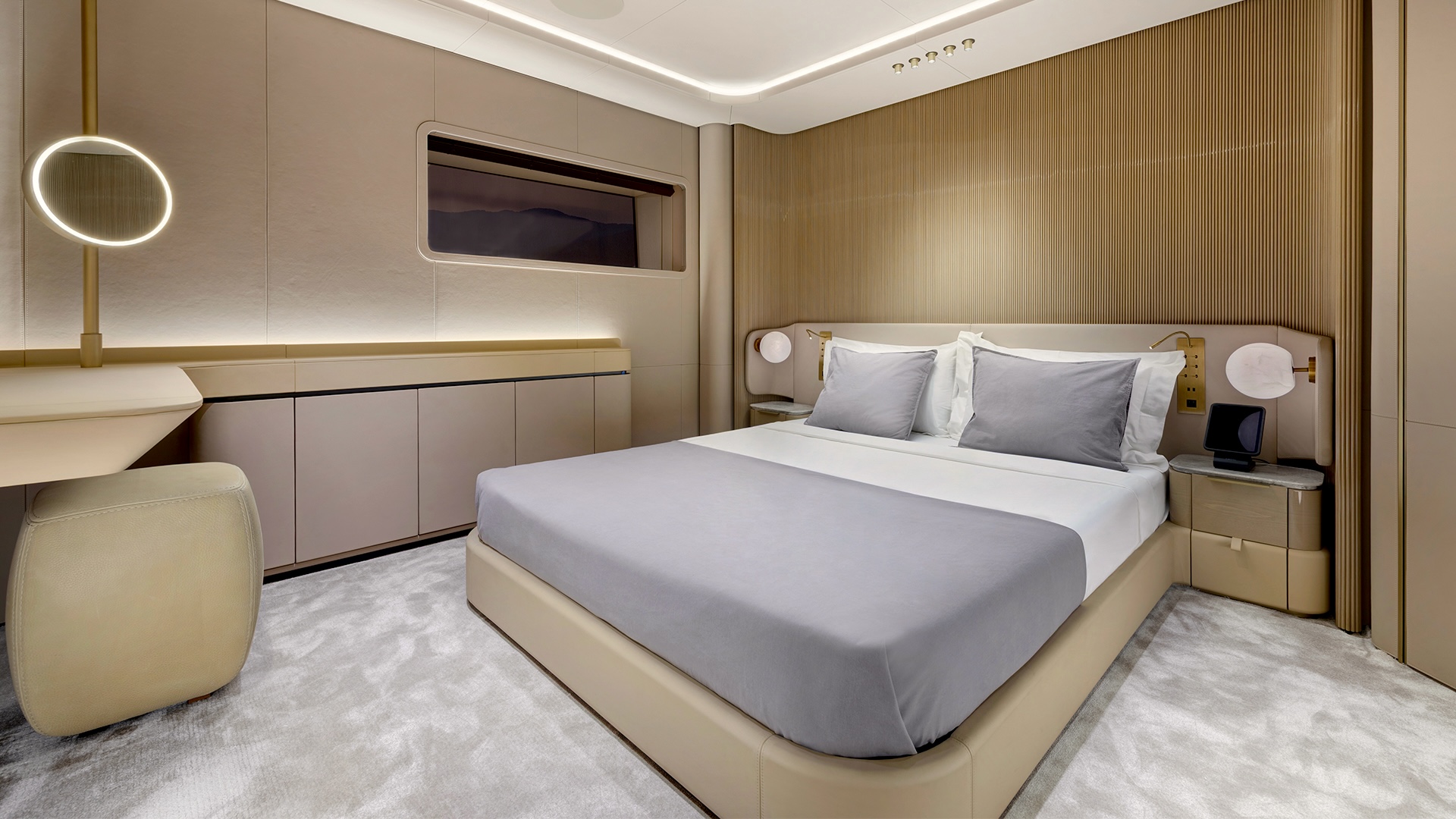
VIP Cabin
A double bed, side glazing, and a quiet variation of the yacht's material palette — travertine and Invisible Grey marble appear here, registering the cabin's identity without breaking the interior's continuity.
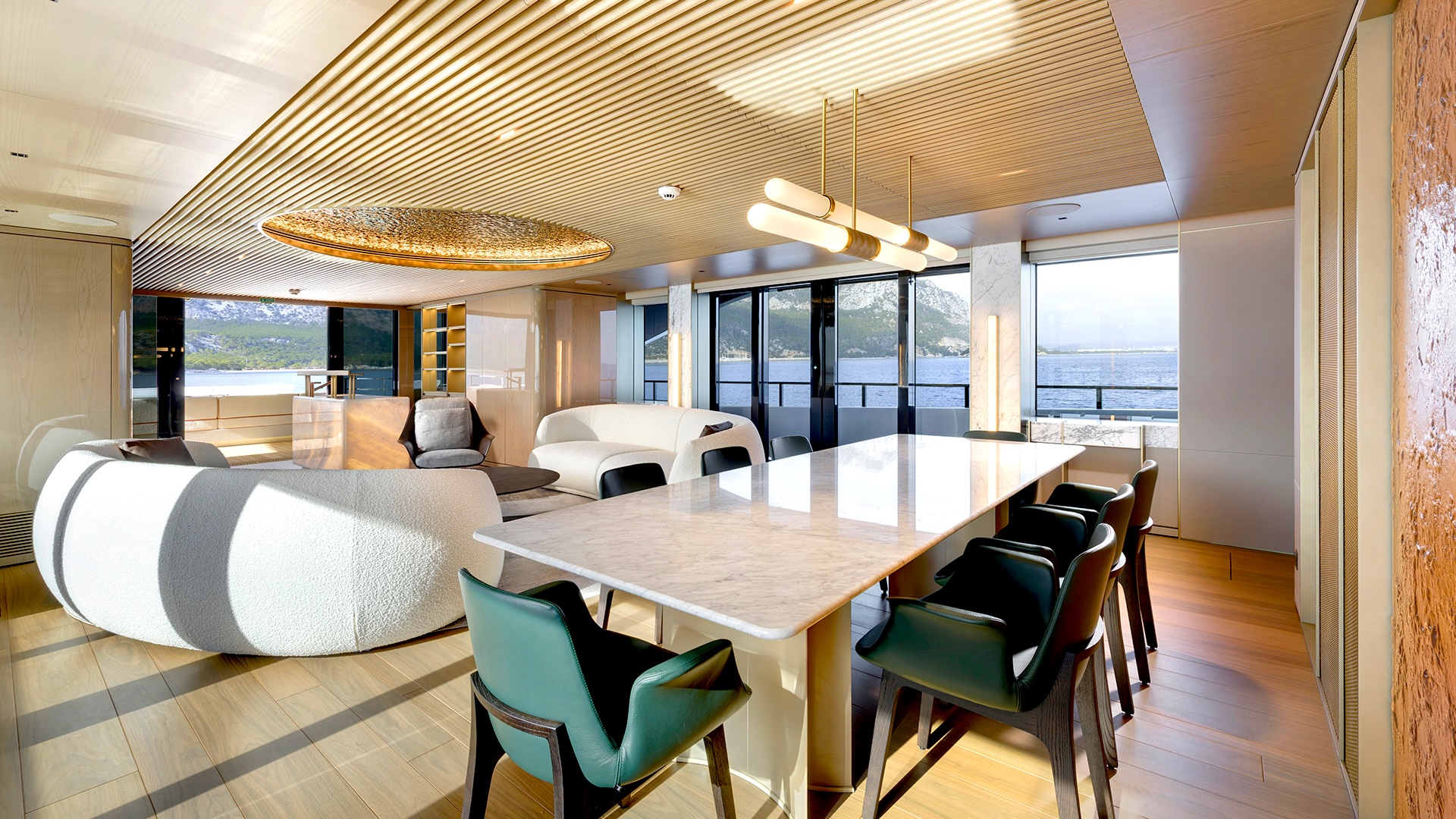
Dining Room
Centered on the pale ivory onyx table, the dining area sits in continuity with the saloon. Natural light from full-height glazing carries the day's hours through the room without artificial intervention.
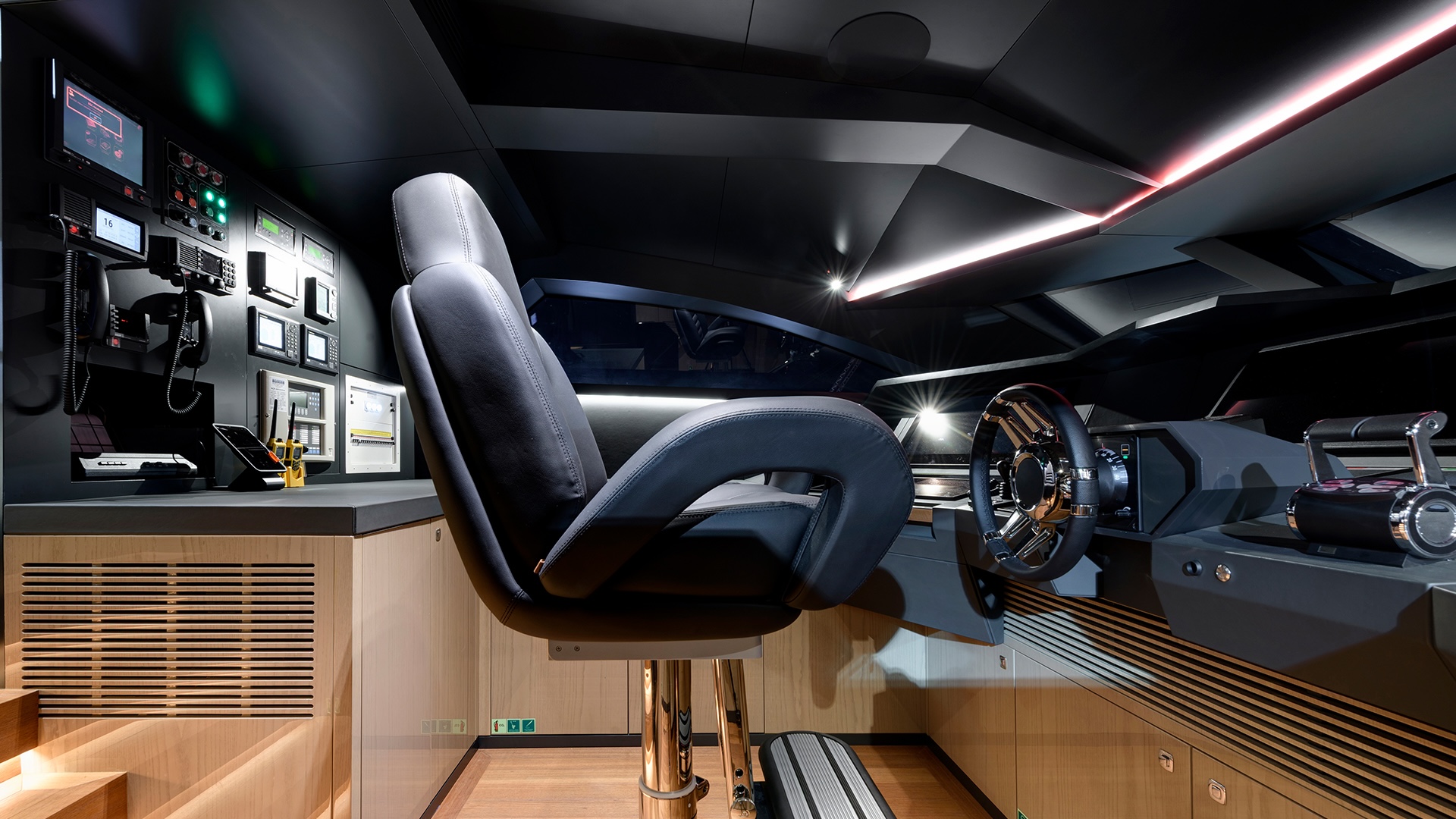
The Wheelhouse
The working brain of the yacht, set above guest decks for clear sightlines and operational quiet. The raised configuration is the structural decision that gives the 43M its characteristic two-and-a-half-deck profile.
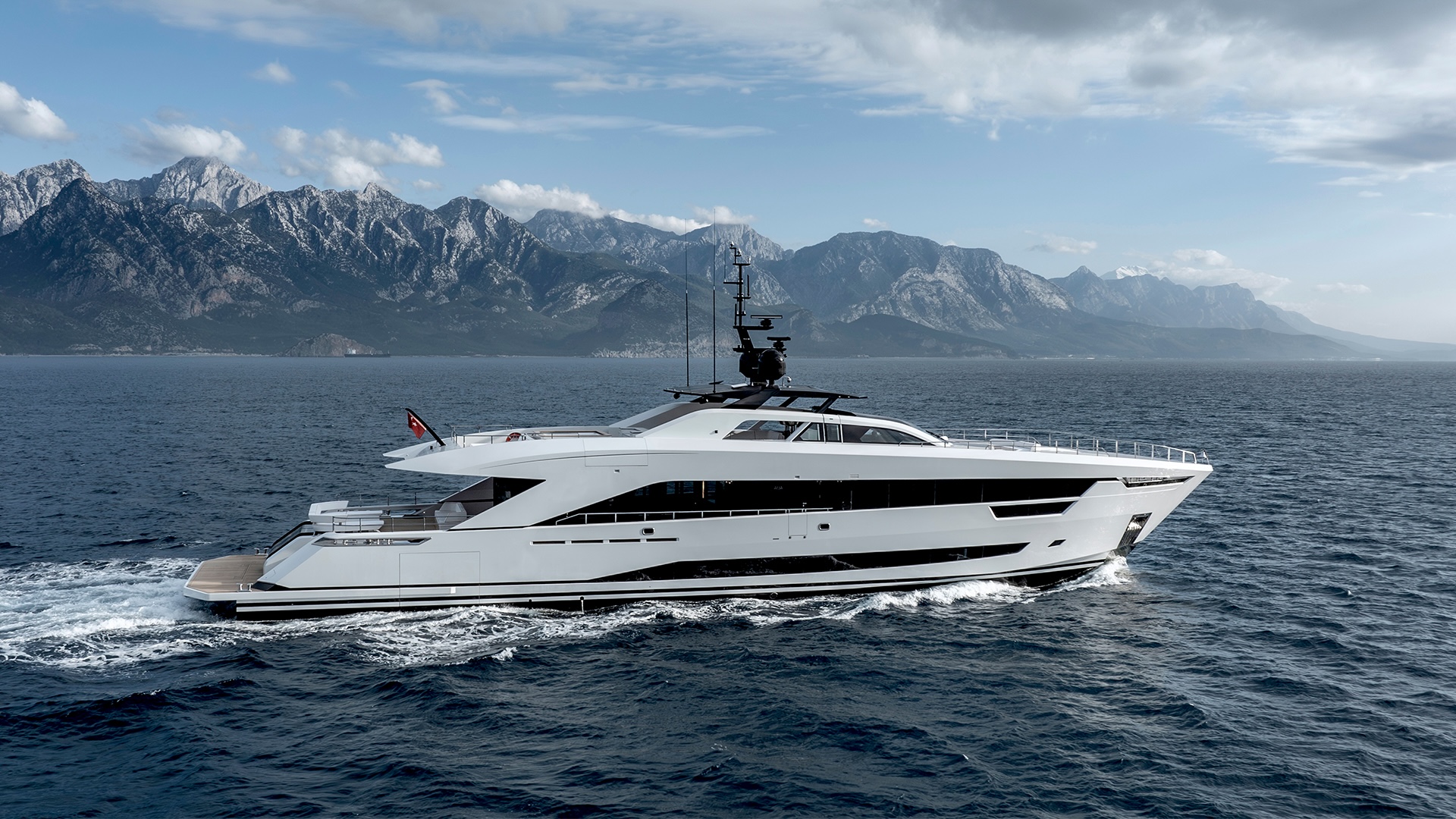
The Profile
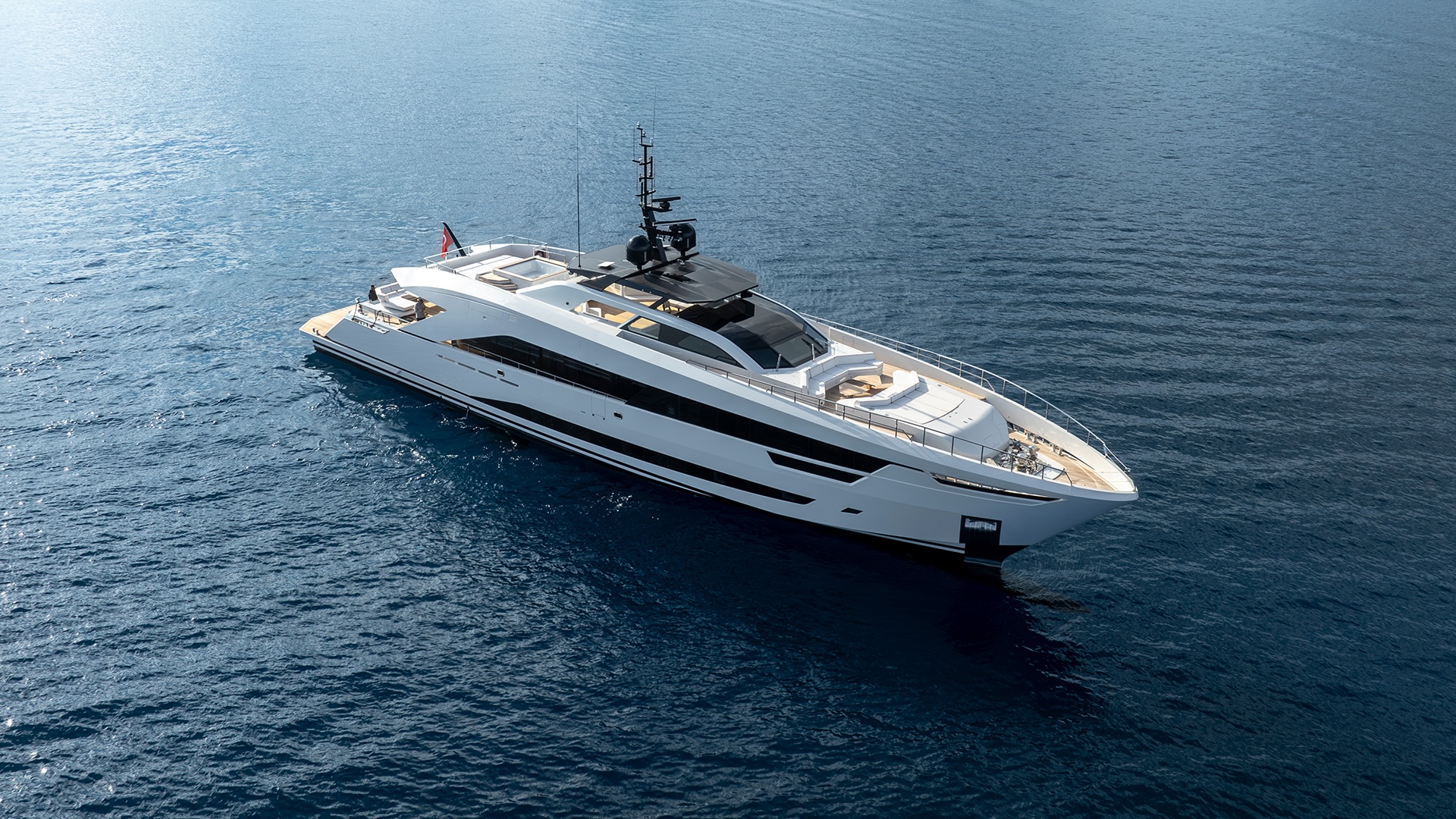
Seen broadside at rest, the yacht's two-and-a-half-deck stack and pelican's bill bow read as a single, deliberately drawn line. The visual signature of a hull form designed before a single panel was cut.
Two columns, one yacht
The argument the segment usually presents as a binary, dissolved into a comparison both columns can occupy at once.
The 43M, in three registers
A reading of the yacht across the three vocabularies that defined her — engineering, spatial, and material.
A 43-meter yacht is not a small object. It is, however, a small enough scale that every decision shows. With the Alia 43M, the Antalya yard has presented a platform in which the decisions argue the same case at every level — performance, layout, surface — and the case is that full custom is not a marketing claim but a working method.
USA Onboard · Yacht PremiereFeature Desk
Yachting Magazine · Skipper ONDECK
Pozitif Studio