




Homes That Begin
at the Dock
The finest American waterfront residences are no longer designed around the view. They are designed around the threshold — the precise point where architecture, terrace, and water finally agree on the same idea.
For years, waterfront property was understood as a real-estate category before it was understood as a way of living. The view added value. The dock counted as an upgrade. Water access functioned as a feature, the way a wine cellar or a four-car garage does. But the house itself was rarely conceived as part of a life lived on the water.
That has changed — quietly, and at the very top of the market. Among the most considered American waterfront residences of the last decade, the dock has stopped behaving like an appendix. It now functions as the true threshold of the home: the point at which the architecture finishes one sentence and the water begins the next. The shift is not stylistic. It is structural. It rewrites how a house is planned, how it is approached, and ultimately how it is lived in.
The change is most visible in the warm-water belt — South Florida, the Gulf Coast of Florida and Texas, the Lowcountry of the Carolinas, the bays and estuaries of Southern California — where the navigable season runs ten to twelve months a year and the boat is treated less as an occasion than as an extension of the household. But the same logic is reshaping the great Northern lake estates, the classic Great Lakes properties, and the deep waterfront tradition of the Northeast, where the season is shorter but the rituals around it run deeper. The geography differs. The principle does not.
What follows is less a checklist than a reading of the moment — the design instincts, ownership habits, and editorial cues that distinguish a house that has water from a house that genuinely begins at the dock. The difference, at this level, is rarely about square footage. It is about continuity.
Ten houses, one reading of the water
The dock has stopped being an appendix
In a well-planned waterfront residence, circulation reads as a single uninterrupted sentence. Interior to deck, deck to dock, dock to vessel — the movement is so logical it never asks to be noticed. That fluency is the first marker of seriousness. Houses that treat the dock as a technical afterthought always reveal themselves on arrival: a service path that runs along the side of the property, a level change that demands a key, a transition that breaks the rhythm of the day. Houses that begin at the dock arrange the entire ground plane so that the water reads as part of the floor plan, not a feature beyond it.
The implications are spatial before they are aesthetic. The best architects working in the warm-water belt now design the dock and its approach with the same care given to a foyer or a primary suite. Lighting is layered, not blunt. Materials hold their composure under salt and humidity. Sightlines remain open between the boat, the terrace, and the rooms that matter. The result is a property that reads as one continuous gesture from street to slip — and that registers, the moment one arrives by water, as composed rather than assembled.
- Fluid circulation between architecture, terrace, and vessel — no service detours, no level breaks.
- Reception spaces directly engaged with the water, not turned politely away from it.
- Premium materials specified for the marine environment — composure under salt, sun, and humidity.
- Privacy preserved without sacrificing visual openness — transparency that does not expose.
- Climate, lighting, and acoustic systems that accompany without intruding.
The dock learns to receive
In a poorly resolved property, the dock is a working surface — a place to maneuver, to load, to depart from. In a great one, it acquires a second life as a social room. It becomes the place where guests are received before the front door has been touched, where evenings are extended past the last cocktail in the saloon, where conversation drifts because the architecture allows it to. The lighting drops. The water settles. The boundary between hosting and resting blurs, and the dock holds both without strain.
This is where waterfront design separates from coastal real estate as a category. A house with a slip serves an owner. A house that begins at the dock serves a way of living that integrates navigation and hospitality as part of the same gesture. Cocktails before departure read as a natural movement; the return at dusk is met by a terrace already prepared for it. The architecture stops asking the owner to mediate between two registers — house and boat — and learns to hold both at once.
It is also where the cultural difference between regions sharpens. In South Florida and the Gulf Coast, the dock as social room is almost a year-round given; the climate writes the script. In the Great Lakes and the Northeast, the season is brief and the rituals are tighter — the opening of the dock in late spring, the closing in October, the last evenings of warm light before the cover comes back on. The structures differ, but the sensibility is the same: the dock is treated as a room of the house, planned with the same intention as any other.
Three ways the house meets the water
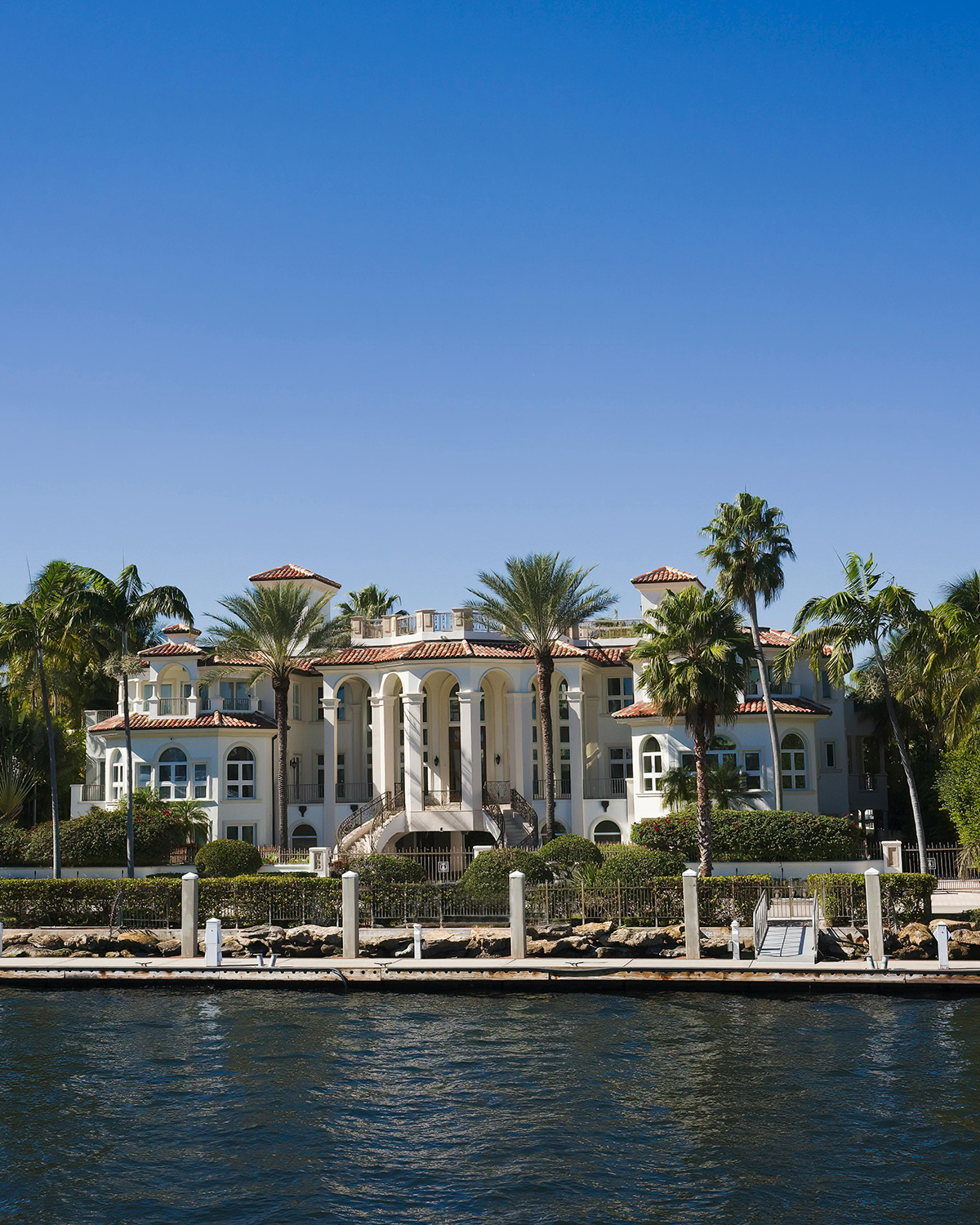 Mansion · Front view from the water
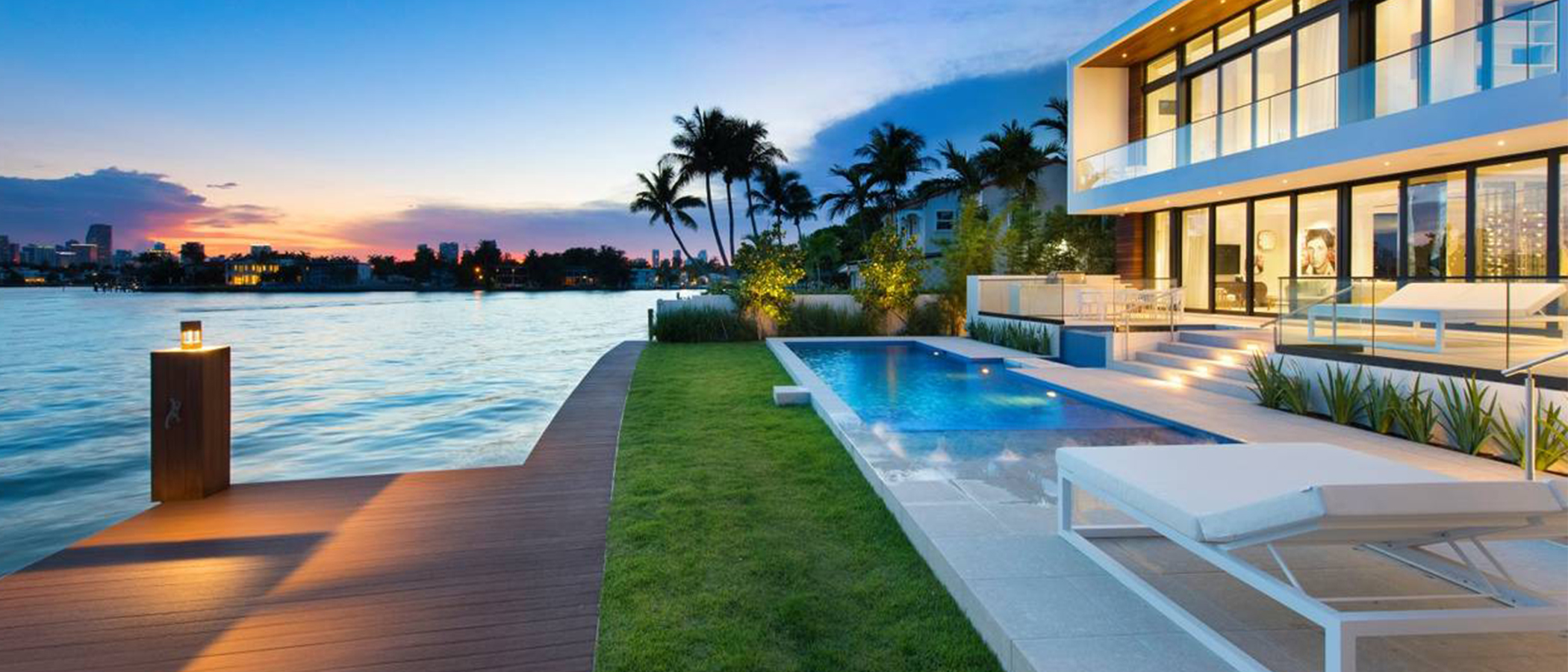 From the dock · At sunset
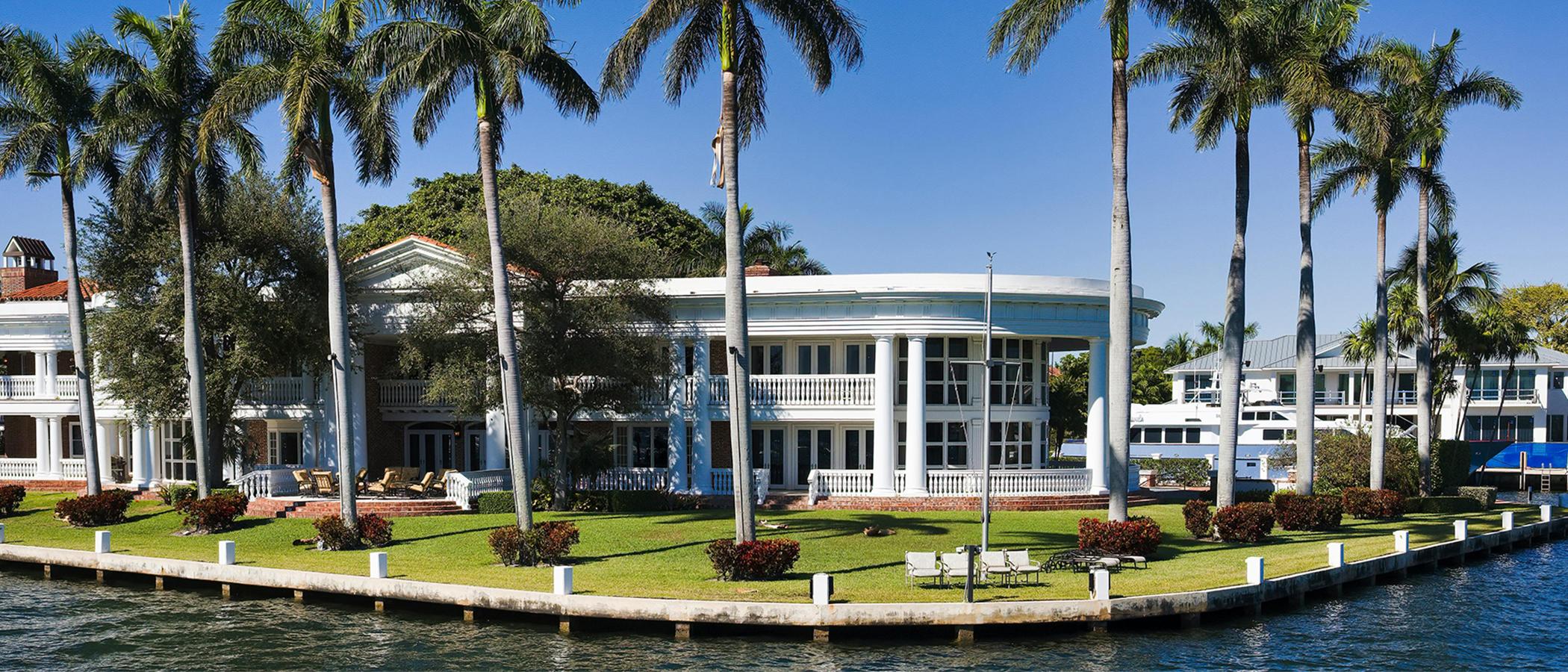 Classic American · The shoreline tradition
The dock stops being a place to maneuver and becomes a place to receive, to linger, to close the day.
USA Onboard · Editorial reading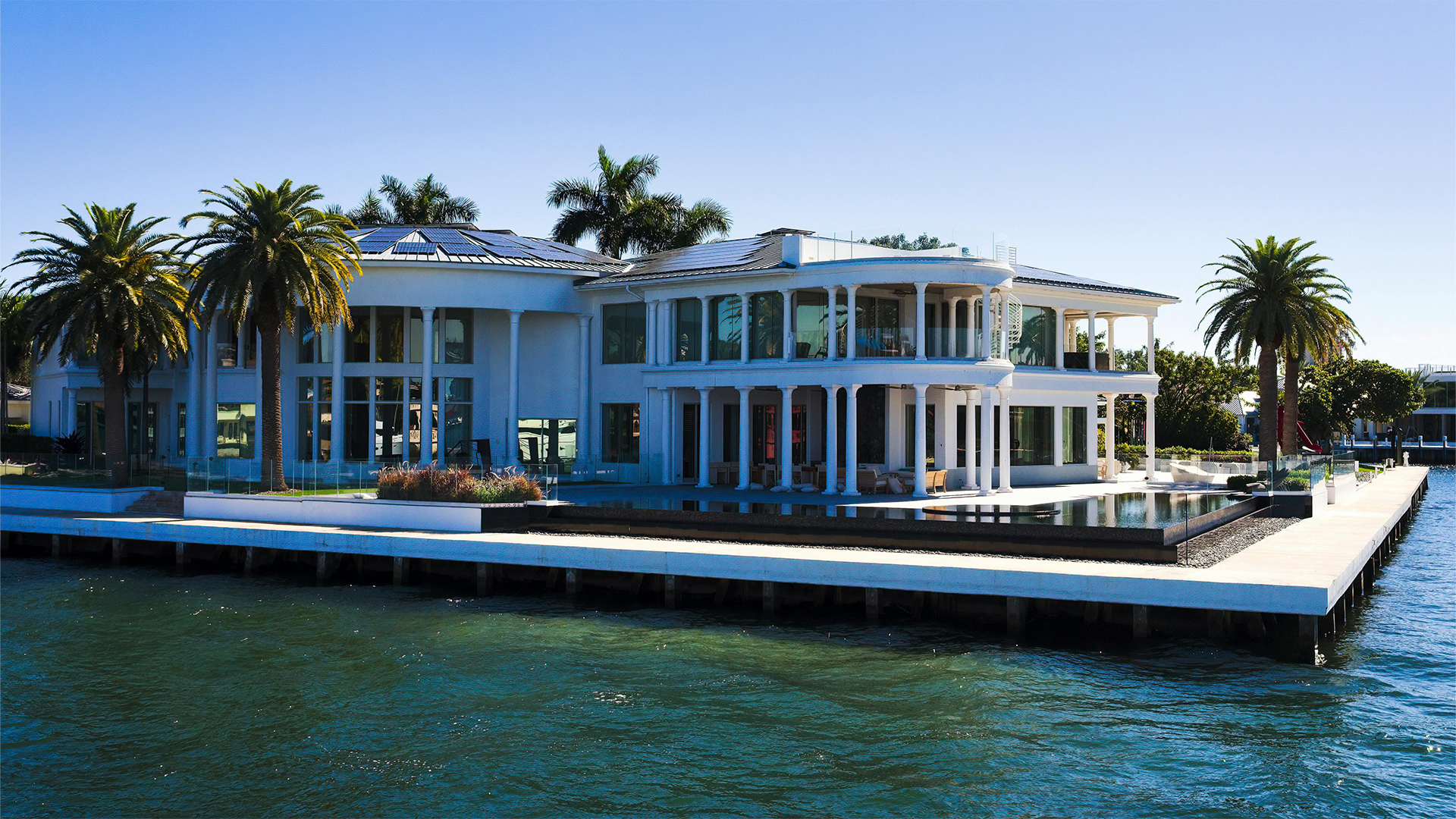
The marine environment is a brief, not a backdrop
A waterfront house is, in technical terms, a building permanently exposed to a corrosive partner. Salt-laden air, intense reflected sun, sustained humidity, occasional storm — every detail of a serious property is a quiet response to that brief. The materials choose themselves only in poorly conceived projects. In the best ones, every surface has been considered for how it will read in five, ten, twenty years of that exposure.
What the discipline produces, when done well, is a particular kind of restraint. Stone is selected for how it weathers, not only for how it looks new. Metals are specified in marine grades, with finishes designed to age rather than fail. Timber is honest about the climate it is asked to live in — teak, ipe, certain thermally treated hardwoods that earn their patina with time. Glass is detailed to handle hurricane loads without losing its lightness. The aesthetic vocabulary is luxurious; the underlying argument is engineering.
Climate management runs along the same logic. The best houses do not fight the sun with brute mechanical force. They calibrate shade through deep overhangs, brise-soleil, calibrated terraces — and only then ask the systems to finish the work. Cooling is silent rather than aggressive. Lighting bends to the natural cycle rather than overruling it. The result is a property that registers as composed rather than conditioned — the climate present in the architecture, not banished by it.
 Great Lakes · Wood and tradition
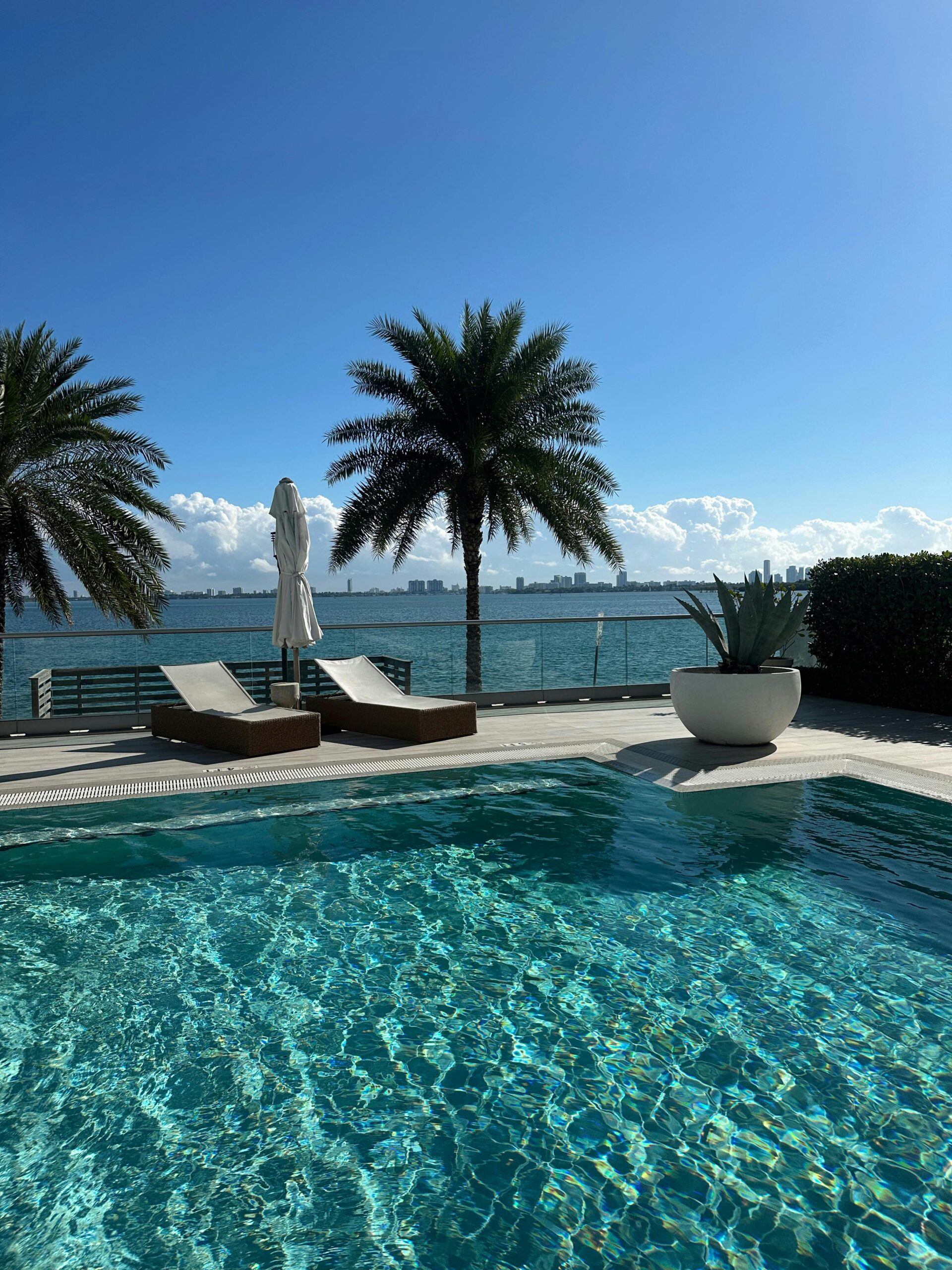 Southern terrace · From pool to sea
Two coasts, one discipline
The American waterfront is not one market. It is several, each with its own grammar. Fort Lauderdale and the Miami canals operate on a vocabulary of generous slips, deep-draft access, and a year-round ritual that allows the boat to function as a daily extension of the house. Naples, Sarasota, and the Florida Gulf Coast work a quieter register — flatter water, longer sightlines, a different kind of light. The Charleston Lowcountry and the Outer Banks import an architectural tradition into a tidal landscape that has shaped American boating for two centuries. The Southern California bays — Newport, San Diego, Marina del Rey — translate the same instincts into a Pacific idiom.
North of the warm-water belt, the conversation shifts but does not break. The Great Lakes — Michigan's western shore, Lake Geneva in Wisconsin, the Finger Lakes — sustain a waterfront tradition that predates the Florida boom by generations. Wooden boats, classic mahogany runabouts, family compounds that open with the thaw and close with the first hard frost. The shoreline of Long Island, Cape Cod, Maine, and the Hamptons works yet another register: high-pedigree houses, deep architectural memory, a season measured in opportunities rather than months. The geography differs. The discipline does not.
A short editorial guide to looking at waterfront
For owners and decision-makers approaching the segment seriously, the marker of quality is not square footage and not even the boat at the dock. It is a small set of architectural readings that recur, with quiet consistency, across every great waterfront residence — regardless of style, period, or coast.
- Approach
- The dock is integrated into the architectural composition from the water, not added at the back of the lot.
- Circulation
- One continuous path from interior to terrace to slip — without service detours or unsightly level breaks.
- Reception
- A defined social space at the dock itself — not only a mooring surface, but a room of the house.
- Materials
- Stone, metal, and timber specified for marine endurance and graceful aging.
- Sightlines
- Transparency between the rooms that matter and the water — without sacrificing privacy from the channel.
- Climate
- Shade calibrated by architecture first; mechanical systems silent, layered, never the dominant note.
- Light
- A lighting scheme that survives both the noon glare and the long evening — and reads composed from the channel after sunset.
- Tenure
- Houses planned for decades on the water, not for the closing photograph.
In the most considered American waterfront residences, the water is not contemplated from a distance. It is inhabited. It enters the rhythm of the household, finds its way into the language of the architecture, and becomes part of the identity of the home. That is the difference, in the end, between owning a house with a view and owning a house that begins at the dock.
USA Onboard · Editorial