
The Maneuver,
Resolved
Why docking, the three-minute sequence that decides the temper of every passage, has become the most contested frontier in marine electronics.
A yacht owner remembers two moments from any given passage. The first is leaving the dock. The second is coming back to it. Everything in between, the open water, the long cruise, the calm hours, settles into a kind of haze. The two endpoints stay sharp. They are where the day is judged.
Docking is the most expensive minute a yacht owner faces. It happens in close quarters, with side wind pushing the bow off line, current sliding the hull laterally, and a slip whose geometry rarely forgives error. Insurance underwriters know the figure: the majority of recreational hull-damage claims occur at speeds under three knots, within twenty meters of a fixed structure. The math is hard to argue with. Almost everything that breaks a yacht happens while it is trying to stop.
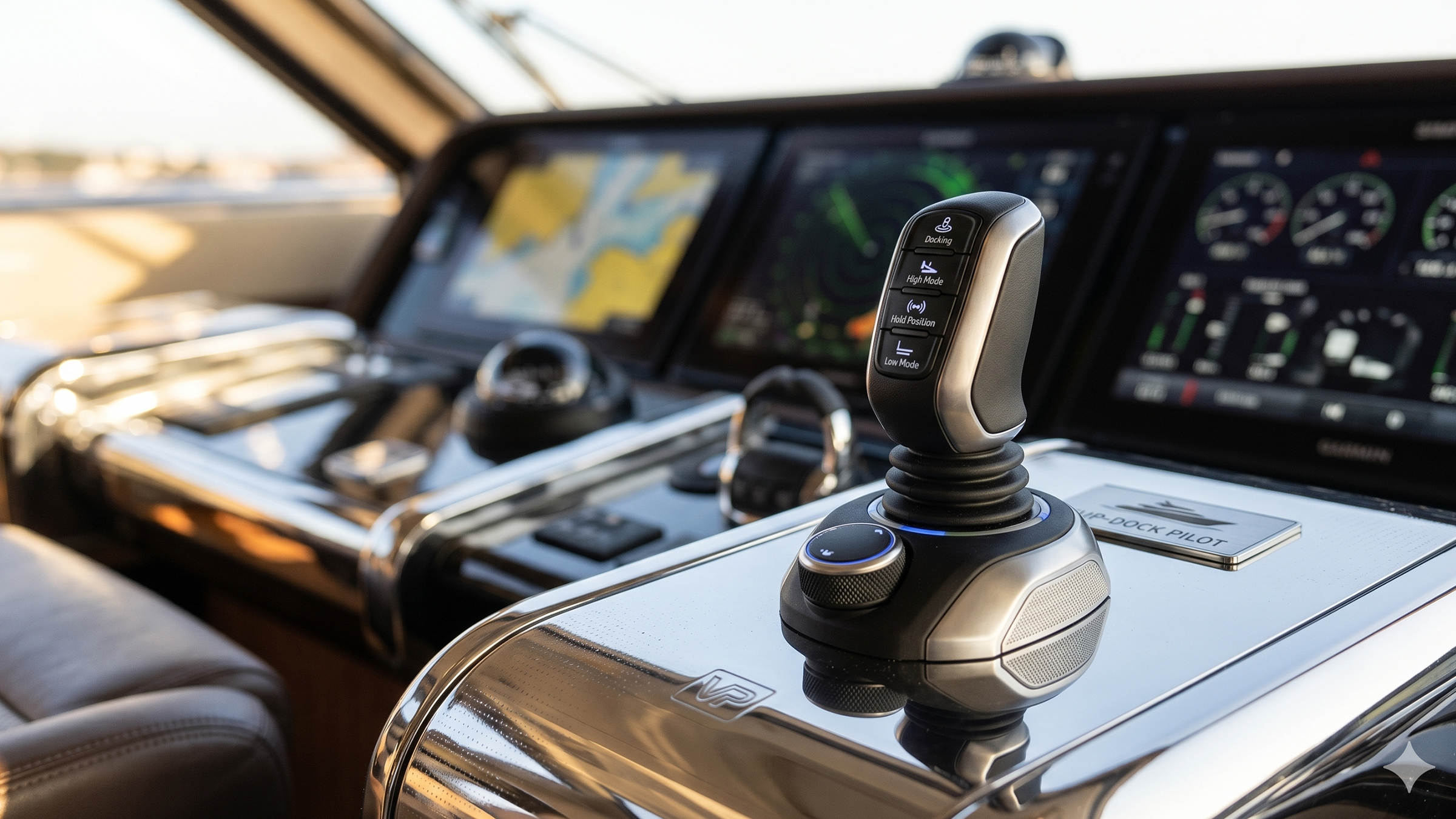
For the last fifteen years, the industry's answer to this has been the joystick. A single lever at the helm, mapping the boat's engines, transmissions, and thrusters into one intuitive input. Move it forward, the yacht moves forward. Twist it, the yacht rotates on its own axis. It is now standard equipment on virtually every motor yacht above forty feet, and it remains a remarkable piece of integration. But the joystick is a translator, not a calculator. It executes what the captain's hand asks for, instant by instant. The mental work of reading the wind and the current, deciding how much correction is needed, and adjusting on the fly, still belongs entirely to the person at the helm.
What has changed in the last five years is the appearance of systems that begin to do that mental work themselves. They read the wind and the current with sensors, they know exactly where the hull is with GPS precision down to the centimeter, and they actively compensate for both, several times per second, while the captain holds the joystick and watches the dock approach. That category, the systems that calculate the maneuver rather than merely execute it, is what the industry has come to call assisted docking. And it is the most consequential thing to happen to close-quarters maneuvering since the joystick itself.
The geography of the last three minutes
What assisted docking is not
The first thing to settle is what the term covers, because the marketing around it has become muddled. A joystick is not assisted docking. Neither is a station-keeping function that holds the yacht on a GPS point while the engines hum. Neither is a 360-degree camera view that gives the captain a bird's-eye perspective of the slip. These are excellent tools. They are, individually, the foundations on which assisted docking is built. But they are not, on their own, what the category describes.
Mercury Marine's Joystick Piloting, with its Skyhook station-keeping function, is the cleanest example of the foundational layer. The joystick maps the yacht's engines and thrusters to one intuitive control. Skyhook, with a button press, holds the boat's position and heading against wind and current. Both are remarkable, both are now standard on most twin-engine motor yachts. Neither calculates the docking approach itself. The captain still does that, manually, every second of the maneuver.
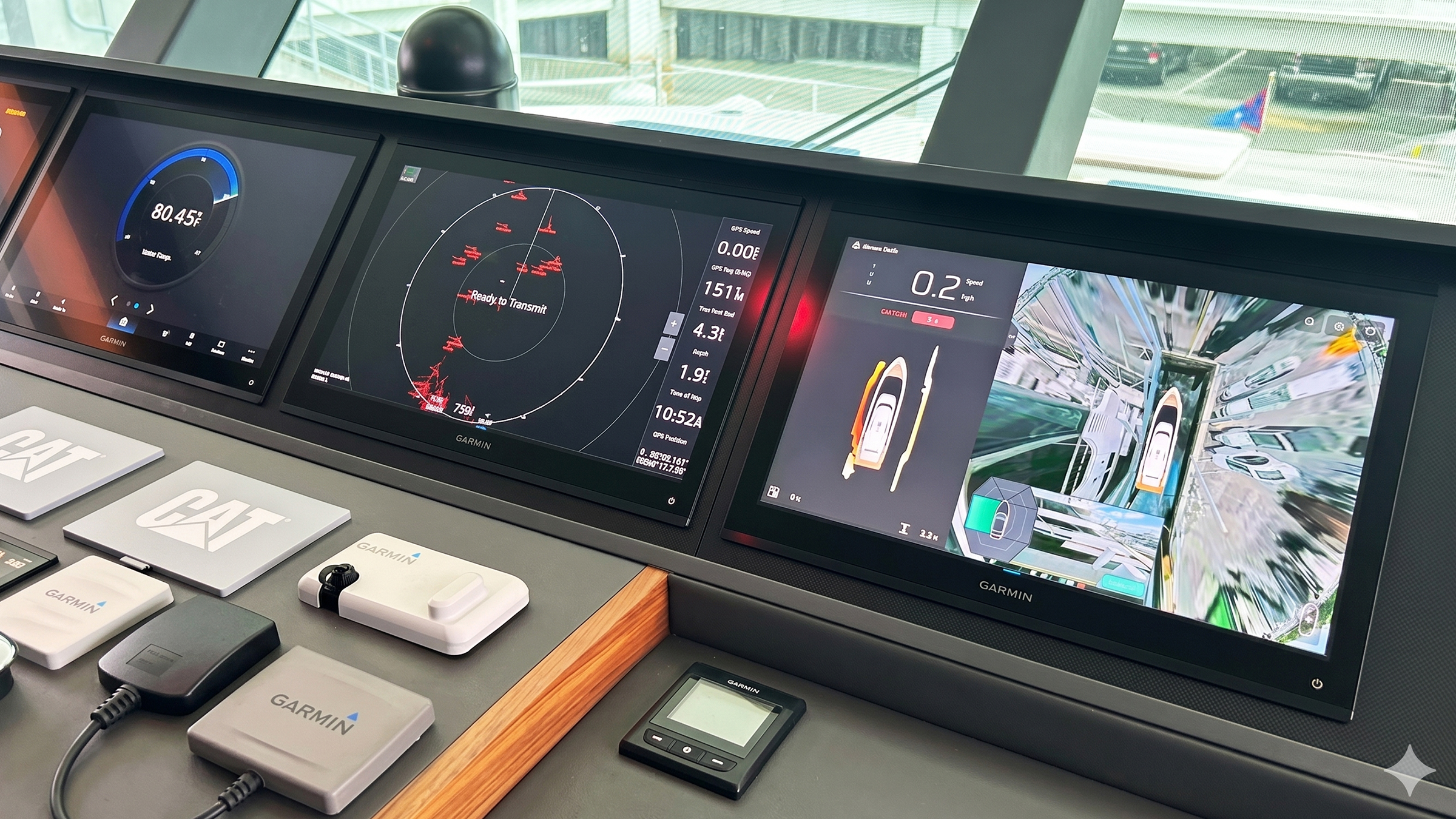
Garmin Surround View belongs to the same foundational tier, on the perception side. Six 1080p cameras integrated into the hull stitch a live, top-down 360-degree view of the yacht and everything around it, displayed on the helm's multifunction screen. The system is a magnificent piece of situational awareness, the equivalent of the bird's-eye parking aid in a modern car, scaled up for an eighty-foot motor yacht. But the cameras report. They do not act. No engine input is corrected, no maneuver is computed.
Assisted docking, properly defined, is what happens when those foundational layers are joined to a software brain that calculates. The brain reads sensors continuously, decides what correction the hull needs, and sends commands to the propulsion system to execute that correction, several times per second, while the captain holds the joystick. There are, at present, four serious systems on the market that meet that definition. The rest of this feature is about them.
Assisted Docking, as Volvo Penta defined it
In January 2021, against the backdrop of the Consumer Electronics Show, Volvo Penta announced what it described as the industry's first fully integrated Assisted Docking system. The claim was technical, not promotional. Earlier products had offered station-keeping, joystick mapping, or camera-based perception. None had joined those layers into a single closed loop where the software actively calculated and corrected the maneuver while the captain held the joystick.
The system is built on three components Volvo Penta already manufactured. The first is the IPS pod drive, the forward-facing propulsion architecture the company introduced in 2005 and which still defines its motoryacht catalog. Each pod rotates independently and can be steered through a wide arc, allowing the hull to translate sideways, rotate on its axis, or hold a fixed point with no rudder involved. The second is the Dynamic Positioning System, a GPS-based station-keeping module that already existed inside the Volvo Penta electronics package. Assisted Docking refined the antenna, added receivers, and improved positional accuracy. The third is the joystick, which had been on the market since 2006.
What the software does is sit on top of all three. When the captain pushes the joystick forward to indicate the desired direction and speed, the system reads the yacht's actual position and heading several times per second, compares them to the captain's intended vector, and adjusts the angle and thrust of each pod in real time to keep the hull on that vector. If the wind tries to push the bow off line, the pods compensate. If the current slides the hull laterally, the pods compensate. The captain is still holding the joystick, but the calculation of how much correction is needed at any given instant has moved into the software. Release the joystick, and the system assumes the captain wants the boat to stop. It holds the position.
The Side Push function deserves a separate note, because it solves the moment most captains describe as the hardest in any docking. Once the hull is positioned alongside the dock, the captain pushes the joystick laterally toward the dock and activates Side Push on the display. The system holds the boat there, against the dock, indefinitely, while the crew handles the lines and fenders. The pods micro-correct against wind and current in the background. It is the difference, in practical terms, between a maneuver that ends with a captain shouting at his crew and one that ends with everyone walking aft and tying off without urgency.
What the system is calculating
Top-down view of a yacht backing into a Mediterranean-style slip between two moored vessels. The captain's intended vector is straight. The wind and the current are not. The software's job is to read both, in real time, and command each pod to keep the hull on the captain's line.
The closed loop · Wind, current, hull position, correction
 The single input
 The helm, with assistance
DockSense, and the virtual bumper
Raymarine took a different route to the same destination. While Volvo Penta built outward from its propulsion package, Raymarine built inward from its perception package. The system, called DockSense, was introduced in 2019 and is the oldest of the four covered in this feature. It exists in two versions, which are useful to separate.
The first, DockSense Alert, is essentially advanced sensing without intervention. Between three and five stereoscopic FLIR cameras are placed around the hull, networked to a central processor and to a Raymarine Axiom multifunction display. The cameras read the environment in three dimensions. When the system detects that something solid, a piling, a pier, a neighboring hull, is closing on the yacht at a rate that may produce contact, it issues an audible and visual alarm to the captain. Three escalating alert levels, yellow flashing, red flashing, full warning. The captain is responsible for everything that happens next.
The second, DockSense Control, is where the system becomes assisted docking in the strict sense. The same cameras and processor now feed a software layer called the Virtual Bumper, a configurable perimeter around the yacht that the captain can define on the display. If an object breaches that perimeter while the captain is using the joystick, DockSense Control intervenes. It introduces corrective steering and throttle commands, automatically, to push the yacht away from the obstacle. The captain is still maneuvering. The system is now editing his inputs in real time to prevent contact.
A useful technical distinction: where Volvo Penta is tightly tied to its own IPS propulsion, Raymarine deliberately built DockSense to be propulsion-agnostic. The partnership underlying the engine intervention is with Emerson Automation Solutions, the manufacturer of the Aventics marine hydraulic actuator platform. That choice was deliberate. DockSense was designed to be installable on yachts running Mercury, Volvo Penta, or other engine architectures, integrated through Raymarine's own electronics rather than through the engine manufacturer's. The trade-off is complexity at install. The benefit is portability.
In practical terms, the two philosophies converge on the same outcome. A captain holding the joystick gets a hull that resists colliding with what it shouldn't. The route to that outcome, propulsion-first in Volvo Penta's case, perception-first in Raymarine's, simply reveals two different engineering instincts at the same moment in the technology's history.
A closed loop, built from familiar parts
An assisted docking system is not a single device. It is a network of sensors that report, a software brain that calculates, and a propulsion package that responds. The captain sits inside the loop.
Sensors · ECU · Captain · Actuators
Assisted docking is a hybrid between automated docking and manual docking.
Ida Sparrefors · Volvo Penta · Director, Autonomous Solutions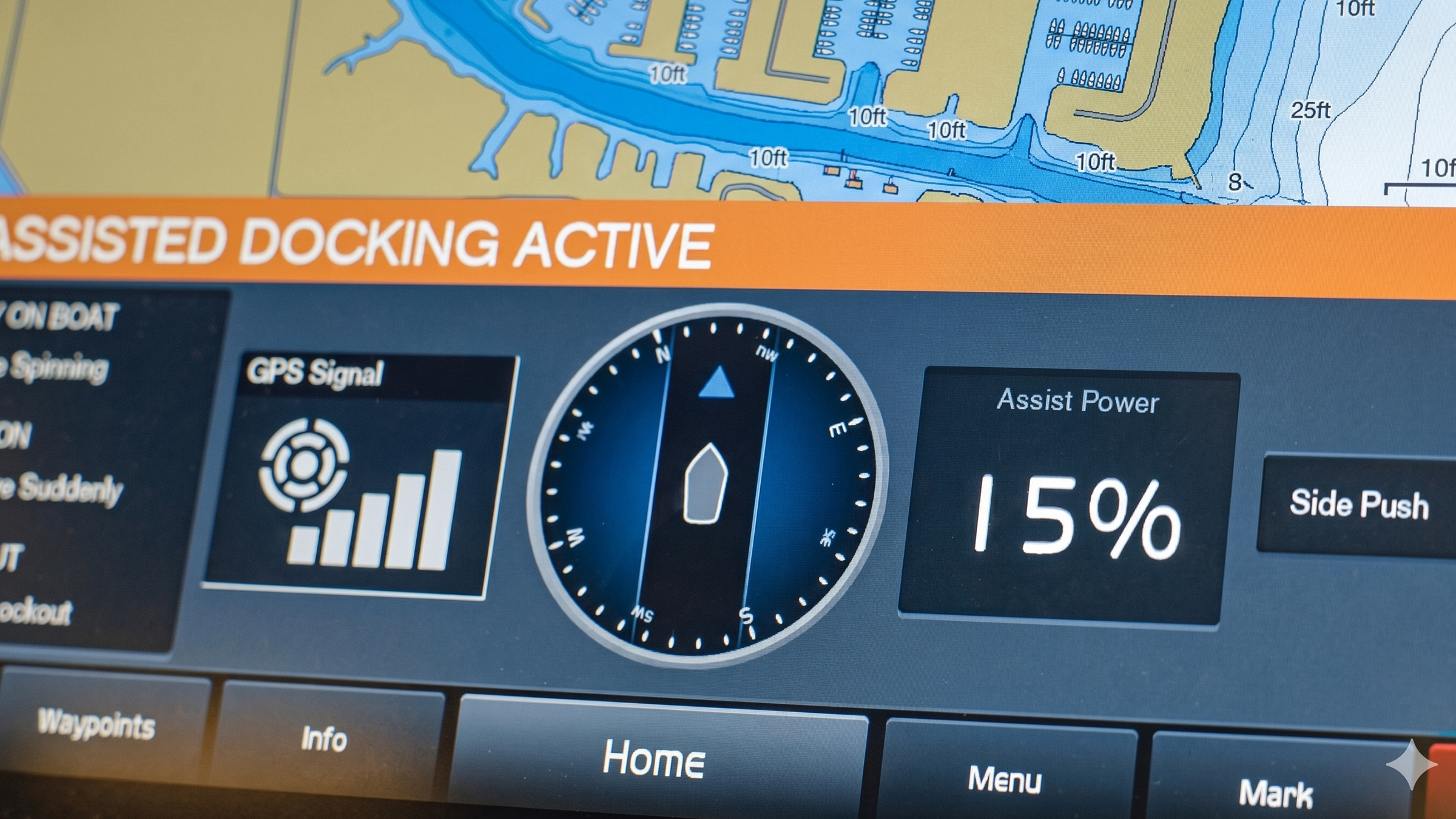 The synthesized view · A virtual perimeter
NeuBoat, the South Korean arrival
The third serious contender comes from a less expected direction. Avikus is the autonomous-navigation startup spun out of HD Hyundai, the largest shipbuilder in the world, established in late 2020. Its leisure-marine product, NeuBoat Dock, was launched at the 2024 Cannes Yachting Festival in partnership with Raymarine. A second-generation version, NeuBoat Dock II, was introduced at the 2025 Miami International Boat Show, where it took the NMMA Innovation Award for technology.
The system is built on the perception side of the problem. Six cameras placed around the hull feed an AI processor that synthesizes a 3D, 360-degree view of the yacht and its surroundings, rendered on the multifunction display. The camera array is the visible part. The intelligence is in what the software does with it. NeuBoat Dock II identifies objects automatically, distinguishes a piling from a neighboring hull from a fender, calculates distances in real time, and triggers an alarm when any non-water object enters a five-meter perimeter around the boat. The captain is given, in effect, an assistant that watches every quadrant of the yacht simultaneously and never blinks.
Two functions deserve specific note. The first is Docking Assist Guidance, which overlays the optimal approach path and target position onto the display as the captain maneuvers in. The second is Home Point: the captain marks a preferred docking position once, and the system thereafter offers a one-touch return route to that exact slip. Both functions sit on the assistance side of the line, not the autonomy side. The yacht does not dock itself. But the captain is operating with a layer of computed guidance that did not exist on the helm three years ago.
Four maneuvers a pod-driven hull can do
When pods and joystick are joined to a calculating brain, the hull acquires a vocabulary no rudder-and-shaft yacht can match. These are the four moves an assisted docking system performs on demand.
Four moves · One joystick · No rudder
AutoCaptain, and the line crossed
In October 2025, Simrad Marine Electronics, a brand inside the Brunswick Corporation, unveiled AutoCaptain at the International Boatbuilders' Exhibition in Tampa. The announcement deserves to be read carefully, because it claims a category none of the three earlier systems claim. Where Volvo Penta, Raymarine and Avikus describe their products as assistance, hybrids between manual and automated docking, with the captain remaining the operating authority, AutoCaptain is presented, in Brunswick's own language, as full autonomy. The captain selects a target on the multifunction display. The yacht goes there.
Three claims set AutoCaptain apart. First, the system is engineered for true autonomous maneuvering, including undocking, docking, and short-distance transit between points. Second, it works in marinas the system has never seen before, dynamically adapting to the environment in real time, rather than relying on pre-mapped slips the boat must return to. Third, it integrates exclusively with Mercury Marine propulsion through a dedicated Simrad display application, sharing a hardware platform that Brunswick has indicated will receive expanding autonomous capabilities through software updates. The first commercial autonomy product to ship under Brunswick's ACES strategy, in other words, is not an end state. It is the foundation of one.
AutoCaptain also includes a function consistent with the rest of the category: the ability to hold the hull firmly against the dock once positioned, while the crew works the lines. The difference is everything that happens before that moment. With AutoCaptain, the approach itself is computed and executed by the system. The captain is supervising, not executing. This is the line between assistance and autonomy, drawn in commercial form for the first time, and it is the most significant development the docking conversation has seen since Volvo Penta opened it four years earlier.
Whether the rest of the industry follows that line, or whether the assistance category proves to be the durable middle ground that most owners actually want, is the next question the technology has set in front of itself.
Five rungs, from the wheel to the algorithm
A ladder of close-quarters maneuvering, from the helm a captain learned on in the 1990s to the autonomous platform Brunswick shipped last October. The four systems covered in this feature occupy the third and fifth rungs.
Five rungs · Four systems · One direction of travel
What none of these systems actually do
No assisted docking system, including the autonomous one, removes seamanship from the equation. Every manufacturer in the category states this explicitly. The systems are designed to operate at low speeds, in protected water, with wind and current within an envelope the software was trained on. Heavy chop, strong gusts that exceed the system's compensation budget, GPS shadow zones inside marinas surrounded by tall buildings, salt-blurred camera lenses, and unexpected obstacles outside the cameras' field of view, all of these continue to require the kind of judgment only the person at the helm can provide.
There is also a legal layer that no software resolves. The captain remains the operating authority of the vessel under maritime law, regardless of which system is engaged. Insurance underwriters are still calibrating their treatment of these technologies; some discount premiums when a system is fitted, others require evidence of operator training before extending coverage. The yacht owner contemplating assisted docking is buying genuine technical capability and a meaningful reduction in stress on the helm. They are not buying a discharge of responsibility. The two are, and will remain, separate questions.
How the category currently divides
Assisted Docking
DockSense Control
NeuBoat Dock II
AutoCaptain
The hardest part of a passage was never the open sea. It was always the last twenty meters.
USA Onboard · EditorialA yacht owner remembers two moments from any given passage. For most of the history of recreational boating, both belonged to the same nervous system. What has changed in the last five years is that the second one, the one that ends with lines secured and the engine off, has begun to feel less like a test and more like a choreography the boat itself participates in. The captain is still in command. The yacht, increasingly, is paying attention.
USA Onboard Editorial