

Chris‑Craft
and the company that
outlasted everyone who owned it
In 1874, a thirteen‑year‑old in a Michigan river town built a small wooden boat. The firm that grew from it became the largest maker of mahogany powerboats in the world, supplied twelve thousand vessels to the United States military, survived the Depression and the loss of its founding family, passed through six owners and one bankruptcy, and is still building boats today. This is the story of a name that kept going long after the men who made it were gone.
The temptation with Chris‑Craft is to tell it as a romance: the mahogany, the chrome, the lake at golden hour, the names of the people who bought the boats. All of that is real, and most of it is beside the point. The more durable fact about Chris‑Craft is administrative rather than aesthetic. It is a company that has been continuously building boats under the same name, with only brief interruptions, since before the automobile existed, and it did so while changing hands repeatedly, going broke at least once, and outliving the family that founded it by more than half a century.
The boats are the reason anyone remembers the name. The continuity is the reason there is still a name to remember. Both halves of that sentence matter, and the second is the harder one to engineer.
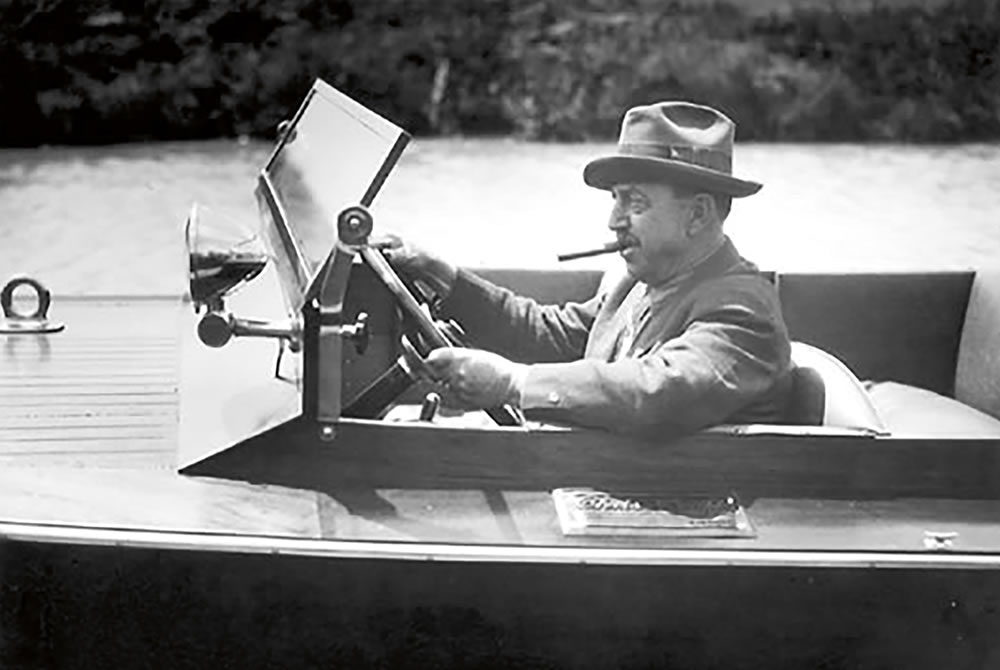
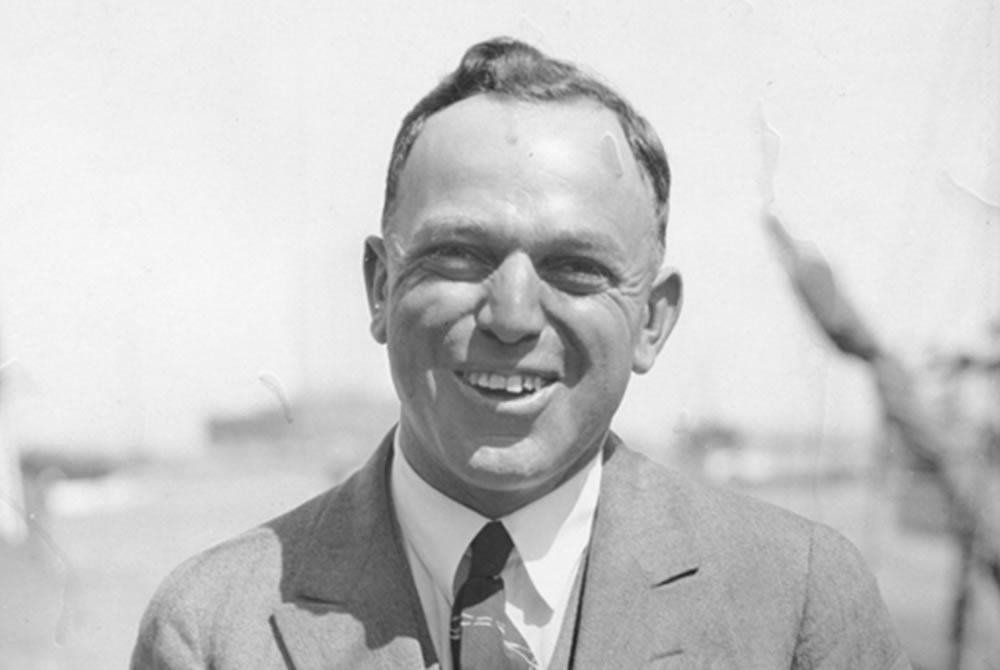
Christopher Columbus Smith was born in Algonac, Michigan, in 1861, in a community spread across the St. Clair River delta — flat, water‑laced country where boats were less a hobby than a condition of daily life. He built his first one in 1874, at the age of thirteen. The early craft were modest: punts and skiffs, the small flat‑bottomed boats a delta hunter or fisherman needed. They were good enough that neighbors began asking for them, and by 1881 Smith and his older brother Henry — always called Hank — were building boats full time. Neither of them, at that point, was building anything that would have suggested an industrial future. They were two brothers making duck boats well.
What changed the trajectory was the engine. Smith was among the first builders in the region to put an internal‑combustion motor into a small hull, and once a boat could move under its own power, the question stopped being how to build a good boat and became how to build a fast one. That question would occupy the next forty years of his working life, and it would draw him into the orbit of the men who were turning powerboat racing into a national spectacle.
Racing taught the boats how to be fast
In 1910 the brothers joined with outside partners to form the Smith Ryan Boat and Engine Company, an attempt to move from one‑off commissions toward something nearer to mass production: fast, affordable runabouts built to a repeatable standard rather than to a single customer's order. The partnership was named in part for John Ryan, a Cincinnati businessman with an appetite for racing on the St. Clair River, and the work mixed crowd‑pleasing race boats with the more sober ambition of building for the general public the way Henry Ford was beginning to build cars. Ryan's finances did not survive the decade, and the partnership dissolved, but the idea of the standardized runabout did not. It would become the foundation of everything that followed.
The decisive education came through racing. In 1915 a Smith‑built hull named Miss Detroit won the Gold Cup, the most prestigious trophy in American powerboat competition. The victory brought Smith to the attention of Garfield Wood — universally known as Gar Wood — a self‑made industrialist and the most relentless competitor the sport would produce. Wood bought Miss Detroit, and then he bought Smith's company, and for roughly six years Smith built race boats under Wood's direction. The boats won repeatedly: more Gold Cups, and two Harmsworth Trophies, the premier prize in international motorboat racing.
The racing years are sometimes told as a detour, the period before the real company began. They were the opposite. Competition forced a discipline on the work that ordinary commissions never would have. Every race exposed a weakness — in a hull form, a fitting, an engine mount — and every weakness had to be solved before the next start. Smith emerged from his time with Gar Wood as a builder who understood, at a level few of his contemporaries did, what made a boat both fast and sound. When he set out on his own again, he carried that knowledge into a market that was about to change completely.
A family name, and the largest fleet of its kind
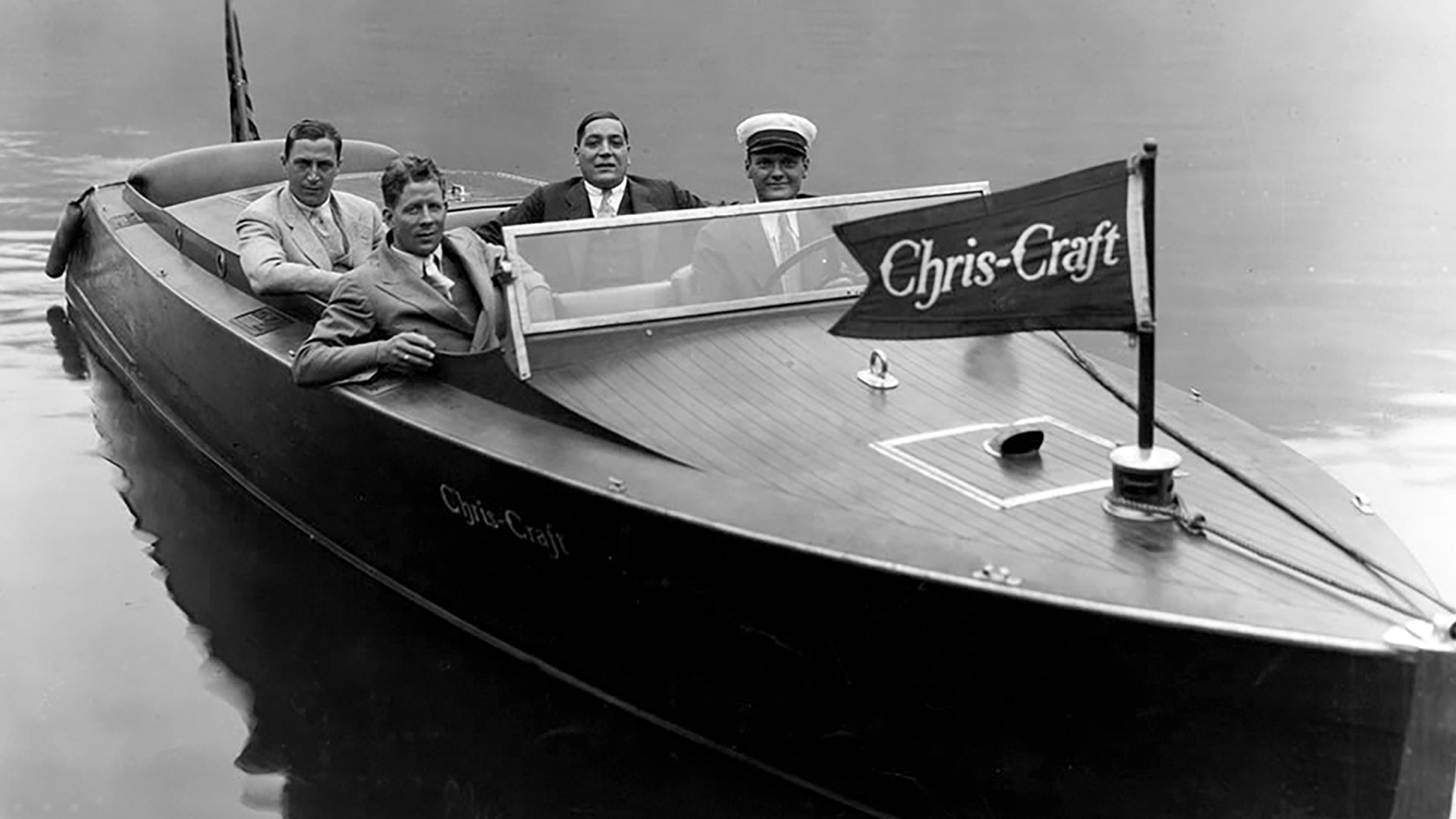
In 1922, with the Smith Ryan partnership behind him, Smith reorganized the business under a name that finally put the family at the center of it: the Chris Smith & Sons Boat Company. Two years later, in 1924, the boats acquired the brand they have carried ever since — Chris‑Craft. The sequence matters. The company existed before the brand; the brand was a marketing decision laid over a business that had already been building boats for half a century. It proved to be one of the most durable brand names in American manufacturing, precisely because it was attached to something that already worked.
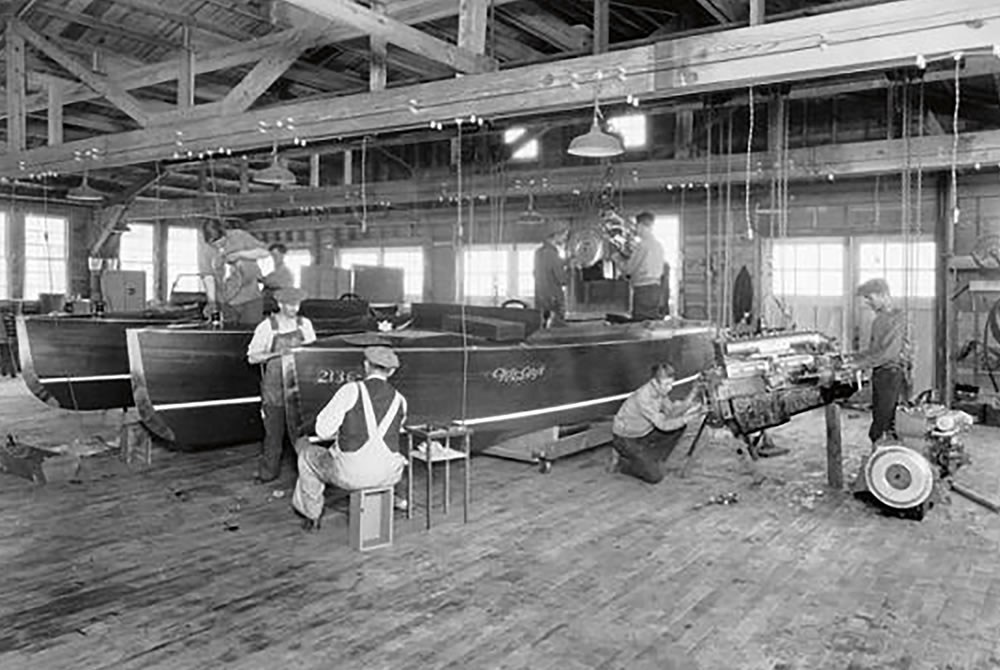
The timing was favorable. The 1920s were producing, for the first time, a substantial American middle class with disposable income and leisure time, and Chris‑Craft met that class with exactly the product Smith had spent a decade learning to build: a handsome, fast, factory‑produced runabout that an ordinary prosperous family could aspire to own. The plant in Algonac moved toward assembly‑line methods, driving down the cost of boats that had until recently been hand‑built luxuries. At the top of the market, the names attached to Chris‑Craft ownership were the kind that sold boats by association — Henry Ford, William Randolph Hearst — but the deeper commercial achievement was at the other end, in reaching buyers who had never before imagined owning a powerboat at all.
In 1927, Christopher Columbus Smith stepped back, and his son Jay Smith took over as president and general manager. Jay would hold those positions for the next thirty‑one years, and it was under his direction that Chris‑Craft became what it is still remembered as: the largest builder of mahogany powerboats in the world. The phrase is worth pausing on. Not the best‑known, not the most prestigious — the largest. Chris‑Craft's distinction in this period was as much industrial as it was aesthetic. It had turned the mahogany runabout into something that could be produced at scale without losing the qualities that made people want it.
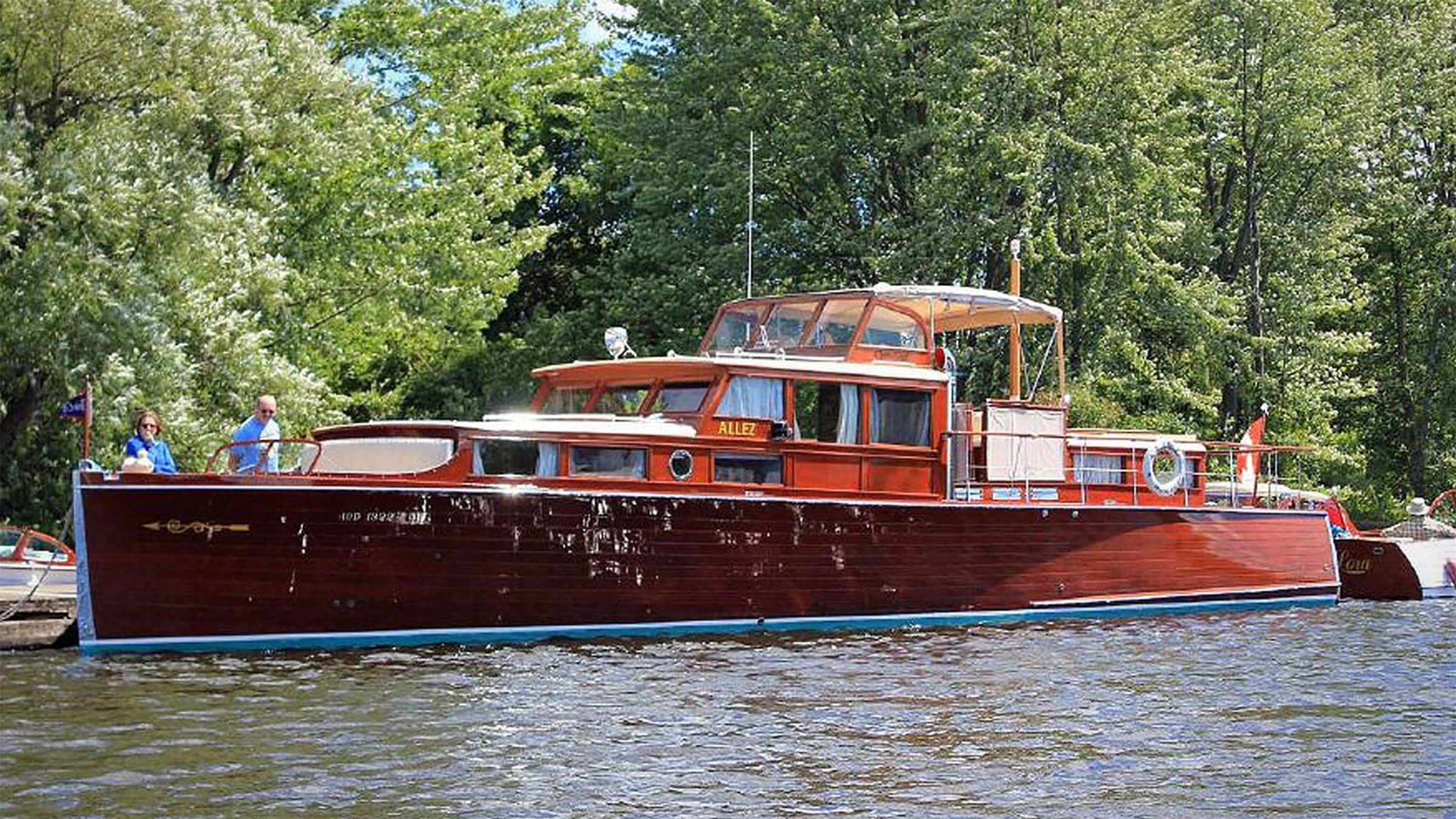
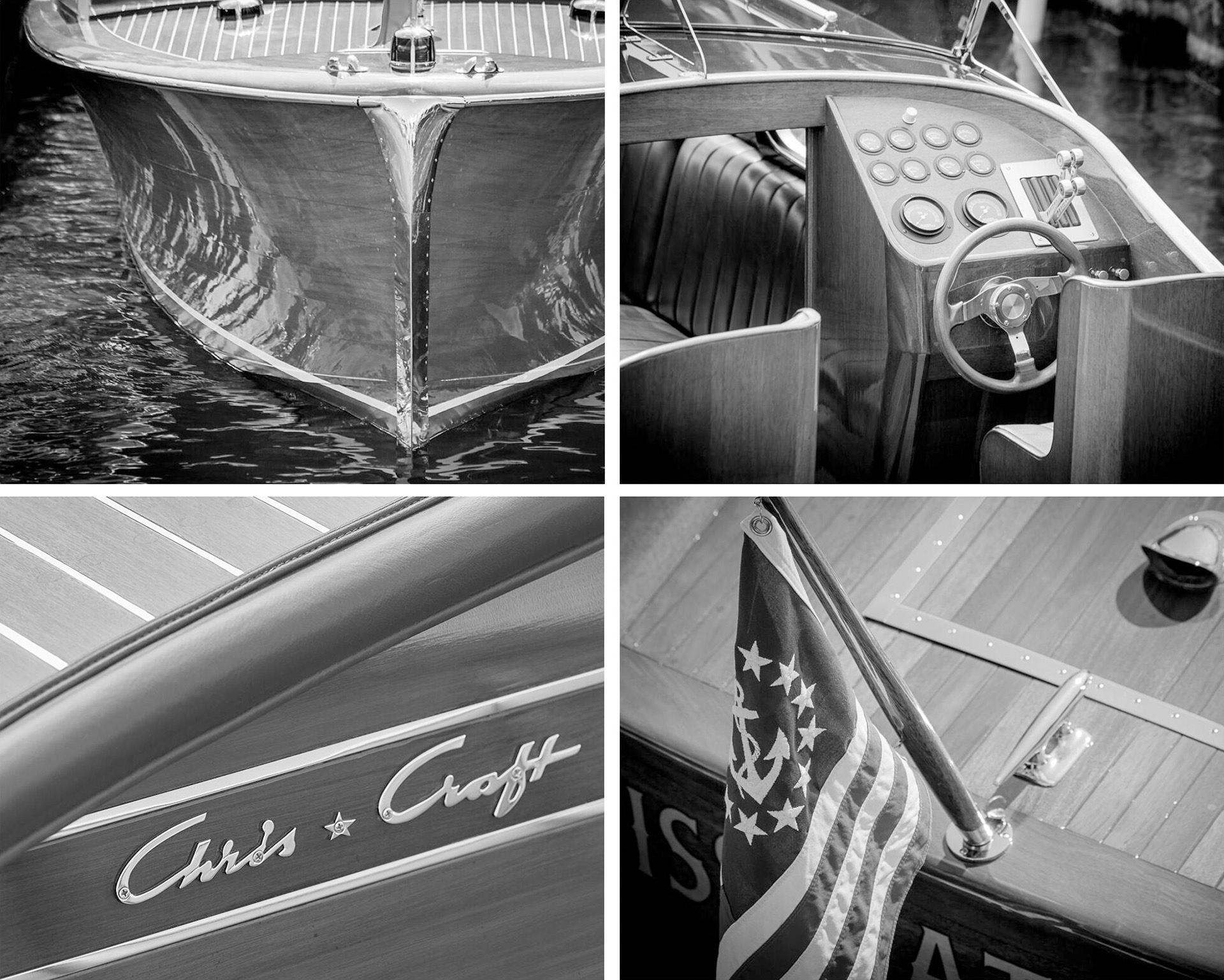
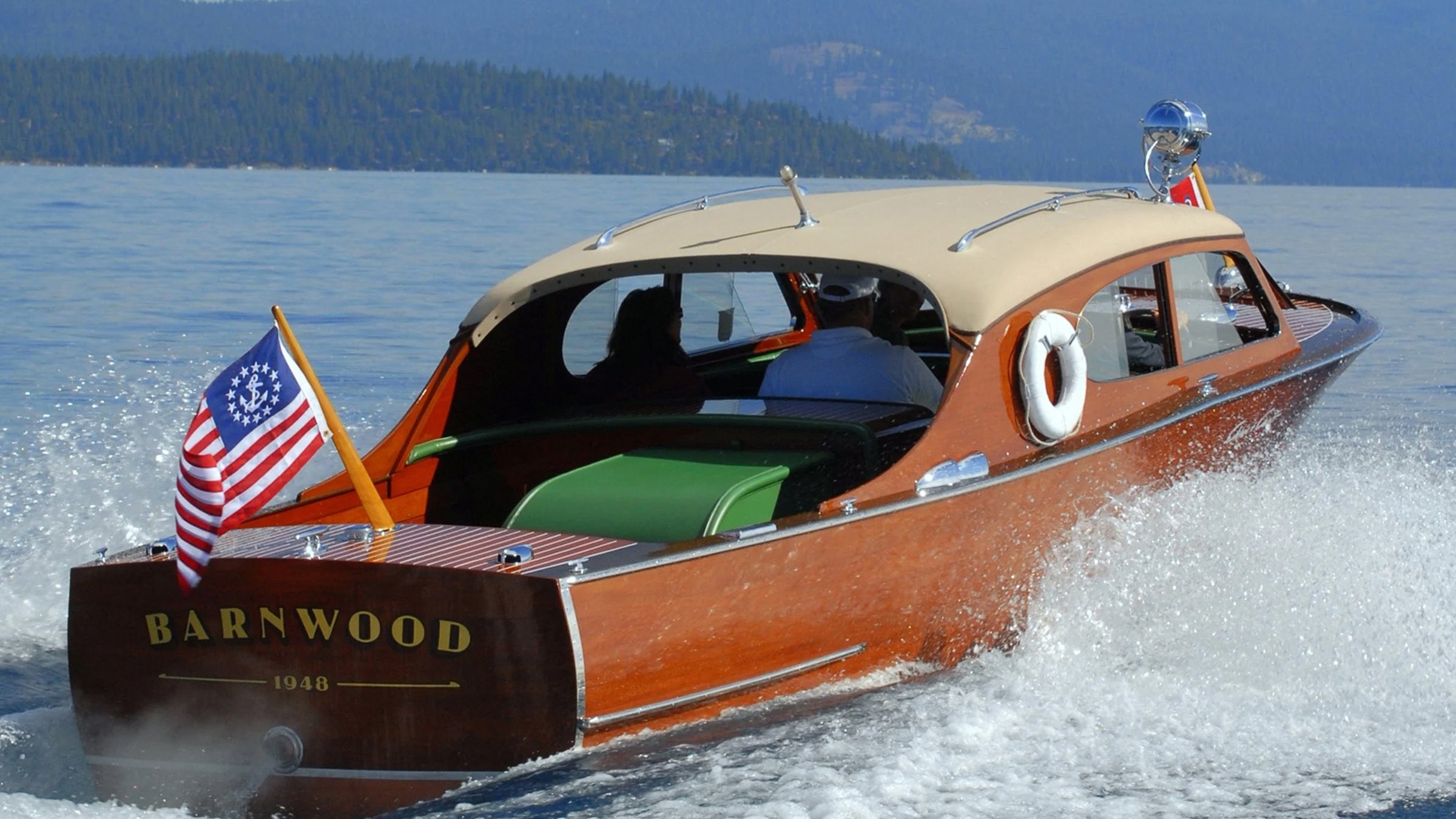
The material itself became inseparable from the identity. Mahogany — close‑grained, dimensionally stable, beautiful under varnish — was the visible signature of a Chris‑Craft, and the company's reputation rested on the consistency with which it could finish that wood to a standard that looked bespoke even when it was not. Decades later, when the boats had long since moved to other materials, it was the bright‑finished mahogany hull that people still pictured when they heard the name. The brand had succeeded in attaching itself to a surface.
Then the surface stopped selling. The Great Depression did to Chris‑Craft what it did to every maker of expensive discretionary goods: demand collapsed. The company's response was instructive, because it was not a reinvention. It was a retreat to what it already knew. As sales fell through the 1930s, Chris‑Craft went back to its origins and concentrated again on smaller, more affordable runabouts — the standardized boats that had built the business in the first place. The strategy was not glamorous, but it kept the plant running and the workforce employed through years that closed a great many competitors permanently.
When demand vanished, the company did not reinvent itself. It went back to the boat that had built it.
Twelve thousand boats, none of them for pleasure
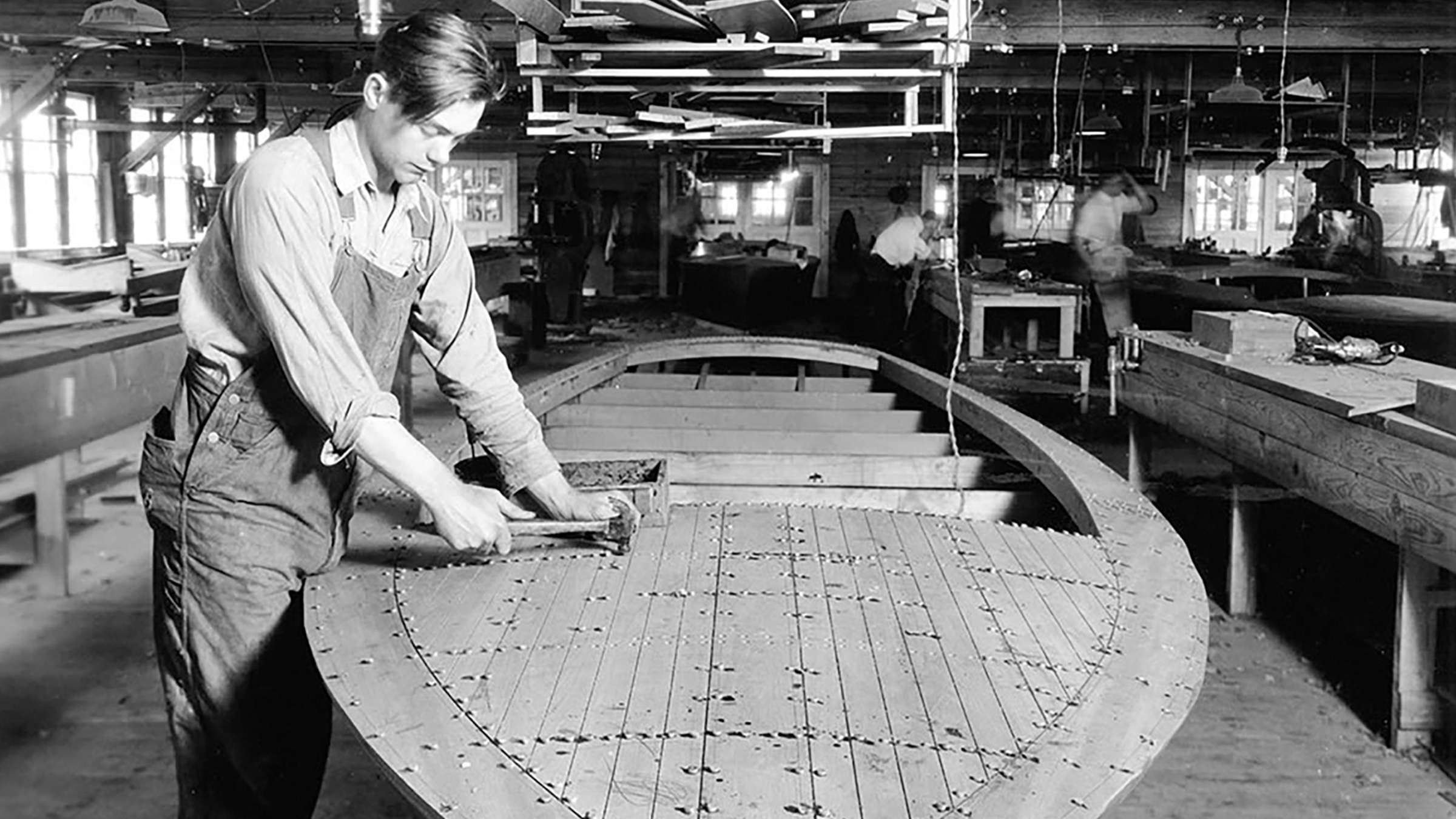
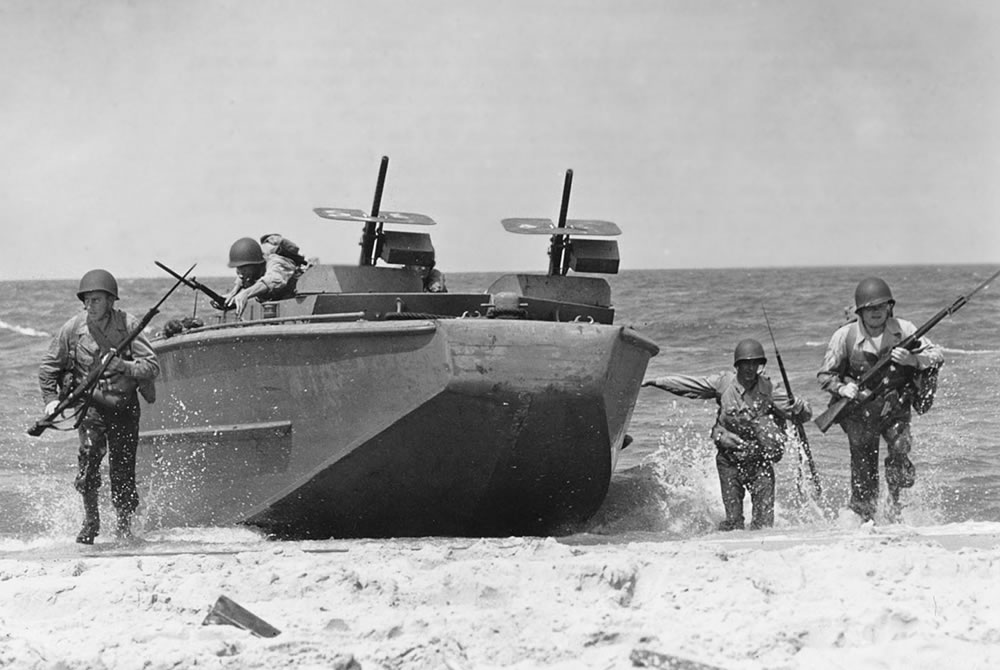
When the United States entered the Second World War, the market for varnished mahogany pleasure boats disappeared overnight, and Chris‑Craft did what the entire American manufacturing economy did: it converted. The same plant that had been turning out runabouts for prosperous families began producing military craft for the United States Navy and Army — patrol boats, utility launches, landing craft and rescue vessels. The skills transferred almost directly. A company that had spent two decades learning to build sound hulls quickly and consistently was, it turned out, exactly the kind of company a wartime government needed.
The numbers are the part that resists romanticizing, and they are the part worth keeping. By 1945, Chris‑Craft had built roughly twelve thousand military vessels. That figure tells you something the photographs of gleaming runabouts do not: that this was, by the 1940s, a genuinely industrial enterprise, capable of output on a scale that had nothing to do with leisure and everything to do with manufacturing capacity. The mahogany runabout was the company's face. The wartime production line was its musculature.
A hundred and thirty‑nine models, and a new material
The postwar years were the company's commercial peak. The manufacturing efficiencies learned in wartime carried straight into civilian production, and by the early 1950s Chris‑Craft offered a catalogue of one hundred and thirty‑nine powerboat models — a range so broad it covered nearly every point on the curve between an affordable family utility boat and a substantial cabin cruiser. American prosperity was expanding, the boats were within reach, and the brand was at the center of a culture of recreational boating it had done much to create.
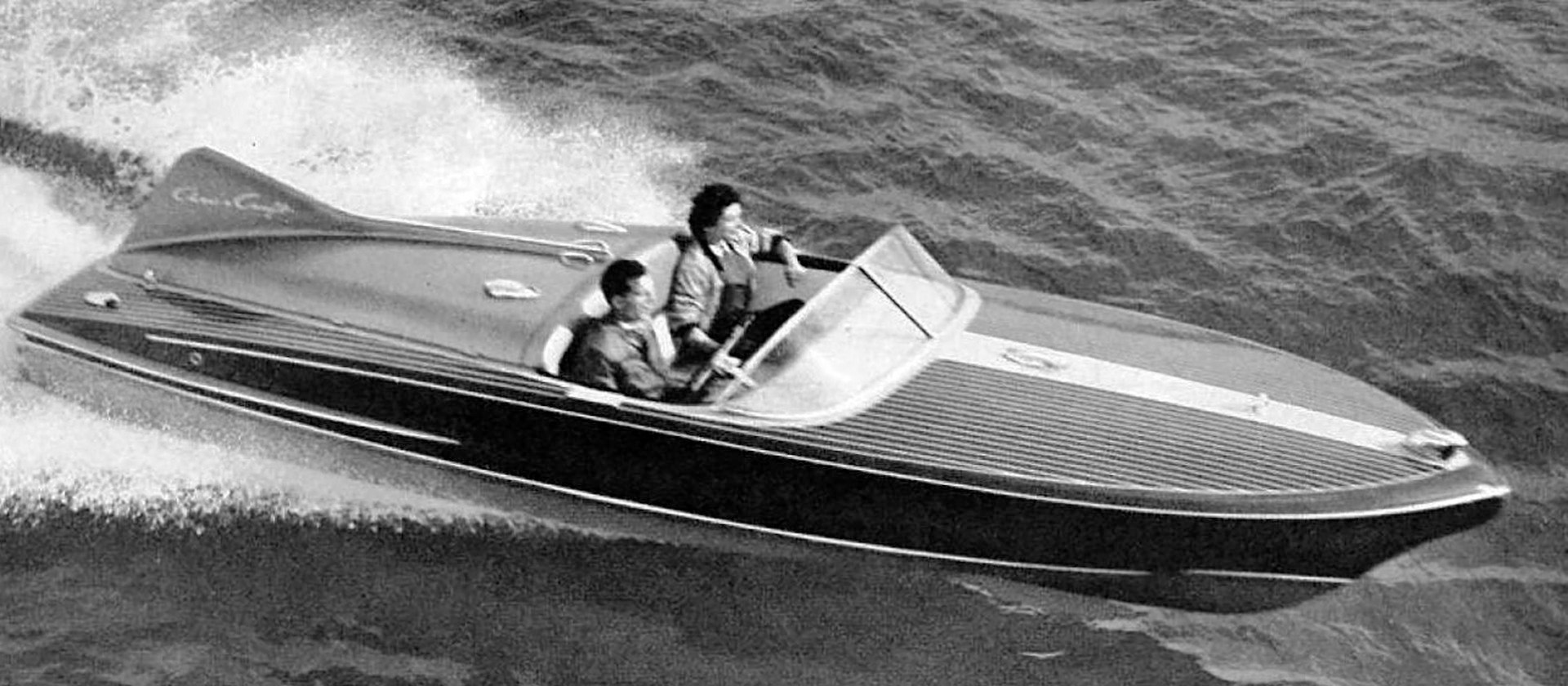
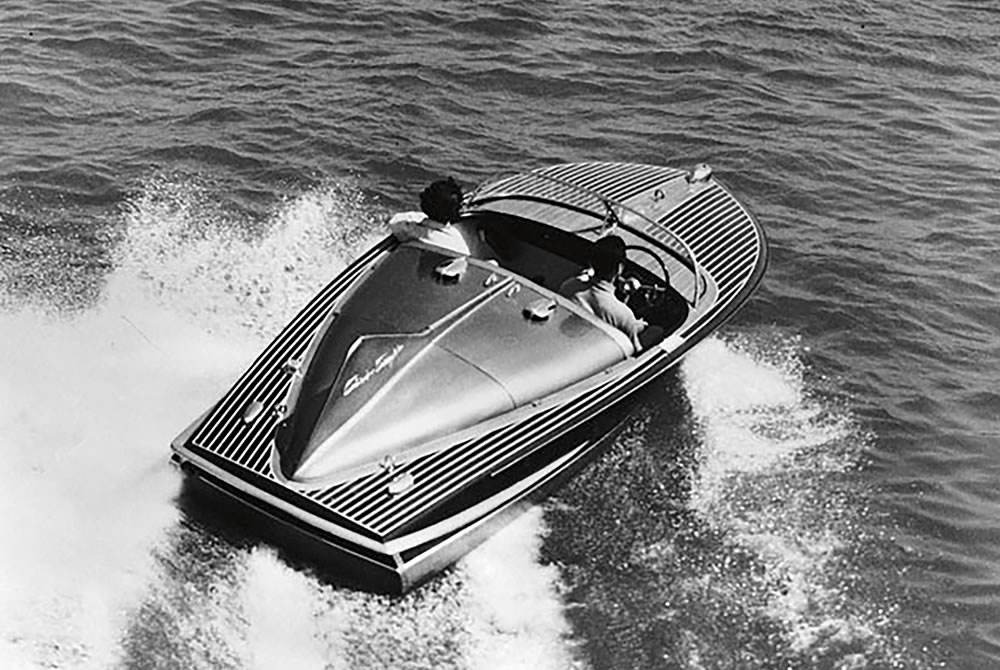
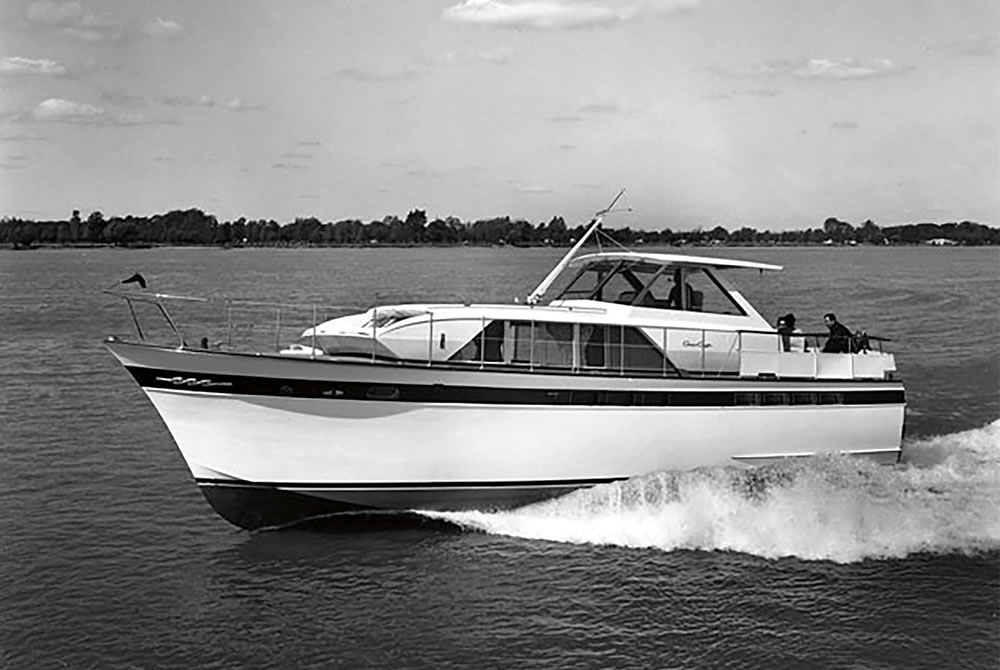
It was also, quietly, the beginning of the end for the material the company was famous for. In 1955, Chris‑Craft built its first fiberglass boat — the Cobra, a striking runabout whose raised tail fin, borrowed from the visual language of postwar aviation and automobiles, was molded from the new material. Two years later the company added a steel‑hull division, producing the Roamer line of cruisers. Wood was no longer the only way, or even the obvious way, to build a Chris‑Craft. The shift was gradual, and for a while the old and new materials coexisted on the same showroom floor, but the direction was set.
It ended, formally, in 1971, when Chris‑Craft built its last mahogany boat — a fifty‑seven‑foot Constellation. The company that had become the largest builder of mahogany powerboats in the world had stopped building them in wood entirely. There is no single moment that closes the classic era of American boatbuilding more cleanly than that one hull, and it is characteristic of Chris‑Craft that the company simply moved on. The boats that made the name were now history. The name kept working.
The boats that made the name were now history. The name kept working.
The whole arc, in nine fixed points

The family leaves, the name stays
For its first eighty‑odd years, Chris‑Craft was a family company in the literal sense: owned, run and identified with the Smiths. That ended around 1960, when the business passed to National Automotive Fibers, Inc. — a holding company that adopted the name Chris‑Craft Industries in 1962 and operated the boats as one division among several. It was the first time the name and the family were no longer the same thing, and it set the pattern for everything that followed. From this point the story is less about boatbuilders than about owners, and the remarkable fact is that the boats kept being built through all of it.
The sequence is dense, and worth setting down plainly. In 1981, the boatbuilding division was sold to a group led by the businessman George Murray, while the parent industrial company kept the Chris‑Craft trademark and licensed it back. That arrangement filed for bankruptcy at the end of 1988. The plants and the licensed name were acquired in 1989 by the Outboard Marine Corporation, then one of the giants of the American marine industry, which folded Chris‑Craft into its recreational boat group. When Outboard Marine itself went bankrupt in 2000, the Chris‑Craft operation changed hands again.
What this register of owners conceals is how close the name came, more than once, to simply stopping. A trademark that has been separated from its factories, licensed, sub‑licensed and passed through two corporate bankruptcies is the kind of asset that usually disappears — absorbed, retired, or quietly allowed to lapse. Chris‑Craft did not disappear, but it is worth being honest that its survival through these decades was a matter of commercial circumstance as much as design. The boats were good. The name had value. Neither guarantee is automatic, and plenty of comparable American names did not make it.
The Smiths of Algonac
For three generations the company and the family were the same enterprise. These are the figures around whom the early business turned.
- Christopher Columbus Smith1861–1939 · built his first boat in 1874; gave the company its name and its method
- Henry “Hank” SmithJoined Chris in 1881 to build boats full time, turning a craft into a business
- Jay SmithPresident and general manager from 1927 for thirty‑one years; built the mahogany empire
Sarasota
In 2001, the British private‑equity firm Stellican acquired the Chris‑Craft boatbuilding operation, and then did something the previous decades of owners had not managed: it bought the Chris‑Craft trademark as well, reuniting the boats and the name under a single owner for the first time in years. The relaunched company set about reintroducing the brand with new models built in modern materials but styled to recall the classic runabouts — the flared bow, the bright wood, the chrome, deployed as deliberate quotation rather than nostalgia.
The most recent turn came in 2018, when Chris‑Craft was acquired by Winnebago Industries — the Iowa‑based manufacturer best known for recreational vehicles, which was assembling a portfolio of outdoor‑lifestyle brands and described the purchase as its entry into the marine market. It is, on its face, an unlikely custodian for a name born on a Michigan river in 1874. But the logic is the same logic that has carried Chris‑Craft through every owner since the Smiths: the boats are good, the name has value, and a larger company saw a reason to keep building both.
Today Chris‑Craft builds its boats in Sarasota, Florida, across a contemporary range of bowriders and outboard‑powered day boats — the Launch, Calypso and Catalina lines among them. They are modern vessels, with modern propulsion and electronics, and they make no pretense of being the mahogany runabouts of the 1930s. What they carry forward is narrower and more durable than a style: an unbroken line of production under one name, now stretching past a hundred and fifty years.
Six owners. One bankruptcy.
One name, still building.
From the Smith family to National Automotive Fibers, to Murray, to Outboard Marine, to Stellican, to Winnebago Industries, the ownership of Chris‑Craft changed hands again and again. The production line did not stop for long.
That continuity — not the mahogany, not the chrome, not the famous owners — is the genuinely rare thing. Very few names in any manufacturing industry survive a century and a half of that kind of turbulence and are still putting product in the water.
A thirteen‑year‑old built a boat in 1874. The men who built the company are long gone, and the family that owned it left more than sixty years ago. The name is still on the water. That, in the end, is the achievement.