

Boating with Manatees
A native species, a million registered boats, and a stretch of inland waters that belongs to both. How to share Florida's rivers and lagoons with the animal that defines them.
The Florida manatee is the closest thing the state has to a living landmark. Slow, gentle, and almost weightless underwater, it surfaces in places where most people never look down. Boaters do. And that meeting, repeated across thousands of miles of waterway, is the heart of one of the most quietly demanding pieces of seamanship in American boating.
There are roughly 8,350 Florida manatees in the state today, the figure used by the Florida Fish and Wildlife Conservation Commission based on its most recent statewide abundance survey. Three decades ago, the minimum count sat closer to twelve hundred. The species has recovered considerably, but it remains federally protected, and in early 2025 the U.S. Fish and Wildlife Service proposed listing the Florida subspecies as endangered once again.
The reasons sit on the water with us. Florida has close to 1,350 miles of coastline before counting the Intracoastal, the rivers, the spring runs, and the inland lagoons. There are now more than a million registered vessels in the state. Manatees inhabit nearly every body of fresh and brackish water along the way, feeding on submerged grasses, drifting with the tide, surfacing every few minutes to breathe. Where boats and animals share the same shallow water, collision becomes the central, predictable risk.
An animal built for quiet water
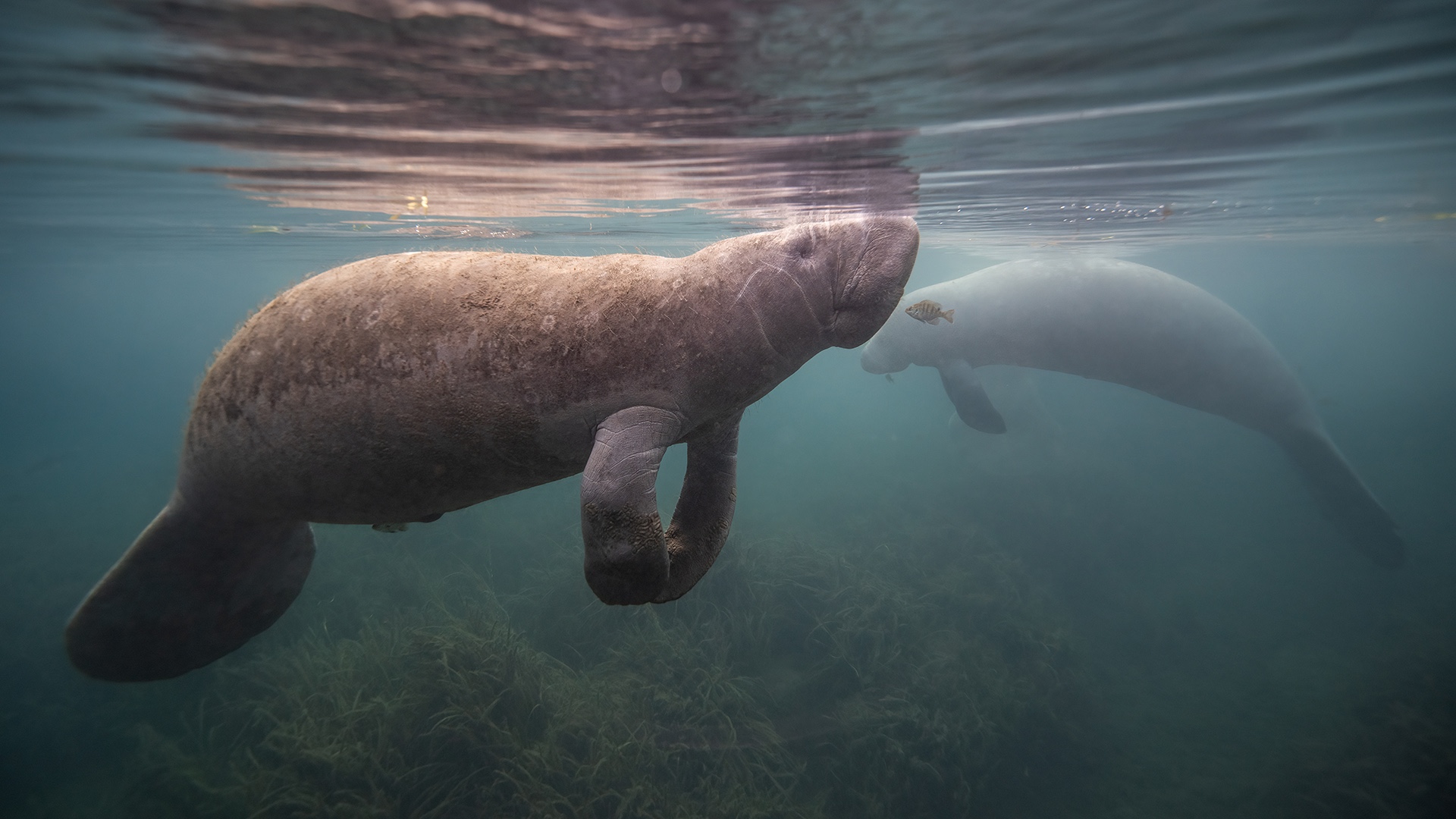
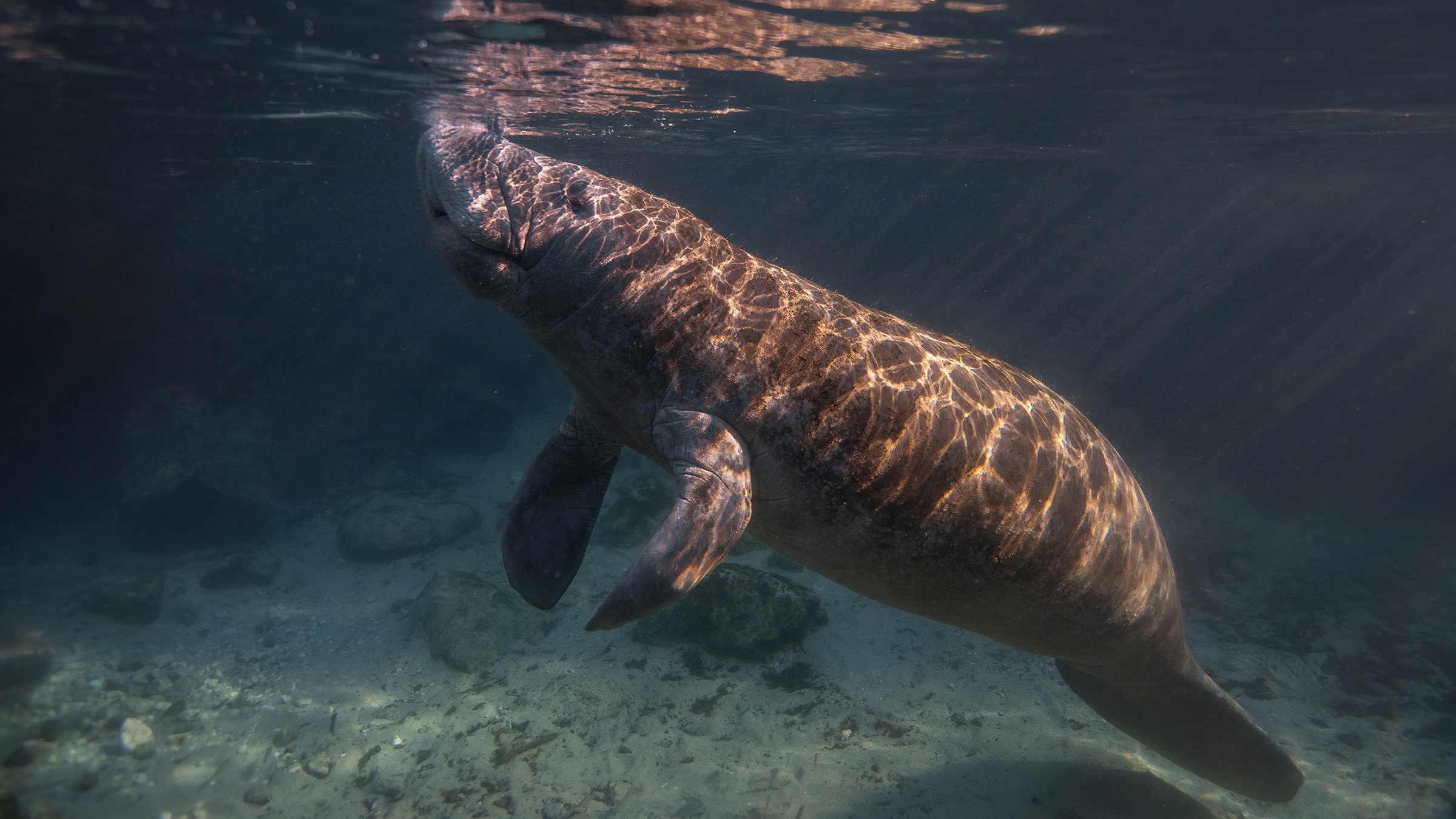
A full-grown Florida manatee can measure ten feet from rostrum to fluke and weigh close to a ton. It moves with the unhurried logic of an animal that has nothing to chase and very few predators to fear. Cruising speed is around three to five miles per hour. It rests for hours, surfaces briefly, and rarely strays from water shallower than ten feet, the depth at which seagrass and freshwater vegetation grow.
Cold is its enemy. Manatees cannot tolerate water below 68°F for long, which is why their winter geography contracts dramatically. From November onward, the population concentrates around warm-water refuges: power-plant outflows, natural springs, deep canals. In summer the same animals disperse widely, occasionally as far north as the Carolinas and west into the Gulf. The seasonal logic matters for boaters because it dictates when, and where, encounters become statistically likely.
Touching, feeding, chasing, or giving water to a manatee is prohibited under federal law. The species is protected by the Marine Mammal Protection Act and the Endangered Species Act, and by Florida's own Manatee Sanctuary Act.
The other reality of the species is that manatees evolved for a sound environment that no longer exists. Studies of hearing in both wild and captive animals show they can detect and avoid a single approaching boat when given adequate time to respond. In open, busy water, where outboards, jet skis, and hulls overlap into a continuous low rumble, that ability collapses. The animal cannot triangulate a specific threat from the noise floor. The burden of avoidance, in practice, lies entirely with the operator.
Reading the surface, slowly
Most collisions happen in shallow water near docks, channels, and the soft edges of salt flats where manatees feed. The animal is hard to spot. From above, a resting manatee can read as a darker shape under murky water, easily mistaken for a shadow, a log, or a passing patch of weed. By the time it lifts its rostrum to breathe, an operator on plane is already past.
Experienced boaters in Florida learn to read the surface for a small repertoire of signs. A pale back breaking the water for a single breath. The wide, paddle-shaped tail visible in clear shallows. The dark snout pushing up like a worn river stone. And the most telling of all, the footprint: a smooth, circular swirl on the surface, sometimes a chain of them, left by the fluke of an animal swimming below. A line of footprints traces direction. Multiple footprints suggest more than one animal. None of these is dramatic. All of them require an operator who is actually looking.
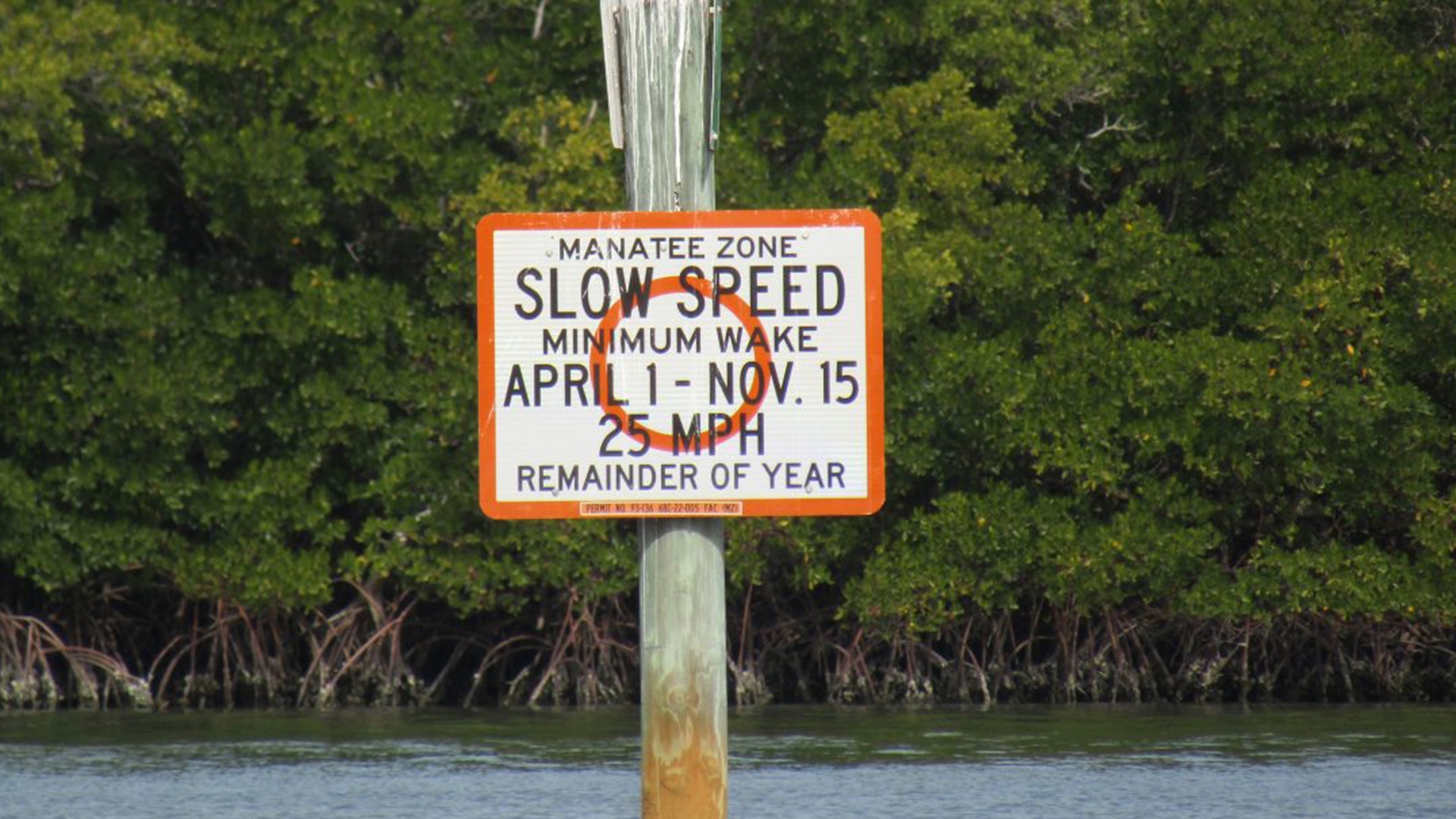
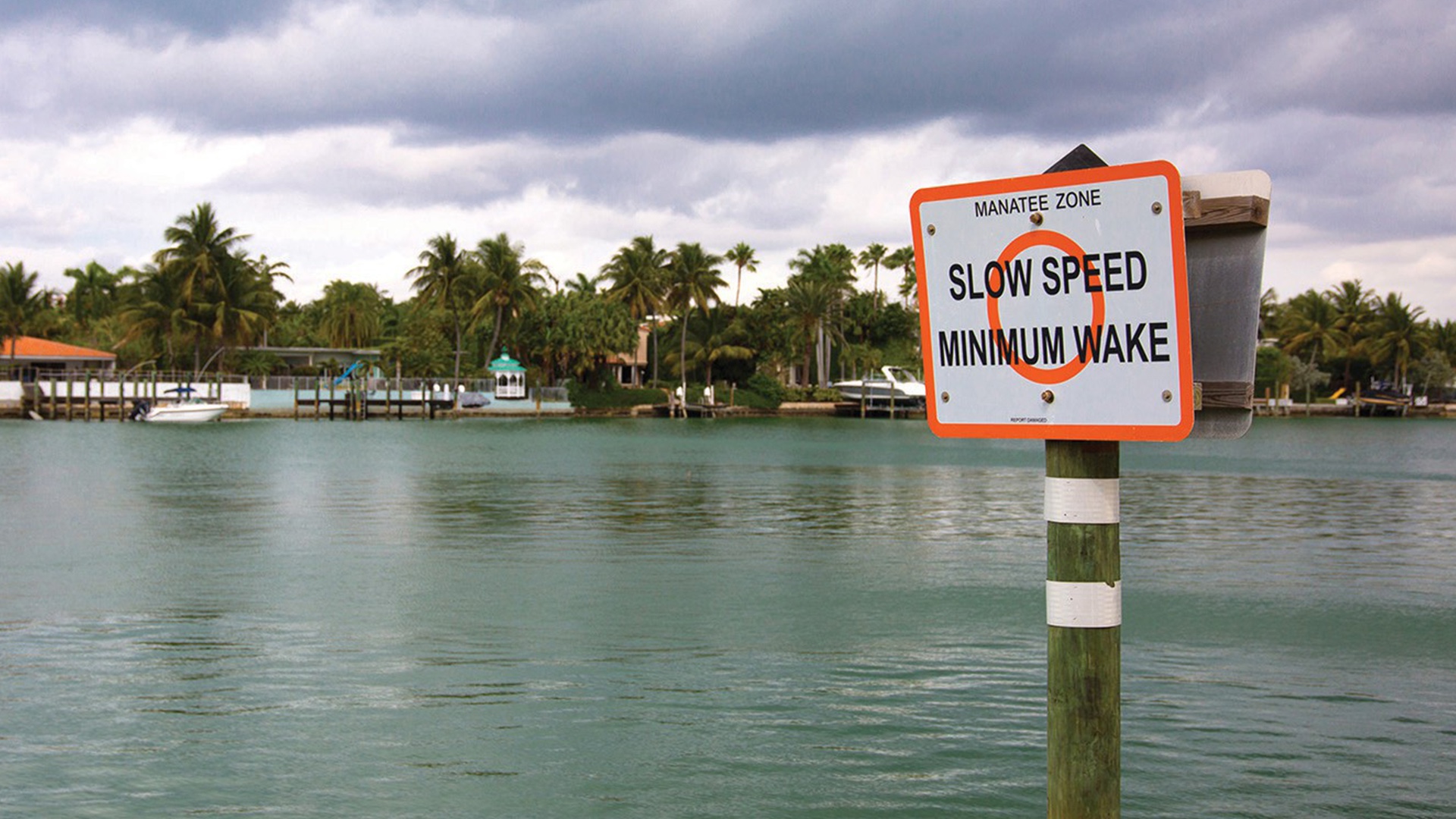
Speed zones do the rest of the work. The Florida Fish and Wildlife Conservation Commission has established manatee protection zones in eighteen counties, covering parts of more than twenty major rivers. Some are in force year-round. Others activate seasonally, generally from November through March, when manatees concentrate in warm-water refuges. The signs are posted on the waterway itself, often above eye-level, easy to miss at speed. They are not advisory. Violations carry fines that can reach into the hundreds of dollars per offense, and enforcement has intensified over the past decade.
Four categories. Different shorelines.
Same intent.
I
No Entry
Closed water
No vessels allowed except for access to private docks or residences. Reserved for the most sensitive manatee habitat.
II
Idle Speed
2 to 5 mph
The slowest speed at which the vessel maintains steerage. No wake. Common around springs and warm-water refuges.
III
Slow Speed
5 to 7 mph
Off plane, settled, fully displaced. No skiing, no aggressive turns. The default speed inside most protection zones.
IV
Posted Limits
25 / 30 / 35 mph
Numeric limits applied in channels and stretches of the Intracoastal where manatee risk is lower but still present.
“
A boat at slow speed is not slower. It is a boat that has time to react.
Field Note · USA Onboard Editorial
Why speed is the single variable
The logic behind every speed zone is mechanical. At lower speeds, both the boater and the manatee gain reaction time, the only currency that matters when an animal weighs half as much as the boat above it. The operator sees the back break the surface and has seconds, not fractions of a second, to alter course or come off the throttle. The animal, in turn, has time to dive, drift sideways, or sense the change in pressure overhead.
When a collision does happen, speed determines whether it is a survivable bump or a fatal impact. The kinetic energy carried by a planing hull rises with the square of velocity. A modest reduction at the moment of contact is not a modest improvement; it is an order-of-magnitude change in the force transmitted to the animal. Most manatees that survive a strike carry parallel propeller scars on the back, which biologists use to identify individuals over time. The marks are a record of how much speed has cost the species over the last fifty years.
What's at stake, up close
Manatees reproduce slowly. Females give birth to a single calf, occasionally twins, after a gestation of roughly thirteen months. The calf stays close for one to two years, learning the geography of warm-water refuges, feeding grounds, and migration corridors from the only animal it knows. A mother and calf surfacing together is one of the most common sights in Florida's spring runs in winter, and one of the slowest. They drift. They breathe. They drift again.
This is also why every avoidable loss reverberates. The species can recover only as fast as it reproduces, and reproduction depends on females reaching adulthood, finding mates, and raising calves to independence. A single fatal strike removes a possible generation, not only a single animal. The arithmetic is unforgiving, and it sits in the background of every speed-zone sign on a Florida channel.
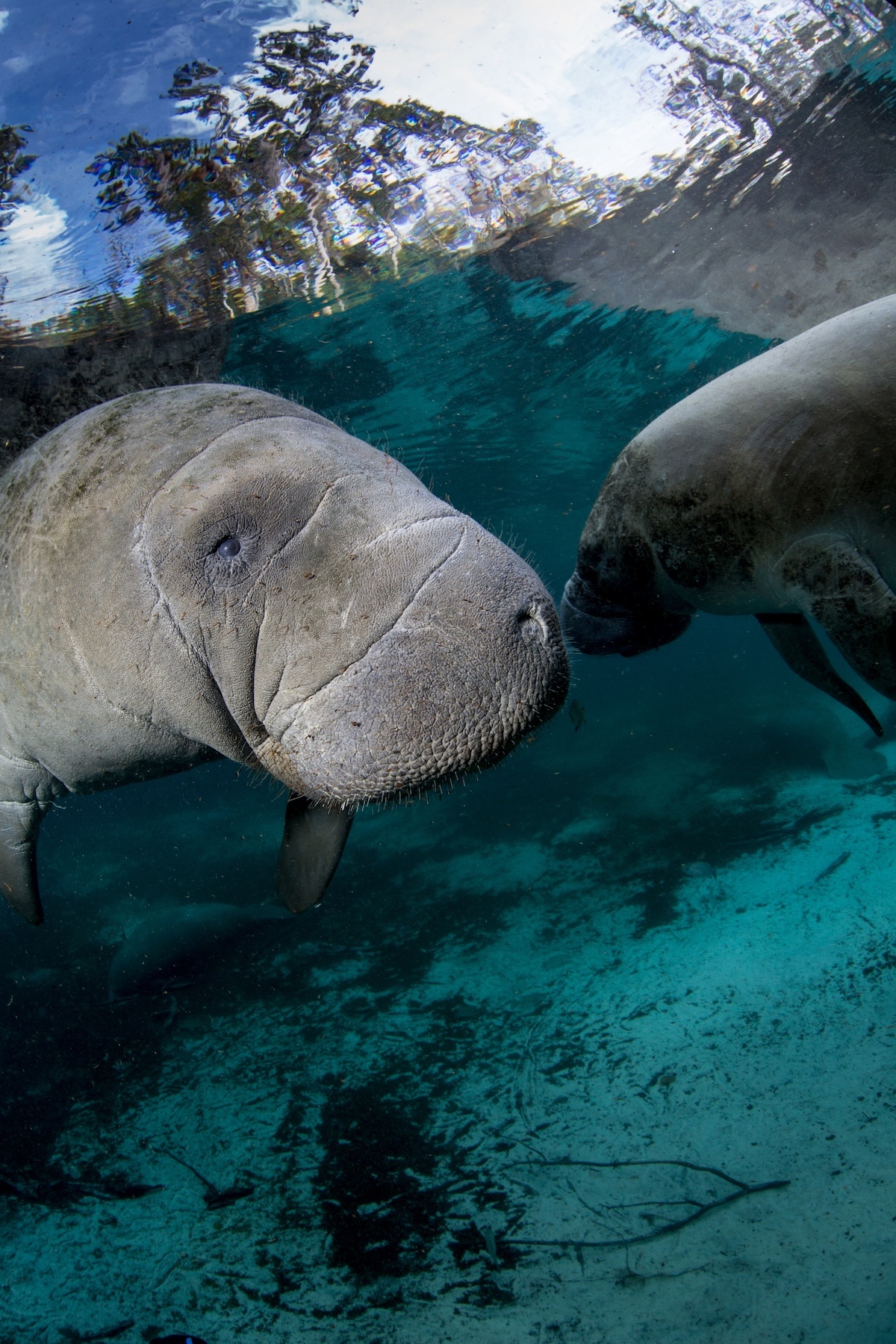
Mother and calf, underwater The closest bond in Florida's shallows lasts up to two years.
There is one more consideration that rarely appears on signage. Recent years have brought additional pressure on the species from causes that have nothing to do with boating. The 2020 to 2022 Unusual Mortality Event in the Indian River Lagoon, declared over by federal agencies in 2025, killed more than twelve hundred manatees through starvation linked to seagrass loss. Nutrient runoff, septic leakage, and algal blooms continue to compromise the food supply. None of that is a boater's fault. All of it raises the cost of every avoidable strike.
A reasonable code of conduct
Most of what works is undramatic. Watch the surface continuously in shallow water, especially near docks and grass flats. Honor every posted zone, in season and out. Maintain off-plane speed in any channel narrower than two boat-lengths from shore. Polarized sunglasses help. A bow lookout helps more. In areas with known concentrations, a slow first transit teaches the geography of the bottom and the likely positions of the animals before any subsequent run.
The federal protections are explicit. Approach, touch, feeding, harassment, and offering fresh water are prohibited. A manatee at the dock is curious, not friendly; it has learned that boats are sometimes attached to people who give attention. The kindest response is the cool one. Watch. Photograph from a distance. Move on.
Two short lists worth keeping.
On the Water · Do
- Run off plane in shallow water and inside any posted manatee zone.
- Scan the surface for backs, snouts, tails, and circular footprints.
- Wear polarized sunglasses to read the column below the surface.
- Place a lookout at the bow in zones with known manatee presence.
- Report injured or stranded animals to FWC at 1-888-404-FWCC.
On the Water · Don't
- Approach, touch, or attempt to feed a manatee. All four are illegal.
- Offer fresh water from a dock or boat, a common and harmful mistake.
- Pursue, corner, or separate a mother from her calf.
- Treat seasonal signage as advisory. Most zones are year-round.
- Assume the animal can hear you. In busy water, it often cannot.
Living in harmony with what was already here is the quiet work of every Florida boater. Collective behavior is only ever the sum of individual ones. Choose well, often, and the water remains shared.
USA Onboard Editorial