

Where the Map
Runs Out
Alia Yachts' fully custom 53-metre Limerence began life as a support vessel and refused to stay one — arriving instead as a long-range explorer with the manners of a superyacht and the appetite of an adventure platform.
Some yachts are built to be looked at. Limerence was built to be used — hard, far, and without asking the nearest marina for permission. What began on the drawing board as a support vessel arrived, eighteen months later, as something rarer: a boat that carries a helicopter on its roof, a submersible's worth of ambition below, and the composure of a proper superyacht throughout.
The brief that produced her was a difficult one, because it asked for two boats at once. The owner wanted the rugged, operational reach of an explorer — the autonomy to leave the marina behind and stay gone — married to the accommodation, finish and entertaining capacity of a standalone superyacht. Most yards would have chosen a side. Alia Yachts, the full-custom shipyard in Antalya, chose to hold the two in tension and engineer the result from a blank page, drawing exterior and naval architecture from Azure Yacht Design & Naval Architecture.
That tension is the whole point of her. Limerence is not a support vessel dressed up, nor a superyacht pretending to be tougher than it is. She is a genuine dual character — a steel-and-aluminium hull sized to swallow a fleet of tenders and a treasure chest of toys, wrapped in a boutique-hotel interior and a run of open deck built for entertaining at anchor. By day she is a launch platform; after dark she becomes a venue. Few boats change register this completely, and fewer still do it without compromise at either end.
The numbers underwrite the ambition rather than decorate it. Fifty-two and a half metres of length, a beam of 8.6 metres, and a transatlantic range that has already carried her across the Atlantic toward the United States. This is a yacht conceived to reach the places a conventional cruiser only reads about — and to arrive there carrying everything needed to make the reaching worthwhile.
Limerence, read from waterline to helideck
The anchorages others reach only in stories
For most of the last decade, the fastest-growing corner of the yachting market has not been the fastest or the shiniest boat, but the most capable one. The explorer — a large, deeply autonomous hull built to leave the marina map behind — has moved from the fringes to the centre of owner ambition. What owners increasingly want is range: the fuel, the sea-kindly hull and the self-sufficiency to reach Greenland's fjords, the far Pacific, a Patagonian channel, and to stay there long after a conventional cruiser would have to turn back for supplies. The category rewards endurance over spectacle, and its rewards are the most remote places on the planet.
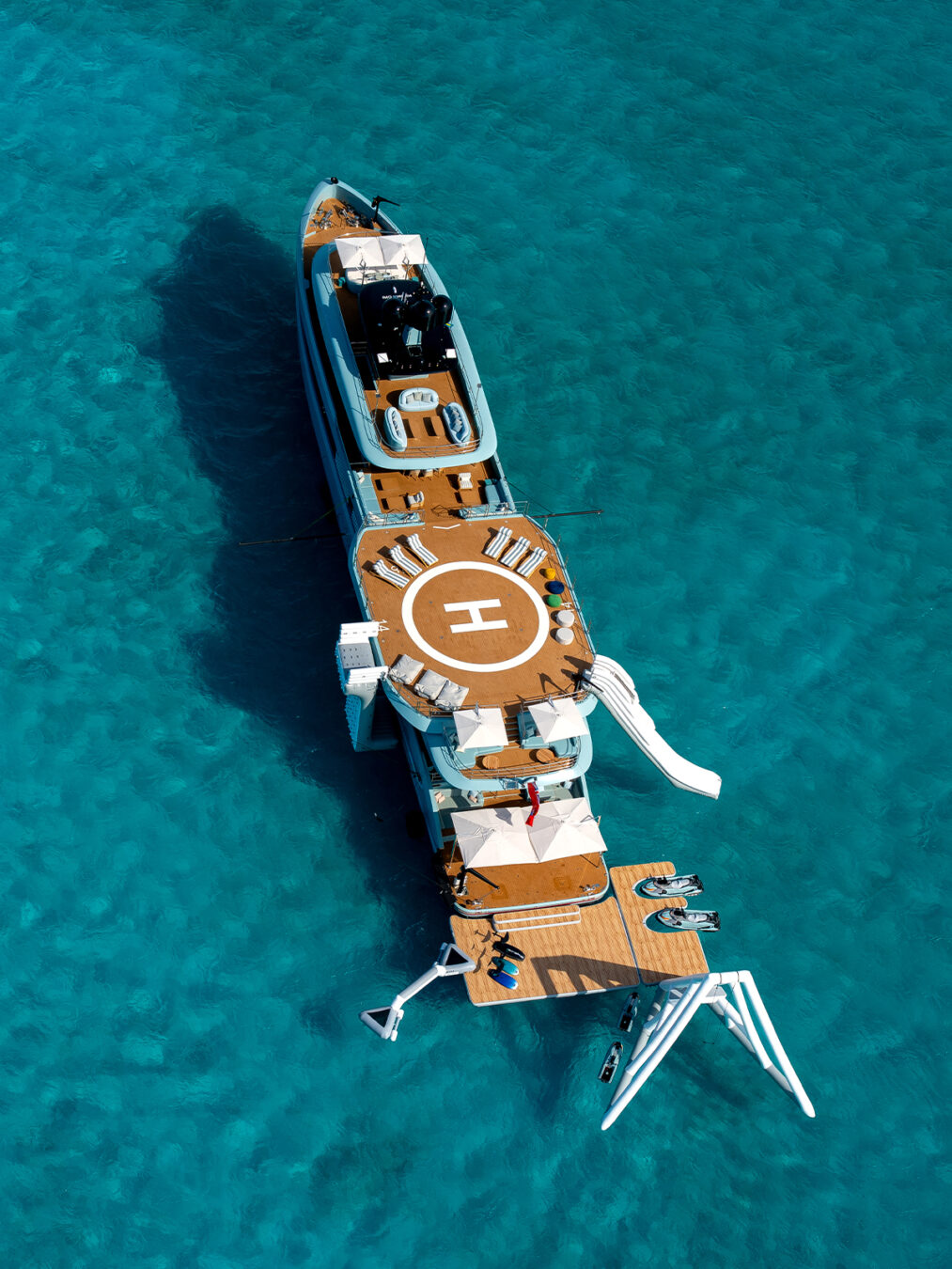
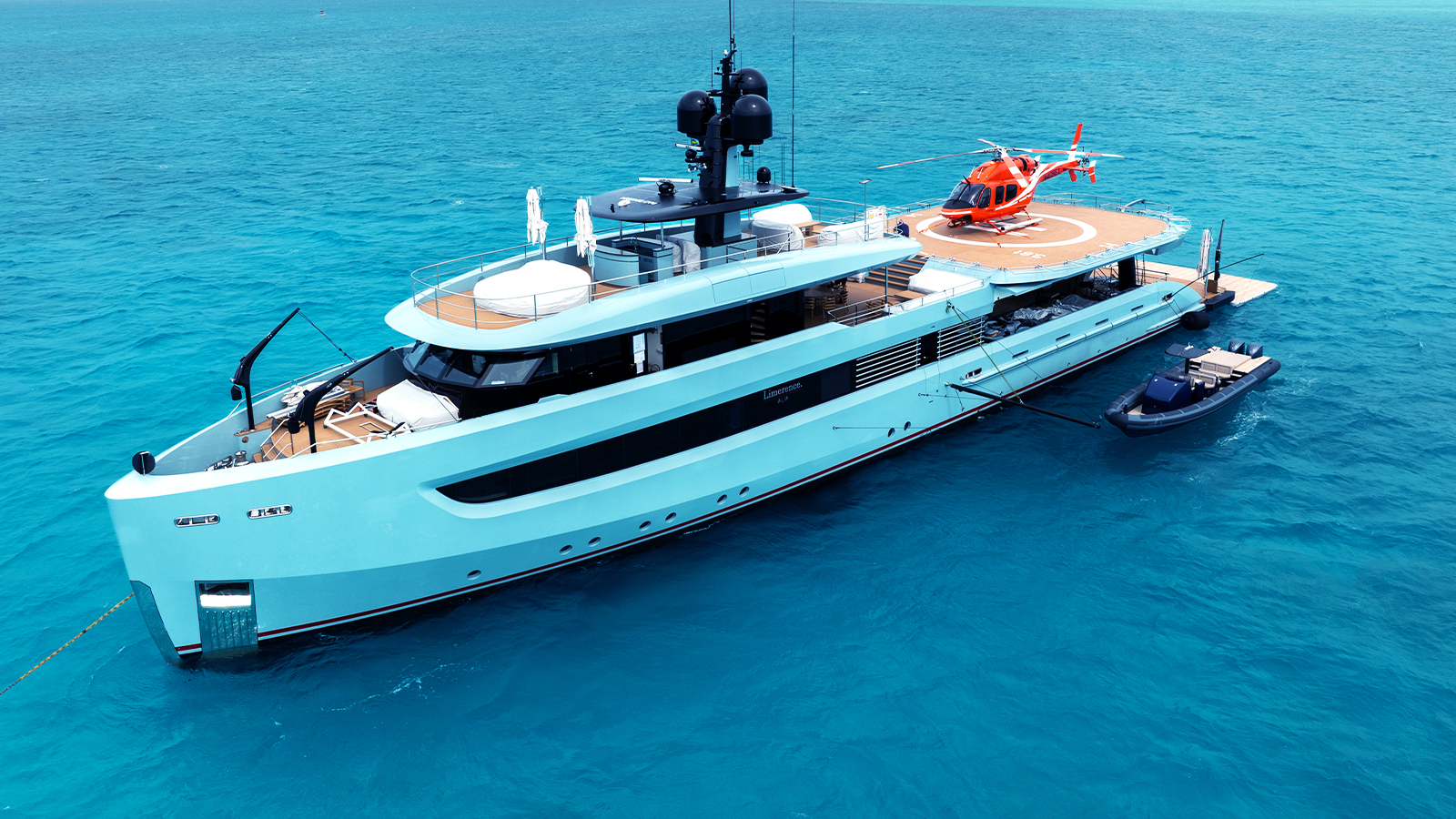
Limerence is a pointed answer to that appetite, but with a twist the genre rarely attempts. Where many explorers wear their utility plainly, hers is styled: sculpted topsides in a distinctive pale blue — a colour chosen by the owner — run back from an explorer bow to a broad, purposeful aft section. That stern is the yacht's engine of possibility. Its raised aft deck is given over to serious tender storage below and, above, to an expanse of open deck that does the work of three ordinary yachts. She looks fast at rest and reads as a ship underway; the profile promises reach, and the specification keeps the promise.
Everything needed to make the reaching worthwhile
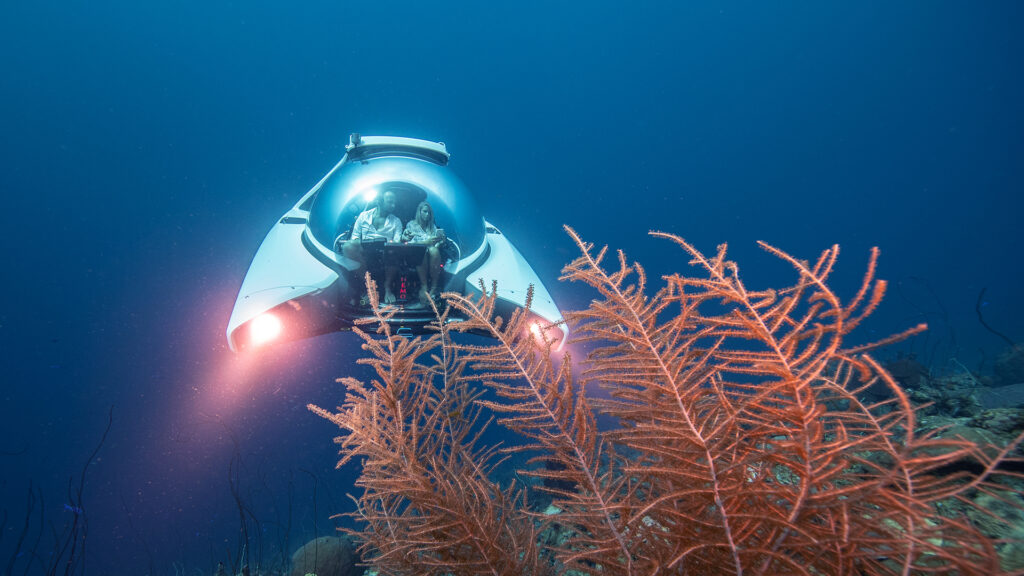
If the range gets Limerence to the remote anchorage, the inventory decides what happens once she arrives — and the manifest is extraordinary for a 52.5-metre hull. Four purpose-built tenders lead the fleet: a custom Wajer 38S, a 12.5-metre X-Tender, a Ski Nautique GS20 rigged for wake sports, and a rescue RIB. Behind them stretches a catalogue usually reserved for far larger vessels — Yamaha stand-up skis and Sea-Doo wake craft, electric surfboards and hydrofoils, foil boards, wakeboards, kite and windsurfing rigs, sailing catamarans and dinghies, seabobs, dive scooters, e-bikes and e-scooters. The yard even engineered her to carry a seven-seat submersible; whether or not one is aboard, the capability remains built in.
Beneath the helideck sits a full dive centre — ten complete scuba sets, free-diving and spear-fishing gear — while the flight deck itself converts, netted and enclosed, into a court for basketball, pickleball, volleyball and football, with golf chipping and laser clay shooting for good measure. From the swim platform unfolds an inflatable adventure park: slide, climbing wall, trapeze swing and floating jet-ski docks. Little of this is decoration. It is the working equipment of a yacht conceived to turn a stretch of empty ocean into a week no guest forgets.
Range, fleet and the water put to work
 Beach park
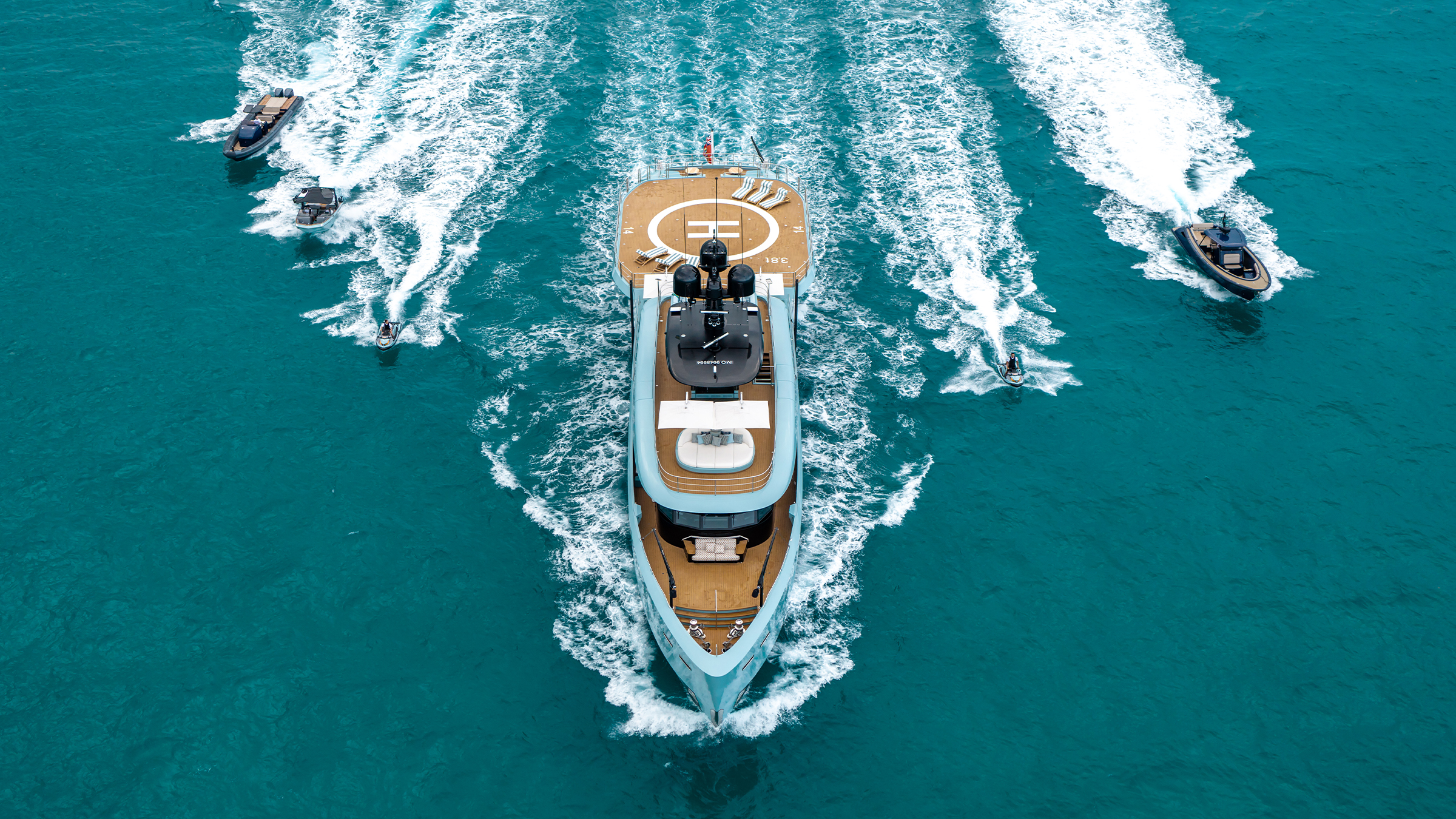 The fleet, out
 Dive centre
There's simply nothing like her.
Gökhan Çelik · President, Alia Yachts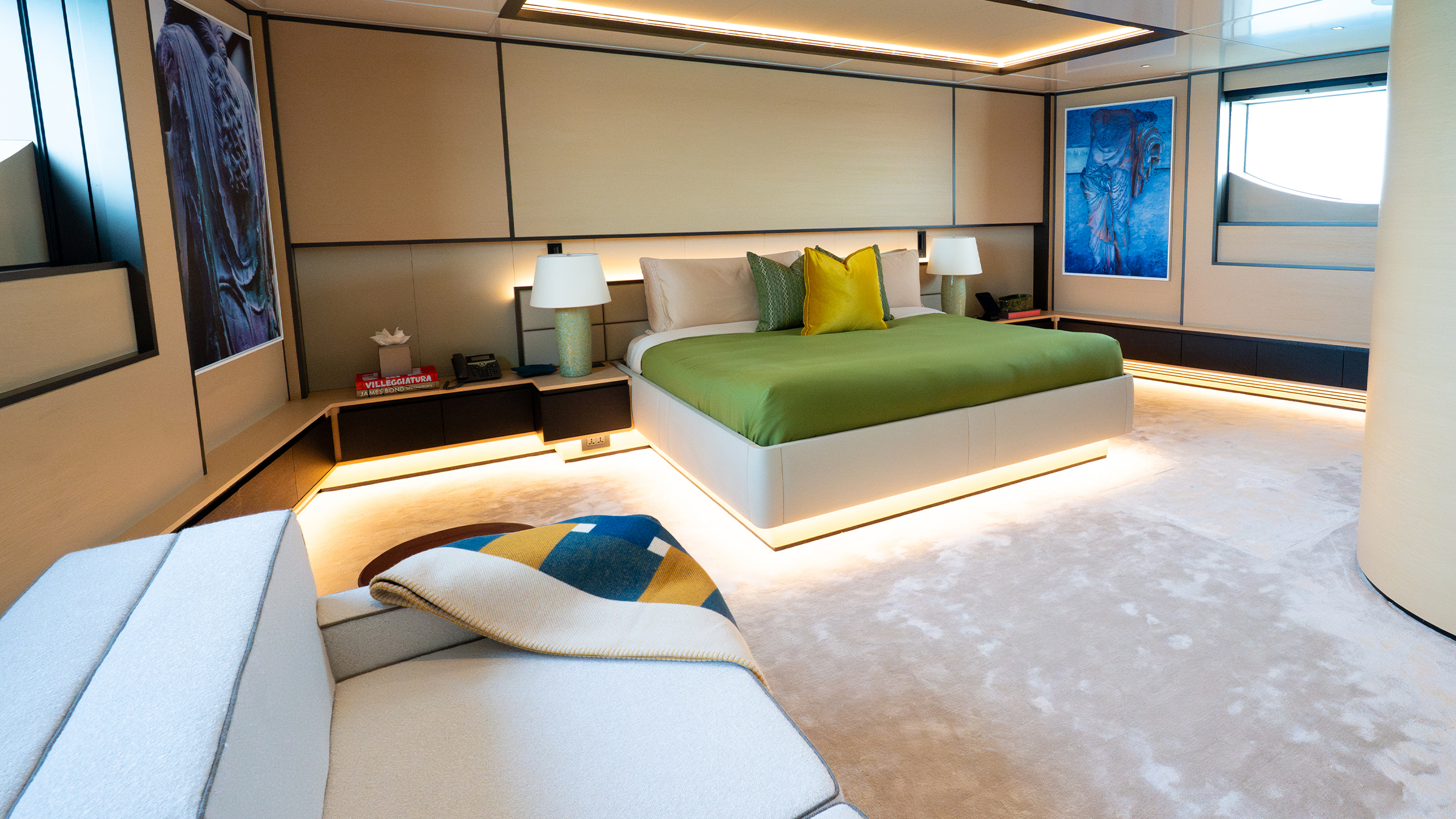 Owner's suite
A working boat with the soul of a small hotel
The surprise of Limerence is what happens when you step inside. Nothing about a support-vessel brief promises warmth, yet the interior — realised by Alia's award-winning in-house division alongside the Azure design team — reads far closer to a boutique hotel than to utilitarian adventure craft. The register is bright and calm: high-end materials, clean lines and an emphasis on a laid-back kind of luxury that never insists on itself. It is the interior of a boat that expects to be lived in for weeks at a time, not admired for an afternoon.
The planning is quietly unconventional, and all of it serves the yacht's outdoor life. A welcoming salon on the bridge deck opens directly onto al fresco dining, so the boundary between inside and sea is a threshold rather than a wall. More tellingly, the traditional main salon has been replaced on the lower deck by a water sports room — coffee station, lounge seating and screens playing back the day's footage — a room that treats the ocean as the yacht's primary entertainment and organises the interior around getting to it.
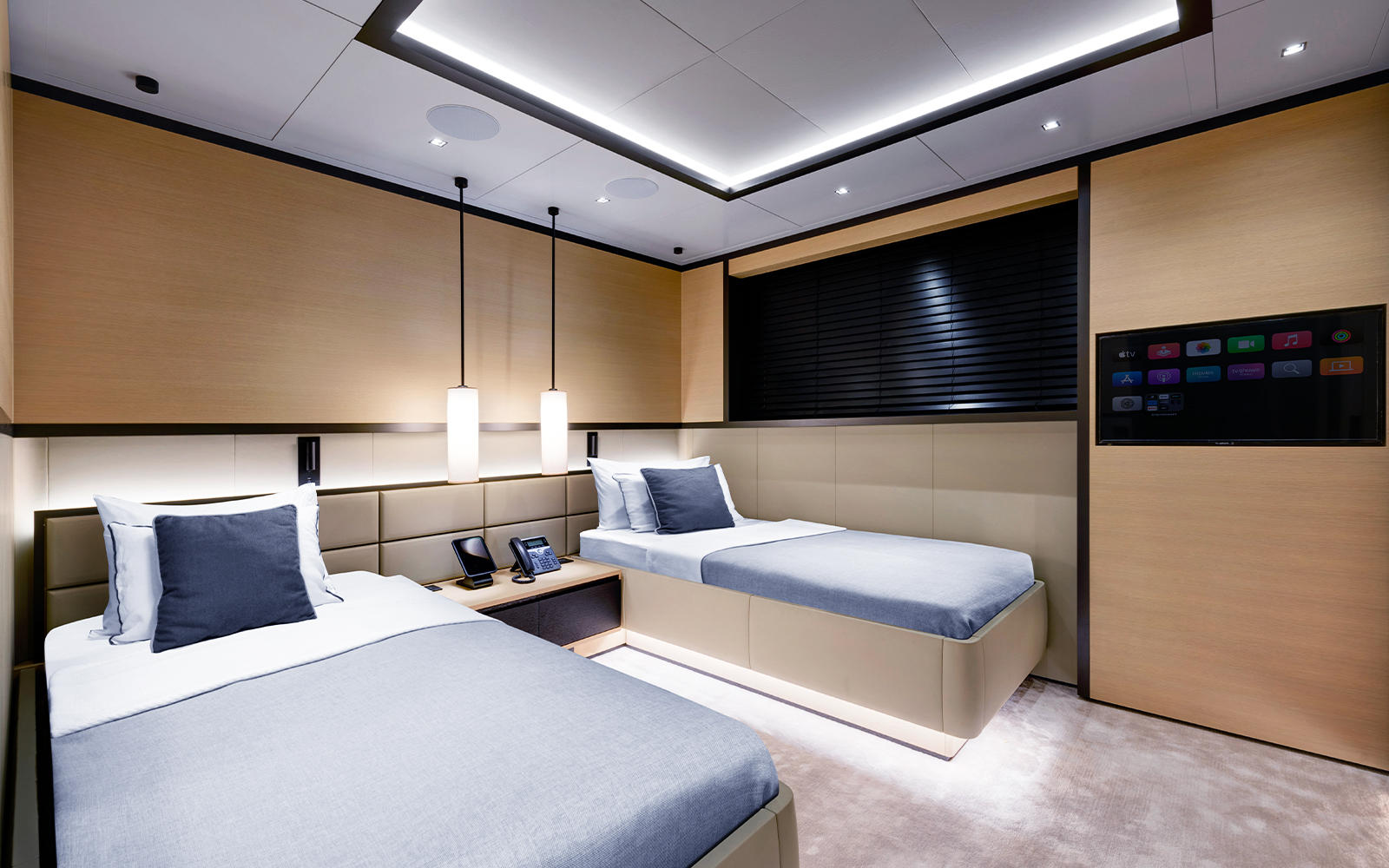 Guest cabin
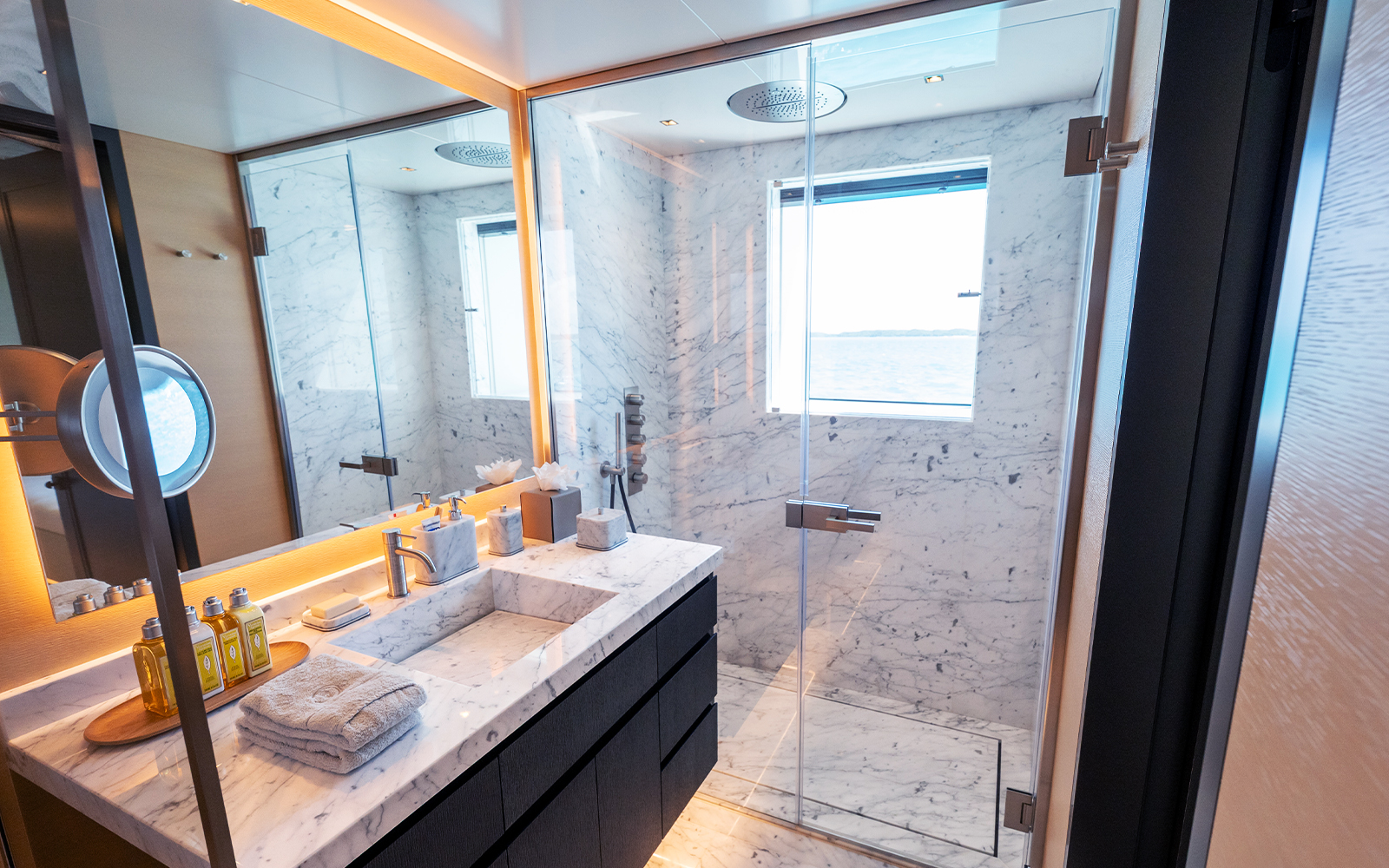 Guest bath
A layout built for the way charters actually travel
Limerence sleeps up to six guests and two children across three ensuite cabins, and the arrangement is engineered for flexibility rather than sheer count. At its heart is a full-beam owner's suite with a lounge area that converts to sleep two additional children — a detail that quietly reveals who the boat is for. The two further cabins convert between double and twin, giving a charter party the freedom to reconfigure the boat around couples, friends or a family without compromise.
The finish holds the boutique-hotel line established forward. Each cabin carries a large marble bathroom, his-and-hers vanities and generous stowage — the kind of specification that reads as restraint rather than excess, and that wears well over the long, far-flung passages this yacht was drawn to make.
When the light goes, the yacht changes register
The most theatrical trick aboard is one of transformation. As the sun drops, the beach club just above the water becomes a candlelit venue for waterside dining. The helideck — an aircraft platform an hour earlier — converts into an open-air venue: professional DJ and AV rig, lighting and effects for an evening with momentum, or a projector and a large screen for a film under the stars. A shaded mezzanine lounge set above the bathing platform, part of the original design concept, gives a quieter vantage on all of it.
This is the reward of the dual brief. A conventional superyacht offers one mood, held well; Limerence offers two, and switches between them cleanly — launch platform by day, entertainment venue by night, with the same deck doing both. It is a yacht that measures a good day not by how it looked at the dock, but by how little of it was spent standing still.
A hull tuned for distance, not display
Under the styling, Limerence is built to travel. A steel-and-aluminium hull is driven by twin Caterpillar C32 diesels of 970 kW each to a top speed of 15 knots, with an economical 10-knot cruise that stretches her legs to a range of roughly 4,000 nautical miles — enough to have already carried her across the Atlantic toward the United States. At 499 gross tons she stays deliberately below the threshold where operation grows heavy, which is part of how a boat this capable remains this manageable.
Comfort at range is engineered rather than hoped for. Anti-heeling stabilisation holds the decks steady enough that the pools, the beach club and the sports deck stay usable in real seaways, while the advanced jet-fuel systems and launching gear behind the helideck represent a level of onboard engineering usually reserved for far larger vessels. A crew of twelve keeps the whole apparatus — aircraft, tenders, dive centre and all — running as a single, unhurried machine.
- Length overall
- 52.5 m · 172 ft
- Maximum beam
- 8.6 m · 28 ft
- Draught
- 2.75 m · 9 ft
- Gross tonnage
- 499 GT
- Guests
- 6 + 2 children
- Cabins
- Three ensuite · one double, two convertible
- Crew
- 12
- Hull · Superstructure
- Steel · Aluminium
- Propulsion
- 2 × Caterpillar C32 · 970 kW each
- Top speed · Cruise
- 15 knots · 10 knots
- Range
- Approx. 4,000 nm
- Helideck
- Certified · onboard refuelling · Airbus H145 / Bell 429
- Tenders
- Wajer 38S · X-Tender 12.5 m · Ski Nautique GS20 · rescue RIB
- Exterior · Naval architecture
- Azure Yacht Design & Naval Architecture
- Interior
- Alia Yachts in-house division
- Builder
- Alia Yachts · Antalya, Turkey
- Delivered
- 2025 · ex Kaiyō
- Charter
- Christie Yachts · from €390,000 / week
The explorer has become the most interesting boat in the harbour precisely because it is built to leave it. Limerence takes that logic further than most, folding a superyacht's finish and an adventure platform's inventory into a single 52.5-metre hull that can reach a remote anchorage under its own range and turn it, for a week, into the most equipped place on the water. It is less a yacht that goes somewhere than one that makes the somewhere worth the going.
USA Onboard Editorial