

A Coast Meant to Be Sailed
Fifteen hundred kilometres of limestone, a thousand islands, and cities built to be approached from the water. Croatia is the rare destination where a private yacht is not an indulgence laid over the experience. It is the natural way in.
The Dalmatian coast runs down the eastern edge of the Adriatic in a long, broken line: mainland cliffs on one side, a scattered archipelago on the other, and between them a corridor of protected water that has carried traffic since antiquity. It is a place designed, almost accidentally, for the way a yacht moves.
Croatia holds more than a thousand islands, islets and reefs along a coastline that, counted shore for shore, stretches beyond 5,800 kilometres. The distances between anchorages are short, the water is famously clear, and the summer winds are steady without being severe. What makes the coast exceptional for chartering is not any single island but the density of them. A morning at sea rarely lasts long before the next headland, the next walled town, the next cove opens up ahead.
The towns themselves reward the approach from the water. Šibenik, Split, Korčula and Dubrovnik were all shaped by centuries of Venetian and Adriatic seafaring, and their finest façades still face the harbour rather than the road. Between them lie eight national parks and ten UNESCO World Heritage sites, most within a comfortable day's cruising of one another. A charter here is less a journey to a place than a passage through a whole coastline of them.
Croatia's rise as a charter destination has been steady rather than sudden. As the Mediterranean's established anchorages grew crowded, the Adriatic offered space, clean water and a shoreline still legible as itself. Aboard a fully crewed yacht such as KOGO, the 72-metre motor yacht offered for charter through Burgess and the vessel this itinerary is built around, the coast reveals its real advantage: the freedom to wake somewhere different each morning, and to let the day's route follow the weather and the mood rather than a fixed schedule.
One coastline, read from the waterline
Every charter is built around you, not the other way around.
The route that follows is one proposal among many. On a private charter, the number of days, the order of the stops, and the balance between time ashore and time on the water are all yours to set, and to change on the morning of, if the weather or the mood suggests it. Read the itinerary ahead as a point of departure, not a fixed product.
The itinerary is the coast. The rhythm is the yacht.
A charter day rarely announces itself. Breakfast is laid on the aft deck while the yacht lies still in a bay that was empty at first light; by mid-morning the tender has already made one run ashore and returned. Lunch is served under way or at anchor, depending on where the afternoon is headed. The crew moves through all of it quietly; the mark of a well-run yacht is how little of the work you are ever asked to notice.
What a fully crewed vessel changes is not the destination but the texture of the time. There is no packing and unpacking between towns, no negotiating for a table with a view, no compromise between the swimmer who wants the cove and the traveller who wants the old quarter. The yacht carries the hotel with it. The day divides, as it should, only between the water and the shore.
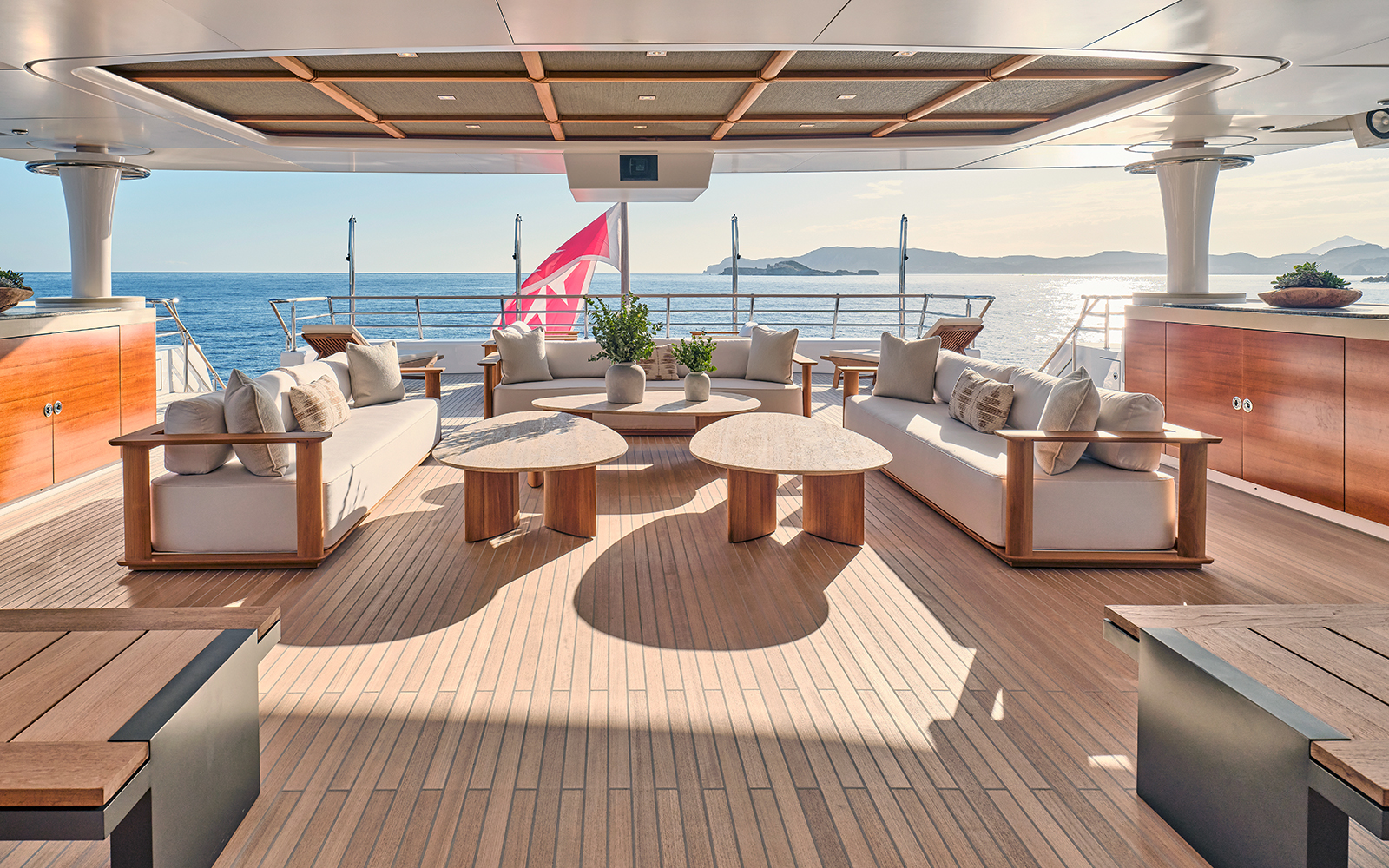 Aboard · Aft lounge, looking out
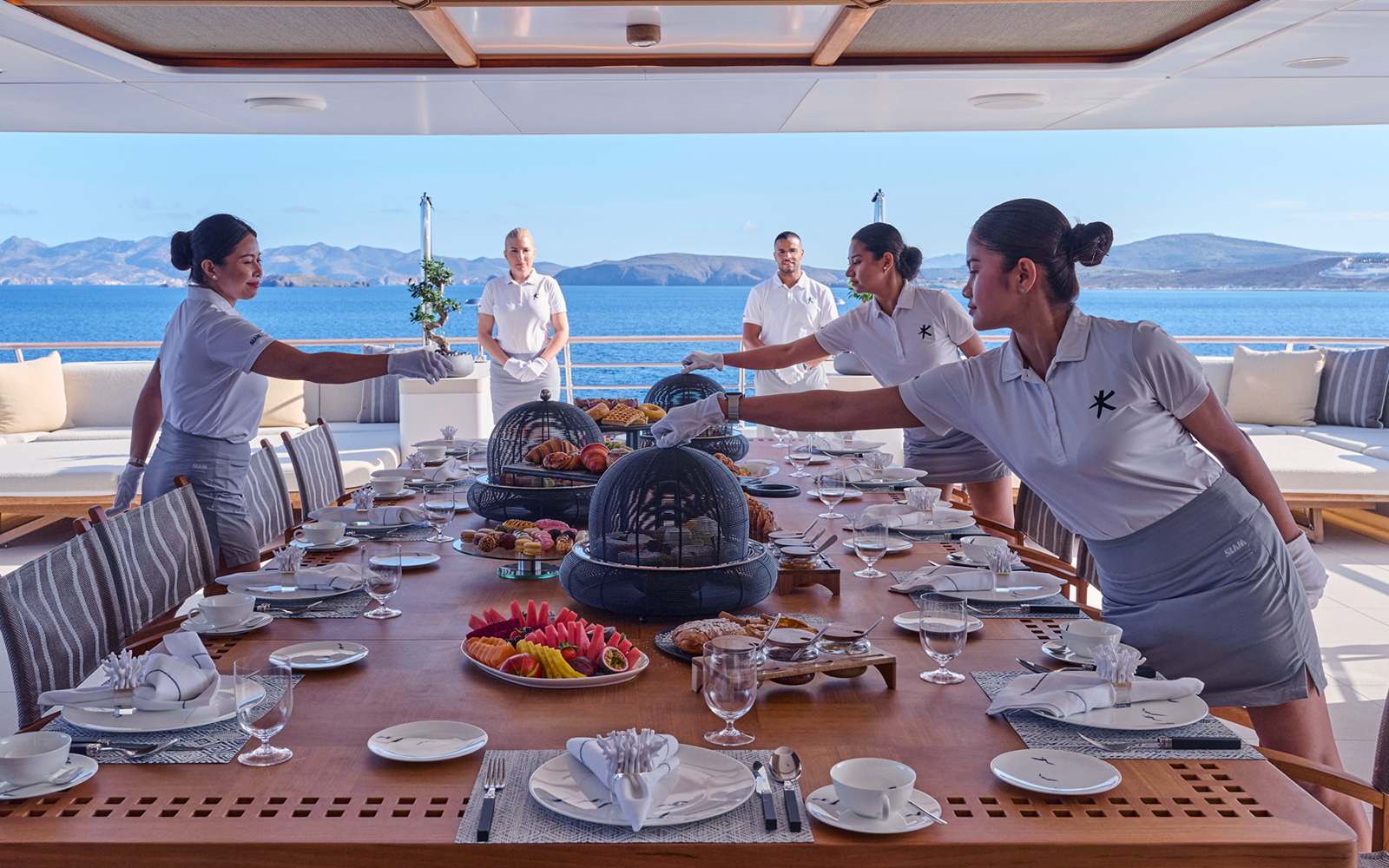 The table · Served
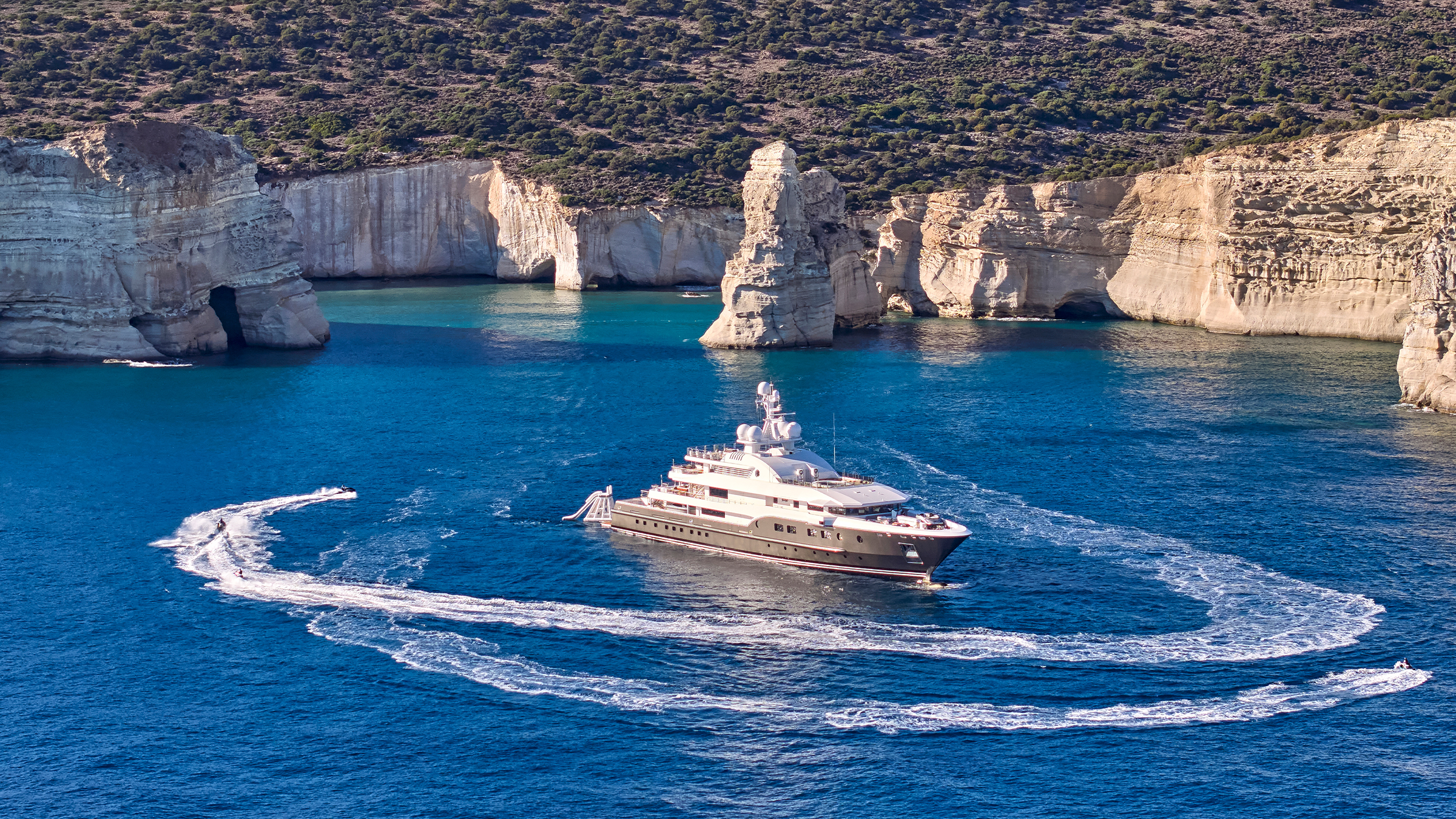 At anchor · At play
A yacht does not take you to the coast. It lets the coast come to you, one anchorage at a time.
USA Onboard Editorial
How a charter is built, and what it costs
A charter price is not a single number. It is assembled from a few clearly defined parts, and understanding them is the difference between a figure that surprises you and one that doesn't. The structure below is standard across the industry; the proportions shift with the yacht, the flag and the cruising country.
The weekly charter fee for the vessel and her full crew. It typically includes the use of the yacht, her tenders and water toys, insurance for the vessel, and linens. It does not include the running costs of your particular week (fuel, food, drink, berths), which are handled separately through the APA.
A cash float, paid before departure, that the captain draws on for the consumable costs of your cruise: fuel, provisioning, wines and spirits, marina and mooring fees, port and customs charges, and shore transfers. For a motor yacht in this region it commonly runs at around 35% of the base rate. It is fully accounted for, and any unspent balance is returned to you.
Value-added tax is charged on the charter according to the waters you sail. In Croatia it is currently 13%, among the lower rates in the Mediterranean and one reason the country has grown as a charter base. It is charged once, based on the country where the charter begins and the yacht is placed at your disposal, not each time you cross a border. Neighbouring markets differ (Greece around 13%, France 20%, Italy 22%), which is worth weighing when you choose where to embark.
A customary tip for the crew, reflecting the level of service over the week. The accepted range is 5–15% of the base rate, with around 10% a common reference point. It is always discretionary, and always yours to judge.
Timing moves the base rate more than any other single factor. Peak summer, July and August, commands the top of a yacht's range; the shoulder weeks of late spring and early autumn can shift the weekly figure by roughly 20% for the same yacht and the same route.
A worked example, following the USA Onboard cost guide
Croatia · a ~24 m (80 ft) yacht chartered for 7 nights in peak season · illustrative figures, not KOGO
Figures are illustrative, following the structure of the USA Onboard cost guide with VAT updated to Croatia's current 13%. They describe a yacht of roughly 24 metres (80 ft), not KOGO, and are not a quotation. Every charter is priced to the specific vessel, route and dates.
Free download
The complete USA Onboard guide to what a yacht charter really costs.
When to sail Croatia
July to August
Peak season. Warmest water, longest days, busiest anchorages and the top of the rate range. Book well ahead.
Late May to June
The early shoulder. Warm, quiet water, towns not yet at full capacity, and softer pricing for the same route.
September to October
The late shoulder. Sea still warm from summer, thinner crowds, and a calmer, more contemplative coast.
Eight days down the coast, north to south
The route below runs from Šibenik in northern Dalmatia to Dubrovnik in the south, following the coast in the order the geography suggests. It is drawn to be sailed comfortably in a week, with short passages between anchorages and a deliberate balance of open water and time ashore. It is also, as ever, only a proposal: a spine that can be lengthened, shortened or reordered to suit.
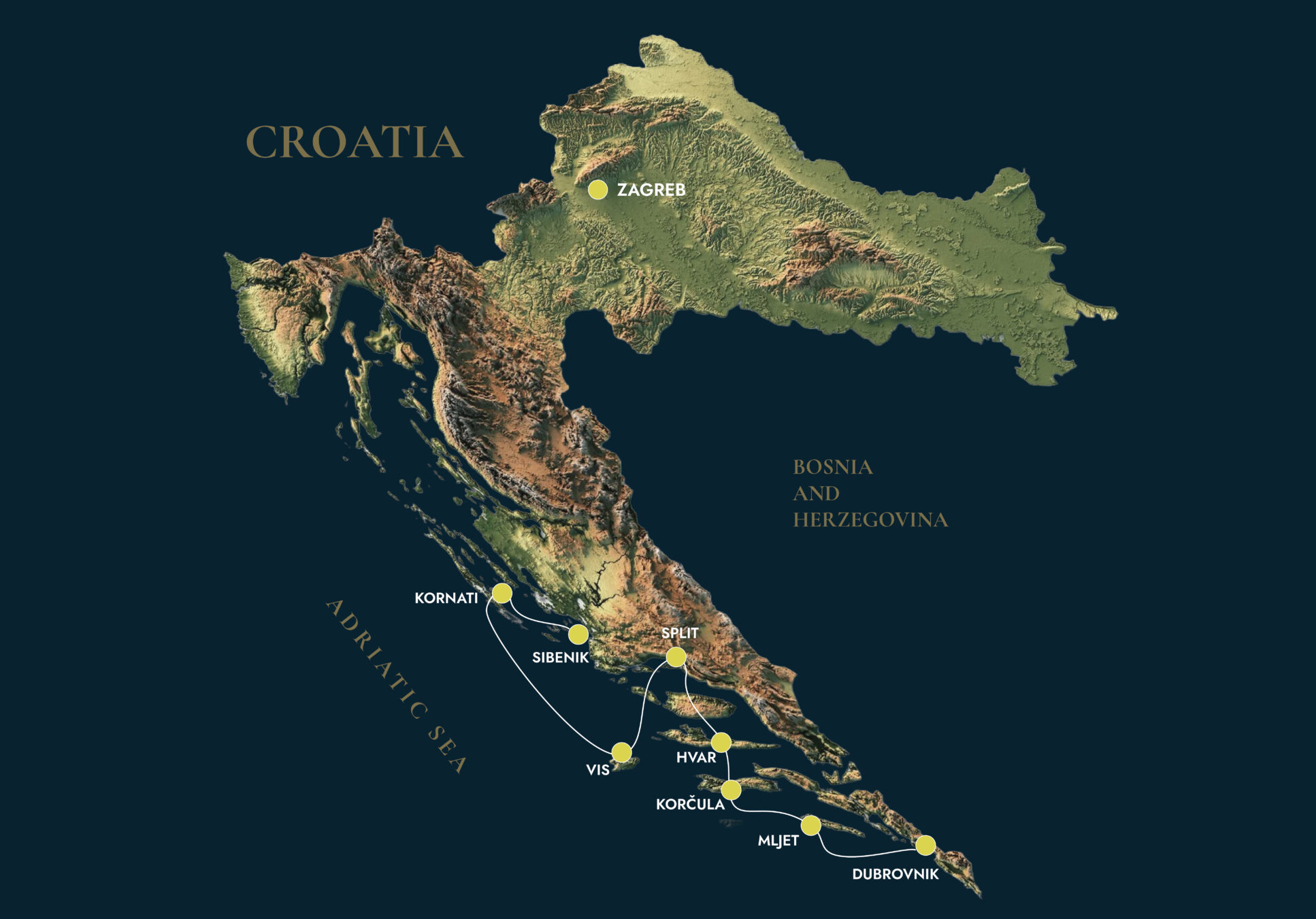
The route, at a glance
Distances approximateDistances are indicative and depend on the exact anchorages chosen. Your captain sets each day's passage around the weather and your plans for it.
Šibenik
Go ashoreA working Dalmatian city rather than a resort, Šibenik makes a quiet, characterful start. Unlike its Roman and Venetian neighbours, it was founded by Croatians, and its old town climbs the hillside in a tangle of stone lanes and stairways. Its centrepiece, the Cathedral of St James, is a UNESCO World Heritage Site, built entirely of stone, without brick or timber, over more than a century. Guarding the harbour approach, the St Nicholas Fortress carries a UNESCO listing of its own. An easy first evening ashore before the coast opens up.
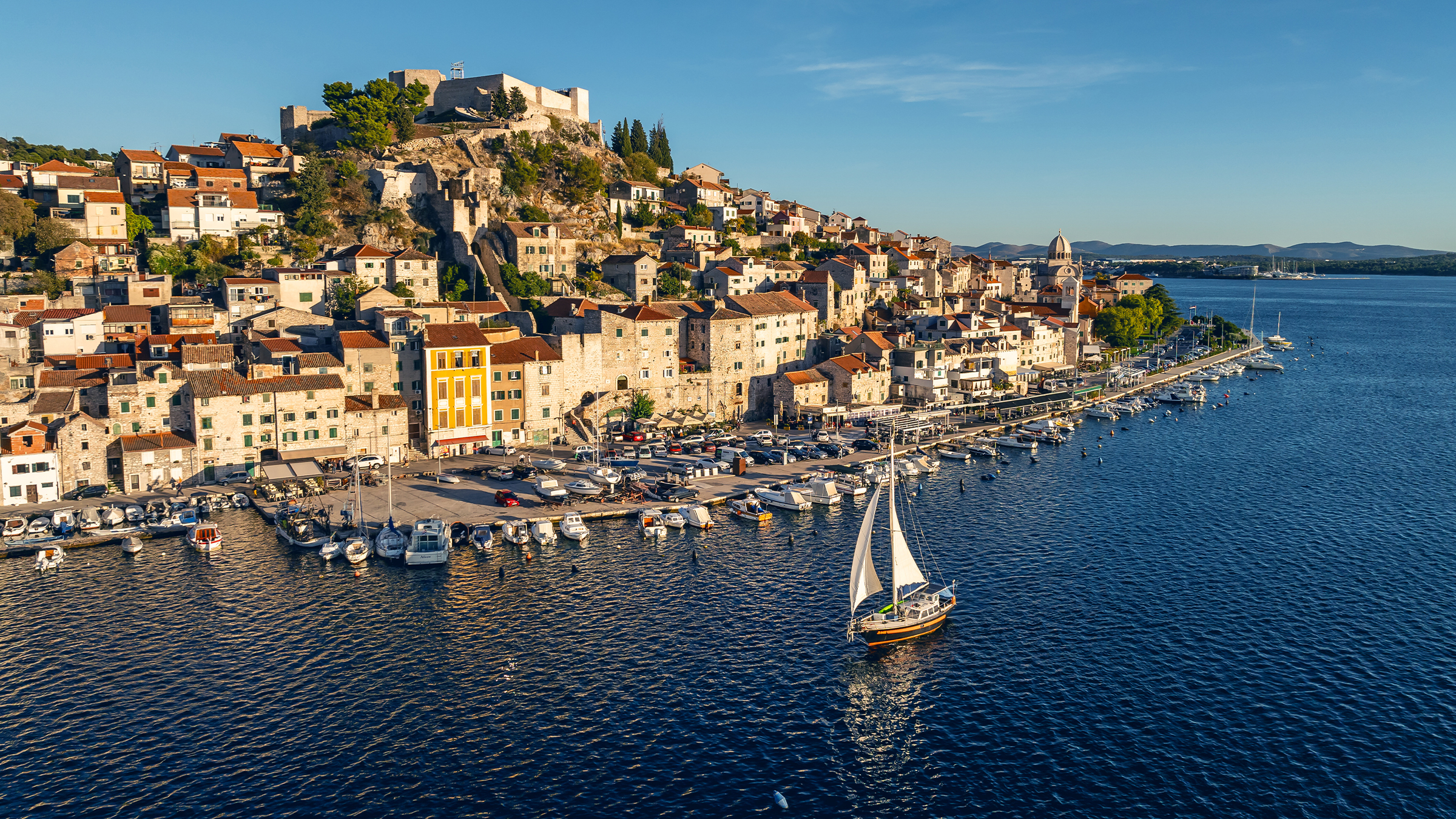 Šibenik · From the water
Kornati National Park
On the waterSome eighty-nine islands, islets and reefs, almost entirely uninhabited, scattered across a stretch of open Adriatic: the Kornati are a national park best experienced from the deck. There is little to go ashore for here, and that is the point: the day is given to swimming off the transom, exploring the maze of channels by tender, and lunch at anchor in water that reads as impossibly clear. Just south lies the Telašćica nature park, with its sheer cliffs and salt lake, an easy addition if the day allows.
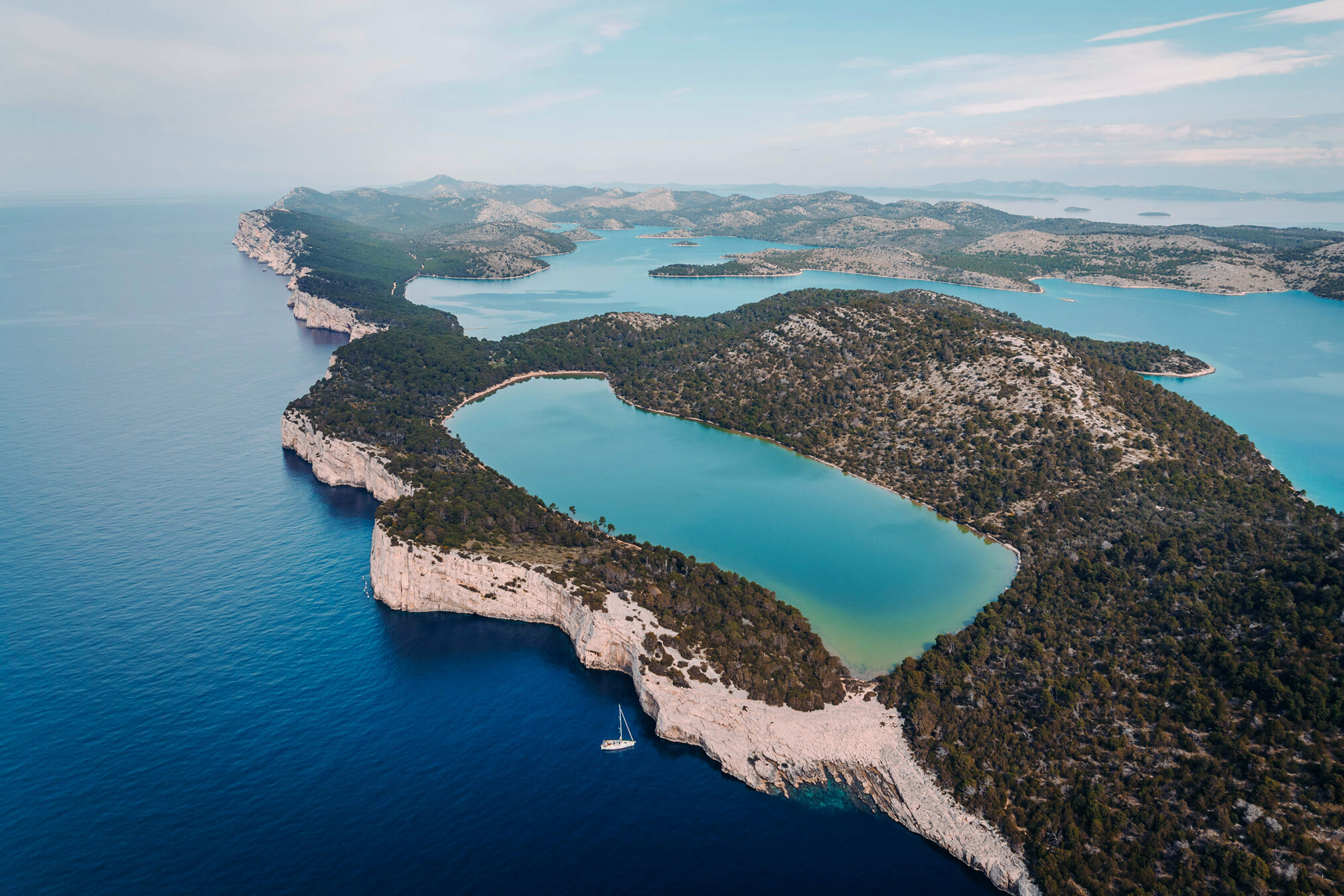 Kornati National Park · From the air
Vis
On the water & ashoreThe most distant of the major Dalmatian islands, Vis was closed to outsiders for decades as a naval base and came late to tourism, which is precisely why it feels unhurried and unspoiled today. The reward for the longer passage is a pair of harbour towns, Vis and Komiža, and some of the finest water on the coast. From here the tender can run to the Blue Cave on nearby Biševo, where late-morning light turns the interior an electric blue, and to Stiniva, a near-enclosed cove reached through a narrow gap in the cliffs.
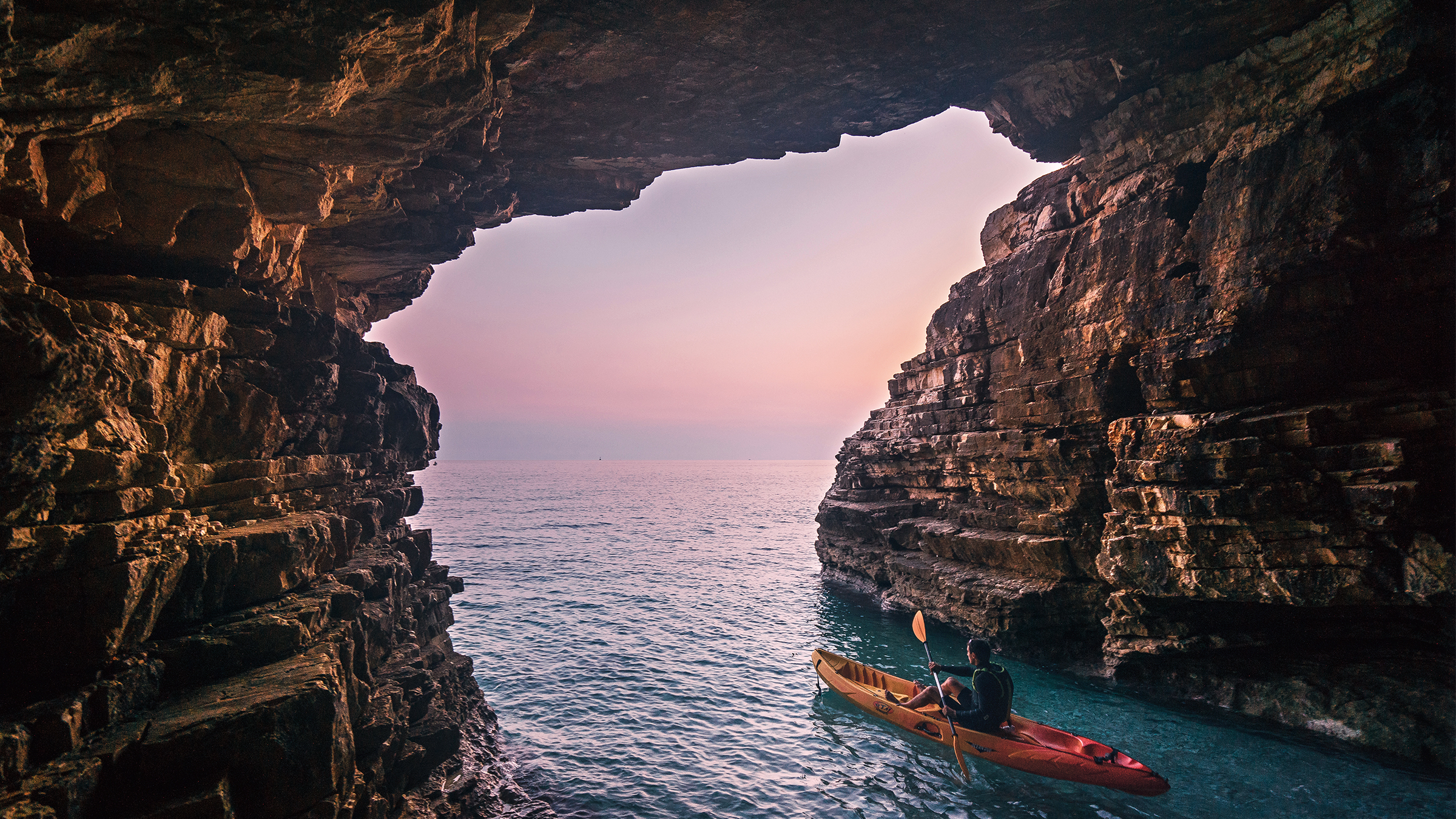 On the water · A sea cave at dusk
Split
Go ashore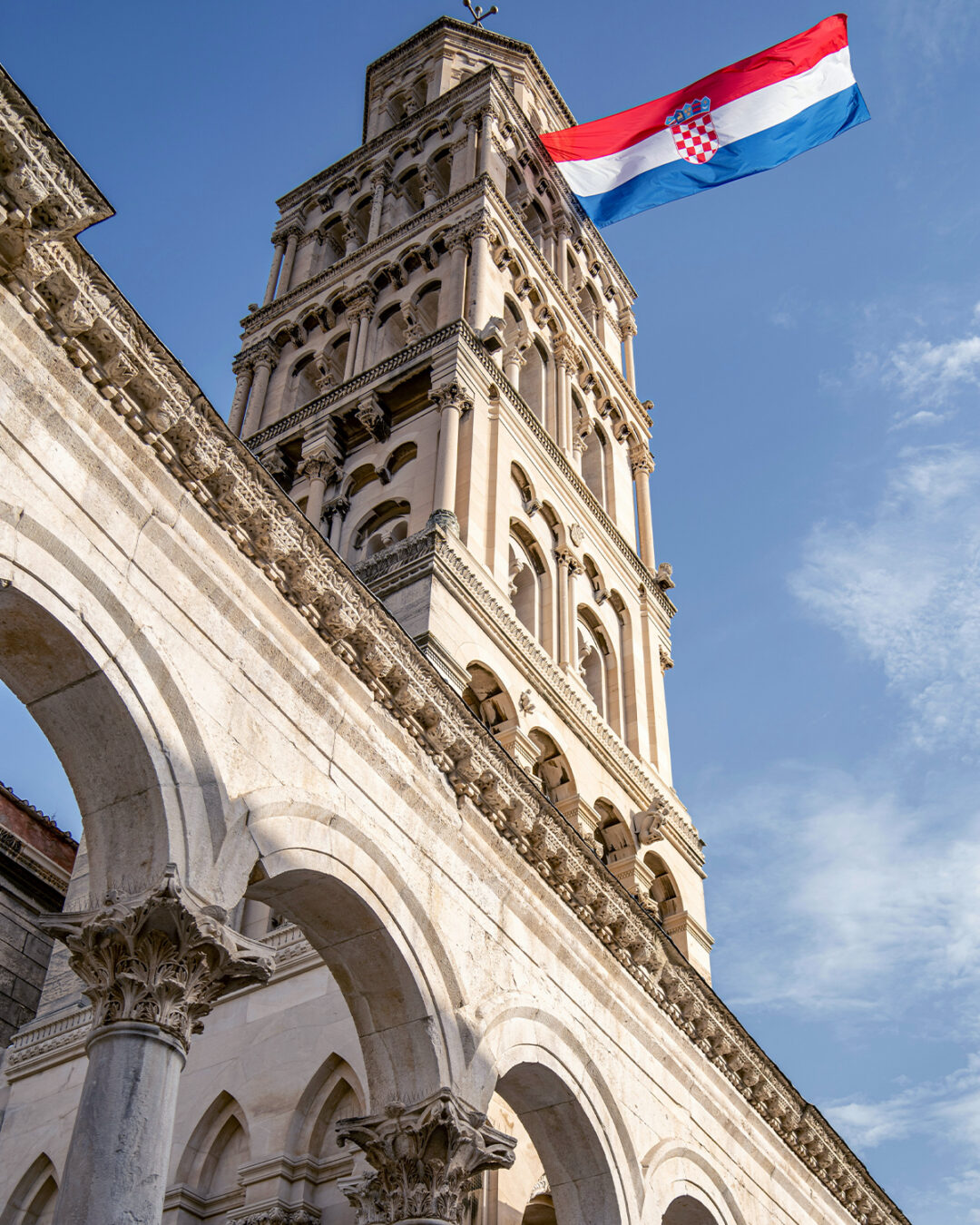 Split · Diocletian's Palace
Split is a rarity: a UNESCO World Heritage city that never became a museum. Its old town is the Palace of Diocletian, built as the retirement residence of a Roman emperor around the turn of the fourth century, and now lived in: cafés, apartments and markets threaded through seventeen centuries of stone. Berth stern-to along the Riva, step off, and you are in it. A morning among the substructures and the peristyle, an afternoon in the surrounding lanes, and the largest city of the itinerary is done on foot.
Hvar
On the water & ashoreHvar wears two faces, and a charter lets you choose which to meet. The town is the coast's most cosmopolitan harbour, its waterfront lined with Venetian palazzi and, in season, with yachts. Just offshore lie the Pakleni Islands, a string of wooded islets with clear-water anchorages a few minutes by tender. Inland, the Stari Grad Plain (a Greek agricultural landscape divided in the fourth century BC and farmed ever since) is a UNESCO World Heritage Site, and the hills above still carry the lavender for which the island is known.
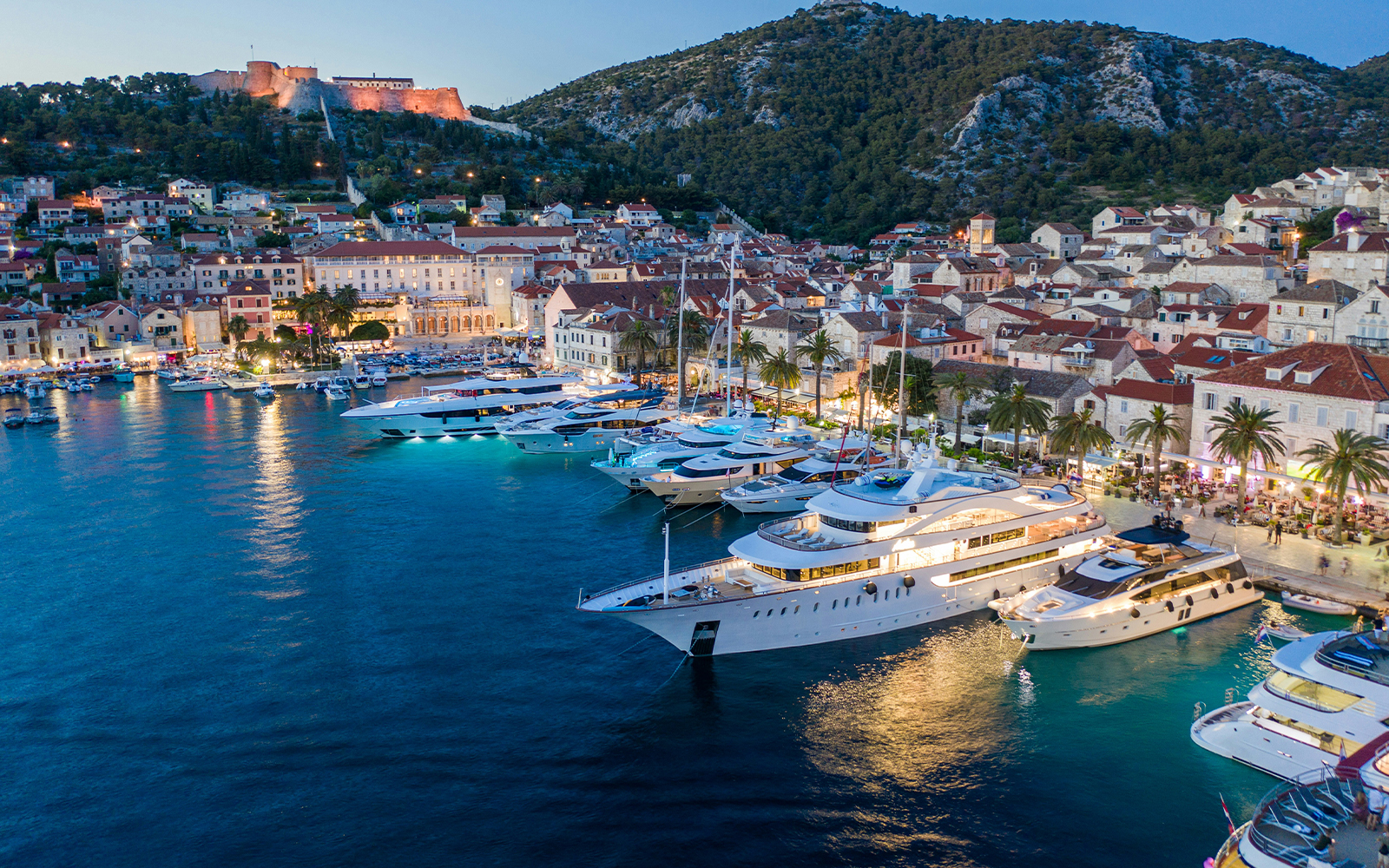 Hvar · The harbour
Korčula
Go ashore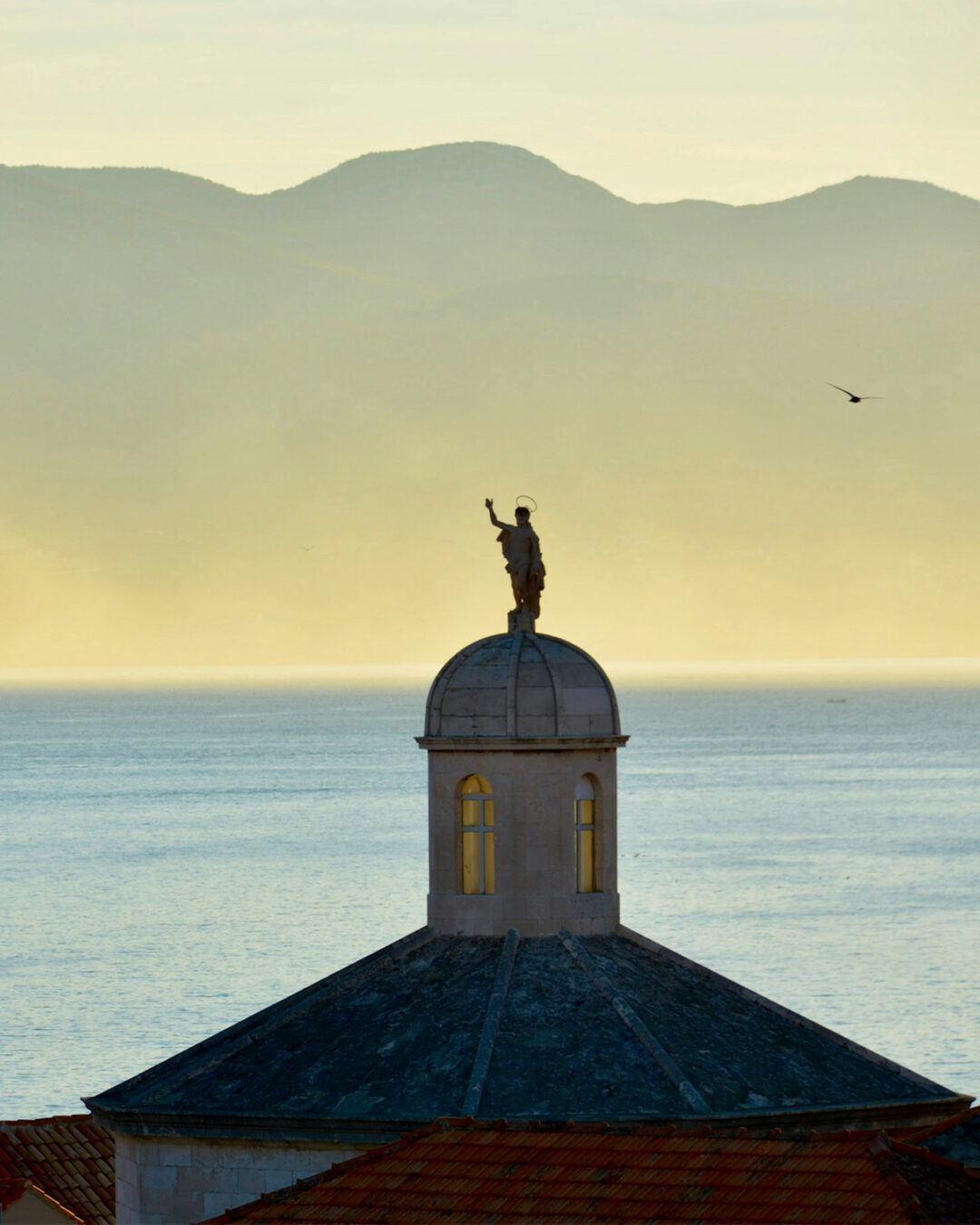 Korčula · At dusk
A fortified medieval town on a small peninsula, Korčula is often called a Dubrovnik in miniature: walls, towers, and a herringbone street plan laid out to break the wind. The town claims Marco Polo as a native son, a claim it wears with some pride and no small commerce. It is also wine country: the surrounding vineyards produce the indigenous whites Pošip and, from the sandy soils of nearby Lumbarda, the rarer Grk. A half-day ashore, an evening at a konoba, and a glass of something you cannot easily find at home.
Mljet
On the water & ashoreThe most forested of the Croatian islands, Mljet gives its western third to a national park built around two connected saltwater lakes. On an islet in the larger lake stands a twelfth-century Benedictine monastery, reached by a short boat ride across water that barely moves. The day is a gentle one: swimming in the lakes, cycling or walking the shaded paths, and anchoring off the quieter southern bays such as Saplunara. After the stone of the towns, an island that is mostly pine and water.
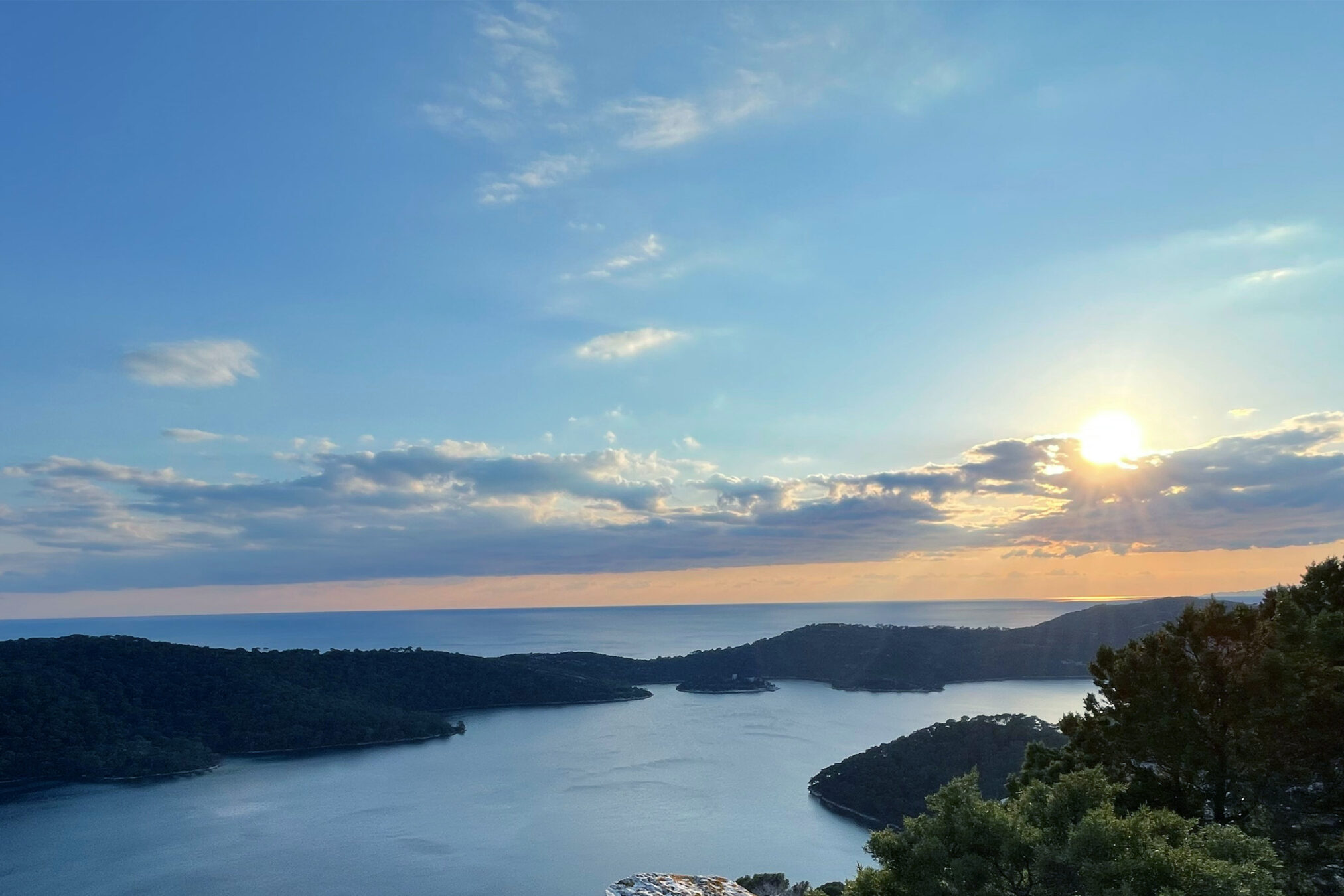 Mljet · National park lakes
Dubrovnik
Go ashoreThe coast saves its grandest statement for last. Dubrovnik's Old Town, ringed by walls that run nearly two kilometres unbroken above the sea, is a UNESCO World Heritage Site and one of the most complete fortified cities in the Mediterranean. Approaching by yacht is the way it was always meant to be seen: the walls rising straight from the water, the terracotta roofs stacked behind them. A morning on the ramparts, a walk down the marble Stradun, and a last swim from the deck before the charter closes.
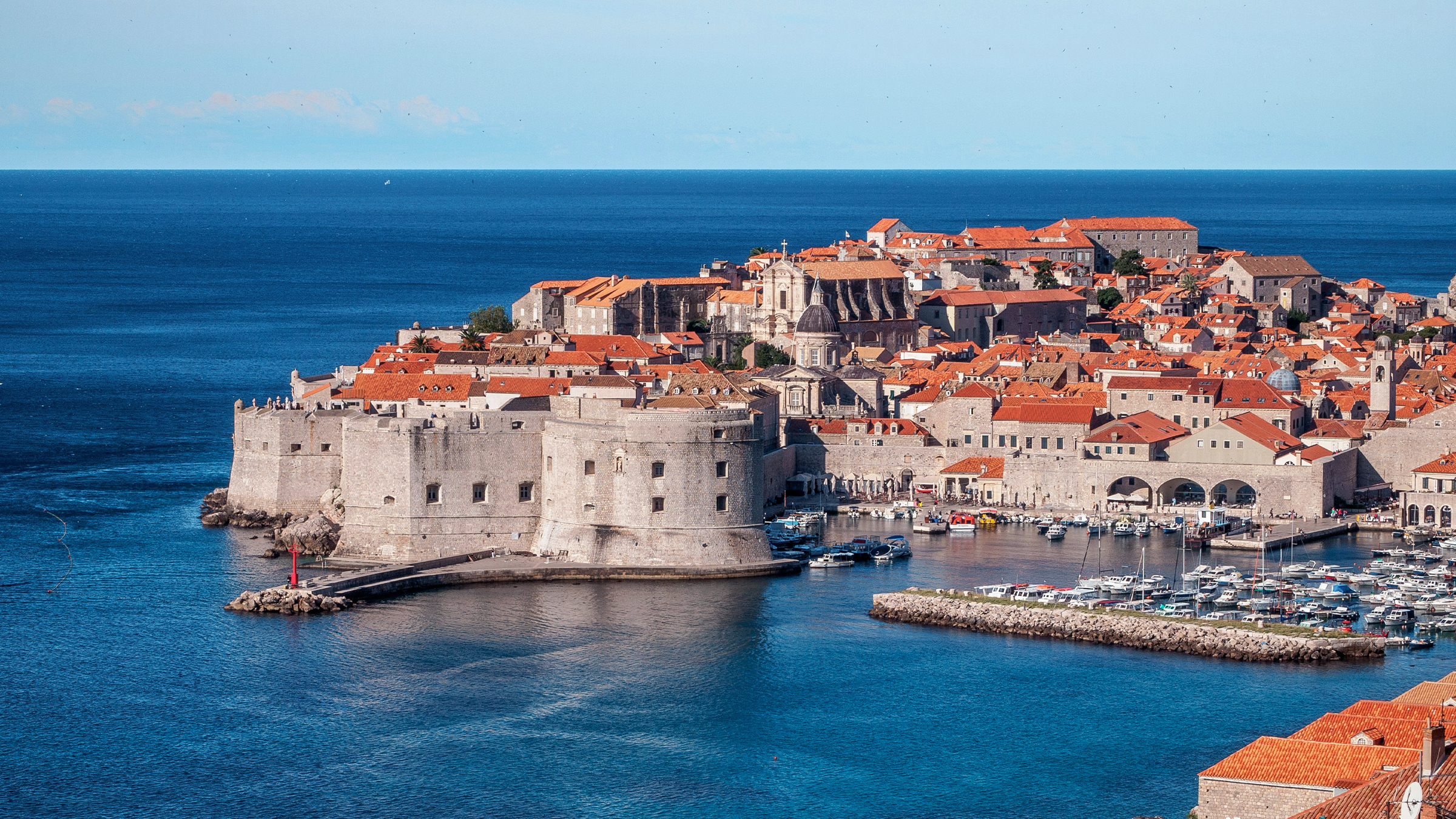 Dubrovnik · The walled city
What the coast puts on the plate
Dalmatian cooking is a cuisine of restraint: grilled fish landed that morning, olive oil pressed on the islands, herbs from the hillsides, and little that gets in the way of good ingredients. The north leans on shellfish and the Adriatic's white fish; the interior islands add lamb cooked slowly under the peka, a bell of hot embers. Truffles from the region turn up over hand-rolled pasta. On a crewed yacht, much of it arrives at the table having been bought at a quay that morning; provisioning is one of the quiet luxuries of chartering here.
The wines are the coast's under-told story. Croatia grows grapes found almost nowhere else: the robust red Plavac Mali from the steep coastal slopes of the Pelješac peninsula and Hvar, and the whites Pošip and Grk from Korčula. They travel poorly and are rarely exported in quantity, which makes drinking them where they are grown one of the genuine pleasures of the route.
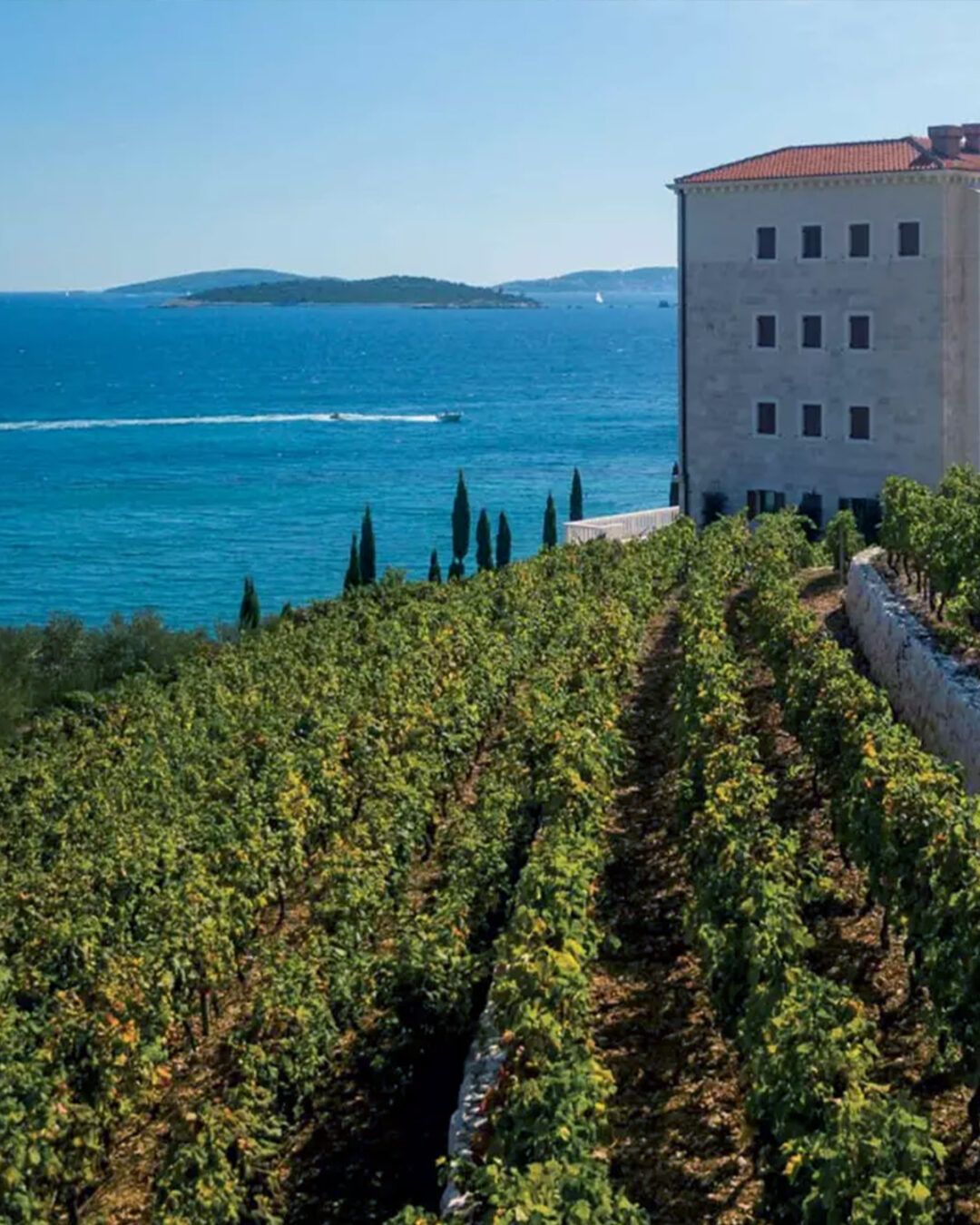 Vines above the sea
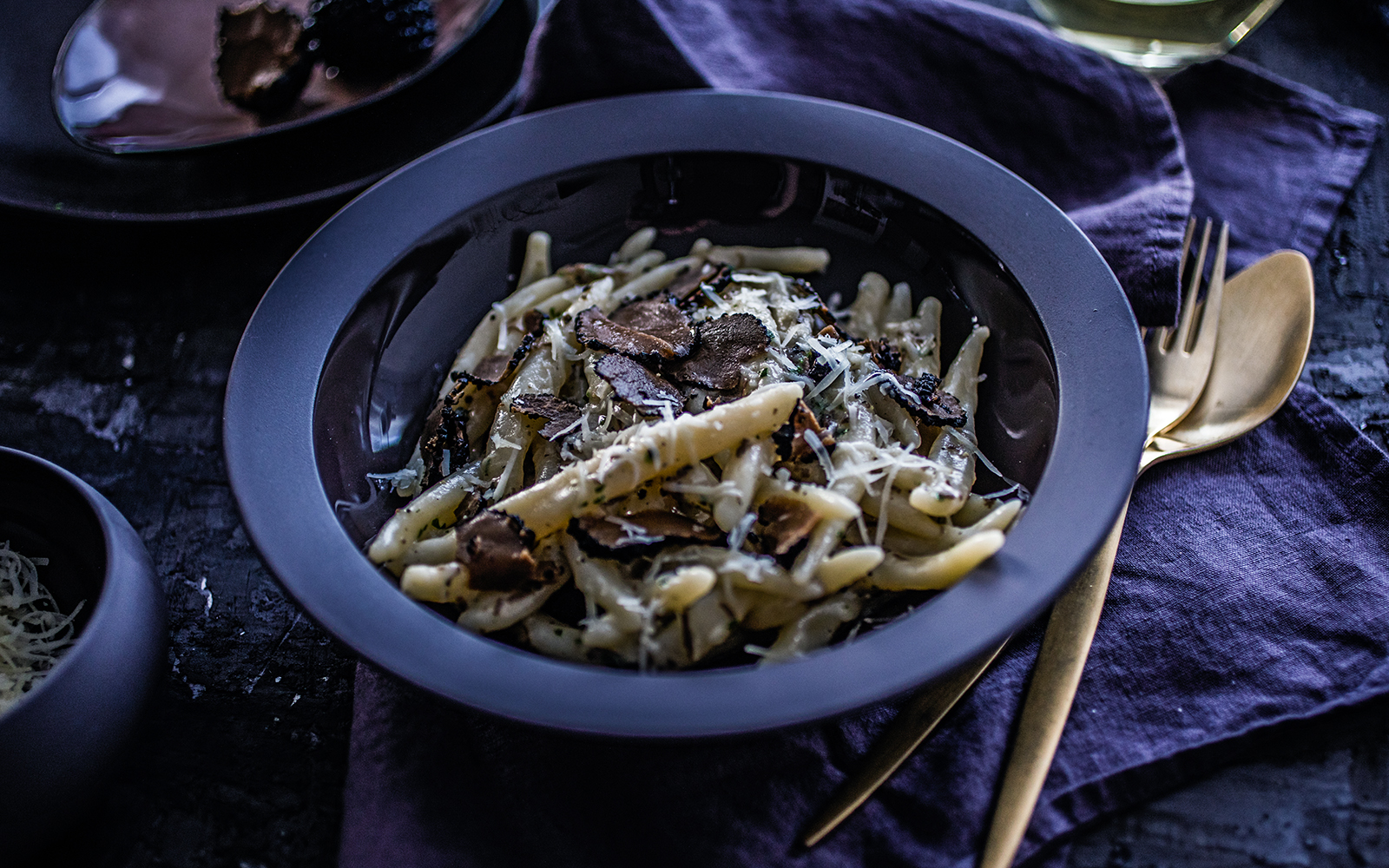 Truffle & hand-rolled pasta
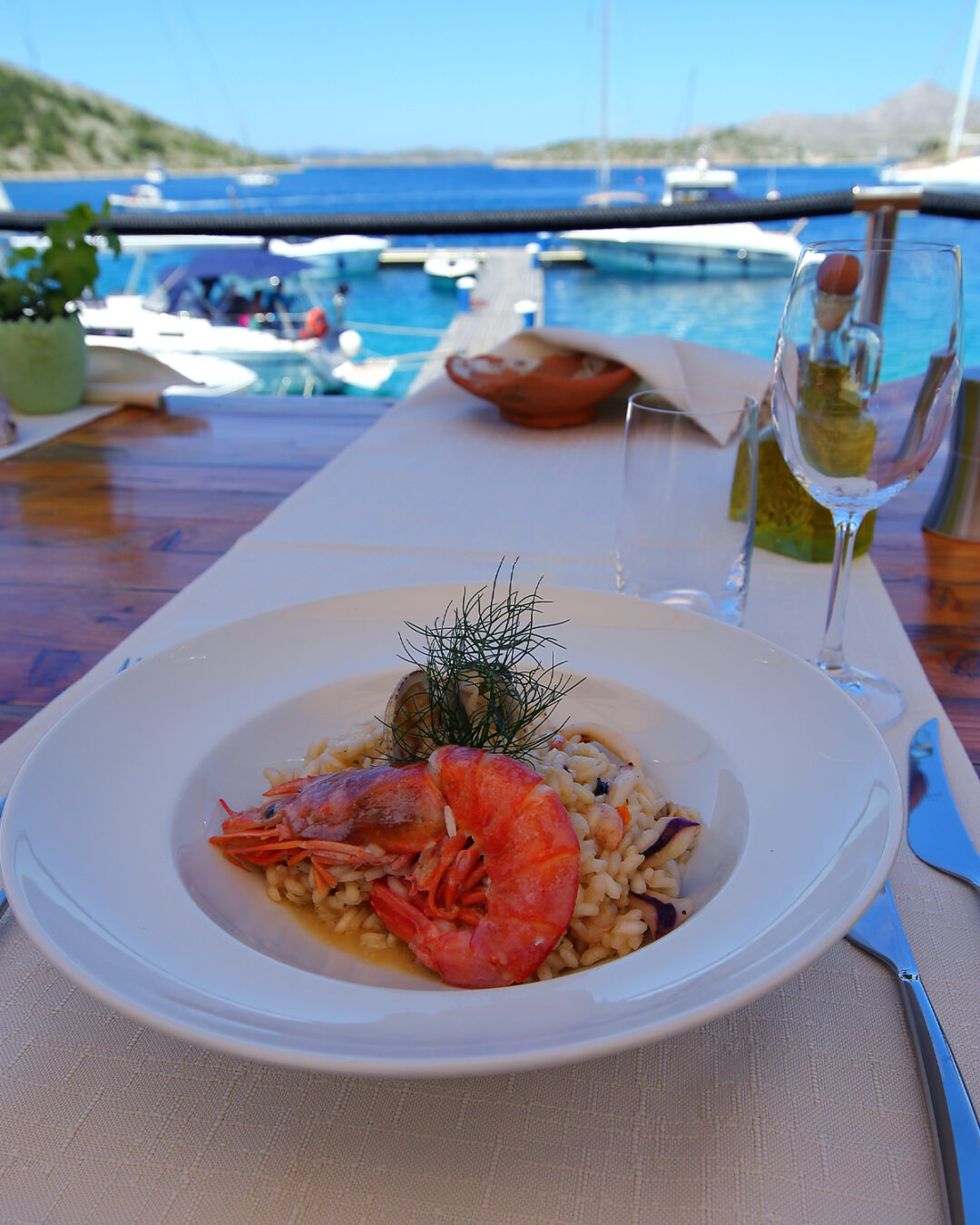 Langoustines · From the quay
The best Dalmatian wines never leave the coast. You go to them.
USA Onboard Editorial
Eight days, eight stops, but nothing here is fixed. Add an island, linger a day longer where the water is best, reverse the whole route from Dubrovnik north. The coast is the constant; the itinerary is always yours to write.
Who runs the charter
Burgess
Superyacht charter · brokerage · management
Founded in London in 1975 by the ocean racer Nigel Burgess, the firm has grown into one of the established houses of the superyacht world. Its work spans the full life of a large yacht: charter, sales and purchase, new construction, technical services and full yacht management, handled from a network of nineteen offices across five continents. KOGO is offered for charter through Burgess, and a charter is arranged, provisioned and crewed under that structure rather than booked off a page.
1975
Established
in London
19
Offices across five
continents
Full
Charter, sales, new-build
& management
KOGO, the vessel this route is built around
A 72-metre motor yacht built by Alstom Leroux Naval in France in 2006 and refitted in 2025, KOGO carries twelve guests in seven cabins with a crew of twenty-one. Her exterior is by Tim Heywood and her interior by Terence Disdale Design, two of the most recognised names in yachts of her generation. What the specification describes, in practice, is scale: a full-beam master with its own lounge, a spa and gym, a beach club at the waterline, a deck jacuzzi, indoor and outdoor cinemas, and a garage of tenders and toys that turns any anchorage into a base for the day.
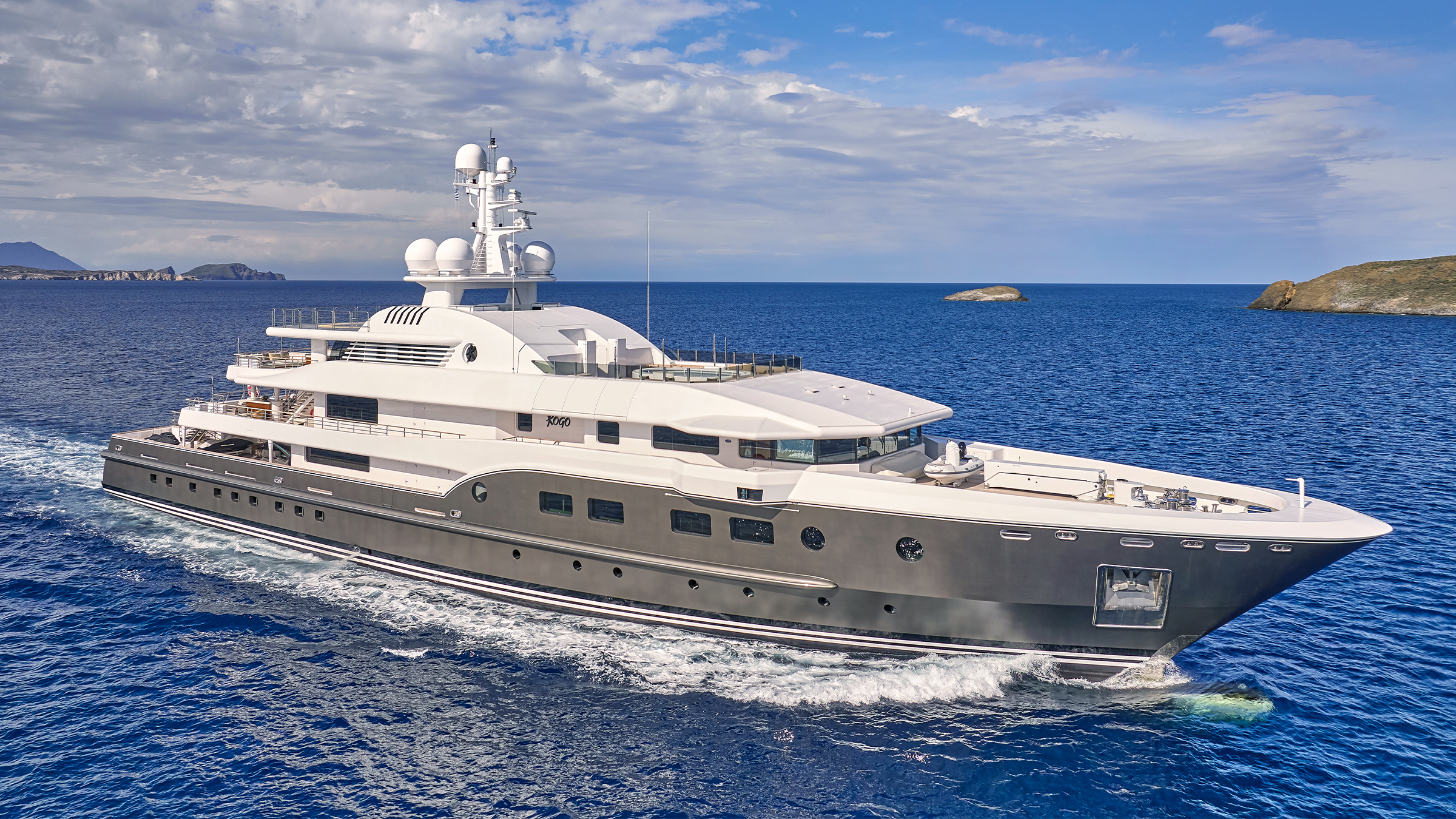 KOGO · Underway
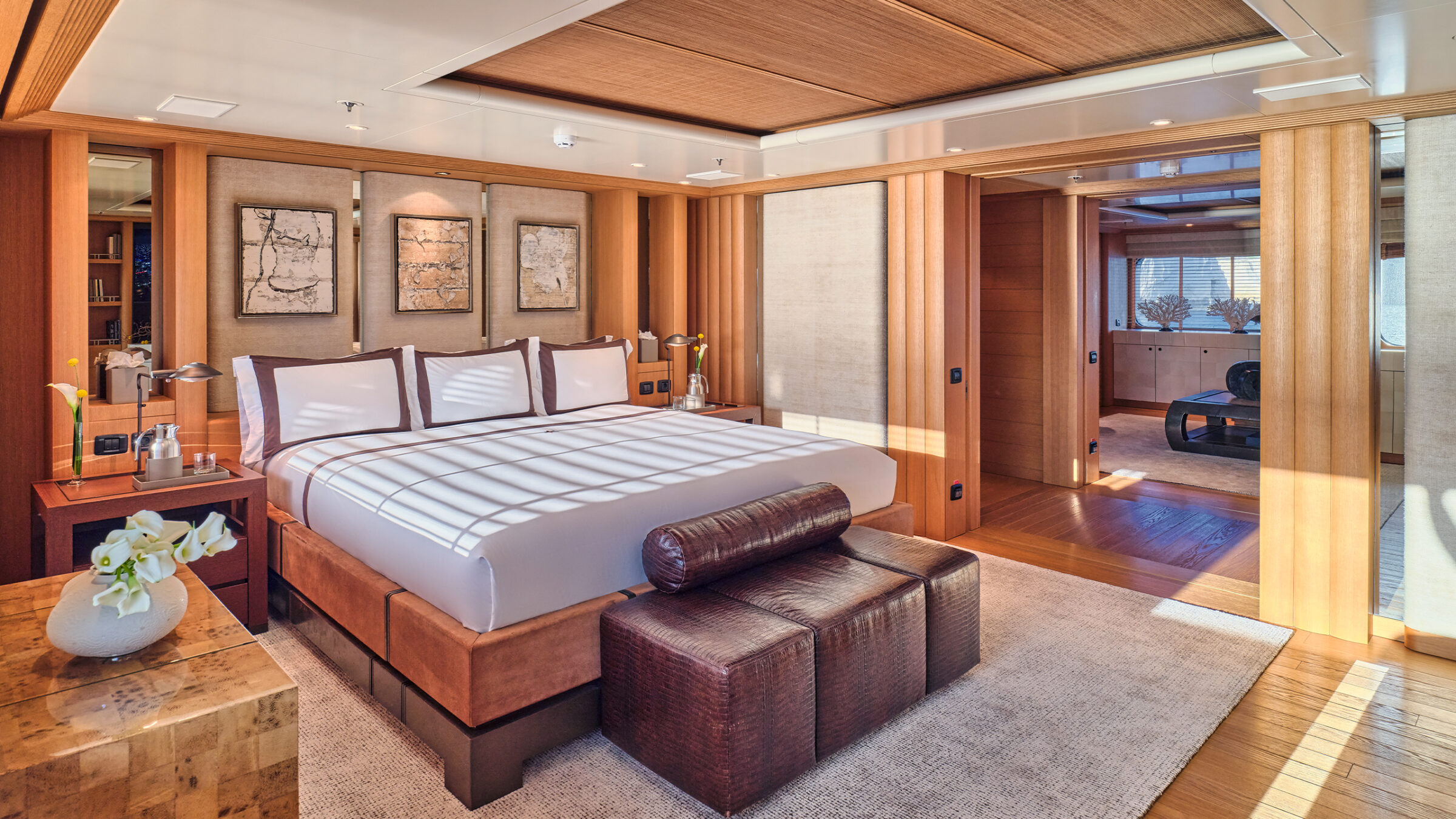 Owner's suite
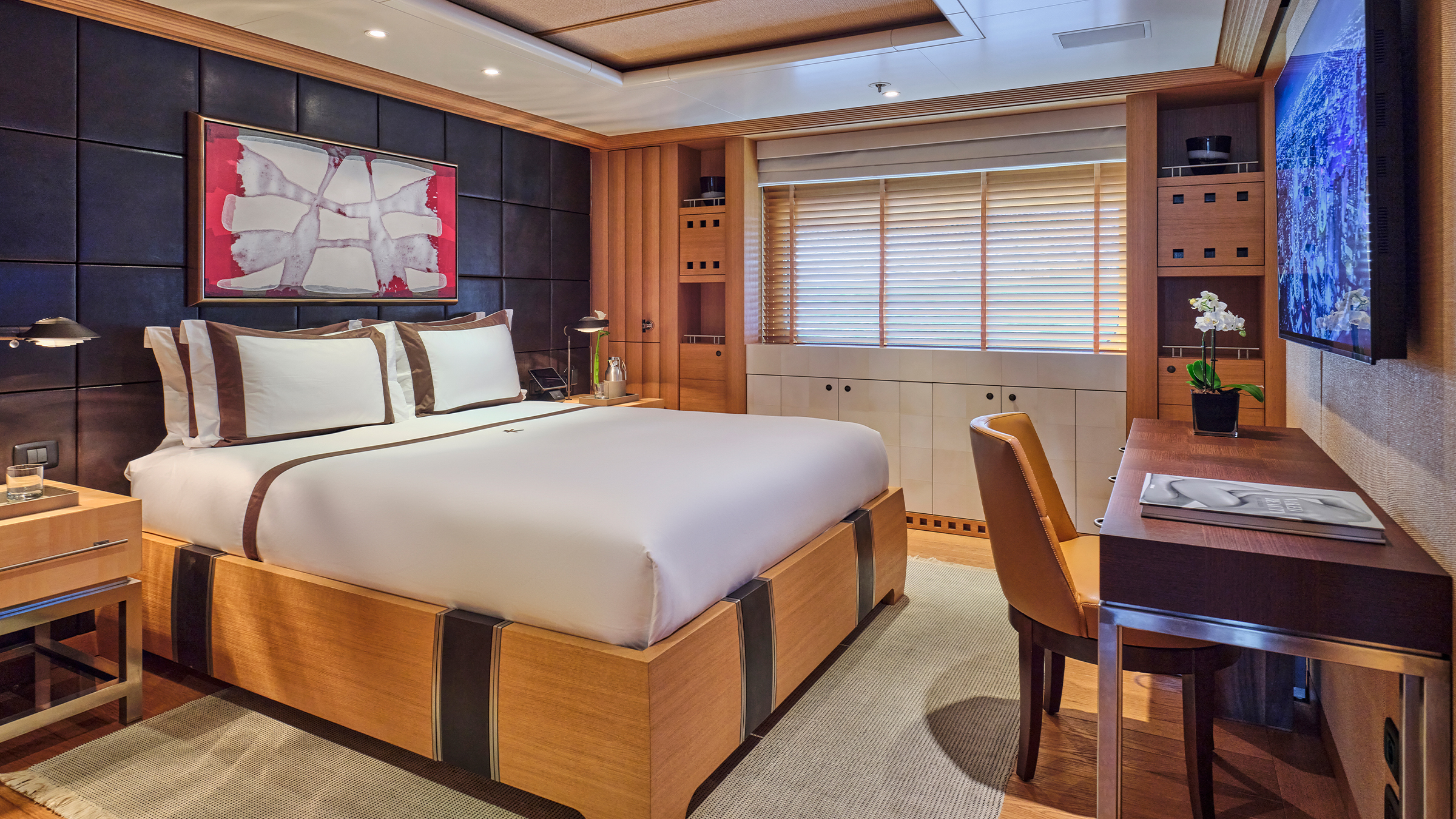 Guest suite
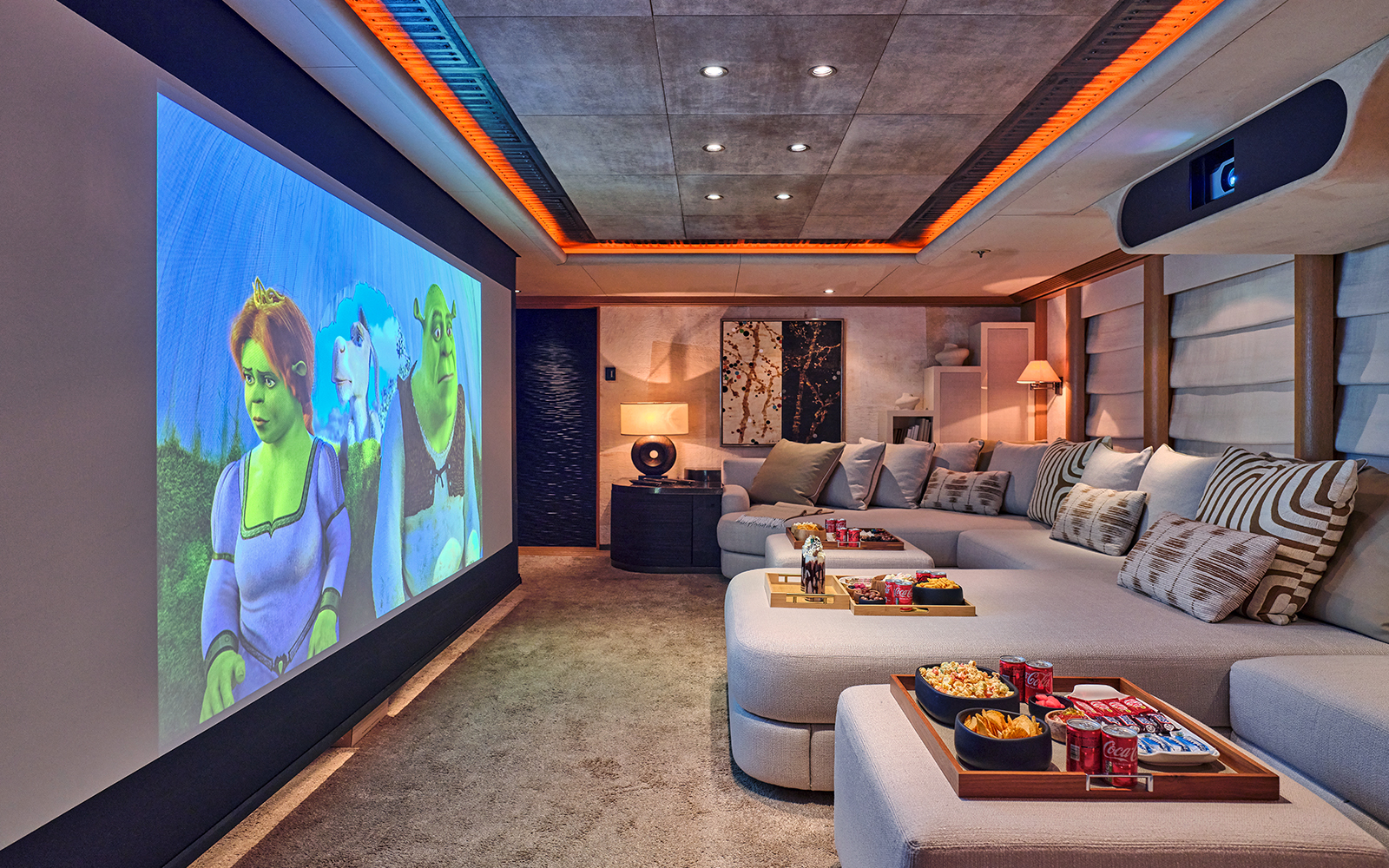 Cinema
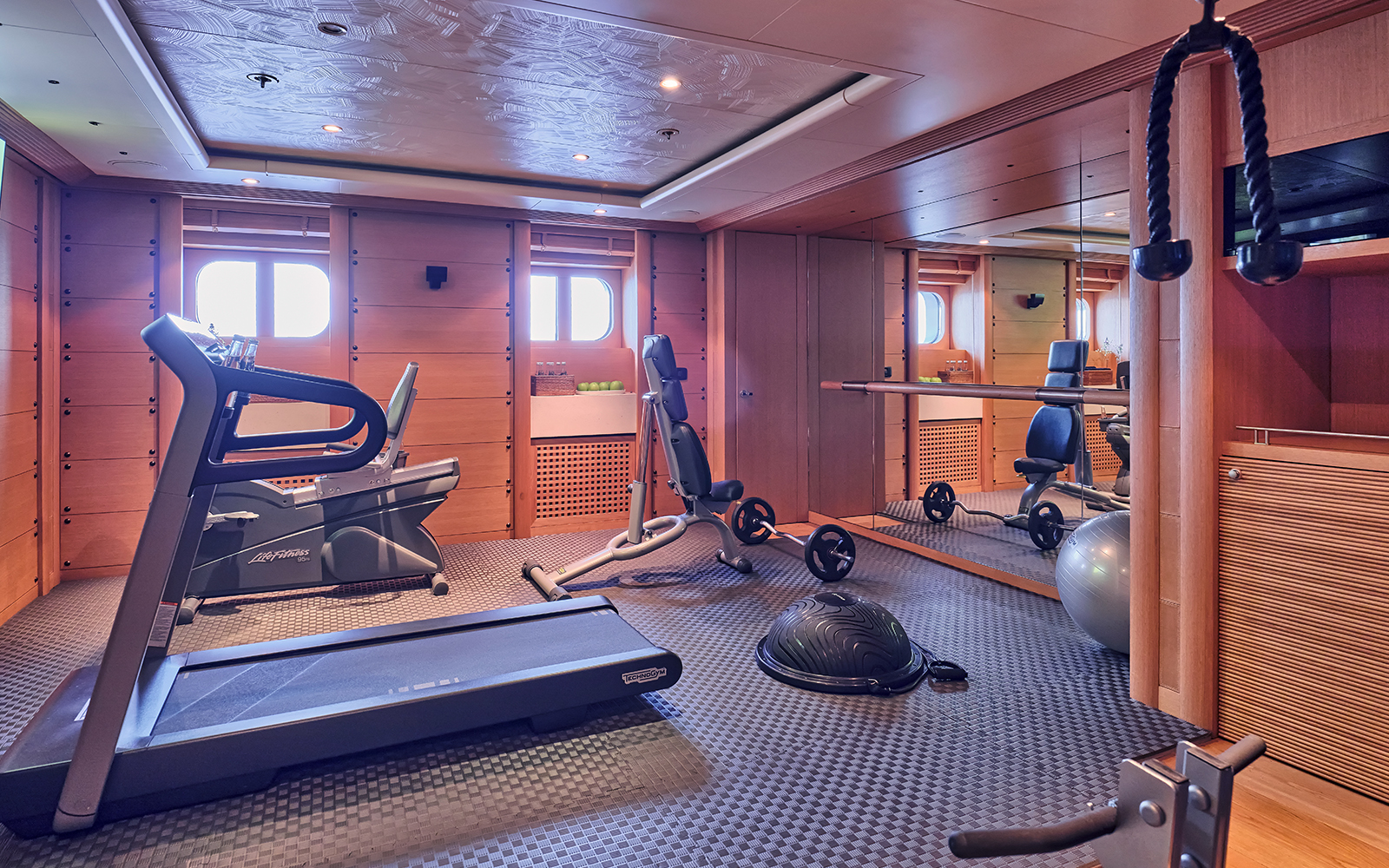 Gym
Gym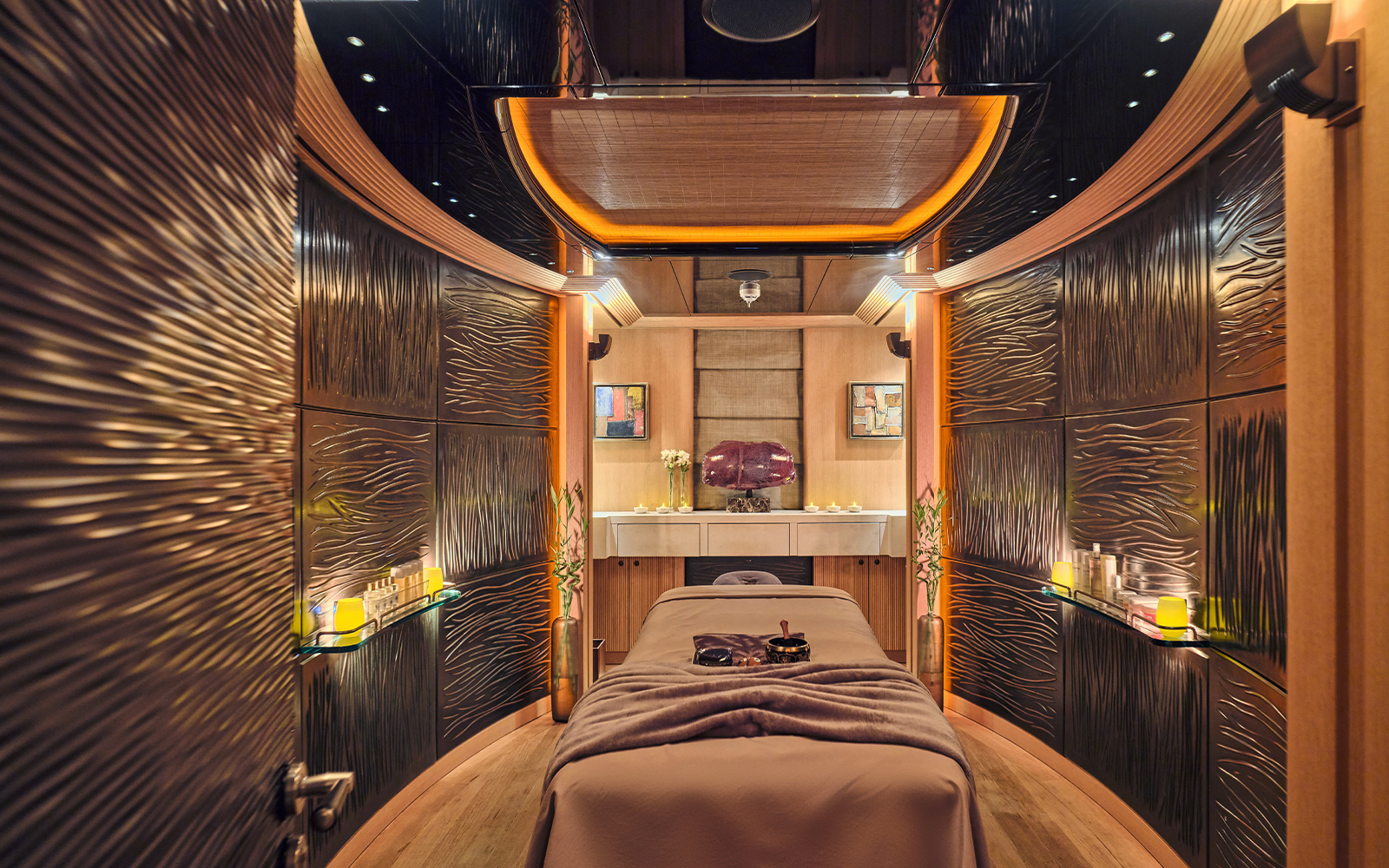 Spa · Massage
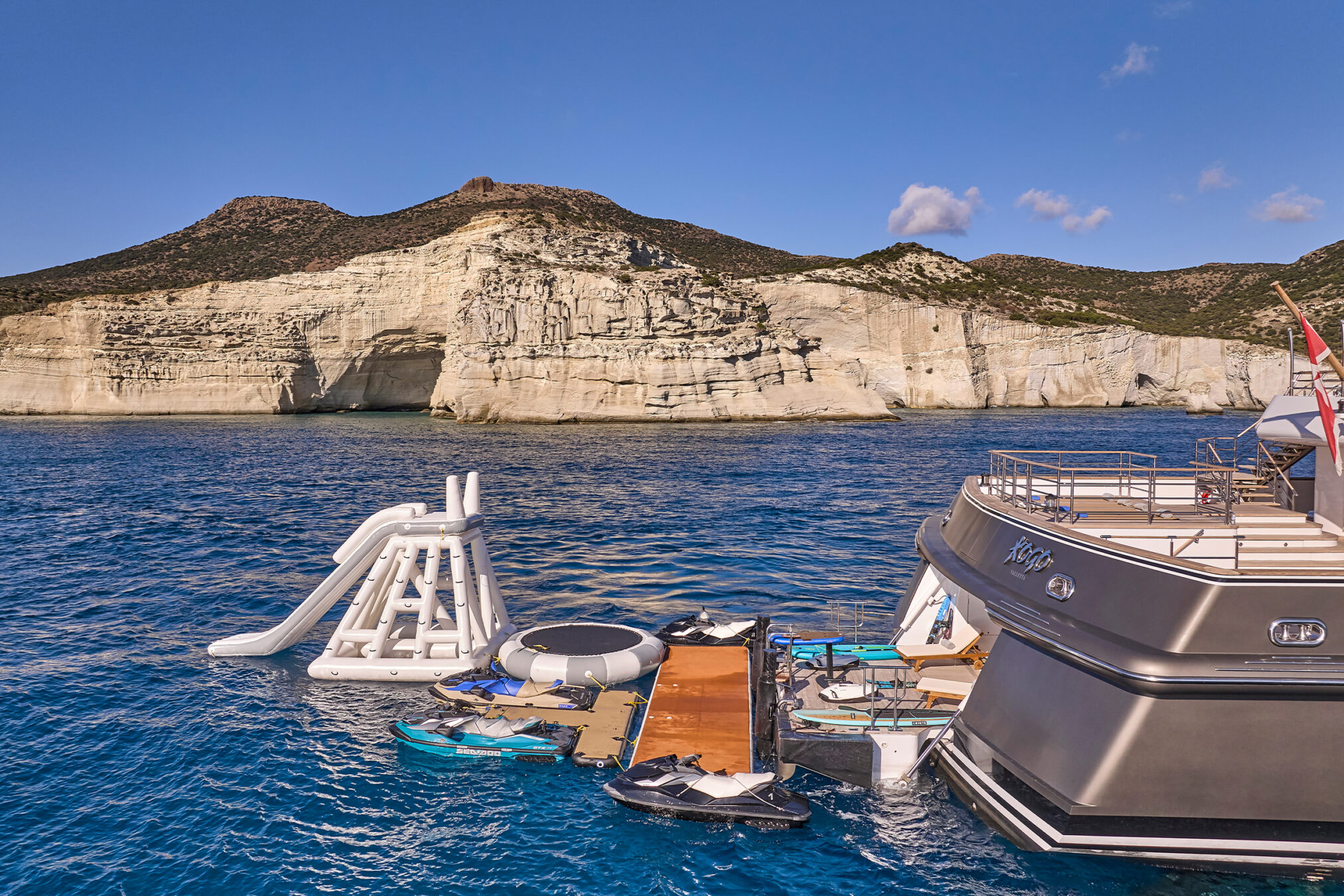 Beach club · Toys deployed
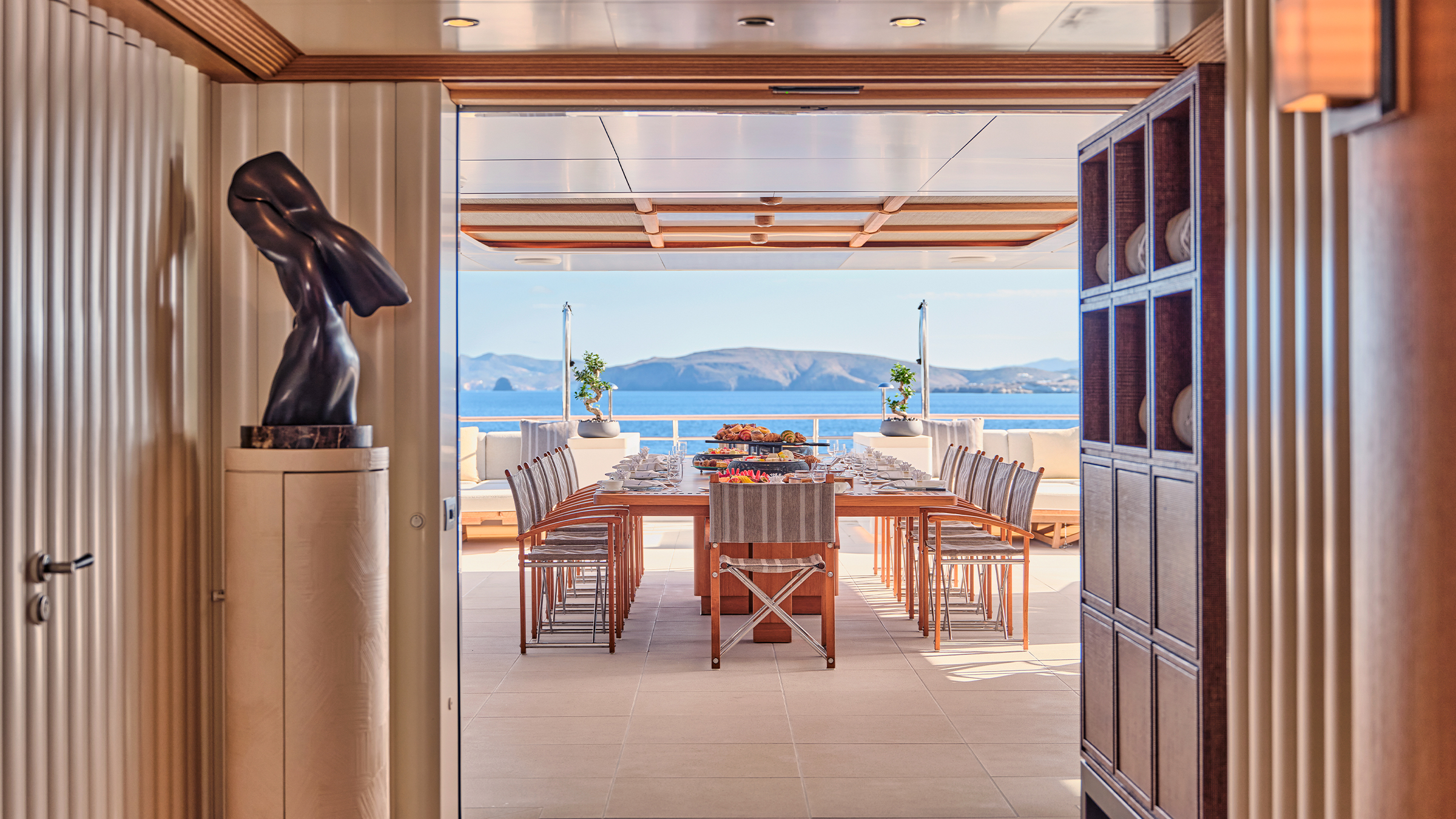 Aft deck · The table
Yacht fiche
KOGO at a glance
71.7 m · 235.3 ft
13.5 m · 44.3 ft
3.8 m · 12.5 ft
1,892 GT
Alstom Leroux Naval, France
2006 · refit 2025
Tim Heywood
Terence Disdale Design
Burness Corlett Three Quays
12
7 · 5 double, 2 twin; master with private lounge
21
14.5 kn cruising · 17 kn max
2 × Caterpillar, 1,910 hp · 2 × MTU generators
Spa (massage & steam room), gym, beach club, deck jacuzzi, pool, helideck, indoor & outdoor cinema
Limousine tender + 3 tenders
4 waverunners, 2 SeaBobs, flyboard, 2 eFoils, kayaks, 6 paddleboards, wakeboard, waterskis, 2 eBikes
€595,000 – €695,000 · low / high
Croatia, Greece, Montenegro, Turkey
Specification and rate as listed for charter by Burgess. Rates are quoted plus expenses (APA), VAT and gratuity, as set out earlier.
Before you enquire
Know exactly how a charter is priced, with the free USA Onboard cost guide.
A thousand islands, a week of clear water, and a coast whose best doors still open from the sea. Croatia does not ask to be toured. It asks to be sailed, aboard the right yacht and on exactly the terms you set.
USA Onboard Editorial
Image credits
Aleksandar Gospić · Aleksandar Vucin · Arthur Hinton · Boris Kačan · Bruno Wolff · Butch Aleksich · Croatia Tourist Board · Dalmatia County Tourist Board · Darko Kesnjer · Fabiana Rizzi · Geio Tischler · Hrvoje Serdar · Ivan Ivankovic · Jan Tang · Janek Valdsalu · Julien Duval · Kevin Charit · Korčula Tourist Board · Kvarner Tourist Board · Melvin Silva · Oskars Lipatovs · Priyanka Sethy · Sandro Tariba · Slobodan Spijunovic · Vjeko Begovic · Zoran Jelača