

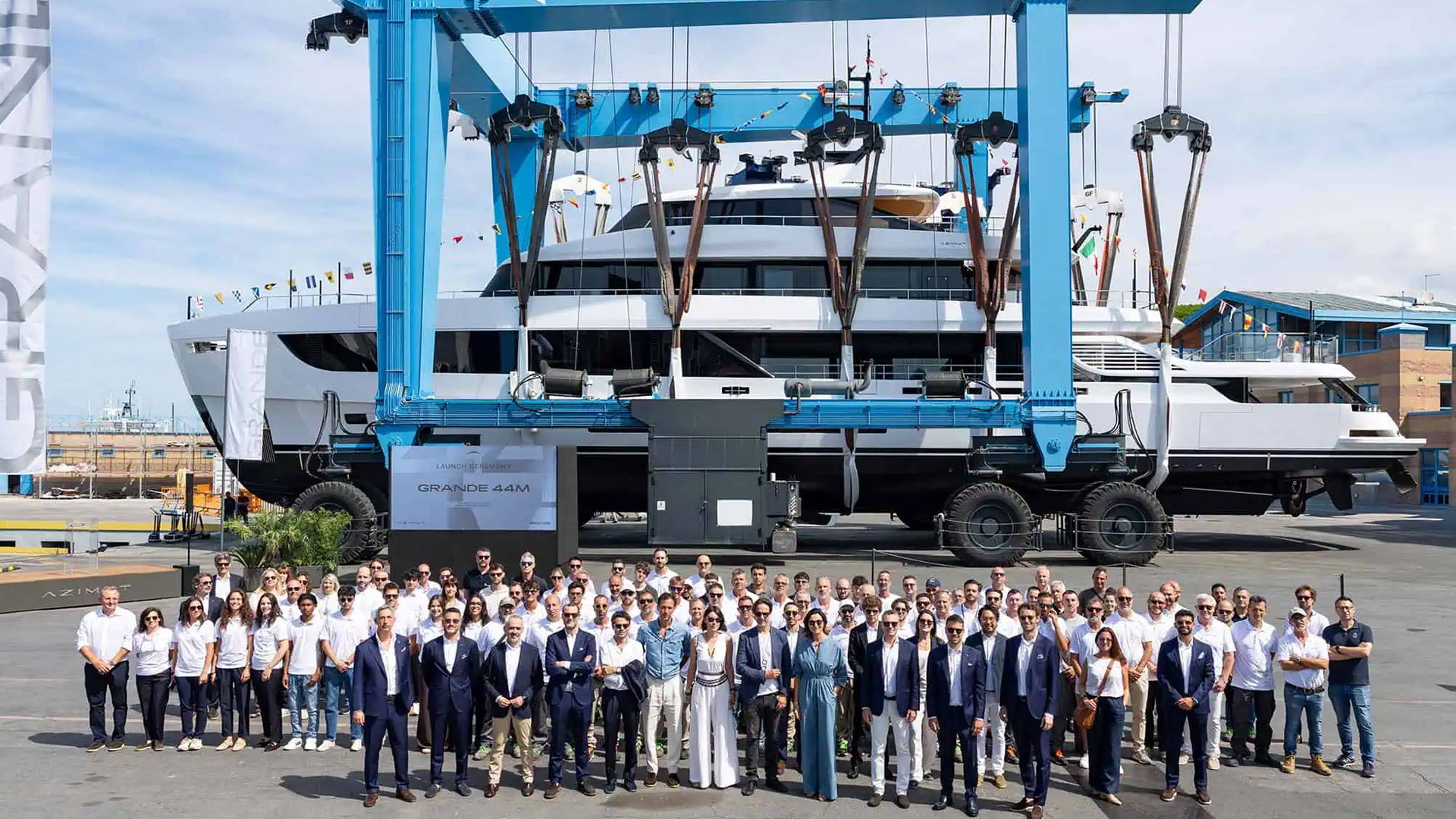
The Grande 44M in profile, dressed for her launch.
Azimut Launches the Grande 44M With Seven Hulls Already Sold
Carbon fiber over half the vessel, a Hull Vane foil at the stern and a four deck architecture. The engineering exists to serve one commercial idea: give the owner an entire deck.
Azimut has launched the first Grande 44M, its new flagship, with seven units already sold. The yacht now enters final outfitting and will make its world debut at the 2026 Cannes Yachting Festival.
The number to hold onto is not on the spec sheet. Azimut says more than two thirds of the brand's production value now comes from models over 24 meters. The Grande 44M is the endpoint of that migration: a builder known for volume production that has spent a decade moving its center of gravity up the size ladder, and is now selling seven hulls of its largest model before the first one is finished.
Carbon as a layout decision
Carbon fiber accounts for more than 50 percent of the vessel: over 1,000 square meters of it, and eight tons taken out of the uppermost areas of the yacht. That weight is what buys the architecture. A fourth deck housing the wheelhouse, integrated into the profile drawn by Alberto Mancini, clears every technical space off the Upper Deck and leaves it entirely to the owner, with private terraces.
This is the argument worth watching across the segment. Composite engineering is being sold not as performance but as square meters, and the yard has the industrial base to back it: the Group's new Composites Hub in Massa exists precisely for this.
Interiors are by m2atelier. The forward area of the upper deck is configurable as a veranda dining room for twelve, a private media room or guest space, opening onto a bow lounge organized around a firepit. Aft, the Mezzanine Deck carries a Sea View Terrace and a See-Through Pool over the beach club.
The technical package
The Mild Hybrid figure that matters operationally: the yacht can sit at anchor with generators off for three to four hours by day and eight to ten hours overnight, and the pack fully recharges in two hours at 15 knots. In other words, the repositioning run between bays becomes the charging cycle. Azimut claims up to 30 percent lower CO2 emissions than conventional naval architecture of the same size.
All figures and emissions claims from Azimut's official communication.
The yacht in profile, newly in the water.
Source: Azimut, official communication, July 9, 2026