

Why Smaller Premium Boats
Matter More Than Ever
In a market trained to celebrate scale, one category is gaining standing for a different reason: it offers more frequent access, more spontaneous use, and a more livable idea of luxury.
High-end boating has long run on a predictable equation — more length, more status; more volume, more aspiration; more complexity, more prestige. The lives of many sophisticated owners have begun to argue with that logic, and in the argument a quieter category has found a new and more interesting place.
None of this denies the emotional pull of a great yacht. Scale keeps a magnetism of its own, and certain experiences only become possible above certain dimensions. What has changed is the relationship between size and desire, which is no longer linear. For a growing number of premium buyers, the question is no longer how much boat can I own, but what kind of experience they want to activate more often, and with less friction.
That is where a particular class of boat earns its standing: contained in length, but unmistakably high-end in language, materials and execution. These are not attempts to replace the dream of the large yacht. They answer a life that is more fragmented, more mobile, more protective of time — short escapes, spontaneous outings, whole days of social life without the logistical weight, a more natural relationship between wanting to go out and actually going.
In contemporary luxury, frequency matters, perhaps more than it once did. A magnificent boat that demands constant coordination can keep its aura and still lose its vitality. A well-chosen premium boat does the opposite: it folds into the owner's life and makes pleasure more accessible. This piece reads that idea through five current boats — the Riva 58' Capri, the VanDutch 75, the Pardo 43R, the Manari 52 and the Itama 54 — European in sensibility, built around open living rather than sheer length.
Five boats, one idea of scale that fits
When the right size is not the largest possible
Choosing a more contained boat no longer means giving up sophistication. One of the more telling movements in the current market is how deliberately certain builders are carrying the finishes, layouts, materials and systems of larger yachts into more compact formats. The result is a boat where luxury no longer depends on the visual impact of scale, but on the perceptible quality of the experience: clean acoustics, legible circulation, intelligent ergonomics, thermal comfort, well-proportioned social areas, interiors written in a residential language, and an aesthetic less anxious to demonstrate power.
There is a cultural shift behind the preference. The current premium owner — the one who combines a waterfront home, an active social calendar, travel, and a real regard for personal time — tends to reward whatever simplifies without impoverishing. The boat should widen a life, not impose a new structure of obligations on it. That instinct favors craft that is more agile, more intuitive, and easier to fold into a free afternoon or an ordinary weekend.
Three boats that put the day outdoors
The VanDutch 75 is the clearest statement of design identity in the group. Built by Cantiere del Pardo, it keeps the low-slung profile, clean geometry and balanced proportions that made the marque a reference in the open segment, and refines them with detailing that doubles as structure. The cockpit runs to forty-five square meters, arranged around two opposing sofas and a pair of convertible tables that seat up to ten, with a fully integrated Fenix galley top — barbecue, twin burners, refrigerator, ice-maker — for long days aboard. A carbon-fiber hard-top shelters the lounge without breaking the line; an anchor that emerges from the hull and a door integrated into the windshield keep the surfaces uncluttered. Where the premium claim lands is in the discipline: stainless-steel fittings made new rather than adapted, a natural teak deck laid with white caulking, and an interior vocabulary of burl veneers, dark woods and brushed metals developed by BurdissoCapponi Yachts&Design over naval architecture by Mulder. Triple Volvo Penta IPS propulsion carries it to around forty knots.
The Pardo 43R makes the opposite argument, and makes it just as well. It is the outboard reading of the walkaround that Cantiere del Pardo has built its recent reputation on — a single-level deck with a reverse bow, a forward sunbed paired with a bow-facing bench, and an aft cockpit of opposing sofas and an extendable table that converts to a sunpad. Rather than a cosmetic variant, the 43R rides on a hull developed specifically for outboard power: up to three Mercury V12 engines of 600 horsepower each carry it beyond fifty knots, its swim platform redrawn around an integrated outboard engine well and the transom space given over to stowage rather than the inboard version's tender garage. Concept by Cantiere del Pardo, naval architecture and exterior by Zuccheri Yacht Design with Nauta Design, interiors by Nauta — the pedigree explains the restraint. Below, hull windows fill bright, quiet spaces finished in the studio's understated Made-in-Italy manner. It is a boat engineered for the spontaneous day out, and for the owner who wants the helm to be part of the pleasure.
The Manari 52 comes at the idea from engineering first. A young Miami-based marque working with Dutch hull designer Mulder, it treats performance and refinement not as a trade-off but as a shared starting point. The hull marries a deep-V geometry with progressive deadrise and optimized spray rails; twin Volvo Penta IPS D8-800 engines return a top speed near thirty-seven knots and an easy cruise in the mid-twenties, with a range of roughly 350 to 400 nautical miles — Miami to Nassau with margin. What distinguishes it is composure: tight turns taken with minimal heel, short chop absorbed without slamming, a dry ride carried through the cockpit, and noise held to the low seventies of decibels at cruise. The helm follows the same logic — minimalist, digitally integrated, built around visibility rather than decoration.
The same idea, drawn three different ways
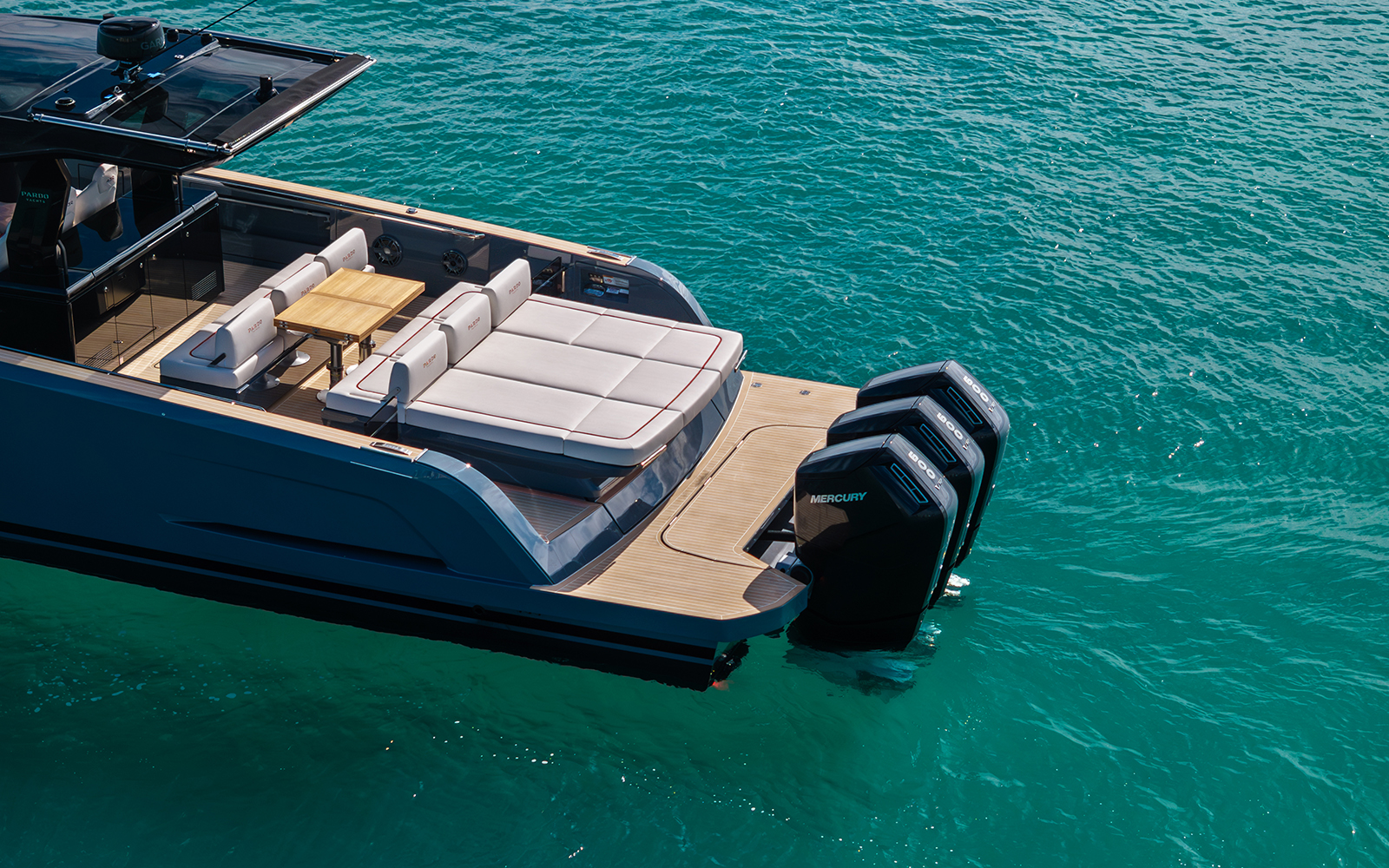 Pardo 43R · Aft deck
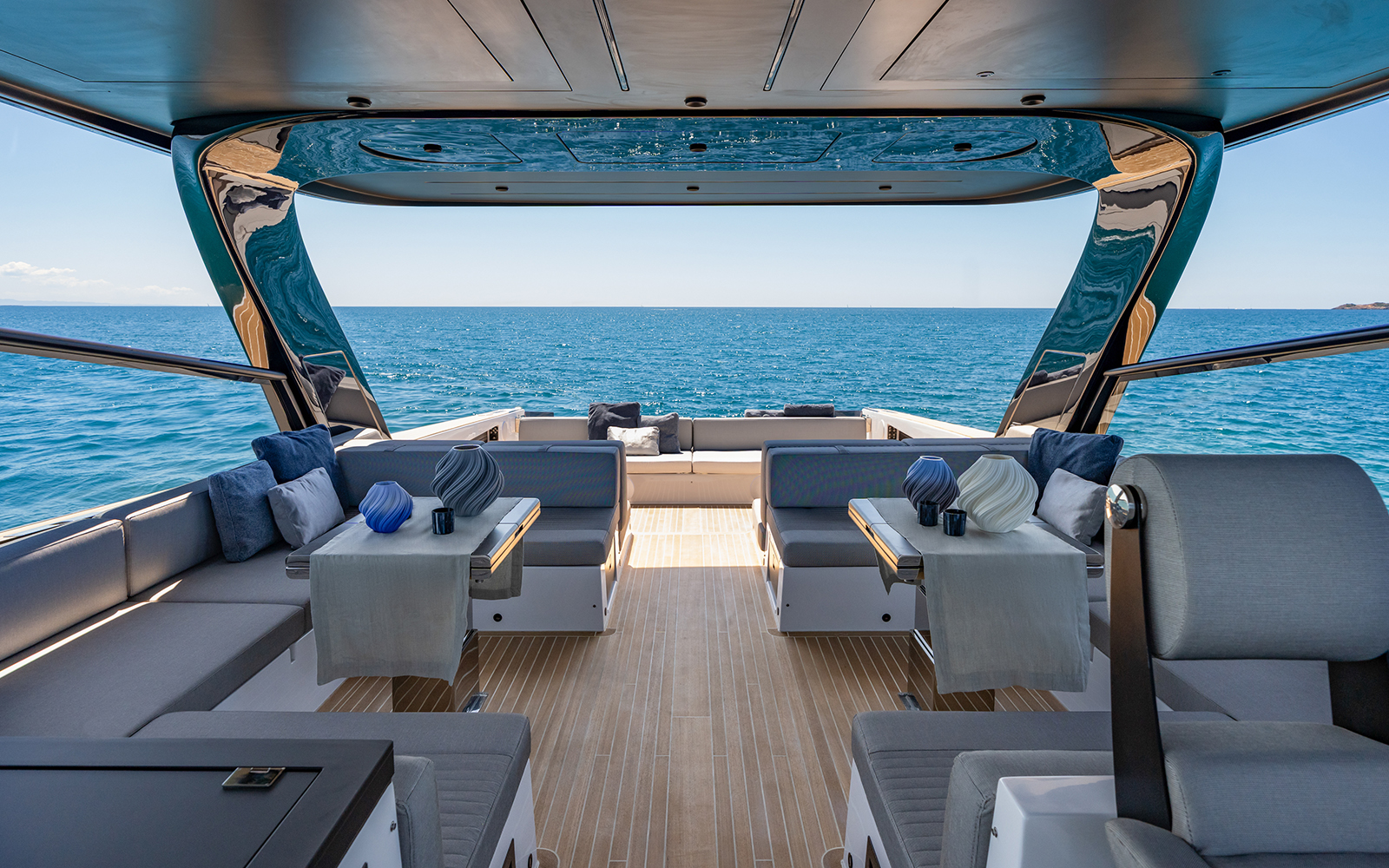 VanDutch 75 · Cockpit
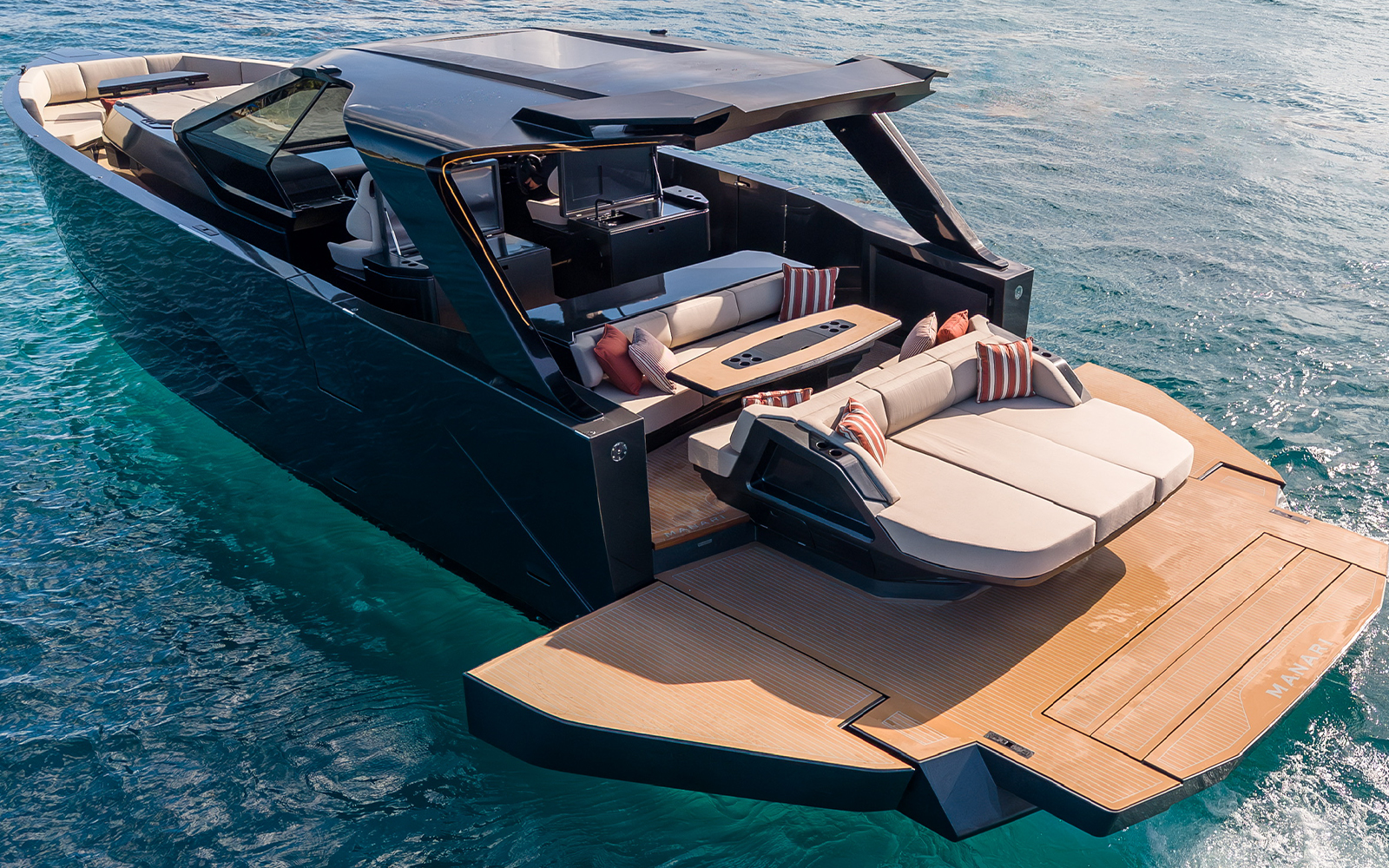 Manari 52 · Side terraces
The question is no longer how much boat one can own, but what kind of experience one wants to activate more often.
USA Onboard Editorial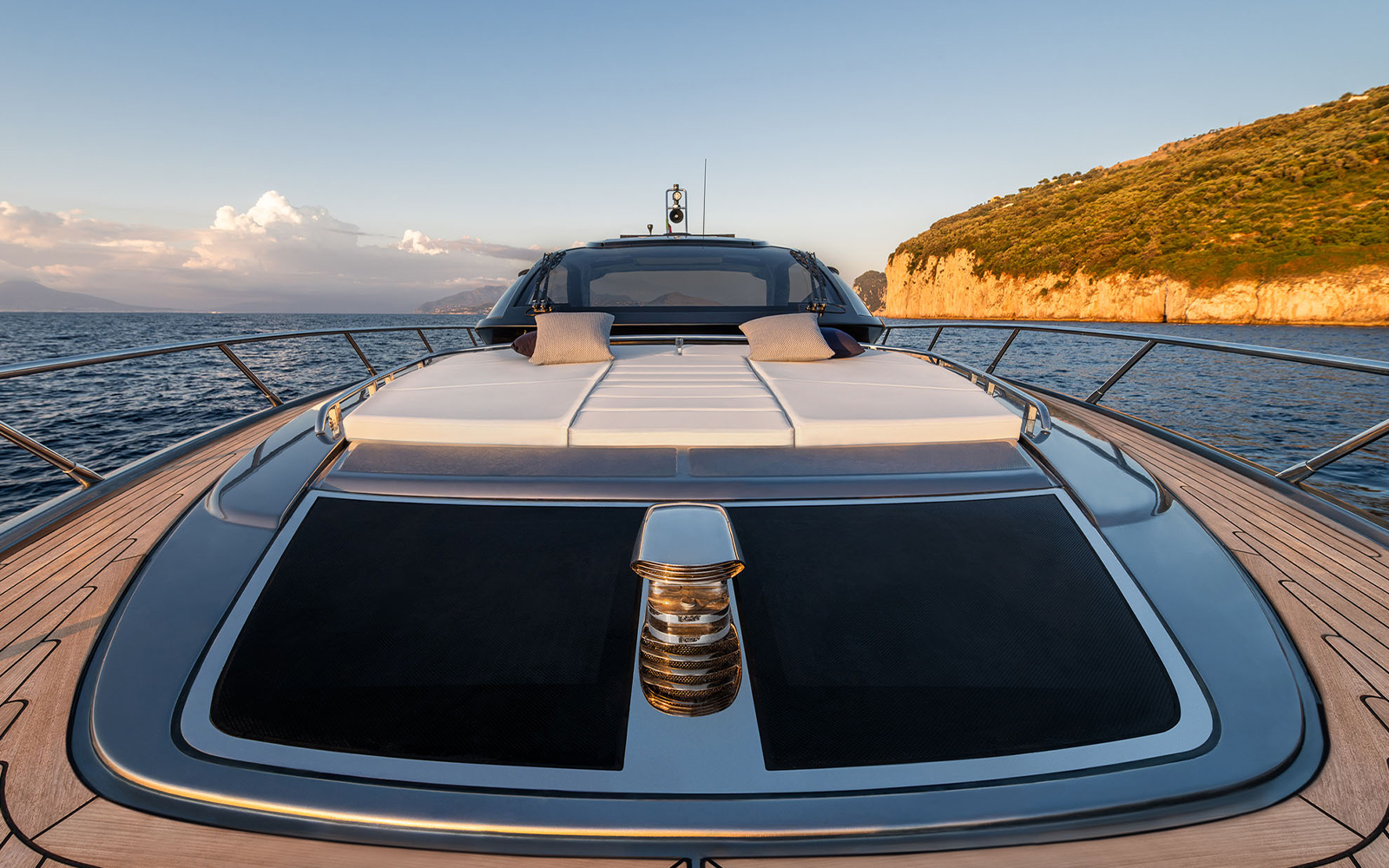 Riva 58' Capri · Foredeck
Craft as the argument
If any boat in this group demonstrates that contained length and full-scale craft can coexist, it is the Riva 58' Capri. The hull and exterior are the work of Mauro Micheli and Sergio Beretta of Officina Italiana Design — the studio that has drawn every Riva since 1994 — developed with the Ferretti Group Engineering Department under the strategic direction of Piero Ferrari. At 17.27 meters overall and a 4.74-meter beam, it carries the marque's codes at a scale an owner can run into an ordinary weekend rather than a season's campaign.
The premium claim here is legible in the detail. A fixed canopy with counter-curved glass and an electric soft top shelters the helm without disturbing the line; a Shark Grey hull with Bright Black detailing gives the profile its restraint. An aft garage accommodates a Williams 325 TurboJet tender, an optional Seakeeper NG6 gyro settles the boat at rest, and the three-cabin layout places the master aft across the beam and a VIP forward with its own bathroom. Power comes from twin MAN V8 engines — 1,000 horsepower as standard, 1,200 optional — for a top speed of 33 to 37 knots, all certified to CE Class A. None of it is decoration. It is the Riva vocabulary, held to the same standard in a smaller hull.
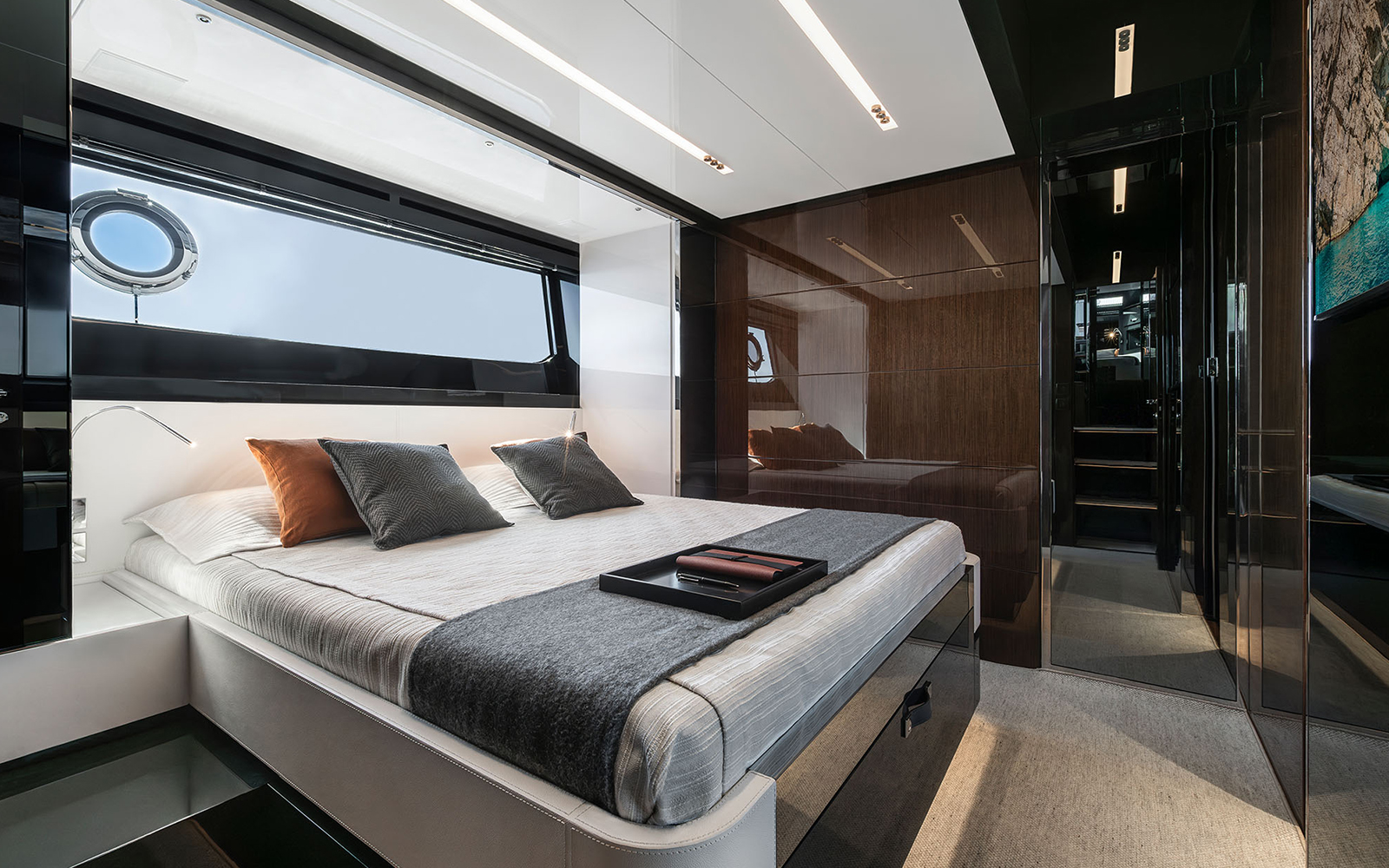 Riva 58' Capri · Suite
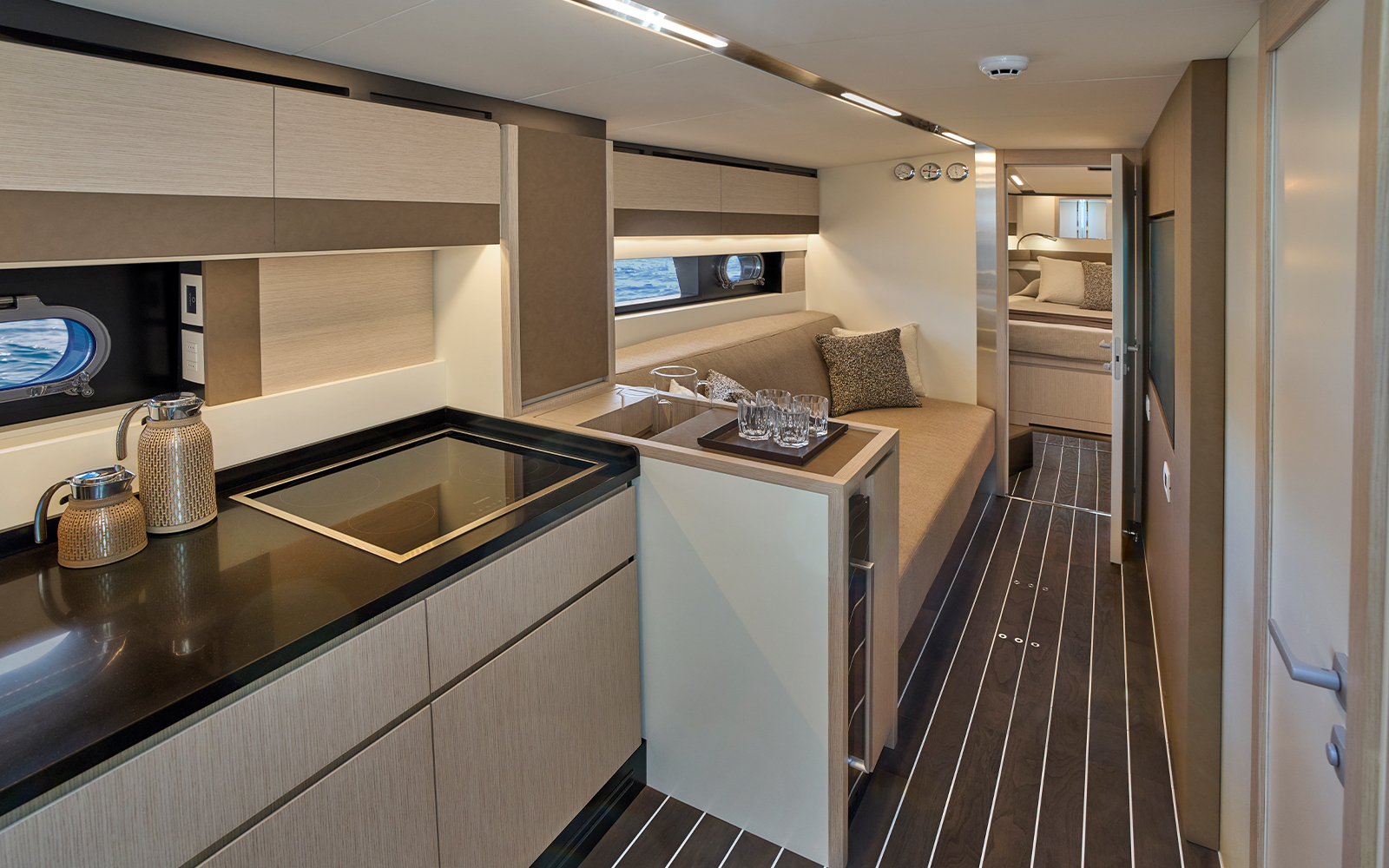 Itama 54 · Interior
Two cockpits, one idea of ease
The Itama 54 earns its place on liveability. Sixteen and a half meters long with a 4.73-meter beam, styled inside and out by Tommaso De Luca with the Ferretti Group Product Strategy Committee and Engineering Department, it stays faithful to the pared-down language that has given every Itama its status as a quiet icon. Its defining move is a dual-cockpit layout: alongside the classic aft cockpit, a second sheltered cockpit sits behind the windscreen, protected from wind and spray under way, with two C-shaped sofas that together seat up to ten and an icebox set between them.
The rest follows the same instinct for uncomplicated comfort. A forward sun pad is built flush into the deck, a bar unit and helm sit to port with a floating dashboard, and side glazing runs the full length of the hull for the first time on the model, drawing light below. The lower deck holds two cabins, two bathrooms, a galley and a dinette, with the master forward; the materials are kept to wood, leather and fabric — welcoming, elegant, unfussy. Twin MAN i6 engines, 730 or 850 horsepower, return a top speed of 33 to 37 knots. It is a boat designed to be used, not managed.
A smaller boat, but a genuinely premium one, can host extraordinarily refined experiences.
USA Onboard EditorialWhat actually makes them premium
Read together, the five make the same case in five accents. What they share is not size but pedigree and integration. Behind them stand the studios whose names the market already trusts — Officina Italiana Design on the Riva, Nauta Design and Zuccheri Yacht Design on the Pardo, Mulder on the hulls of the Manari and the VanDutch, BurdissoCapponi on the VanDutch interiors, Tommaso De Luca on the Itama. Each hull is developed around its propulsion rather than fitted with it afterward: Volvo Penta IPS on the VanDutch and the Manari, triple Mercury V12 outboards on the Pardo, MAN inboards on the Riva and the Itama.
That discipline is where the luxury lives. It surfaces as the perceptible things — a dry, composed ride; low noise at cruise; clean circulation; materials chosen for the hand as much as the eye; social spaces sized for real days rather than for photographs. These are boats where the premium quality is felt in use, not measured in feet.
Figures as published by each builder. Lengths and speeds are the manufacturers' stated values; optional engine packages are noted where they raise the ceiling.
- Length overall
- 17.27 m · 56 ft 8 in
- Maximum beam
- 4.74 m · 15 ft 7 in
- Propulsion
- 2 × MAN V8-1000 · optional V8-1200
- Top speed
- 33 kn · 37 kn optional
- Accommodation
- Three cabins · master aft, VIP forward
- Design
- Officina Italiana Design · Micheli & Beretta
- Length overall
- 22.18 m · 72 ft 9 in
- Maximum beam
- 5.80 m · 19 ft 0 in
- Propulsion
- 3 × Volvo D13 IPS1050 · optional IPS1350
- Top speed
- Up to 40 kn
- Accommodation
- Three cabins plus independent crew cabin
- Design
- Mulder naval architecture · BurdissoCapponi interiors
- Length overall
- 14.93 m · 48 ft 11 in
- Maximum beam
- 4.20 m · 13 ft 9 in
- Propulsion
- 3 × Mercury V10 400 hp · up to 3 × V12 600 hp
- Top speed
- Beyond 50 kn · with triple V12
- Accommodation
- Forward cabin plus midship guest berths
- Design
- Zuccheri Yacht Design · with Nauta Design
- Class
- 52-foot open cruiser
- Propulsion
- 2 × Volvo Penta IPS D8-800
- Top speed
- ~37 kn · cruise 24–26 kn
- Range
- 350–400 nm · at optimal speed
- Naval architecture
- Hull design by Mulder
- Sea trials
- Off Miami · Haulover Inlet
- Length overall
- 16.44 m · 53 ft 11 in
- Maximum beam
- 4.73 m · 15 ft 6 in
- Propulsion
- 2 × MAN i6-730 · optional i6-850
- Top speed
- 33 kn · 37 kn optional
- Accommodation
- Two cabins · dual-cockpit main deck
- Design
- Tommaso De Luca · Ferretti Group
There is a particular sophistication in knowing that the right scale is not the largest one available, but the one that best keeps pace with a well-designed life. As luxury is increasingly measured in freedom, spontaneity and the quality of one's time, these more contained premium boats stop reading as the lesser option. For a certain kind of owner, they become — quite simply — an intelligent decision.
USA Onboard Editorial