

The Art
of the Passage
Sirena Marine's largest yacht to date is a 42-metre flagship drawn by Luca Vallebona, dressed by Hot Lab and given a fast-displacement hull by Van Oossanen: a boat built less for the marina than for the long way there.
Sirena Marine sums the 42M up in two words, "Life Uninterrupted," and the whole yacht turns out to be an argument for them. It is the largest, most ambitious vessel the Turkish yard has built, and its ambition is aimed at a specific target: the long passage, taken in comfort, without the compromises that usually accompany distance.
The project began, unusually, as a competition. Sirena invited designers to push past their own defaults, and the exterior that won belongs to Luca Vallebona, who has described the brief as thrilling and unnerving in equal measure. The interiors come from Hot Lab, the Milan studio now part of the Viken Group, working under a phrase it uses for its whole practice: architecture for voyagers. Naval architecture is by Van Oossanen, engineering by Eureka Yachts, and the build carries the signature of a yard that treats craftsmanship as its founding discipline.
The numbers behind the styling are the quiet part of the story. Beneath a steel hull and an aluminium superstructure sits a fast-displacement platform, the hull form Van Oossanen is known for, engineered to move efficiently rather than merely quickly. The result is a range of 4,500 nautical miles at a cruising speed of ten knots. This is a yacht sized at 42 metres and 433 gross tons, but scaled, in intent, for the open sea.
What that platform carries is a full-height, light-filled interior organised around one idea: keeping the connection to the water unbroken. Accommodation runs to ten guests and two more across five cabins, served by a crew of up to nine. The social spaces are staged in registers, from a beach club that folds open at the waterline to a flybridge that reads as a private terrace. Read together, they explain a title the yard chose with care, and a sale concluded before the yacht had even reached Monaco.
The 42M, read across every deck
A hull that reads as a single arrow
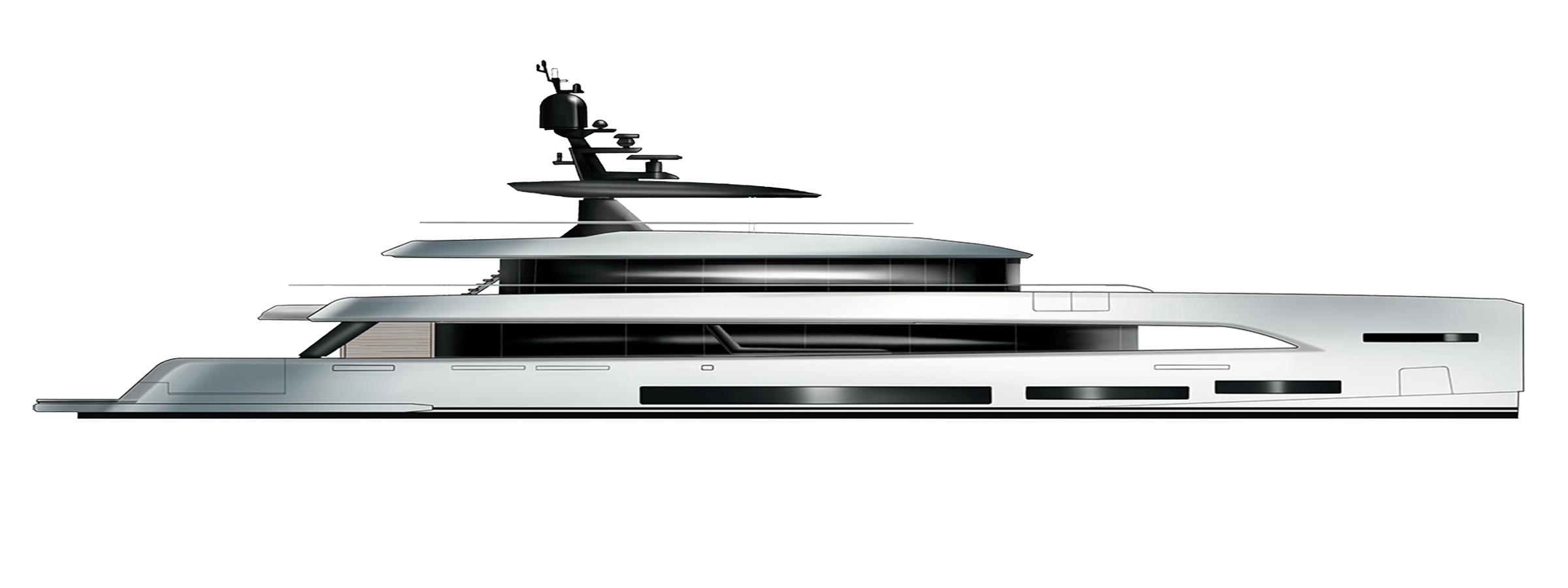
Seen from the water off the bow, the 42M resolves into one long, penetrating line, a profile drawn to look purposeful rather than decorative. This is what Sirena's design competition was meant to produce: an exterior with the nerve to commit to a shape. Luca Vallebona's answer carries a low, forward-leaning silhouette and, at the bow, a distinctive run of sculptural steps that link the foredeck's levels into a single stair, an idea that turns circulation into one of the yacht's more memorable gestures.
The discipline beneath the styling is the part that earns the profile. The hull is steel, Grade A; the superstructure is aluminium; and the underwater geometry is a fast-displacement form by Van Oossanen, engineered to slip through water with less resistance than a conventional hull of the same length. The dividend is efficiency rather than sprint speed: a cruise of ten knots that opens a range of 4,500 nautical miles, and a top speed of fifteen when the schedule tightens.
The stern, opened to the sea
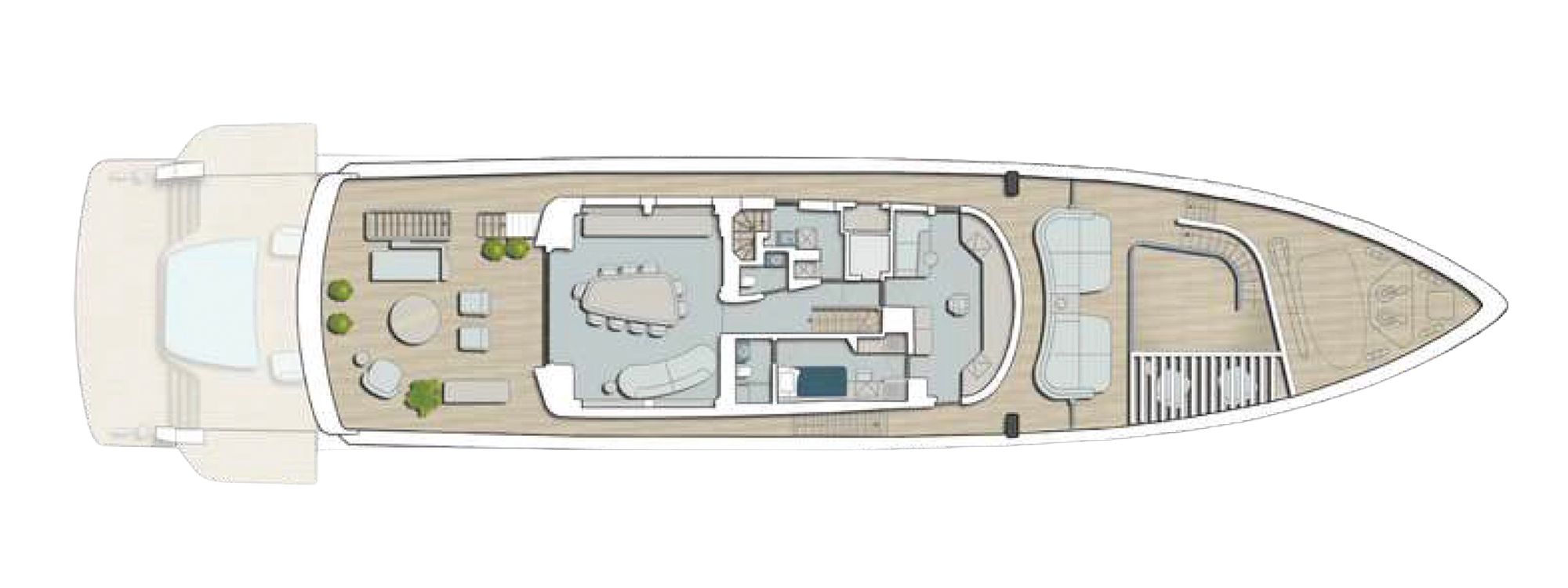
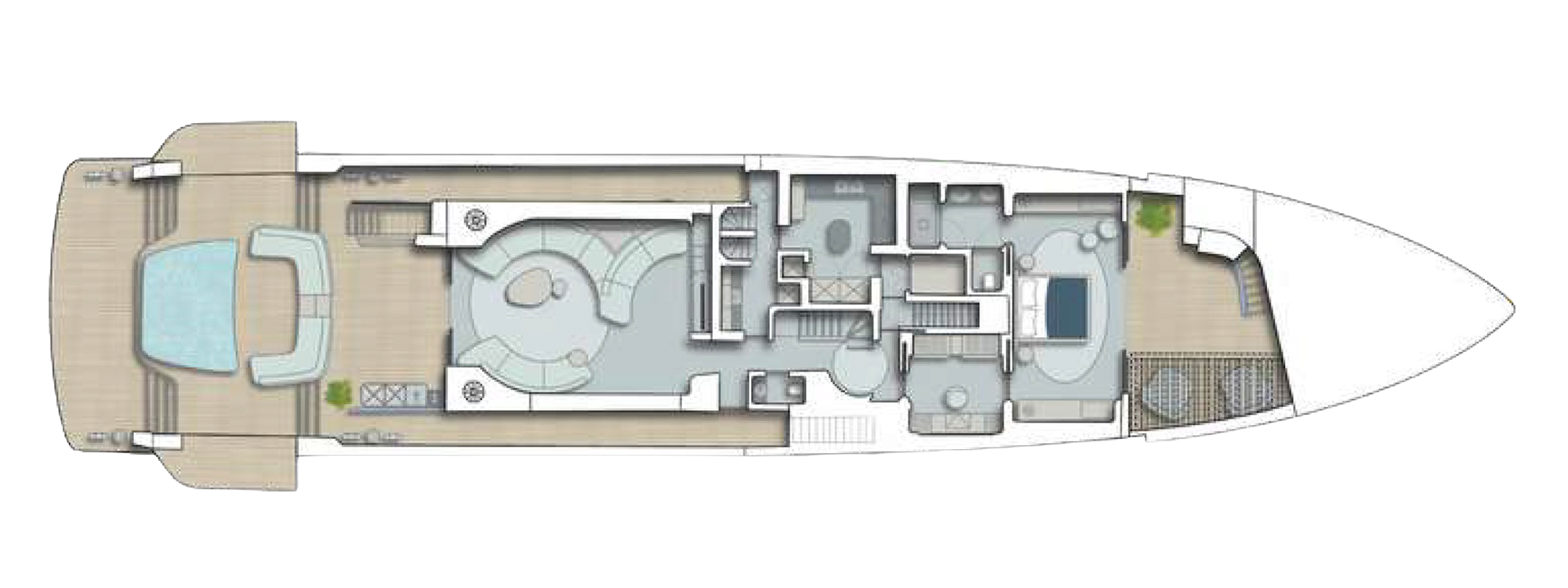
The 42M spends its best ideas at the waterline. At the stern, a generous jacuzzi sits above a swim platform, and the bulwarks fold down on both sides to widen the deck out over the water, turning the aft deck into a broad terrace only inches above the surface. A lounge holds the centre of it. When the yacht is at anchor, this is where the boat stops being an object to look at and becomes a place to be.
The rhythm continues upward and forward. The flybridge is given over to a solarium and a long table set for lunch under open sky, the kind of space that makes a passage feel like a slow afternoon. Forward, on the intermediate deck, a semi-covered bow lounge does the subtler work: shaded overhead, open at the sides, it draws the breeze through and frames the sea without ever fully enclosing it. Everywhere, the same instinct governs, keeping the horizon in the room.
From the bow steps to the water's edge
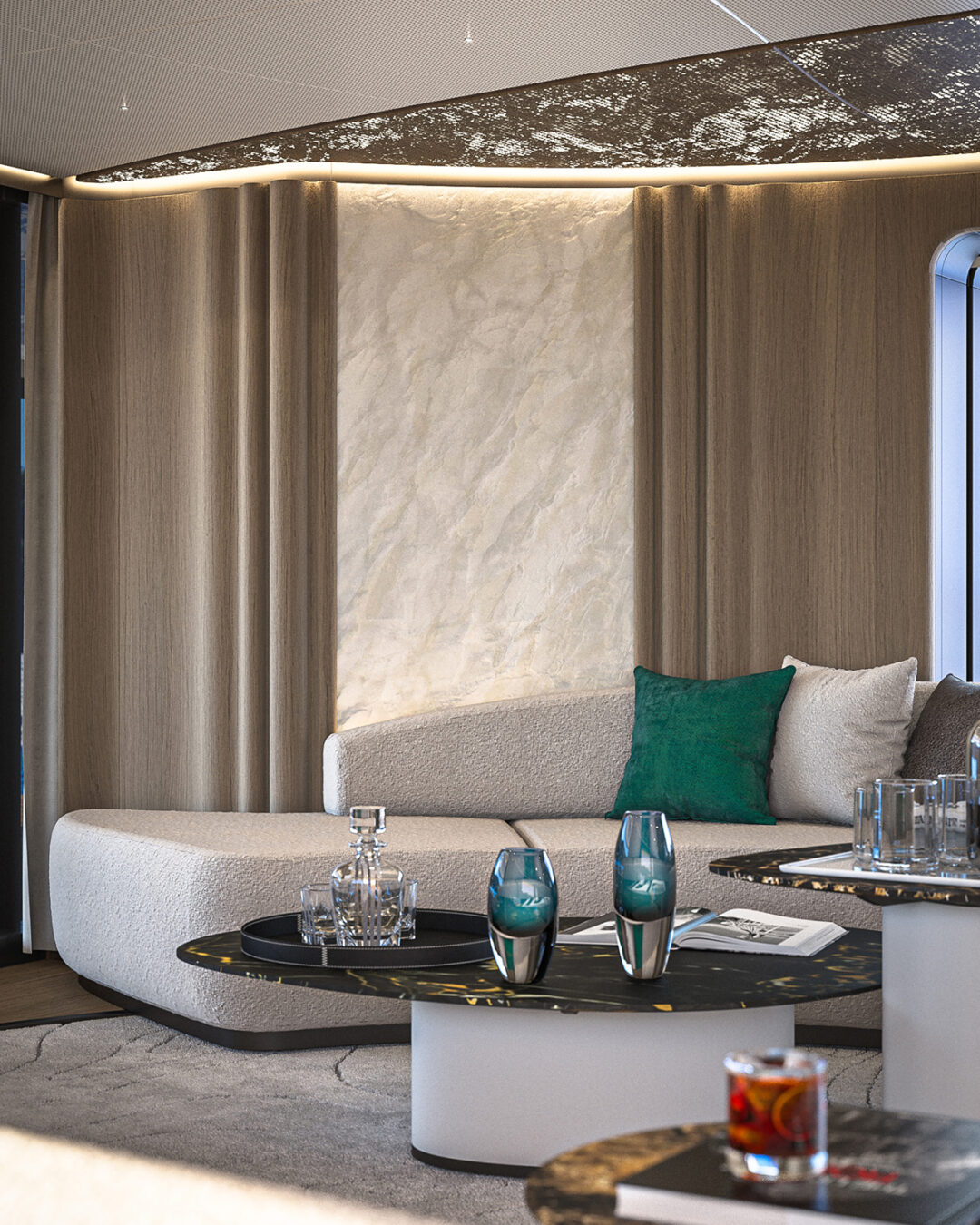 Main saloon · Detail
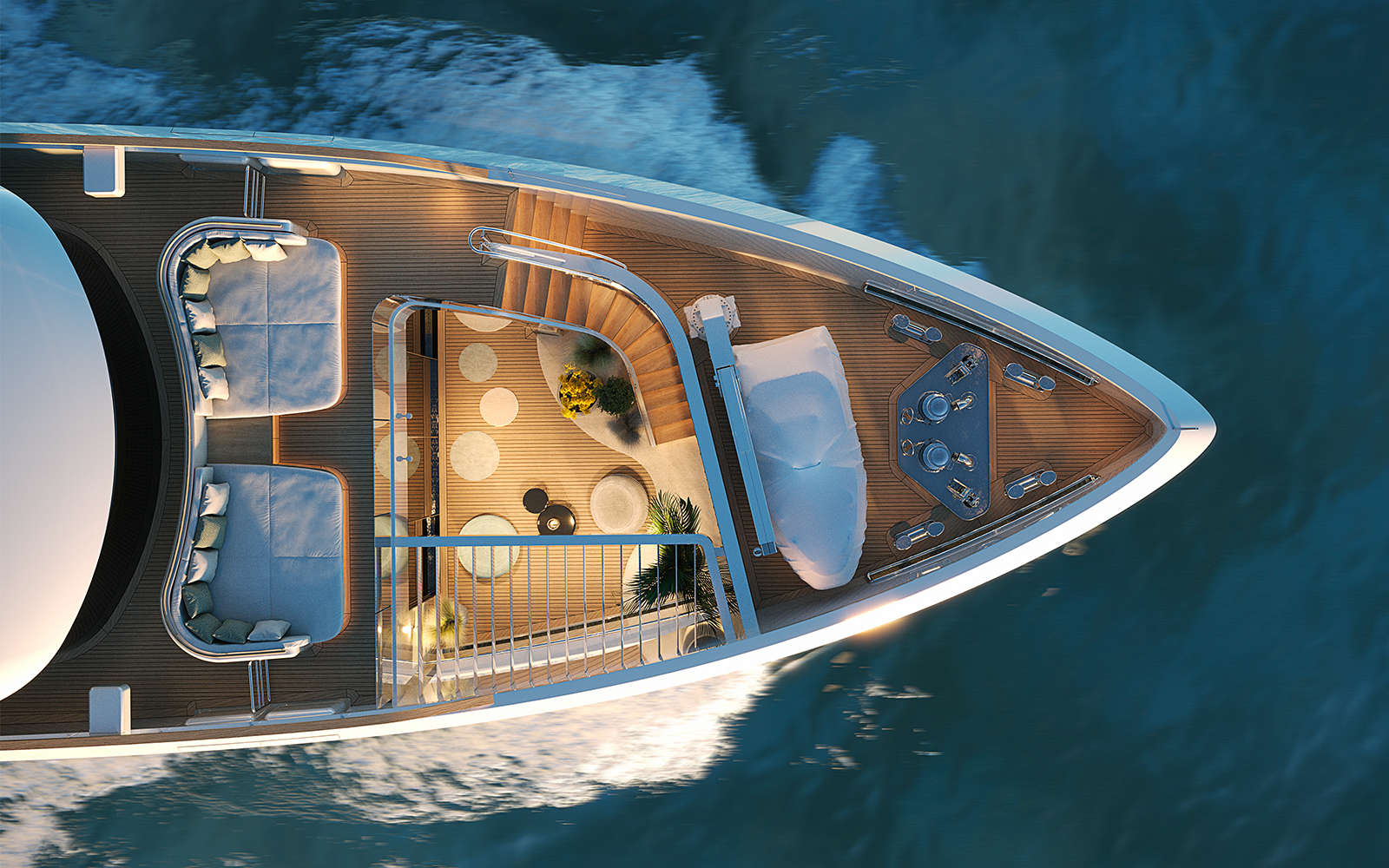 Bow · Sculptural stairs
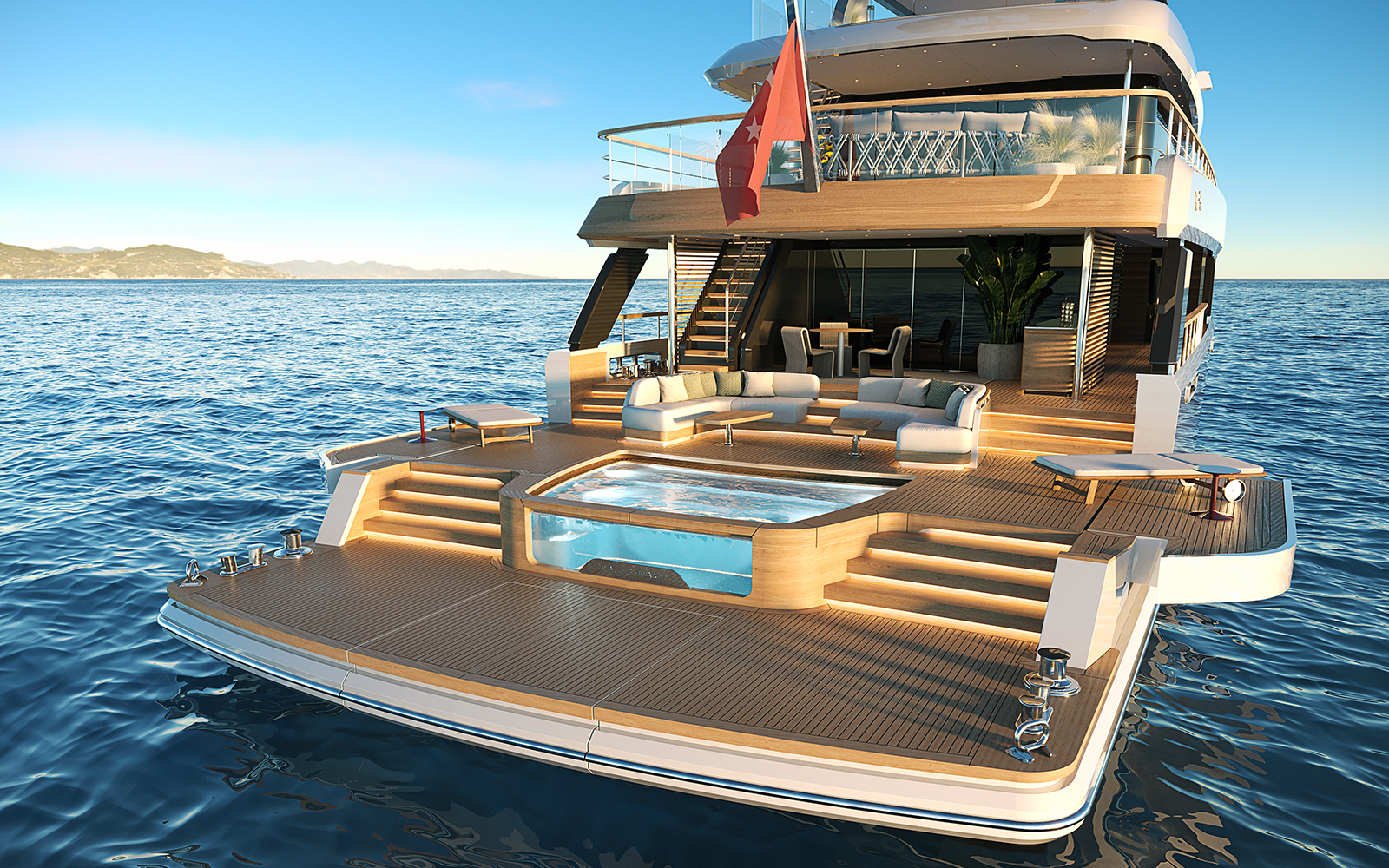 Stern · Fold-down terraces
These contradictory feelings are fuel for creativity.
Luca Vallebona · Exterior designer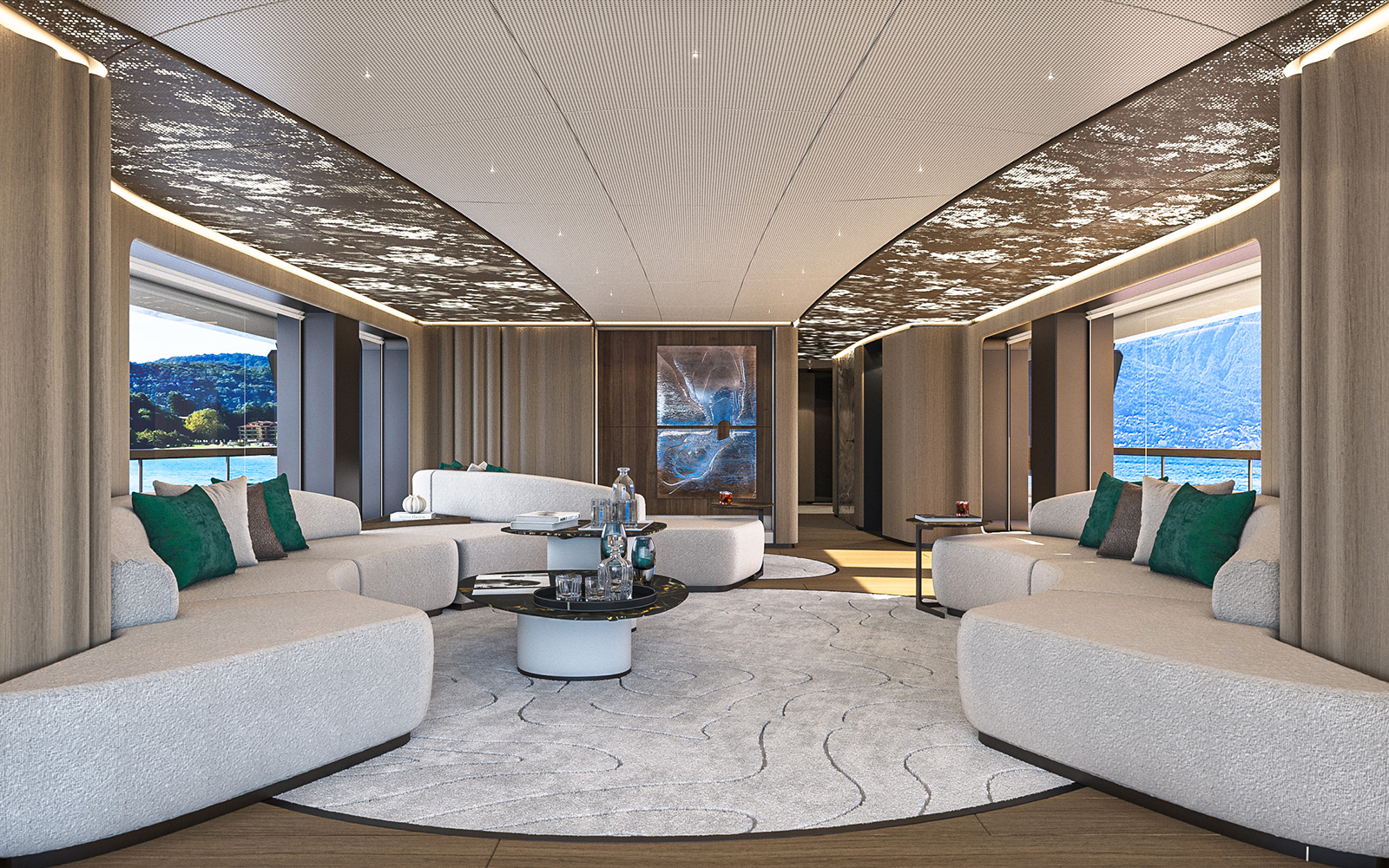 Main saloon · Lounge option
An interior drawn for voyagers
Hot Lab describes its practice as architecture for voyagers, and on the 42M the phrase is more than a slogan. The interior is conceived for people who will actually be aboard for the length of a passage, not just a weekend. The main saloon, offered as a lounge, is a low, calm room in pale bouclé and warm timber, its curved seating gathered under a sculptural ceiling; upstairs, the upper saloon can be configured for dining, a long table set against a wall of glass. The materials are consistent throughout, oak, marble, soft neutral textiles, with a restraint that lets the outside do the talking.
The connective tissue is where the studio's care shows. Between decks, the lobbies are treated as rooms in their own right, sculptural stairs winding past book-matched marble and backlit stone rather than the usual utilitarian companionway. And light is everywhere the priority: full-height glazing runs through the saloons and the cabins, pulling the coastline indoors and dissolving the line between where the yacht ends and the sea begins. It is the interior expression of a single idea, keeping the connection to the water unbroken.
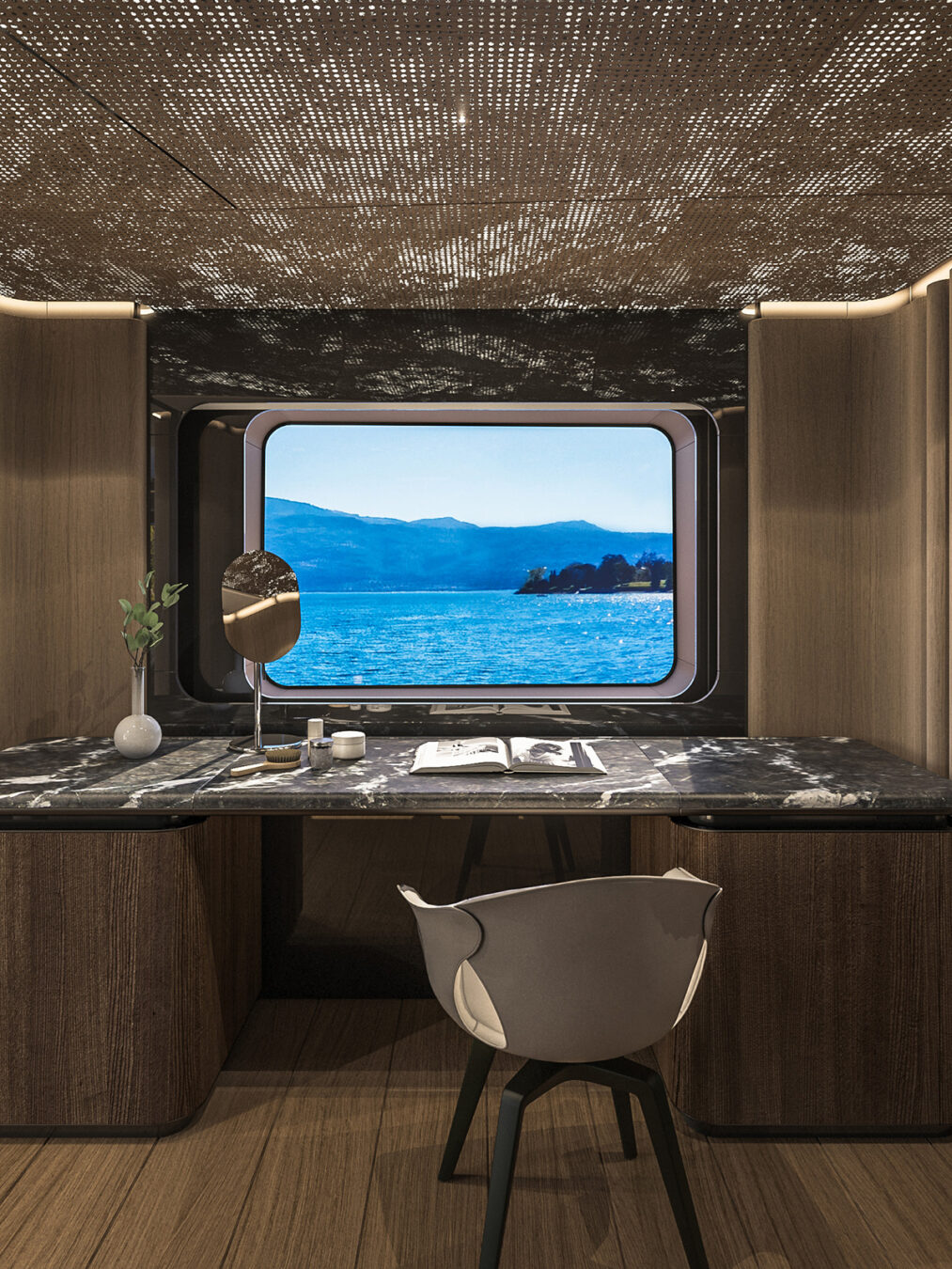 Master suite · Desk
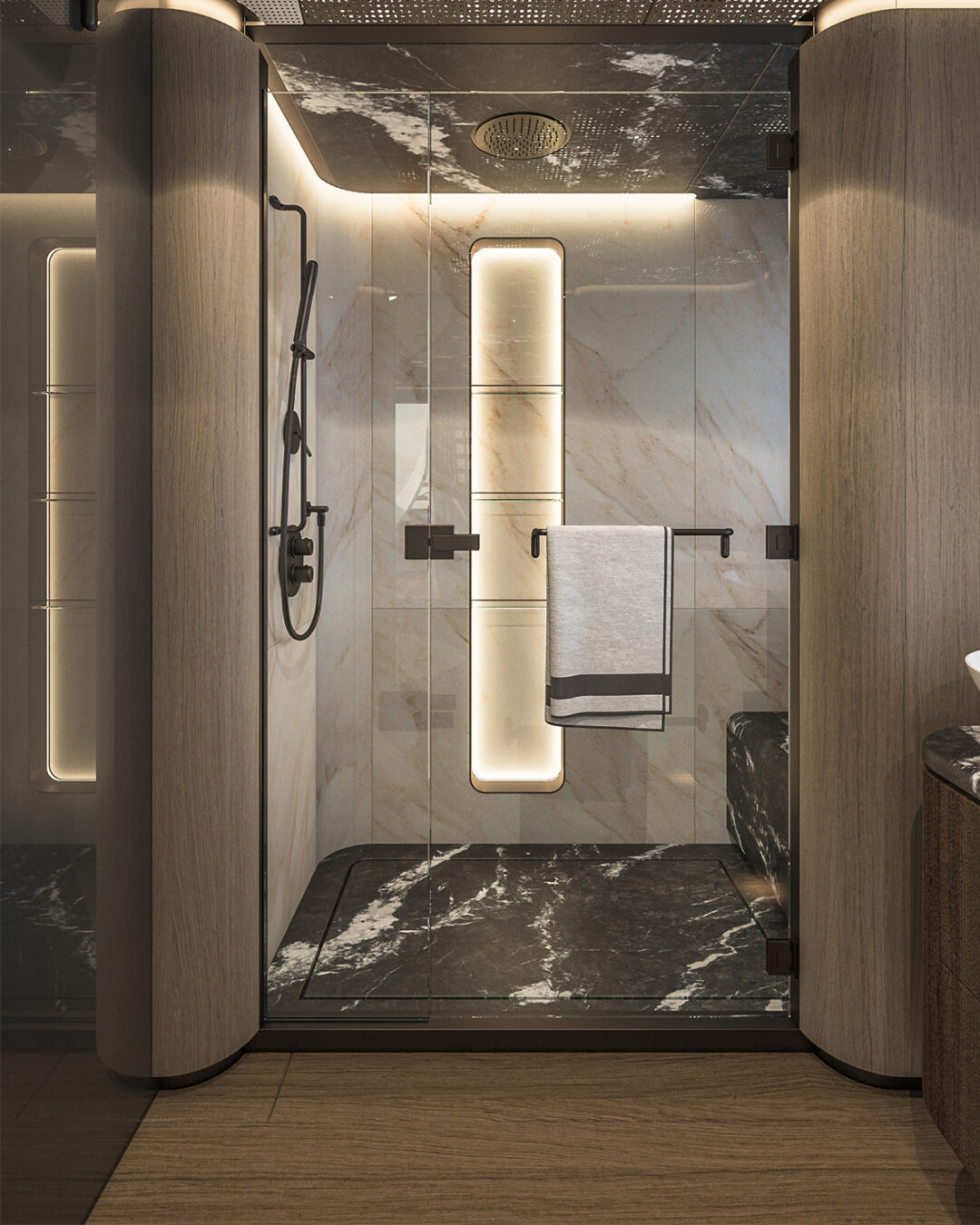 Master bath · Shower
Ten guests, and the sea in every room
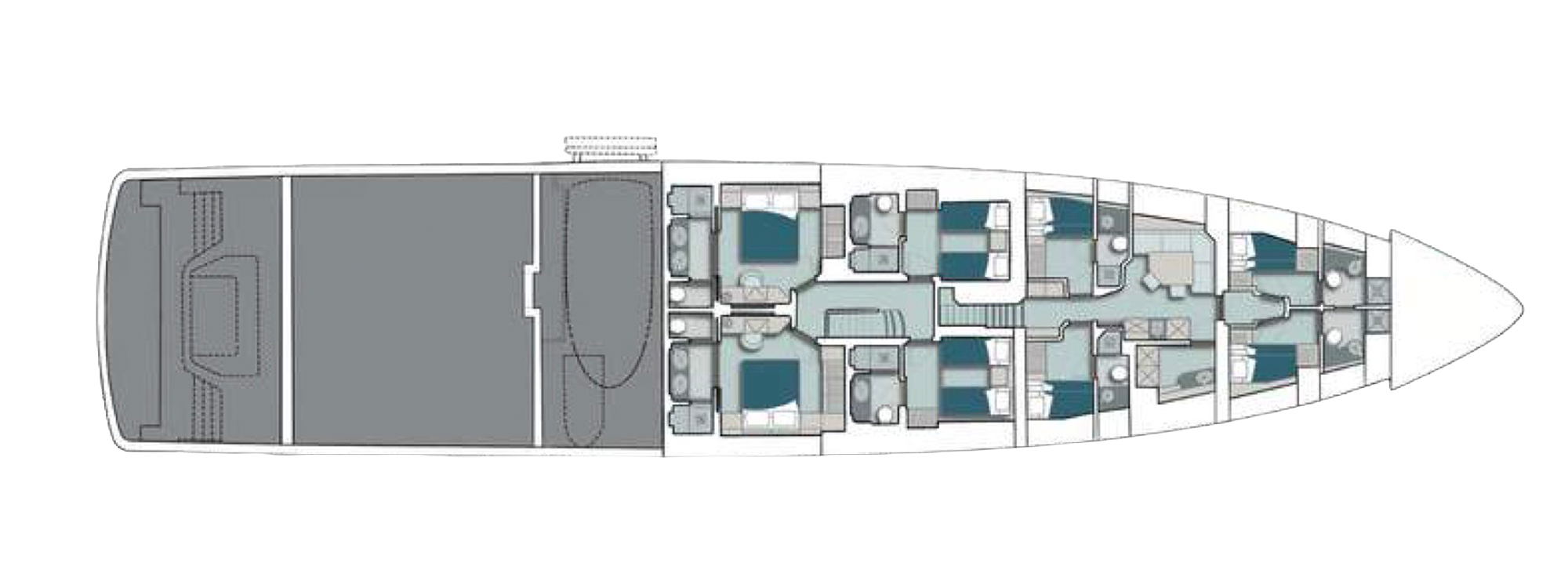
The 42M sleeps up to ten guests, with room for two more, across five cabins, and it gives the best of them to the master. Positioned forward with its own desk facing a broad hull window, the master suite treats the view as furniture; the bathroom carries twin basins and the same quiet palette as the rest of the interior. A VIP cabin and twin cabins complete the guest accommodation, each with its own en-suite, each drawing daylight through generously sized glazing rather than the modest portholes of an older generation of yachts this size.
Behind the guest areas runs the working yacht that makes the passage possible. A crew of up to nine is accommodated in five cabins of its own; a full galley serves both saloons; and the wheelhouse, wrapped in glass, gives the captain the same unbroken horizon the owner enjoys one deck below. It is a layout built on a simple premise, that comfort at sea is a matter of how well the invisible half of the yacht is resolved.
Efficiency, engineered in from the keel
The 42M's composure comes from decisions made long before the interior was styled. Van Oossanen supplied the fast-displacement naval architecture; Eureka Yachts handled the detailed engineering; and Sirena Marine built the result in steel and aluminium at its own yard, to a standard the shipyard frames as the core of its identity. The vessel is classed by RINA under its rules for yachts in commercial use, the discipline that governs a boat intended to work as well as to please.
The performance figures are modest by design and generous where it counts. Top speed is fifteen knots; cruising speed is ten; and it is at that cruise that the hull returns its 4,500-nautical-mile range, enough to turn an ocean into an itinerary. At 42.23 metres and 433 gross tons, drawing just 2.25 metres at half load, the 42M is a yacht sized to reach shallow anchorages and cross deep water with equal ease. Every number here serves the same end: distance, taken comfortably.
Forty-two metres, read deck by deck
- Length overall
- 42.23 m · 138.5 ft
- Maximum beam
- 8.8 m · 29 ft
- Draft (half load)
- 2.25 m · 7.38 ft
- Gross tonnage
- 433 GT
- Hull · Superstructure
- Steel, Grade A · Aluminium, 5083 H321
- Hull type
- Fast displacement
- Guests
- Up to 10+2 · 5 cabins
- Crew
- Up to 9 · 5 cabins
- Range
- 4,500 nm at 10 knots
- Cruising speed
- 10 knots
- Top speed
- 15 knots
- Classification
- RINA · Yachts for commercial use
- Exterior design
- Luca Vallebona
- Interior styling
- Hot Lab
- Naval architecture
- Van Oossanen
- Engineering
- Eureka Yachts
- Shipyard
- Sirena Marine · Turkey
- Status
- Flagship · launching 2026
The measure of a flagship is not its size but its clarity of purpose, and the 42M has an unusually settled sense of what it is for. Every decision, the efficient hull, the folding stern, the glass-walled cabins, the crew quarters engineered for long service, points the same way: toward the horizon, and the uninterrupted life a yacht is supposed to make possible once it reaches it. That an owner recognised as much before she ever touched the water tells its own story.
USA Onboard Editorial