

Feadship Reveals HIVE at the Monaco Yacht Show 2026: a 115 Meter Concept With a Virtual Bridge and a 5 MWh Battery Bank
The largest concept design in the yard's history is being shown privately, as a scale model, to invited guests. The renderings will get the attention. The specification table is the document worth reading.
Feadship has revealed HIVE, a 115 meter concept design, during the Monaco Yacht Show. It is the yard's largest concept to date, developed by a Studio De Voogt team led by senior designer Jan Schaffers with Feadship's naval architects and engineers, and it is being presented privately at the House of Feadship through a scale model.
Feadship has published concept designs since 2006, and the useful way to read them is as a procurement signal rather than as a fantasy. Hybrid propulsion, new structural applications of glass and alternative fuels all appeared first in these studies and later on delivered Feadships. On that reading, HIVE is less a drawing than a list: a DC electrical architecture, a 5 MWh battery bank, two separate fuel cell routes, a methanol reformer and Voith Schneider propulsion, specified from technologies that already exist or are in active development.
The bridge moved, and the architecture followed
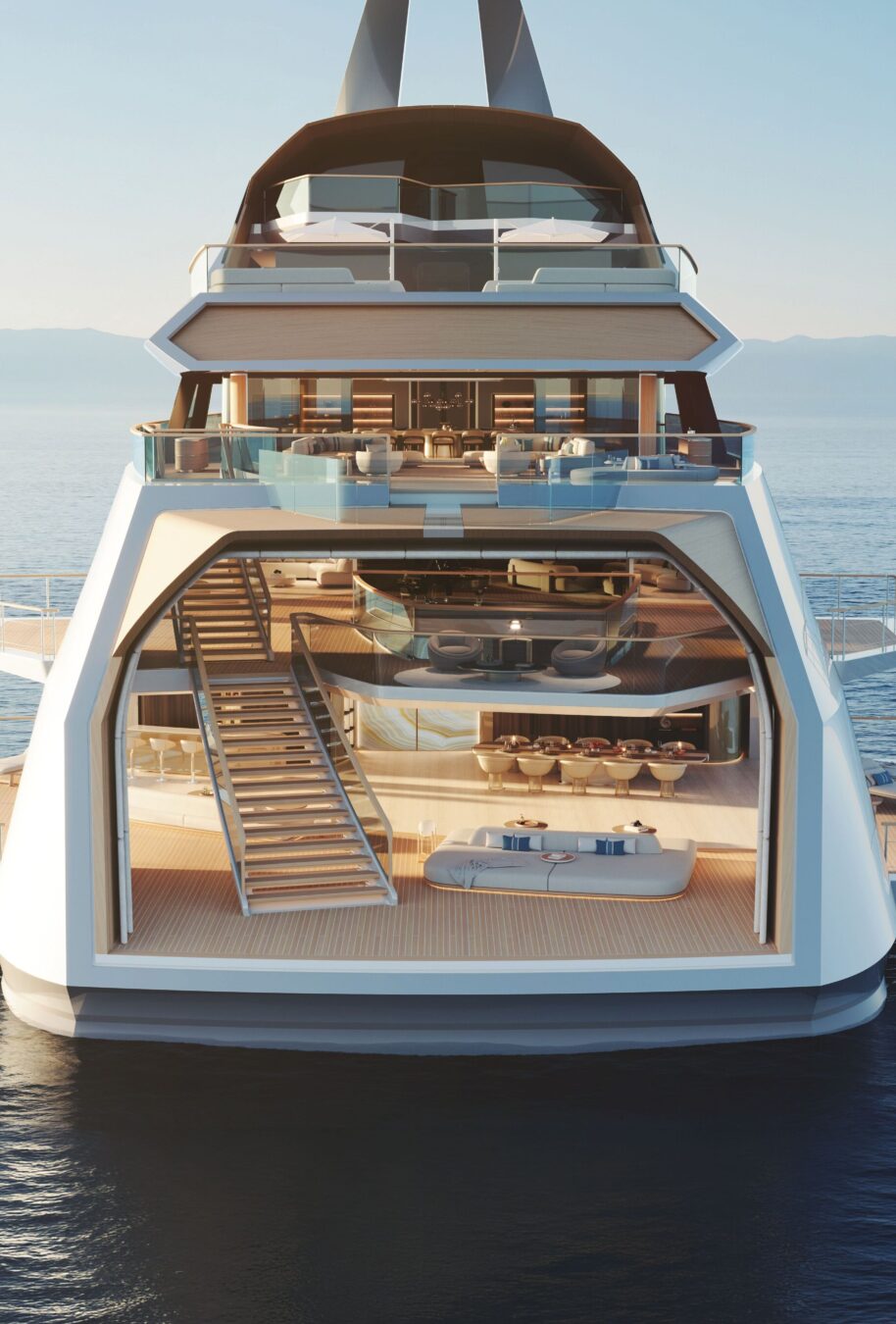
The decision that shapes the exterior is the removal of the conventional bridge. A virtual command center, fed by cameras and sensors, frees the forward sections of the superstructure for the owner's accommodations and an observation lounge, with retractable glass wing stations giving a direct view outside during close-quarters maneuvering. Feadship presents this as a continuation of the concepts Pure and C, where rethinking the bridge arrangement opened up the architecture. What it produces here is a long, low profile with a largely glazed superstructure, integrated terraces and levels that read as a single volume instead of a stack of decks.
For anyone specifying at this size, that is the part with consequences. Taking navigation off the best real estate on the boat is a class and crew question before it is an aesthetic one, and it is the kind of change that has to convince a surveyor as well as a client. It is also, on Feadship's own record, exactly the sort of idea these studies exist to test in public before it reaches a contract.
A shared heart across four decks
The concept starts with life on board rather than with a general arrangement. A fictional family of four was written to give it human context, and the organizing idea is the hive itself: many activities coexisting around a shared center. The social character of the salons of 1930s Paris supplied a second reference.
At the center is an open space running through four decks. On main deck it becomes an expansive salon, a stage or an auditorium, with terraces opening to port and starboard and curved staircases connecting balconies and more intimate rooms above. Service pantries, furniture storage and a green room sit behind it, so the same volume can carry family life, a lecture or a performance.
Around that heart, the environments are deliberately unalike: a two-story beach lounge leading to water-level dining for 24 or more, a circular glass-enclosed library on the foredeck opening onto a secluded garden, a 20 meter pool on the owner's deck using Feadship's patented ContraWave technology and continuing indoors as a suspended glass-bottomed infinity pool, an underwater lounge, and an observation lounge with a retractable glass roof.
"HIVE is designed around the idea that experiences can change people"
Jan Schaffers · Senior Designer, Studio De VoogtWhat the two range figures say
The energy package is where the concept earns its claim to being buildable. A DC electrical architecture combines three 900 kW variable speed permanent magnet generators running on HVO with fuel cells and a 5 MWh battery bank, roughly five times the 1 MWh installation Feadship pioneered on Savannah and inside a comparable battery room footprint. Zero emission operation is offered two ways: seven 75 kW solid oxide fuel cells, or nine 250 kW PEM fuel cells paired with a methanol reformer. Voith Schneider propellers replace conventional rudders, a technology already proven on ferries and research vessels, well suited to dynamic positioning and notably quiet.
The specification table is more candid than the prose. HIVE is quoted at 9,500 nautical miles at 12 knots on HVO and 5,000 nautical miles at 12 knots on methanol, from the same 410,000 liter tank capacity. Choosing the cleaner fuel costs about 47 percent of the range. Cruising speed is 12 knots and maximum is 16, modest for 115 meters and evidently deliberate. This is a yacht organized around energy rather than around speed, and the honest reading of those two lines is that the fuel transition is still a trade and not a free upgrade.
A concept design is not an order, and this one is being shown behind closed doors rather than on a stand. But the yard's own record is the argument for taking it seriously, because these studies are where Feadship has tested ideas it later sold. The parts of HIVE most likely to reappear on a contract are not the auditorium or the garden. They are the DC architecture, the battery room and the missing bridge.
All figures from Feadship's press release dated Monaco, September 24, 2026, including its technical specification table. Fuel capacity is 410,000 liters of HVO or methanol and fresh water capacity is 75,000 liters. The range difference of about 47 percent between the two fuels is calculated from the two figures Feadship publishes. HIVE is a concept design and is not under construction.
Source: Feadship, press release, Monaco, September 24, 2026