


Rockport Marine's Ouzel, a 95-Foot Wood-Composite Sailing Yacht, Makes the Case for Building Superyachts in Maine Again
Built over five years by a team spanning Newport, Rockport and Lymington, UK, the fully bespoke yacht pairs a classic pilothouse cutter profile with a modern performance hull. Her June sea trials, ten knots upwind and twelve on a reach, are the argument her builders set out to make.
Ouzel, a 95 foot bespoke sailing yacht built by Rockport Marine in Maine, has completed sea trials and is now cruising under her owner. The five year project brought together Newport based Langan Design Partners for naval architecture, Rockport Marine for construction, and Mark Whiteley Design of Lymington, UK for the interior. The result argues, deliberately, that a wood composite hull and a classic profile can still deliver genuine offshore performance.
Custom sailing yachts of this size are usually associated with Northern European yards, and American builders are more often linked to production boats than bespoke superyachts. Ouzel answers that assumption without saying so directly: a construction method rooted in wood, shaped into a hull built for speed.
Wood, carbon, and a technique built to outlast trends
Rockport Marine built Ouzel using wood composite construction, laminating planks of Douglas fir and western red cedar in multiple orientations, with carbon fiber worked in where it helps and an outer sheathing of e-glass. It is a technique that demands old fashioned skill with wood and still lets a builder reinforce load bearing areas the way a modern composite yard would. Rockport Marine president Sam Temple has argued the practical case for the approach: a hull that resists corrosion, holds a strong strength to weight ratio, and does not need the upkeep owners associate with traditional wooden boats.
Classic lines, a modern hull underneath
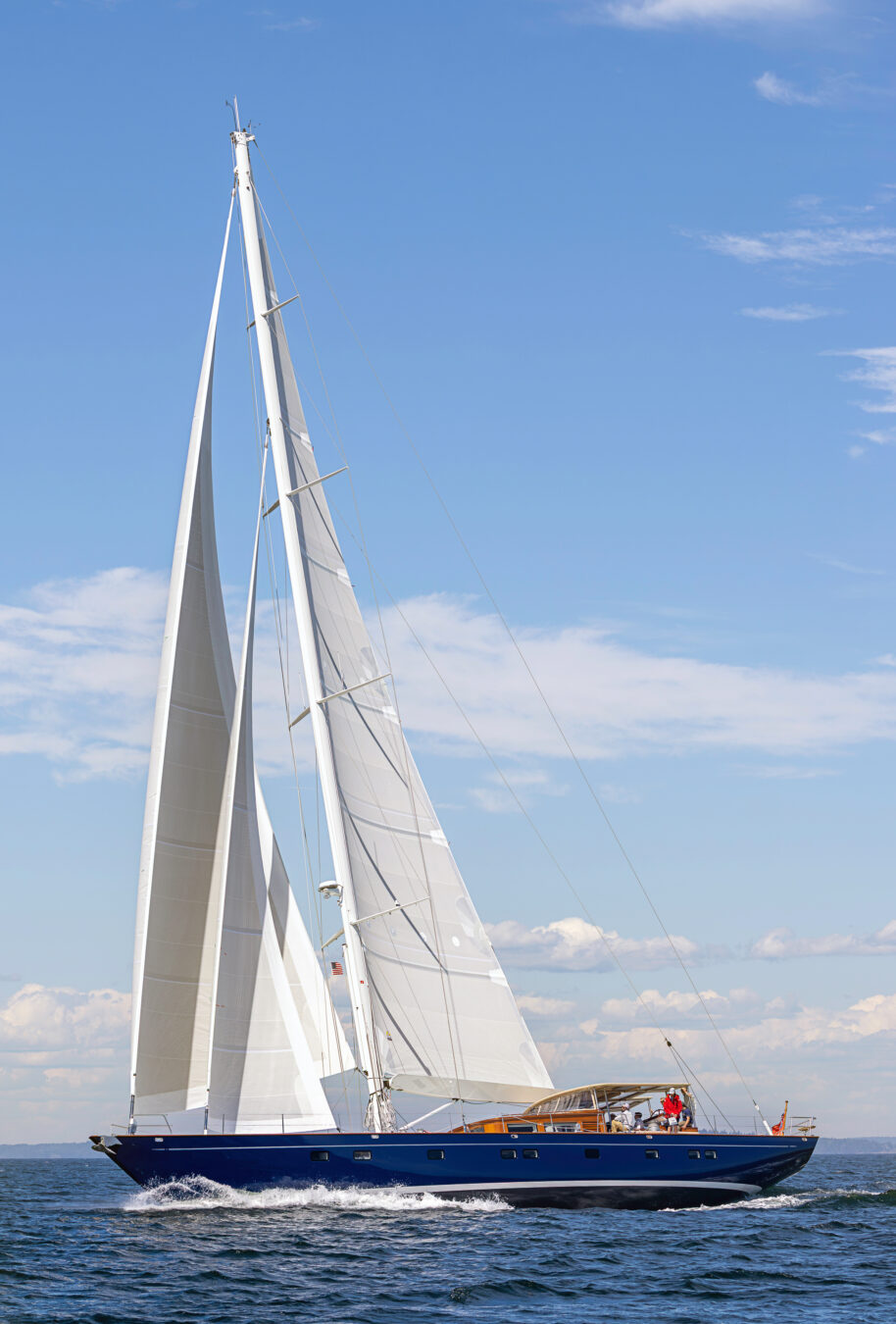
Above the waterline, Langan Design Partners drew a long bow overhang, a classic counter stern and a sheer meant to read as timeless, framed by teak clad bulwarks and a traditional deckhouse. Below it, the boat makes a different argument. A fin keel with a hydrodynamic bulb, a deep spade rudder and a modern propeller push her draft to 12 feet, a choice the owner made deliberately to sharpen performance.
That choice paid off on Penobscot Bay in June. In 10 to 15 knots of breeze, Ouzel held 10 knots upwind under staysail and Yankee, then touched 12 knots cracked off onto a reach, a result naval architect Tom Degrémont described as matching every performance goal the team had set.
What five years of remote coordination bought
Below deck, Mark Whiteley of MWD paired a simple, functional layout with detailing meant to carry a superyacht feel: painted panels, mahogany cabinetry, and a raised saloon with deep sofa seating and a navigation station that allies practicality to comfort. Three guest cabins and one crew cabin complete the accommodation.
"She's going to turn a few heads for sure."
Peter Wilson · President, MCM, Owner's RepresentativeNone of it happened by accident. Four firms across two countries coordinated the build over weekly calls for half a decade, with an owner closely involved at every stage. Marine Construction Management, the project manager, frames the finished yacht as a rebuttal to the idea that a boat like this cannot be built in the United States anymore. Ouzel is the argument, afloat.
All figures from Rockport Marine, Langan Design Partners and MCM's official press release, September 2026.
Source: Rockport Marine / Langan Design Partners / Mark Whiteley Design / MCM, official press release, September 2026